Preservatives: Cell-Envelope Damage and Internal Chemical Stress
Why in News?
On September 23, PIB reported an INST Mohali-Unilever study linking preservative action to bacterial cell-envelope damage and internal biochemical stress.
- Sodium benzoate and phenoxyethanol were investigated using microscopy and biochemical tests; the work appeared in Letters in Applied Microbiology.
- The study examined Staphylococcus aureus, a Gram-positive bacterium, and Pseudomonas aeruginosa, a Gram-negative bacterium.
- The reported responses combined physical damage to the cell envelope with accumulation of reactive substances inside bacterial cells.
- Preservation helps prevent microbial spoilage in products; understanding its mechanism can improve formulation choices rather than relying only on observed growth inhibition.
- Laboratory evidence must be separated from claims about consumer safety, treatment of infections or the effectiveness of every finished product.
UPSC Relevance
Prelims Relevance
- Cell envelope and membrane integrity
- Gram-positive and Gram-negative bacteria
- Transmission electron microscopy
- Minimum inhibitory concentration
- pH-dependent preservative activity
Mains Relevance
GS Paper 3
- Connecting basic microbiology with product formulation and spoilage reduction.
- Interpreting laboratory evidence before claiming commercial or clinical benefits.
GS Paper 2
- Evidence standards for consumer-product safety.
Essay
- Scientific understanding improves decisions when its limits remain visible.
Background and Context
What a preservative must disrupt
Preservatives interfere with microbial survival, but the affected structures and internal processes must be examined together to explain their action.
- The cell envelope is the protective boundary surrounding a bacterial cell, including its membrane and associated layers; damage to this boundary can disturb the controlled internal conditions essential for survival.
- The cell membrane regulates exchanges between the cell and its surroundings; loss of integrity can permit leakage, linking a visible structural change to disruption of the cell’s normal internal functioning.
- Gram-positive and Gram-negative bacteria have different envelope architectures; studying representatives of both groups broadens the investigation, although two tested organisms cannot establish how every bacterial species will respond under all conditions.
- Sodium benzoate is used in acidic food products, while phenoxyethanol is used in personal-care formulations; these existing applications explain the practical interest in understanding how their antibacterial action works.
- The research question concerns mode of action: what happens to cells exposed to a preservative; this differs from simply establishing whether bacterial growth slows or stops during a particular laboratory test.
Envelope damage and internal stress
The findings connect changes in bacterial shape with biochemical injury inside the cell, supporting an explanation involving several cellular targets.
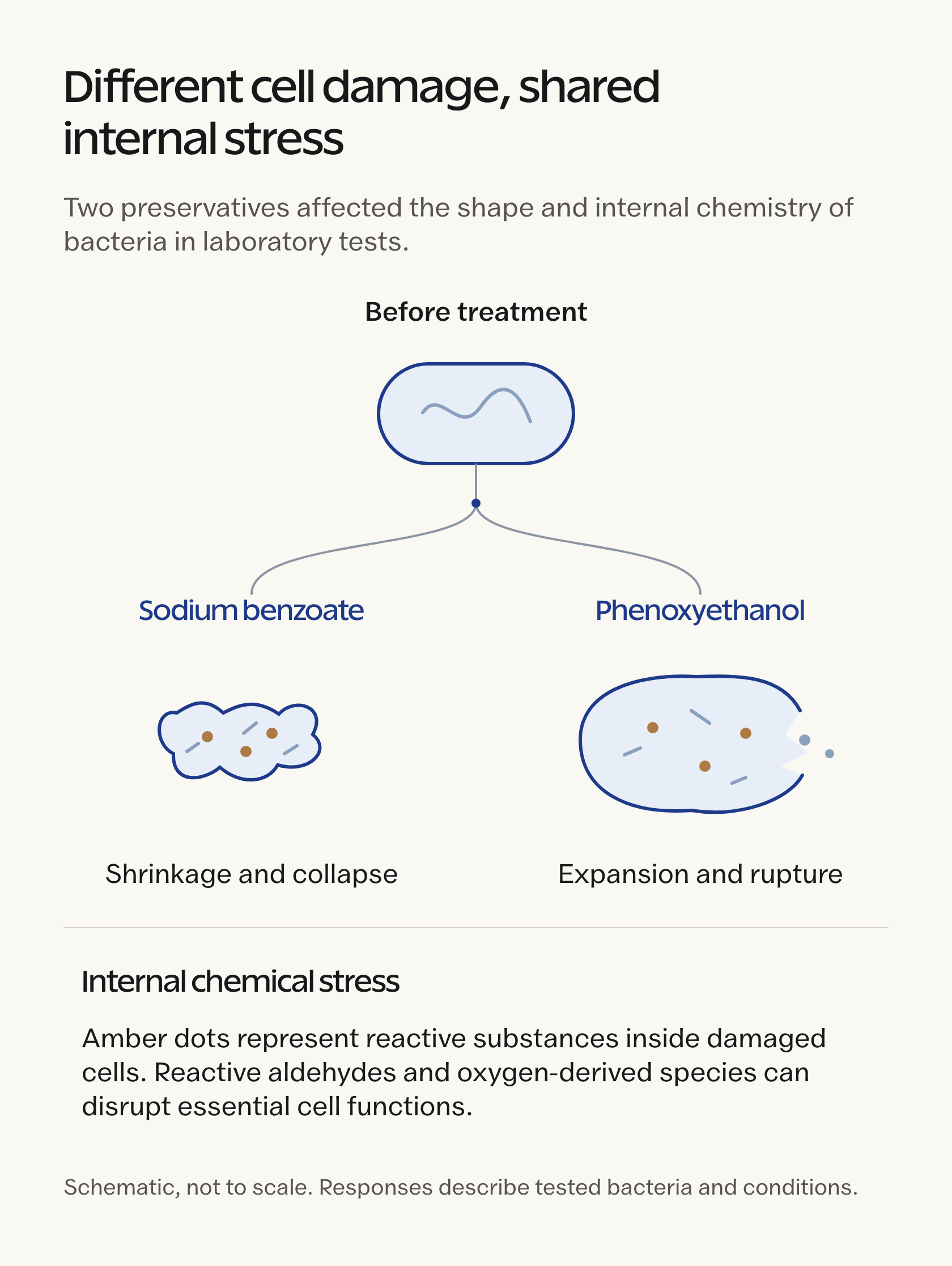
- Transmission electron microscopy revealed altered cell structures after treatment; the reported observations included membrane rupture and cytoplasmic leakage, providing visual evidence of envelope damage rather than merely a change in growth.
- Reactive aldehydes and oxygen-derived species accumulated inside treated cells; the researchers linked this internal chemical stress with disruption of proteins, genetic material and other functions needed for bacterial survival.
- Sodium benzoate induced cellular shrinkage and collapse, whereas phenoxyethanol caused membrane expansion and eventual rupture; these are distinct responses observed in the tested systems, not universal sequences for every microorganism.
- Dye-leakage tests helped assess compromised membranes, while biochemical assays examined internal changes; using complementary methods connects outward structural damage with inward chemical stress more convincingly than relying on cell appearance alone.
- Growth-inhibition tests and minimum inhibitory concentration measurements establish whether growth is suppressed under specified conditions; microscopy and biochemical analyses address the separate question of how that suppression may occur inside cells.
Why formulation conditions and evidence limits matter
Preservative performance depends on the environment in which it acts, so a laboratory result cannot become a universal formulation rule.
- Sodium benzoate showed stronger activity in acidic conditions, while phenoxyethanol performed more consistently across the tested pH conditions; the comparison concerns experimental settings rather than an assurance covering every possible product.
- pH describes how acidic or alkaline an environment is; choosing a preservative requires attention to that environment, since results obtained under one condition need not transfer unchanged to another formulation.
- Multiple cellular targets help explain bacterial inactivation, but they do not prove that resistance can never develop; claims about resistance require specific evidence beyond identifying several forms of damage in treated cells.
- Product validation remains necessary because a finished formulation combines ingredients and storage conditions absent from a simplified experiment; the study can inform choices without replacing tests on the actual product.
- Antibacterial activity does not establish suitability for treating human infections or universal sterilisation; the reported findings neither grant a new regulatory approval nor justify increasing preservative quantities beyond applicable product requirements.
Way Forward
Translate mechanisms into tested formulations
- Validate preservative performance in the finished formulation, including its intended pH and storage conditions, before making claims about protection against spoilage.
- Assess safety and efficacy separately: bacterial damage alone cannot demonstrate that a particular exposure is appropriate for consumers.
- Report experimental limits alongside benefits, distinguishing observed mechanisms from proposed improvements in products or resistance management.
Conclusion
- Preservative action can combine damage to a bacterial boundary with chemical injury inside the cell; this study is useful because it links those processes through complementary observations rather than treating growth inhibition as a complete explanation.
- For an analytical answer, connect mechanism, formulation and validation: knowing how a substance acts helps guide product development, while evidence from tested organisms and conditions must remain distinct from wider claims about safety or clinical usefulness.
UPSC Practice Questions
Prelims MCQ 1
With reference to the reported preservative study, consider the following statements:
- The researchers examined both Gram-positive and Gram-negative bacteria.
- Microscopy and biochemical analyses were used together.
- The findings constitute approval to use preservatives for treating bacterial infections.
How many of the above statements are correct?
(a) Only one (b) Only two (c) All three (d) None
Answer: (b) Only two
Explanation:
The study examined representatives of both bacterial groups using complementary methods. It investigated laboratory mechanisms, not approval of clinical treatments.
Prelims MCQ 2
Which observation best illustrates why formulation pH matters when interpreting preservative activity?
(a) All preservatives act identically at every pH. (b) Sodium benzoate showed stronger activity under acidic conditions in the study. (c) Microscopy alone establishes consumer safety. (d) Multiple cellular targets eliminate the need for product testing.
Answer: (b) Sodium benzoate showed stronger activity under acidic conditions in the study.
Explanation:
The reported pH-dependent response shows why experimental conditions matter. It does not support a universal dose or removal of finished-product testing.
UPSC Mains Questions
- Explain how combining structural and biochemical evidence improves understanding of antibacterial preservative action. (150 words)
- Discuss the limits of translating laboratory findings on preservatives into claims about product effectiveness and consumer safety. (150 words)
Source: PIB, Ministry of Science and Technology.
Frequently Asked Questions
What did the preservative study find?
It linked bacterial cell-envelope damage with internal biochemical stress. Sodium benzoate and phenoxyethanol produced different structural responses, indicating that preservative action involves more than a single visible change in the cell.
Why were microscopy and biochemical tests used together?
Microscopy showed structural damage, while biochemical tests examined internal stress. Combining these methods helped connect changes in cell appearance with processes affecting proteins, genetic material and other essential cellular functions.
Why does pH matter for preservatives?
The study found stronger sodium benzoate activity in acidic conditions and more consistent phenoxyethanol activity across tested conditions. This makes the formulation environment relevant when interpreting performance, without establishing a universal rule.
Does this research recommend treating infections with preservatives?
No. The findings concern laboratory bacterial responses and possible formulation improvements. They do not establish clinical treatment, new regulatory approval, universal sterilisation or permission to increase the preservative content of products.