President confers 66 Padma Awards; actor Dharmendra, violinist N Rajam honoured
Why in News?
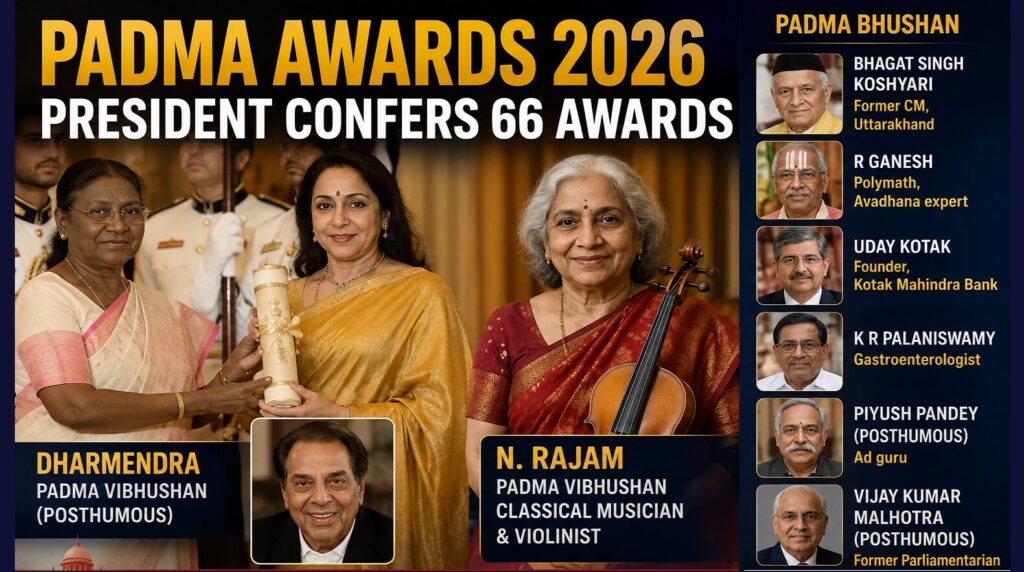
President Droupadi Murmu conferred Padma Awards at a Civil Investiture Ceremony held at Rashtrapati Bhavan. Among the prominent awardees were Dharmendra (posthumously awarded Padma Vibhushan) and N. Rajam for her contribution to Indian classical music. The 2026 list includes 131 Padma Awards across different categories.
UPSC Relevance
Prelims: Padma Awards, civilian honours system, Bharat Ratna, constitutional and administrative aspects.
Mains:
GS I (Indian culture and heritage),
GS II (Governance and institutions),
GS IV (Recognition of public service and values).
Background/Context
India recognises exceptional contributions made by individuals in various fields through its civilian honours system. The Padma Awards constitute one of the highest civilian recognitions and seek to honour distinguished service across domains such as art, literature, science, social work, public affairs, medicine, sports, civil service and other fields of human endeavour.
Instituted in 1954, the awards aim to acknowledge individuals whose work has had a significant impact on society and national development.
The Padma Awards are announced annually on the eve of Republic Day and are presented by the President of India at ceremonial functions held at Rashtrapati Bhavan.
Understanding India’s Civilian Honours Structure
India has a hierarchy of civilian awards:
- Bharat Ratna: India’s highest civilian award, given for exceptional service of the highest order in any field of human endeavour.
- Padma Vibhushan: Awarded for exceptional and distinguished service of a very high order.
- Padma Bhushan: Awarded for distinguished service of high order.
- Padma Shri: Awarded for distinguished service in any field.
Unlike military decorations, these awards are civilian recognitions and do not confer titles.
Constitutional and Legal Dimensions
Article 18 of the Constitution prohibits the State from conferring titles except military or academic distinctions.
A constitutional question had emerged regarding whether national awards violate Article 18. In the Balaji Raghavan vs Union of India judgment, the Supreme Court held that civilian awards such as Bharat Ratna and Padma Awards are constitutional because they are recognitions and not hereditary titles.
The Court also observed that recipients cannot use these awards as prefixes or suffixes to their names.
Evolution of Padma Awards
Initially, Padma awards existed under three classes:
- Pahela Varg
- Dusra Varg
- Tisra Varg
These were reorganised in 1955 into:
- Padma Vibhushan
- Padma Bhushan
- Padma Shri
Over time, reforms have attempted to make the selection process more transparent and inclusive.
The government increasingly emphasises recognition of “unsung heroes” — individuals who work at the grassroots level with substantial societal impact.
Selection Process of Padma Awards
The selection process involves multiple stages:
- Nominations are invited from the public, State governments, Union Territories, Ministries and institutions.
- A Padma Awards Committee constituted by the Prime Minister annually reviews nominations.
- Recommendations are submitted to the Prime Minister and President.
- Final approval is granted by the President.
The process increasingly encourages public participation through online nomination systems.
Significant Features of Padma Awards
Recognition beyond celebrity status
The awards are intended to acknowledge contributions rather than popularity. Increasingly, grassroots workers, tribal artists, social reformers and innovators have been included.
Diverse representation
The awards cover:
- Arts and culture
- Science and engineering
- Public affairs
- Medicine
- Literature
- Education
- Social work
- Sports
- Civil service
Recognition of posthumous contributions
Awards can also be conferred posthumously where contributions have left a lasting impact.
For example, actor Dharmendra received posthumous recognition through Padma Vibhushan in 2026.
Notable Awardees from the 2026 Ceremony
Some important awardees include:
- Dharmendra — recognised for contribution to Indian cinema and arts.
- N. Rajam — known for pioneering the “Gayaki Ang” style in violin performance.
- Bhagat Singh Koshyari — public affairs.
- Uday Kotak — business and finance.
- R. Ganesh — revival of Avadhana tradition.
Importance of Padma Awards in Nation Building
Padma Awards perform functions beyond symbolic recognition.
They create role models who inspire society, preserve cultural and artistic traditions, reward public service, and promote social contributions that may otherwise remain unnoticed.
Recognition of local innovators and cultural practitioners also strengthens India’s soft power and cultural continuity.
Challenges and Criticisms
Allegations of politicisation
Concerns are sometimes raised regarding possible political influence in selection of recipients.
Questions over transparency
Selection criteria are often viewed as insufficiently clear by sections of society.
Perceived urban and elite bias
Historically, awards were often criticised for favouring prominent public figures while overlooking grassroots contributors.
Subjectivity in evaluating contributions
Assessing impact across different sectors can be difficult because social contributions are not always measurable.
Way Forward
Strengthen transparency
Selection procedures and evaluation criteria can be made more open and publicly understandable.
Greater recognition of grassroots contributions
Expanding representation of tribal communities, local innovators and social workers can enhance inclusiveness.
Promote public participation
Increasing awareness regarding open nominations can democratise the awards process.
Build institutional documentation
Awardees’ work may be systematically documented and integrated into educational and public knowledge systems.
Conclusion
The Padma Awards represent India’s attempt to celebrate excellence across diverse fields while recognising service to society and nation-building. Their larger significance lies not merely in honouring individuals but in reinforcing social values, preserving cultural heritage and inspiring future generations.
Practice Questions
Prelims Question 1 (Inference-based)
Consider the following statements regarding India’s Padma Awards system:
I. Padma Awards seek to recognise distinguished contributions across multiple fields of public life.
II. Article 18 prohibits conferring hereditary or title-based distinctions by the State.
III. The Supreme Court has upheld the constitutional validity of civilian awards while restricting their use as titles.
Which of the following relationships among the above statements is correct?
- Statement III validates how Statement I can operate without violating Statement II.
- Statement II contradicts Statement I because recognition through awards itself is unconstitutional.
- Statement III extends Statement II by distinguishing honours from prohibited titles.
(a) 1 only
(b) 1 and 3 only
(c) 2 and 3 only
(d) 1, 2 and 3
Answer: (b)
Explanation: The Supreme Court clarified that civilian awards are recognitions rather than titles, thereby allowing awards under constitutional limits.
Prelims Question 2
Match the following:
| Award | Description |
|---|---|
| 1. Bharat Ratna | A. Distinguished service in any field |
| 2. Padma Vibhushan | B. Highest civilian award |
| 3. Padma Bhushan | C. Exceptional and distinguished service of very high order |
| 4. Padma Shri | D. Distinguished service of high order |
Select the correct answer:
(a) 1-B, 2-C, 3-D, 4-A
(b) 1-C, 2-B, 3-A, 4-D
(c) 1-B, 2-D, 3-C, 4-A
(d) 1-A, 2-C, 3-B, 4-D
Answer: (a)
Explanation: Bharat Ratna is the highest civilian award, followed by Padma Vibhushan, Padma Bhushan and Padma Shri in descending order.
Mains Questions
- Discuss the significance of Padma Awards in promoting inclusiveness, cultural preservation and recognition of public service in India.
- “National honours must balance recognition of excellence with transparency and public trust.” Examine in the context of India’s civilian awards system.