President Promulgates Ordinance to Increase Number of Supreme Court Judges
Why in News?
The President of India has promulgated the Supreme Court (Number of Judges) Amendment Ordinance, 2026, increasing the sanctioned strength of judges in the Supreme Court from 33 to 37, excluding the Chief Justice of India.
The move is aimed at addressing the growing pendency of cases and ensuring faster delivery of justice in the country’s highest court. The current backlog is over 93,000 cases.
| UPSC Relevance: GS-2 Polity and Governance: Judiciary Prelims: Article 123, Article 124, Appointment process of the Judiciary Mains: Issues facing the Indian Judicial System. |
Supreme Court (Number of Judges) Amendment Ordinance, 2026:
- The Supreme Court (Number of Judges) Amendment Ordinance, 2026, has been promulgated in accordance with the powers of the President under Article 123 of the Constitution.
- The ordinance will be placed in both Houses of Parliament when it convenes.
- It will cease to operate if six weeks expire without any resolution passed on it after the reassembly of Parliament or if resolutions are passed in both Houses of Parliament disapproving the ordinance. The President can withdraw the ordinance at any time.
The ordinance has amended Section 2 of the Supreme Court (Number of Judges) Act, 1956, to replace the word “thirtythree” with “thirtyseven”. The Gazette notification specifically mentioned that Parliament was not in session and immediate action was necessary.
| Article 123 of the Indian Constitution: Under Article 123, the President can promulgate an Ordinance when the Parliament is not in session, and Immediate action is necessary. The ordinance has the same force as an Act of Parliament, but it must be laid before both Houses of Parliament. It ceases to operate six weeks after Parliament reassembles unless approved. |
With the latest amendment ordinance, the total sanctioned strength of the Supreme Court will now rise to 38 judges, including the Chief Justice of India. The move is being seen as a significant step towards strengthening judicial infrastructure and enhancing access to timely justice across the country.
Constitutional Basis: Article 124
- Article 124(1) of the Indian Constitution: “There shall be a Supreme Court of India consisting of a Chief Justice of India and, until Parliament by law prescribes a larger number, of not more than seven other Judges.”
- This article gives Parliament the power to expand judicial strength through legislation, without requiring a constitutional amendment under Article 368. The Bill requires to be passed by both the Houses of Parliament with a simple majority.
The Salaries and allowances of SC judges are charged to the Consolidated Fund of India, a non-votable expenditure.
Timeline of Evolution of Judicial Strength:
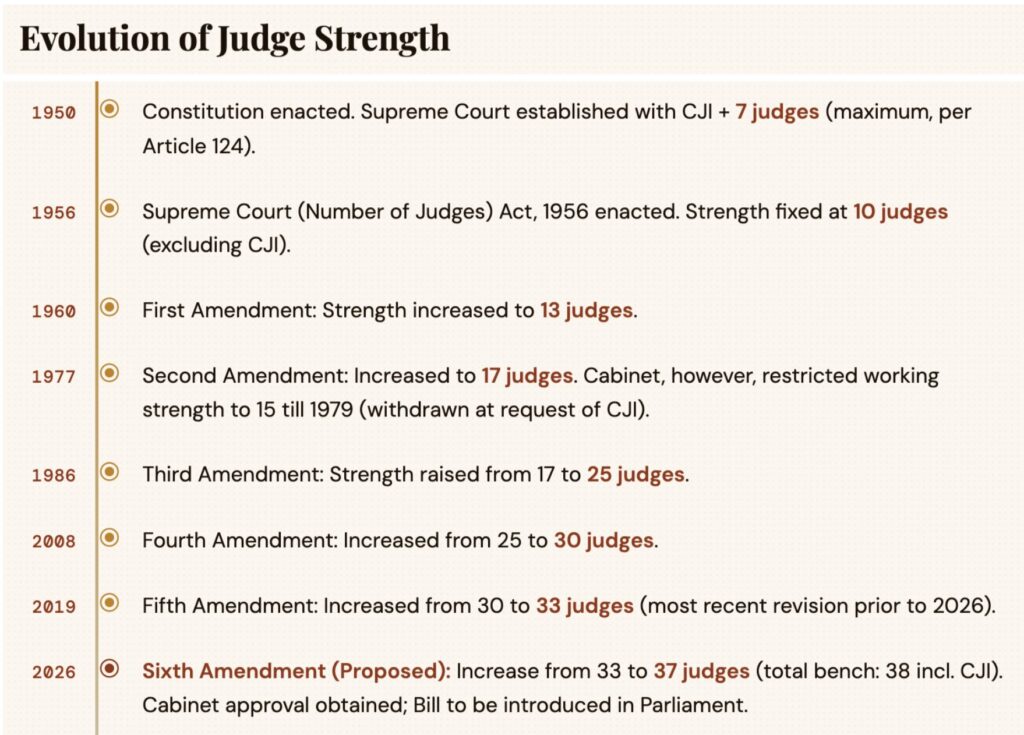
Significance of Expanded Sanctioned Strength:
- Reduction in Judicial Pendency: Over 92,000 cases are pending in the Supreme Court, spanning constitutional disputes, criminal appeals, civil matters, and PILs. The expansion aims to enhance the Court’s adjudicatory capacity and improve disposal rates.
- Strengthening Constitutional Benches: A larger bench strength can facilitate: Frequent Constitution Bench formation, faster adjudication rate, and enhanced specialisation in commercial, technological, and environmental matters.
- Rule of Law & Access to Justice: The Supreme Court has held the right to speedy trial as a component of Article 21. Thus, delays in justice delivery violate the fundamental right. Larger benches enable faster hearing of bail matters, habeas corpus, and fundamental rights cases.
- Greater scope for Diversity: Additional vacancies create an opportunity to improve representation in the higher judiciary by including: Women judges, Judges from underrepresented High Courts, SC/ST/OBC and minority communities and experts from specialised branches of law.
Associated Challenges:
- Insufficient numbers: Even at 38, India has one SC judge per ~3.7 crore people, which is far below global standards. Former CJIs have called for a strength of 70+ judges.
- Structural delays in appointments: The sanctioned strength increase is meaningful only if vacancies are filled swiftly. The collegium system (Second Judges Case 1993) controls appointments. Structural delays in the collegium-government interface remain unresolved. This can neutralise the benefit of increased sanctioned strength.
- Collegium opacity: The process of recommending names lacks statutory transparency, which raises concerns about accountability in judicial appointments. This can neutralise the scope for increasing diversity in judicial strength.
- Infrastructure gap: The existing Supreme Court building has been operating at near-capacity with 17 courtrooms and two registrar courts. Increased judges create an immediate need for additional dedicated support staff, specialised technical staff for digital, virtual, and hybrid hearing infrastructure.
- Bottleneck at High Courts: Pendency in High Courts exceeds 60 lakh cases; District courts hold over 4 crore cases. The expansion of judicial strength alone is just a partial fix.
The expansion of SC’s sanctioned strength offers an opportunity to improve judicial efficiency and representation. However, the need of the hour is to address systemic issues in the collegium process (opacity, delays, and inadequate accountability) to strengthen the justice delivery system.
UPSC Mains PYQ 2021:
Q. Discuss the desirability of greater representation of women in the higher judiciary to ensure diversity, equity and inclusiveness.
UPSC Mains PYQ 2017:
Q. Critically examine the Supreme Court’s judgment on ‘National Judicial Appointments Commission Act, 2014’ with reference to the appointment of judges of the higher judiciary in India.