PRIP Scheme: The Second Call for Pharma and MedTech Innovation
Why in News?
The Department of Pharmaceuticals announced the second PRIP application call on 28 August 2026, with the submission window scheduled to open by mid-September.
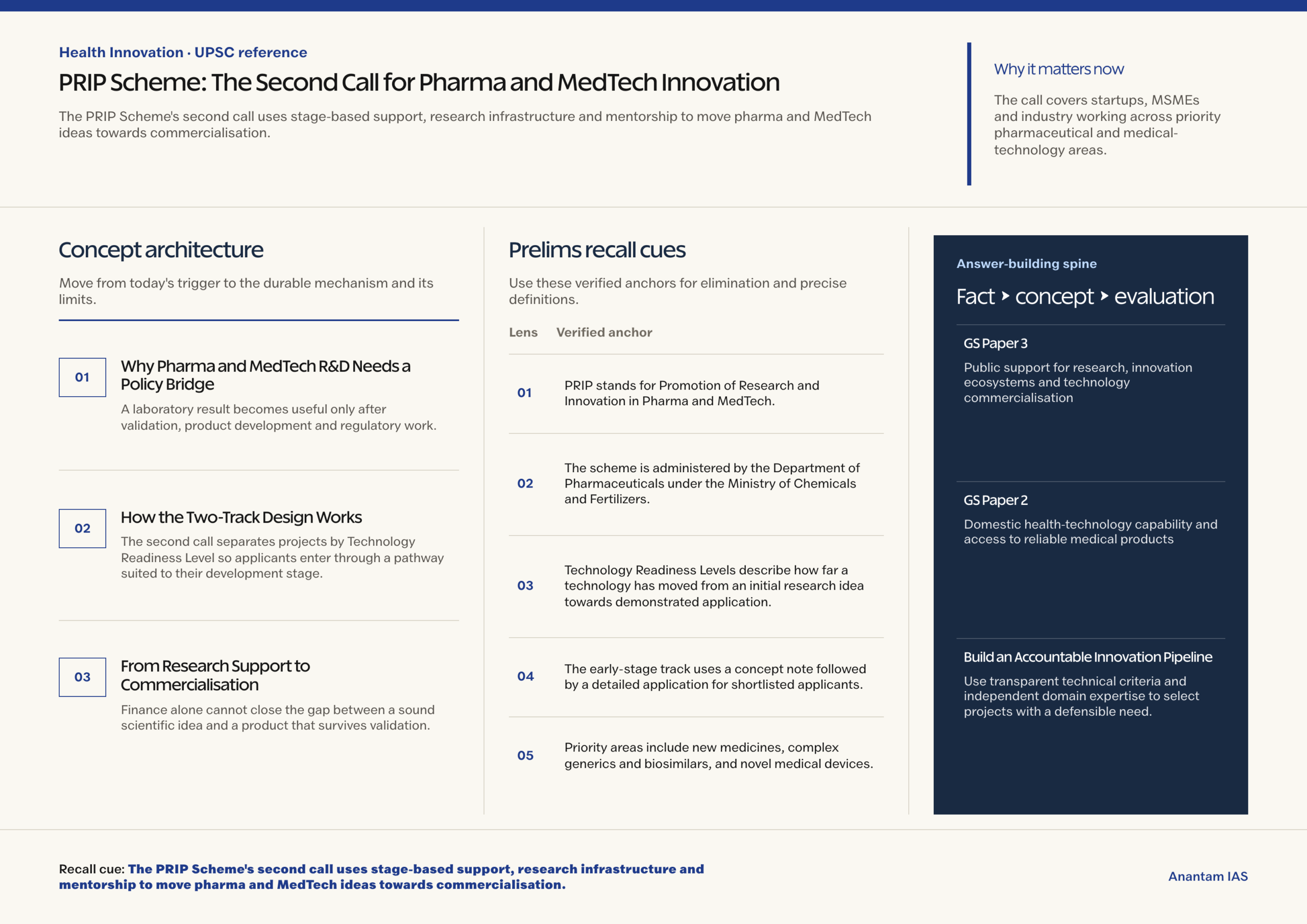
- The call covers startups, MSMEs and industry working across priority pharmaceutical and medical-technology areas.
- Early-stage projects begin at TRL 1, 2 or 3 and may receive support to progress no further than TRL 5.
- Later-stage projects begin at TRL 4, 5 or 6 and seek support to advance towards higher readiness levels.
- The announcement opens a new selection round; it does not mean that applications are open already or that any project has received funding.
- India’s challenge is not only producing medicines and devices, but converting research into validated, scalable and commercially viable technologies.
- PRIP links project finance with research infrastructure, mentorship and collaboration, addressing several gaps along the innovation pathway.
- Stage-based selection can direct different forms of support to proof-of-concept work and technologies that are closer to deployment.
UPSC Relevance
Prelims Relevance
- PRIP stands for Promotion of Research and Innovation in Pharma and MedTech.
- The scheme is administered by the Department of Pharmaceuticals under the Ministry of Chemicals and Fertilizers.
- Technology Readiness Levels describe how far a technology has moved from an initial research idea towards demonstrated application.
- The early-stage track uses a concept note followed by a detailed application for shortlisted applicants.
- Priority areas include new medicines, complex generics and biosimilars, and novel medical devices.
Mains Relevance
GS Paper 3
- Public support for research, innovation ecosystems and technology commercialisation
- The role of startups and MSMEs in pharmaceutical and medical-device innovation
GS Paper 2
- Domestic health-technology capability and access to reliable medical products
- Institutional design for collaboration among government, academia and industry
Essay
- Innovation policy succeeds when it connects scientific discovery with institutions capable of testing, scaling and delivering public value.
Background and Context
Why Pharma and MedTech R&D Needs a Policy Bridge
A laboratory result becomes useful only after validation, product development, regulatory work, manufacturing preparation and market adoption.
- Pharma and MedTech innovation is capital-intensive and failure-prone; long development cycles can discourage private investment before technical or commercial viability is clear.
- Startups may generate promising intellectual property but lack specialised laboratories, testing facilities, regulatory expertise or partners capable of manufacturing at scale, leaving viable ideas stranded before validation.
- MSMEs often understand manufacturing and supply chains, yet may struggle to finance uncertain research or absorb the cost of moving a prototype through validation.
- Public support can reduce early risk, while competitive selection and milestone review should keep assistance tied to credible scientific progress, validated evidence and a realistic development plan.
- The policy objective is innovation capacity, not merely import substitution: stronger research institutions, skilled talent, viable enterprises and technologies that can reach users.
How the Two-Track Design Works
The second call separates projects by Technology Readiness Level so applicants enter through a pathway suited to their development stage.
- Under the early-stage track, eligible startups and MSMEs may move projects from TRL 1–3 towards higher readiness, but not beyond TRL 5.
- Early-stage applicants first submit a concise concept note; only shortlisted applicants proceed to a detailed application, reducing the initial documentation burden.
- Ecosystem enablers may submit concept notes on behalf of promising projects in their networks, helping discover research teams outside established corporate channels and connect them with application support.
- The later-stage track accepts projects at TRL 4–6 from industry, startups and MSMEs, using a direct detailed application for advancement to higher levels.
- Later-stage assistance is capped at 35% of approved project cost, with the applicant co-funding the remainder; this shares risk while demanding commitment from the developer.
From Research Support to Commercialisation
Finance alone cannot close the gap between a sound scientific idea and a product that survives validation, regulation and adoption.
- PRIP, launched in 2023, also seeks stronger research infrastructure and a deeper pool of trained students for pharmaceutical and medical-technology R&D.
- Mentorship can help teams plan development milestones, protect intellectual property, understand regulatory requirements and identify manufacturing or clinical-validation partners before preventable design errors consume scarce capital.
- Initiatives including MedTech Mitra and Patent Mitra are intended to facilitate technical-regulatory guidance, patent support, collaboration and partnership across the ecosystem.
- The priority areas extend beyond conventional drugs to complex generics, biosimilars and novel devices, including software-based, diagnostic, robotic, telemedicine and precision-medicine applications.
- Commercialisation should not be confused with immediate market entry: projects still require evidence, appropriate approvals, quality assurance, responsible procurement and a viable route to manufacturing and adoption.
Way Forward
Build an Accountable Innovation Pipeline
- Use transparent technical criteria and independent domain expertise to select projects with a defensible need, credible team and realistic development pathway.
- Link disbursement to verifiable milestones without imposing reporting burdens that crowd out research time for small firms.
- Give applicants coordinated access to shared facilities, regulatory advice, patent strategy, clinical partners and manufacturing mentors rather than isolated financial support.
- Track outcomes beyond grants, including validated prototypes, intellectual property quality, regulatory progress, industry partnerships and technologies that reach patients or health systems.
Conclusion
- The second PRIP call illustrates a stage-gated innovation policy: public support is matched to technological maturity, while infrastructure, mentorship and partnerships address non-financial barriers.
- In a Mains answer, connect the scheme to India’s need for stronger research capacity, accountable risk-sharing and a reliable bridge from scientific discovery to affordable health technology.
UPSC Practice Questions
Prelims MCQ 1
With reference to the second call under the PRIP Scheme, consider the following statements:
- Early-stage projects may begin at Technology Readiness Level 1, 2 or 3.
- Early-stage applicants must first submit a concept note before shortlisted applicants submit a detailed application.
- The submission window was already open when the call was announced on 28 August 2026.
How many of the above statements are correct?
(a) Only one (b) Only two (c) All three (d) None
Answer: (b) Only two
Explanation:
Statements 1 and 2 are correct. The Department announced that the submission window would open by mid-September, so Statement 3 is incorrect.
Prelims MCQ 2
The Promotion of Research and Innovation in Pharma and MedTech Scheme is administered by which department?
(a) Department of Biotechnology (b) Department of Health Research (c) Department of Pharmaceuticals (d) Department of Science and Technology
Answer: (c) Department of Pharmaceuticals
Explanation:
PRIP is administered by the Department of Pharmaceuticals under the Ministry of Chemicals and Fertilizers.
UPSC Mains Questions
- How can stage-based public support help India move pharmaceutical and medical-technology research from laboratories to commercially viable products? Discuss with reference to the PRIP Scheme.
- Financial assistance alone cannot create a health-innovation ecosystem. Examine the role of research infrastructure, mentorship and institutional collaboration in strengthening India’s Pharma and MedTech capacity.
Source: PIB, Department of Pharmaceuticals.
Frequently Asked Questions
What is the PRIP Scheme?
PRIP is the Promotion of Research and Innovation in Pharma and MedTech Scheme, administered by the Department of Pharmaceuticals to strengthen research capacity and support technology development and commercialisation.
Is the second-call submission window open?
No. The 28 August announcement said the PRIP portal’s submission window would open by mid-September; the announcement itself did not open submissions or award support.
How do the early-stage and later-stage tracks differ?
The early-stage track covers TRL 1–3 projects and begins with a concept note, while the later-stage track covers TRL 4–6 projects through a detailed application.
Who can apply under the second PRIP call?
Startups and MSMEs are eligible in the early-stage track; industry, startups and MSMEs may apply under the later-stage track, subject to the announced requirements.
Why does PRIP include mentorship and research infrastructure?
Innovators need laboratories, talent, regulatory guidance, patent strategy and industry partners alongside finance to validate technologies and build a credible route towards commercialisation.