Prisons in India continue to be overcrowded by undertrials
Why in News?
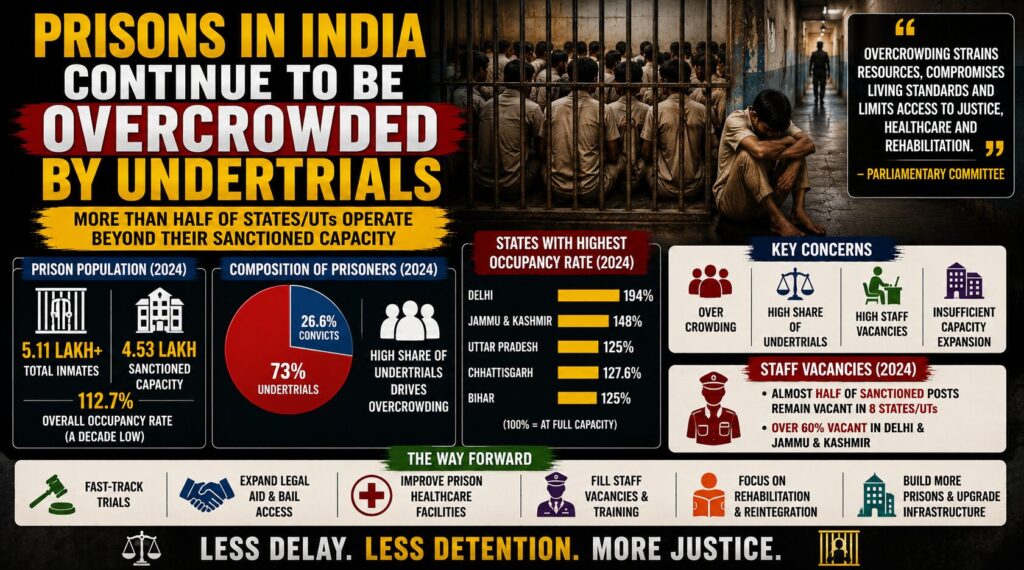
The latest Prison Statistics India 2024 report released by the National Crime Records Bureau shows that the occupancy rate in Indian prisons declined to a decade-low of 112.7%. However, overcrowding remains a serious concern, with prisons housing more inmates than their sanctioned capacity. The report also highlights the dominance of undertrial prisoners, inadequate infrastructure expansion, and large staff vacancies, all of which contribute to a growing prison health and human rights crisis.
UPSC Relevance
Prelims: NCRB, Prison Statistics India Report, Undertrial Prisoners, Prison Reforms, Fundamental Rights, Model Prison Manual.
Mains:
GS-I: Social Issues,
GS-II: Governance, Human Rights, Criminal Justice System,
GS-III: Internal Security and Institutional Reforms,
Background
Prisons are an essential component of the criminal justice system. Beyond confinement, they are expected to provide safe living conditions, healthcare, rehabilitation, skill development, and opportunities for reintegration into society.
However, Indian prisons continue to face structural challenges. Overcrowding, delayed trials, shortage of staff, inadequate healthcare facilities, poor sanitation, and insufficient rehabilitation measures have transformed many prisons into spaces of vulnerability rather than correction.
The latest NCRB data indicates some improvement in prison capacity, but the underlying issues remain largely unresolved.
Status of Indian Prisons in 2024
At the end of 2024, India had approximately 1,333 prisons with a sanctioned capacity of about 4.53 lakh inmates. However, the actual prison population exceeded 5.11 lakh prisoners, resulting in an occupancy rate of 112.7%.
Although this represents a decline from previous years, more than half of the States and Union Territories continue to operate prisons beyond their sanctioned capacity.
Capacity Expansion Efforts
Between 2015 and 2024, prison capacity increased by nearly 24%. This growth was driven by the construction of new prisons, expansion of existing facilities, and renovation projects undertaken across the country.
More than 120 new prisons were constructed during this period, reflecting attempts by governments to address overcrowding. Despite these efforts, inmate growth has continued to outpace capacity creation in several regions.
Overcrowding: The Core Challenge
The Parliamentary Committee on Prison Conditions, Infrastructure and Reforms has identified overcrowding as one of the most serious issues affecting Indian prisons.
Impact on Prison Administration
Overcrowding places enormous pressure on prison infrastructure and administration. It reduces living space per inmate, strains food and sanitation facilities, increases tensions among prisoners, and makes prison management more difficult.
It also limits access to healthcare services, educational opportunities, vocational training, counselling, and rehabilitation programmes, thereby undermining the correctional objectives of imprisonment.
State-wise Concerns
Several States continue to report severe overcrowding.
Delhi recorded the highest occupancy rate in the country at nearly 194% in 2024, meaning prisons housed almost twice their sanctioned capacity. Jammu and Kashmir also witnessed a significant increase in occupancy rates over the last decade.
Although States such as Uttar Pradesh and Chhattisgarh have shown improvement, occupancy levels remain substantially above ideal standards.
Undertrial Prisoners: The Main Driver of Overcrowding
A major reason for prison overcrowding is the disproportionately high number of undertrial prisoners.
Who are Undertrials?
Undertrials are individuals who have been arrested and charged with offences but whose guilt has not yet been determined by a court of law.
They remain legally presumed innocent until convicted.
Magnitude of the Problem
Undertrials accounted for approximately 73% of the total prison population in 2024.
While this is lower than the peak observed during the pandemic years, it remains significantly higher than pre-COVID levels.
At the same time, the share of convicted prisoners has steadily declined, indicating that prisons are increasingly being used to house people awaiting trial rather than those already convicted.
Why are Undertrial Numbers High?
Several factors contribute to the growing undertrial population:
- Slow judicial processes and case backlogs delay the completion of trials.
- Many prisoners are unable to secure bail due to poverty or lack of legal assistance.
- Inadequate legal aid prevents vulnerable individuals from effectively pursuing their rights.
- Investigative delays and procedural inefficiencies prolong detention periods.
Regional Trends
Delhi and Bihar reported some of the highest proportions of undertrial prisoners, with more than 87% of inmates belonging to this category.
Such figures indicate that prison overcrowding is closely linked to broader challenges within the criminal justice system.
The Prison Health Crisis
Overcrowding directly translates into a public health challenge.
Physical Health Concerns
When prisons operate beyond capacity, healthcare infrastructure becomes inadequate for the inmate population.
Limited medical staff, insufficient hospital beds, poor ventilation, and overcrowded barracks increase the risk of communicable diseases such as tuberculosis, skin infections, respiratory illnesses, and gastrointestinal diseases.
Inadequate sanitation and hygiene facilities further worsen health outcomes.
Mental Health Challenges
Prison environments often expose inmates to anxiety, uncertainty, social isolation, and psychological stress.
For undertrial prisoners who may spend years awaiting the outcome of their cases, prolonged incarceration can lead to depression, trauma, and other mental health disorders.
The availability of trained counsellors and mental health professionals remains limited across many prisons.
Women and Vulnerable Groups
Women prisoners face unique challenges relating to reproductive healthcare, maternal health, childcare facilities, and personal hygiene.
Juveniles, elderly inmates, persons with disabilities, and prisoners with chronic illnesses also require specialised healthcare interventions that many prisons are unable to adequately provide.
Staff Shortages and Governance Deficits
The Parliamentary Standing Committee on Home Affairs has repeatedly highlighted staff shortages as a major weakness in prison administration.
Extent of Vacancies
Several States and Union Territories continue to report alarmingly high vacancy rates in prison departments.
In places such as Delhi and Jammu and Kashmir, more than 60% of sanctioned prison staff positions remain vacant.
Consequences
A shortage of prison personnel affects every aspect of prison management. It reduces supervision, delays administrative processes, weakens security arrangements, limits healthcare delivery, and affects rehabilitation activities.
Overburdened prison staff often struggle to maintain humane conditions and effectively manage large inmate populations.
Constitutional and Legal Dimensions
Prison administration falls under the State List of the Constitution.
However, prison reforms are closely linked to several constitutional protections:
- Article 21 guarantees the right to life and personal liberty, which includes the right to live with dignity even while incarcerated.
- Article 14 ensures equality before law.
- Article 39A promotes equal access to justice and free legal aid.
The Supreme Court has repeatedly held that prisoners do not lose their fundamental rights merely because they are incarcerated.
Important Committees and Reform Measures
Justice Amitava Roy Committee (2018)
The committee recommended measures to reduce overcrowding, including faster trials, greater use of bail, and improved legal aid mechanisms.
Model Prison Manual, 2016
The manual advocates modern prison administration, prisoner welfare, healthcare services, vocational training, and rehabilitation-oriented approaches.
E-Prisons Project
Implemented under the Digital India framework, the project seeks to digitise prison records and improve coordination among prisons, courts, and police agencies.
Challenges
Persistent Undertrial Population
Judicial delays continue to keep large numbers of individuals in prison without conviction.
Inadequate Infrastructure
Capacity expansion has not kept pace with rising inmate populations in many States.
Healthcare Deficiencies
Medical facilities, mental health services, and specialised healthcare remain inadequate.
Human Resource Constraints
Large staff vacancies undermine prison governance and prisoner welfare.
Limited Rehabilitation
Overcrowding often shifts focus away from education, skill development, counselling, and reintegration programmes.
Way Forward
Speeding Up Criminal Justice Delivery
Fast-track courts, greater use of technology, and improved case management systems can reduce trial delays and prevent unnecessary detention.
Bail and Legal Aid Reforms
Expanding access to legal aid and promoting liberal bail policies for minor offences can significantly reduce the undertrial population.
Strengthening Prison Healthcare
Dedicated prison hospitals, telemedicine facilities, mental health support systems, and regular health screening programmes must be expanded.
Filling Staff Vacancies
Recruitment drives and specialised training programmes are necessary to improve prison administration and inmate welfare.
Focus on Rehabilitation
Prisons should function as correctional institutions rather than mere detention centres by expanding education, vocational training, counselling, and post-release support.
Conclusion
The decline in prison occupancy rates is a welcome development, but it should not obscure the deeper structural problems confronting India’s prison system. Overcrowding, excessive reliance on undertrial detention, inadequate healthcare, and severe staff shortages continue to undermine both prisoner welfare and the broader goals of justice. Meaningful prison reform requires a shift from a purely custodial approach to a rights-based, rehabilitation-oriented framework that upholds constitutional values and human dignity.
Practice Questions
Prelims Question 1 (Inference-Based)
Consider the following statements:
- A reduction in prison occupancy rates automatically indicates a reduction in prison overcrowding across all States and Union Territories.
- High proportions of undertrial prisoners can contribute significantly to prison overcrowding even when prison capacity is expanded.
Which one of the following is the most appropriate inference?
(a) Only Statement 1 is correct
(b) Only Statement 2 is correct
(c) Both Statements 1 and 2 are correct
(d) Neither Statement 1 nor Statement 2 is correct
Answer: (b)
Explanation: A national decline in occupancy rates does not mean overcrowding has been resolved everywhere, as many States still operate above capacity. The article clearly indicates that undertrial prisoners constitute the primary driver of overcrowding despite capacity expansion.
Prelims Question 2
Assertion (A): Overcrowded prisons often face greater difficulties in providing adequate healthcare and rehabilitation services.
Reason (R): Overcrowding increases pressure on prison infrastructure, staff, and available resources.
(a) Both A and R are correct, and R is the correct explanation of A
(b) Both A and R are correct, but R is not the correct explanation of A
(c) A is correct, but R is incorrect
(d) A is incorrect, but R is correct
Answer: (a)
Explanation: Overcrowding places significant strain on prison infrastructure and personnel, reducing the ability of prisons to provide healthcare, sanitation, counselling, and rehabilitation services. Therefore, the reason directly explains the assertion.
Mains Questions
- Overcrowding in Indian prisons is a symptom of deeper structural issues within the criminal justice system. Examine.
- Discuss the implications of a high undertrial population on prison administration, human rights, and access to justice in India.