Private R&D Spending: Research Capacity and the ANRF
Why in News?
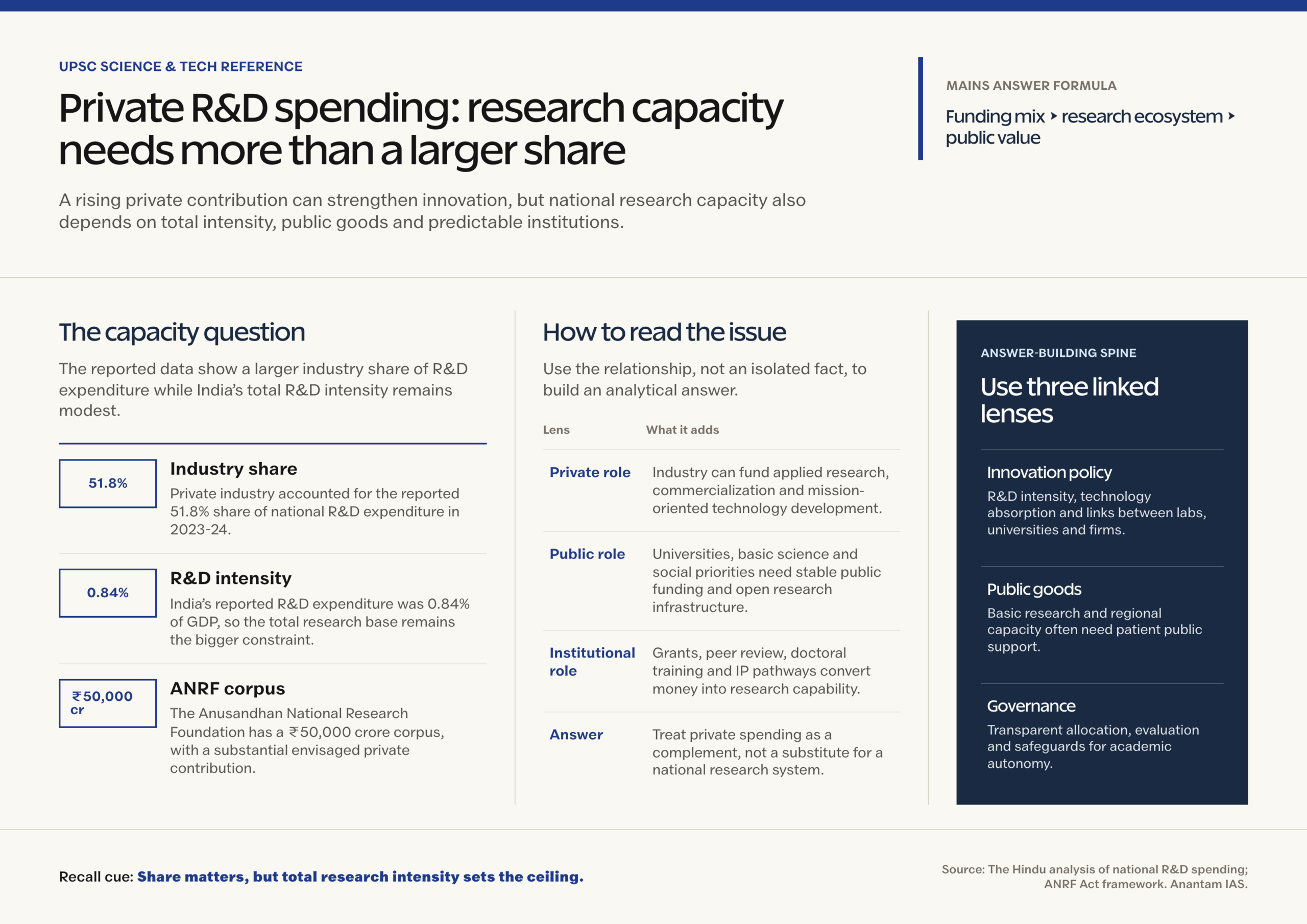
Why in news: Latest DST figures report private industry at 51.8% of national research spending in 2023-24.
- Latest DST figures report private industry at 51.8% of national research spending in 2023-24.
- India’s R&D expenditure was reported at 0.84% of GDP, compared with higher ratios cited for China, the United States and South Korea.
- The report cautions that reporting changes and better capture of multinational and overseas spending may explain part of the shift.
- The Anusandhan National Research Foundation was created with a ₹50,000-crore corpus largely expected from private sources.
- Separate the current event from the durable constitutional, economic or governance concept it activates.
- Use the evidence with its limits; a single headline or reported number is not a complete policy verdict.
- Frame the way forward around capacity, accountability, equity and implementation.
UPSC Relevance
Prelims Relevance
- Latest DST figures report private industry at 51.8% of national research spending in 2023-24.
- India’s R&D expenditure was reported at 0.84% of GDP, compared with higher ratios cited for China, the United States and South Korea.
- The report cautions that reporting changes and better capture of multinational and overseas spending may explain part of the shift.
- Research and development covers systematic work that creates or applies knowledge, but accounting labels can differ across firms and sectors.
- A rise in private spending can broaden innovation capacity when it complements public laboratories, universities and skilled researchers.
- Research intensity is better read with researcher availability, outcomes, technology absorption and manufacturing capability than with a single ratio.
Mains Relevance
GS Paper 2
- Use the issue to assess research measurement, private investment and manufacturing capability.
- Link institutional design with rights, transparency and accountable implementation.
GS Paper 3
- Explain how evidence, technology or fiscal capacity changes delivery outcomes.
Essay
- Public policy succeeds when institutional capability and humane safeguards grow together.
Background and Context
The Current Development
This topic is best understood through research measurement, private investment and manufacturing capability, not as an isolated headline.
- Latest DST figures report private industry at 51.8% of national research spending in 2023-24.
- Research and development covers systematic work that creates or applies knowledge, but accounting labels can differ across firms and sectors.
- A rise in private spending can broaden innovation capacity when it complements public laboratories, universities and skilled researchers.
- A robust assessment should connect the current trigger with institutional capacity, implementation safeguards and the public consequence.
- The relevant authority should publish clear criteria, disclose the basis of important decisions and allow timely correction when implementation departs from the stated objective.
The Core Concept
This topic is best understood through research measurement, private investment and manufacturing capability, not as an isolated headline.
- India’s R&D expenditure was reported at 0.84% of GDP, compared with higher ratios cited for China, the United States and South Korea.
- A rise in private spending can broaden innovation capacity when it complements public laboratories, universities and skilled researchers.
- Research intensity is better read with researcher availability, outcomes, technology absorption and manufacturing capability than with a single ratio.
- A robust assessment should connect the current trigger with institutional capacity, implementation safeguards and the public consequence.
- The relevant authority should publish clear criteria, disclose the basis of important decisions and allow timely correction when implementation departs from the stated objective.
Institutions and Design
This topic is best understood through research measurement, private investment and manufacturing capability, not as an isolated headline.
- The report cautions that reporting changes and better capture of multinational and overseas spending may explain part of the shift.
- Research intensity is better read with researcher availability, outcomes, technology absorption and manufacturing capability than with a single ratio.
- The ANRF is intended to strengthen India’s research ecosystem and connect public institutions with wider research support.
- A robust assessment should connect the current trigger with institutional capacity, implementation safeguards and the public consequence.
- The relevant authority should publish clear criteria, disclose the basis of important decisions and allow timely correction when implementation departs from the stated objective.
Evidence and Limitations
This topic is best understood through research measurement, private investment and manufacturing capability, not as an isolated headline.
- The Anusandhan National Research Foundation was created with a ₹50,000-crore corpus largely expected from private sources.
- The ANRF is intended to strengthen India’s research ecosystem and connect public institutions with wider research support.
- Policy should reward genuine additional research while keeping measurement transparent and avoiding inflated classification of routine spending.
- A robust assessment should connect the current trigger with institutional capacity, implementation safeguards and the public consequence.
- The relevant authority should publish clear criteria, disclose the basis of important decisions and allow timely correction when implementation departs from the stated objective.
Way Forward
Design for implementation
- Set clear responsibilities, timelines, transparent data and an accessible grievance route.
- Fund maintenance, trained personnel and independent review rather than only initial announcements.
- Use safeguards that protect affected people and build trust in institutions.
- Measure outcomes, correct gaps and make lessons available for wider replication.
Conclusion
- Private R&D Spending: Research Capacity and the ANRF is a current hook for a larger UPSC lesson: policy legitimacy depends on whether institutions can translate stated intent into fair and reliable outcomes.
- A strong answer should begin with the development, explain research measurement, private investment and manufacturing capability, acknowledge implementation limits and end with accountable, evidence-led reform.
UPSC Practice Questions
Prelims MCQ 1
With reference to Private R&D Spending: Research Capacity and the ANRF, consider the following statements:
- Latest DST figures report private industry at 51.8% of national research spending in 2023-24.
- India’s R&D expenditure was reported at 0.84% of GDP, compared with higher ratios cited for China, the United States and South Korea.
- The issue can be analysed without considering institutional design or implementation.
How many of the above statements are correct?
(a) Only one (b) Only two (c) All three (d) None
Answer: (b) Only two
Explanation:
The first two statements reflect the current development. Institutional design and implementation are central to the topic, making the third statement incorrect.
Prelims MCQ 2
Which approach best improves the quality of a public-policy answer?
(a) Treating a headline as the whole policy (b) Ignoring implementation constraints (c) Linking evidence, institutions, rights and outcomes (d) Replacing analysis with a list of slogans
Answer: (c) Linking evidence, institutions, rights and outcomes
Explanation:
UPSC answers are stronger when they connect the current development with durable concepts, capacity, safeguards and measurable outcomes.
UPSC Mains Questions
- Discuss the policy and governance lessons raised by Private R&D Spending: Research Capacity and the ANRF.
- How can institutional design improve outcomes while protecting accountability and equity in the context of Science Policy?
Sources: The Hindu and Official and constitutional reference material.
Frequently Asked Questions
What is the current issue behind Private R&D Spending: Research Capacity and the ANRF?
Latest DST figures report private industry at 51.8% of national research spending in 2023-24. India’s R&D expenditure was reported at 0.84% of GDP, compared with higher ratios cited for China, the United States and South Korea.
Why is this relevant for UPSC?
The issue links a live development with research measurement, private investment and manufacturing capability. It can be used in both Prelims fact revision and Mains answers on institutions, policy design and implementation.
What is the best Mains answer structure?
Start with the current trigger, explain the durable concept, use the relevant evidence, identify a limitation and finish with practical safeguards.
Why should a headline be read cautiously?
A reported development may show a real policy direction without proving final outcomes. Distinguish announcement, design, implementation and measured effect.
What should a way forward include?
Specify responsible institutions, finance, trained capacity, transparent monitoring, grievance redress and safeguards for affected people.