Project Freedom: US Hormuz Convoy Initiative and Why India Is Watching Closely
Project Freedom is the latest US Navy attempt to protect commercial shipping through the Strait of Hormuz, and within days of its quiet rollout in early May 2026, it was paused. The pause itself tells the more interesting story. A unilateral American convoy plan, no matter how well-intentioned, runs straight into the politics of a waterway that touches Iran, the UAE, Oman, Saudi Arabia, and Iraq. Each coastal state has a different reading of what “freedom of navigation” means when foreign warships start escorting tankers through their backyard.
For India, this is not a distant naval squabble. Roughly 60 percent of India’s crude oil imports and a meaningful share of LNG transits through Hormuz. Any tightening of the chokepoint, any escalation between Iran and the US, any insurance-premium spike on tanker hulls passing through the strait, lands directly on Indian refiners, fuel retailers, and current-account math. The Strait of Hormuz is the single most consequential geographic feature in India’s external energy security map.
This piece walks through what Project Freedom actually proposed, why it stalled, where India’s interests sit, and what the realistic paths forward look like.
Quick Facts at a Glance
- Project name: Project Freedom (US-led merchant escort initiative)
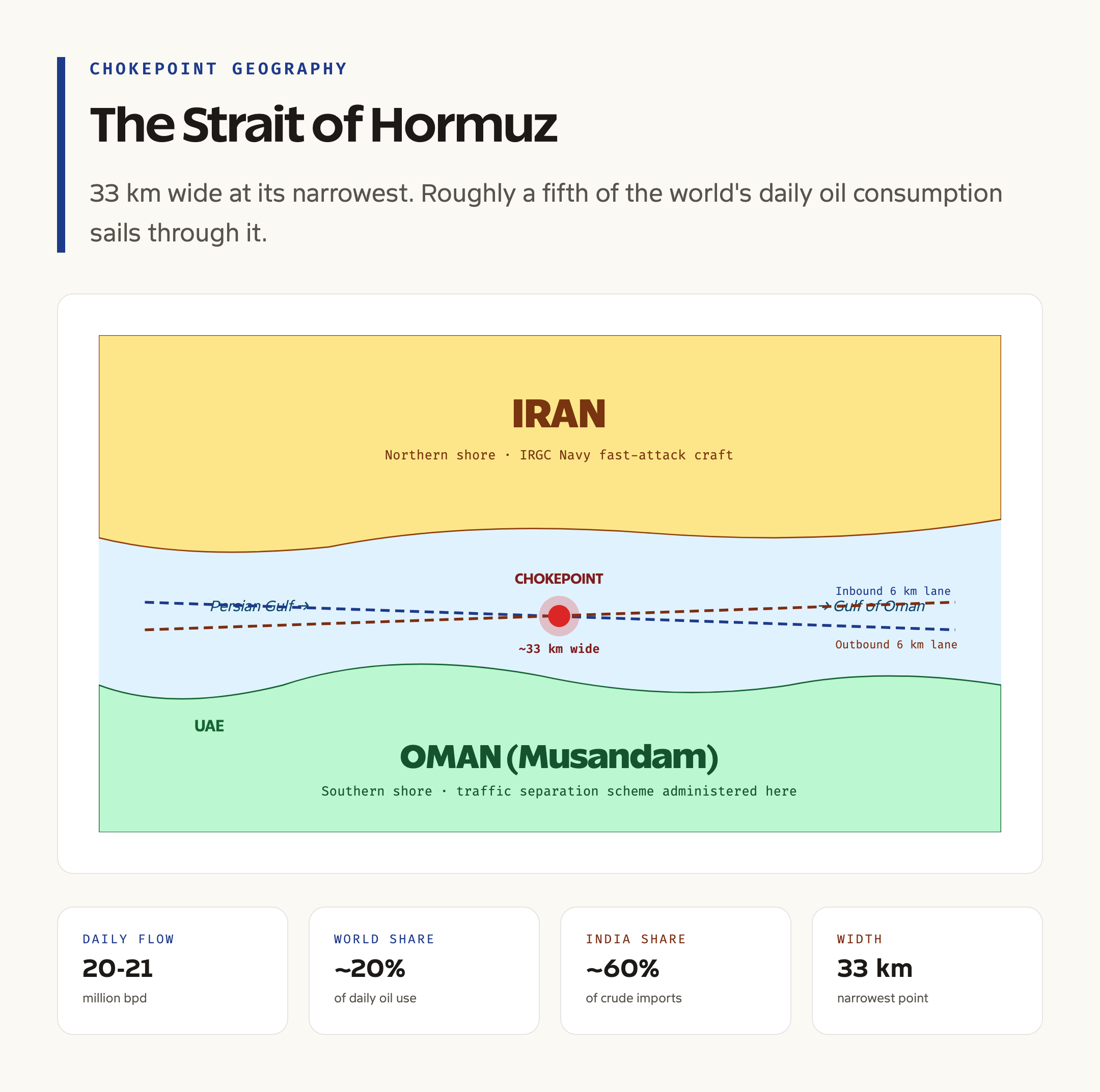
- Geography: Strait of Hormuz, between Iran and Oman, connecting the Persian Gulf to the Gulf of Oman
- Chokepoint width: Roughly 33 km at narrowest, with a 6-km inbound and 6-km outbound shipping lane
- Daily oil flow: Approximately 20 to 21 million barrels per day, around 20 percent of global oil consumption
- India’s exposure: Roughly 60 percent of crude imports and significant LNG volumes pass through Hormuz
- Predecessor mission: Operation Sentinel (2019), International Maritime Security Construct
- Project Freedom status: Announced early May 2026, paused within days after regional opposition
What Just Happened
Washington floated Project Freedom in early May 2026 as a structured US Navy escort plan for civilian tankers transiting the Strait of Hormuz. The basic concept is straightforward. Merchant vessels register with a coordination cell, sail in loose convoy formation through high-risk segments, and benefit from overhead protection by US destroyers and supporting allied warships.
The plan was paused almost immediately after Iran objected on sovereignty grounds and several Gulf Cooperation Council members expressed reservations. Oman, which administers the southern shore of the chokepoint, prefers de-escalation arrangements and has historically played a quiet mediation role between Iran and the US. The UAE, while a security partner of the US, signaled caution about a mission that could draw the Gulf back into open confrontation. Within roughly a week of announcement, the convoy mechanism was effectively shelved pending wider consultation.
The pause matters because it shows the limits of unilateral US security architecture in a multipolar Gulf. Iran is no longer easily isolated. Saudi Arabia and the UAE have rebuilt working channels with Tehran since the 2023 China-brokered normalization. China’s energy interests in the Gulf are larger than ever. India, Japan, and South Korea, the three largest Asian buyers, watched without committing publicly.
Background and Historical Context
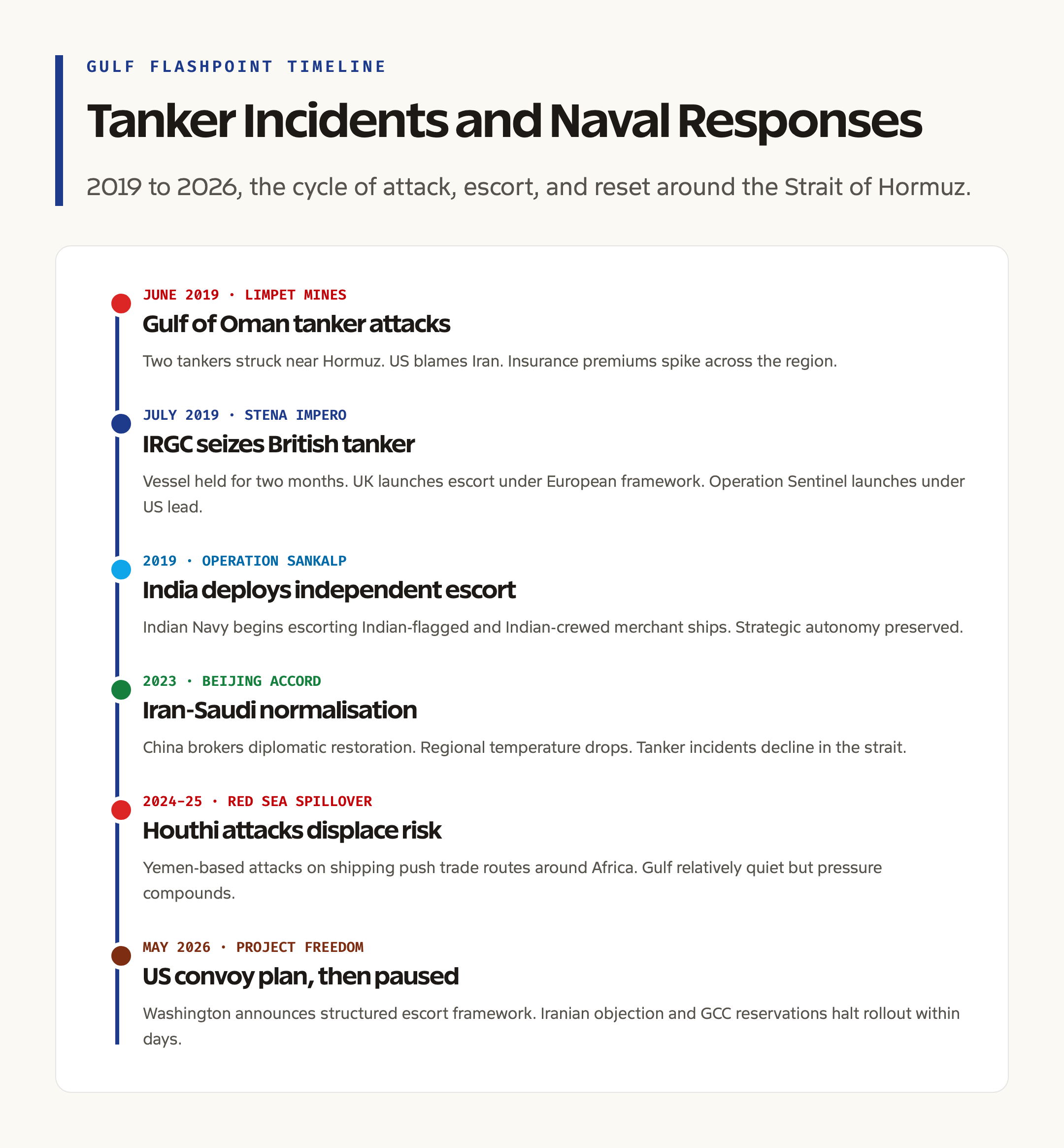
The Strait of Hormuz has been the world’s most important oil chokepoint since the 1973 oil embargo first put petroleum geopolitics on the global agenda. The 1980s tanker war between Iran and Iraq, the 1987 US reflagging of Kuwaiti tankers under Operation Earnest Will, and the post-2019 spate of mine attacks and tanker seizures all rehearsed today’s tensions. Each cycle followed the same logic. A flashpoint somewhere in the Gulf threatens shipping. Insurance premiums spike. A coalition of buyers and the US Navy responds with some form of escort or surveillance arrangement. Once tensions ease, the arrangement quietly winds down.
Operation Sentinel and the International Maritime Security Construct were the 2019 iterations after Iranian forces seized the Stena Impero and limpet mines damaged tankers off the Gulf of Oman. India did not formally join Sentinel but did send naval assets independently under Operation Sankalp to escort Indian-flagged vessels and Indian-crewed ships passing through the area. That distinction, contributing to security without aligning with a US-led structure, captures the broader Indian approach. New Delhi guards its strategic autonomy carefully when great-power blocs form around its energy lifelines. The current pattern resembles past Indian responses to security shocks in the Strait of Hormuz.
Key Features of Project Freedom
Project Freedom, as described in the few public details before the pause, had four design elements:
Voluntary registration: Shipping companies could opt in, providing transit schedules and vessel data to a US-led coordination cell. Registration was free and confidential.
Loose convoy escort: Rather than tight formation sailing, registered tankers would transit on staggered schedules with overhead surveillance and naval support within response distance. This pattern minimizes the operational footprint while preserving deterrent effect.
Multilateral participation pathway: The framework was designed to accept contributions from European navies, GCC partners, and Asian states. Bahrain-based US Fifth Fleet would host the coordination cell.
Defensive rules of engagement: Escorting warships would respond to attacks on merchant vessels but were not chartered to conduct offensive operations against Iranian assets unless directly fired upon.
The design borrowed heavily from Operation Sentinel’s playbook. Where it differed was branding and tempo. Project Freedom signaled a higher US political commitment, with public statements from senior defense officials framing the chokepoint as a strategic priority. That higher visibility may have contributed to the speed and intensity of regional pushback.
Why Project Freedom Matters for India
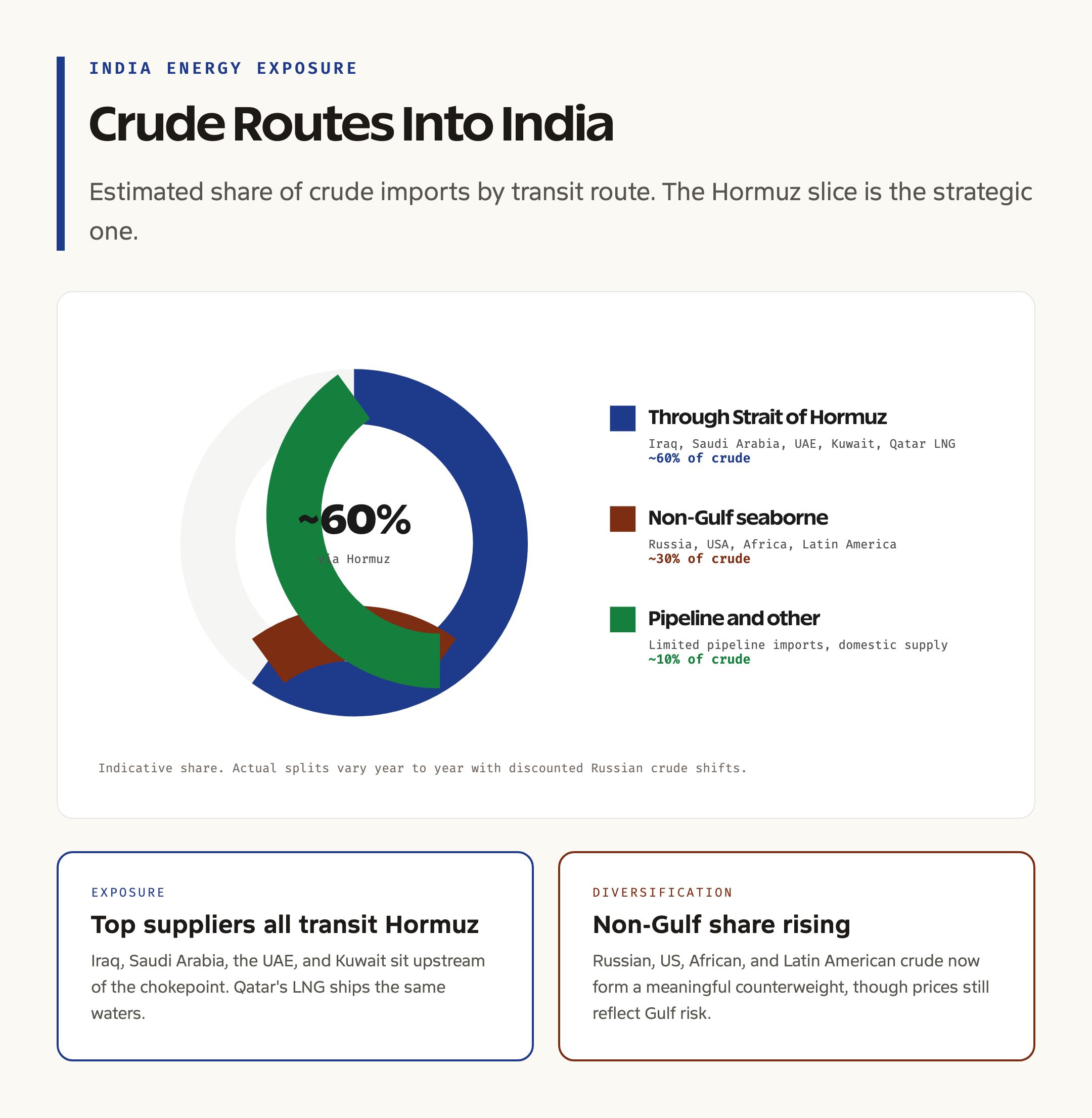
The Indian stake in Hormuz transit security is large and direct. Around 60 percent of crude oil imports, by some estimates, pass through the strait. Iraq, Saudi Arabia, and the UAE are India’s top three crude suppliers, all of them Gulf states whose primary export route is Hormuz. Even oil from Africa or Russia that reaches India through the Indian Ocean does not transit Hormuz, but the price of every barrel in the global market reflects the geopolitical risk premium attached to Gulf flows.
The LNG picture is similar. Qatar is India’s largest single LNG supplier, and Qatari LNG sails out through Hormuz. Disruptions show up immediately in spot LNG prices and in city-gas distribution costs in Indian cities.
The strategic implications run further. If Project Freedom or a successor mission militarises the chokepoint, India faces a tightrope. Joining a US-led structure complicates relations with Iran, with whom India runs Chabahar port and balances its India-Iran relations. Staying entirely outside risks being seen as a free-rider on security provided by others. India’s preferred path so far, independent naval presence under Operation Sankalp, threads this needle but doesn’t scale if the security situation worsens.
There’s also a current-account dimension. A protracted Hormuz crisis pushes oil prices up sharply. India’s import bill swells. The rupee weakens. Inflation pressure builds. The macro stack tightens before a single Indian ship is touched. The stagflation risk associated with Gulf flashpoints is a real economic threat, not an academic one.
Detailed Analysis
The deeper question is whether escort missions actually deter attacks on tankers. The historical evidence is mixed. Operation Earnest Will in 1987 to 1988 did reduce attacks on reflagged Kuwaiti tankers but coincided with the end of the Iran-Iraq war, so isolating the deterrent effect is hard. Operation Sentinel after 2019 saw a steady decline in incidents, but again the regional politics shifted in parallel, with the 2020 Abraham Accords and 2023 Iran-Saudi rapprochement easing tensions independently of the naval mission.
What escort missions reliably do is reduce insurance premiums for participating tankers. Marine insurance underwriters such as Lloyd’s price war-risk premiums daily based on incident frequency and the perceived security environment. A credible convoy mechanism shaves basis points off premiums, and over a year of operation, those savings can fund a meaningful share of the mission cost. That economic logic is part of why shipping companies often welcome these missions even when their home governments don’t formally join.
The Iranian calculation is different. From Tehran’s perspective, foreign warships escorting tankers right through Iranian territorial waters in some segments of the strait represent a sovereignty challenge. The Islamic Revolutionary Guard Corps Navy, which is distinct from Iran’s regular navy and operates the bulk of small fast-attack craft and naval mines in the Gulf, treats Hormuz as a strategic lever. Iran has repeatedly threatened to close the strait in past crises, though doing so would also choke Iranian oil exports and invite massive international response. The deterrent value of the threat is high. The likelihood of actual closure is low. The risk lies in tactical incidents that escalate, not in deliberate strait closure.
Comparative Perspective
| Initiative | Year | Lead | Scope | India’s Role |
|---|---|---|---|---|
| Operation Earnest Will | 1987-88 | US | Reflagging and escort of Kuwaiti tankers | Not involved |
| Operation Sentinel | 2019 onward | US (IMSC) | Surveillance and escort, multilateral framework | Independent presence |
| EMASoH | 2020 onward | France-led | European maritime awareness in Hormuz | Not a member |
| Operation Sankalp | 2019 onward | India | Indian naval escort of Indian shipping | Lead |
| Project Freedom | 2026, paused | US | Convoy escort with multilateral pathway | Watching |
The pattern is unmistakable. India consistently provides security for its own shipping without joining a US-led architecture. That position has costs, including the lack of intelligence-sharing and coordination benefits that membership would bring. But it also preserves freedom to maintain ties with Iran, with whom India has economic and connectivity stakes in Chabahar, the International North-South Transport Corridor, and broader Indian Ocean strategy.
Challenges and Concerns
The principal challenges around Hormuz security are political, not operational. Naval escort missions are well-rehearsed. The hard part is assembling a coalition that doesn’t antagonise Iran into asymmetric escalation, doesn’t undermine GCC mediation efforts, and doesn’t force fence-sitting buyers like India and China to pick sides openly.
A second concern is asymmetric retaliation. Iran’s response to perceived US naval pressure has historically taken the form of attacks on tankers in the broader region, including off the Gulf of Oman and even the Red Sea via Houthi proxies. Project Freedom in Hormuz might displace incidents elsewhere rather than reduce them in aggregate.
A third issue is the cost of inaction. If no mechanism exists when an actual closure threat materialises, the global oil market reaction would be severe. India holds strategic petroleum reserves of only a few weeks of net imports. Building those reserves further is a long-term insurance against exactly this scenario.
Prelims Pointers
- The Strait of Hormuz lies between Iran (north) and Oman (south), connecting the Persian Gulf to the Gulf of Oman
- Approximately 20 percent of global oil consumption transits Hormuz daily
- Project Freedom is a 2026 US initiative for merchant escort in the strait, paused after regional opposition
- Operation Sankalp is India’s independent naval presence for protecting Indian shipping
- India imports around 60 percent of crude through Hormuz; Qatar LNG also transits the strait
- The US Fifth Fleet, headquartered in Bahrain, runs convoy and surveillance missions
- Iran’s IRGC Navy operates separately from the regular Iranian Navy and controls many Gulf fast-attack assets
- The International Maritime Security Construct (IMSC) and EMASoH are existing escort frameworks
Mains-Style Questions
- GS-II (International Relations): Analyse India’s strategic autonomy in the context of US-led maritime security initiatives in the Persian Gulf such as Project Freedom. (250 words)
- GS-III (Energy Security): Examine the implications of any disruption to the Strait of Hormuz on India’s energy security and current account balance. Suggest measures to reduce dependence on Hormuz transit. (250 words)
- GS-II (International Relations): Discuss the strategic significance of the Strait of Hormuz in West Asia’s geopolitics with reference to recent US-Iran tensions. (150 words)
- GS-III (Internal Security): Critically evaluate the role of the Indian Navy in safeguarding India’s sea lines of communication beyond its territorial waters. (150 words)
Way Forward
India’s best response to Project Freedom and its likely successors is layered. Diversification of crude sourcing toward non-Gulf producers, including Russia, Guyana, the US, and Africa, reduces statistical exposure to Hormuz disruption. Building strategic petroleum reserves toward a 90-day import-cover benchmark provides cushion during a crisis. Sustaining and expanding Operation Sankalp keeps Indian-flagged shipping protected without aligning India formally with US-led blocs.
On the diplomatic side, India can encourage Gulf-led de-escalation through quiet engagement with Iran, Saudi Arabia, and the UAE simultaneously, leveraging its working relationships with all three. The longer-term play is to invest in alternative routes, including the International North-South Transport Corridor through Iran and pipeline diplomacy that reduces tanker dependence. None of these solves Hormuz vulnerability overnight. Each shaves a percentage point or two off the strategic exposure, and over a decade those margins compound.
Frequently Asked Questions
What is Project Freedom?
Project Freedom is a US Navy initiative announced in early May 2026 to escort merchant tankers through the Strait of Hormuz under a structured convoy framework. It was paused within days due to opposition from Iran and reservations from regional partners including Oman and the UAE.
Why is the Strait of Hormuz strategically important?
The strait carries roughly 20 percent of the world’s daily oil consumption and a significant share of global LNG. Its narrowest width is about 33 km. Any disruption affects global oil prices immediately and disproportionately hits Asian importers including India, China, Japan, and South Korea.
How much of India’s oil and gas transits through Hormuz?
Estimates suggest around 60 percent of India’s crude oil imports pass through the strait, with Iraq, Saudi Arabia, and the UAE being the top suppliers. Qatari LNG, the largest single source of India’s LNG, also transits Hormuz.
Why did Iran oppose Project Freedom?
Iran considers foreign warship escort missions in waters around its coastline a challenge to its sovereignty. Tehran has repeatedly framed US-led security architectures in the Gulf as destabilising, preferring regional security arrangements that exclude extra-regional powers.
Is India part of Project Freedom?
India has not joined Project Freedom. India operates its own naval mission, Operation Sankalp, which provides escort for Indian-flagged and Indian-crewed merchant vessels in the Gulf and Gulf of Oman, preserving strategic autonomy in line with India’s broader West Asia policy.
What happens to oil prices if Hormuz is disrupted?
A serious disruption to Hormuz traffic typically pushes global crude prices sharply higher within days. Even short-lived incidents add a risk premium that shows up in international benchmarks like Brent. Sustained disruption could push prices well above current levels and trigger inflation pressure across importing economies.
Could Iran actually close the Strait of Hormuz?
Iran has the military capability to disrupt traffic through mines, fast-attack craft, anti-ship missiles, and shore-based systems. Complete closure would also stop Iran’s own oil exports and invite a massive international response. The deterrent threat is more strategically useful to Tehran than actual closure would be.
What is India’s alternative if Hormuz is blocked?
India’s options are limited in the short term. Strategic petroleum reserves provide only a few weeks of cover. Diversifying crude imports toward non-Gulf producers, expanding strategic reserves, investing in alternative connectivity such as the INSTC, and maintaining diplomatic channels with all Gulf actors are the layered measures that reduce dependence over time.