Property Connectivity Ratings: Testing the Network Inside Buildings
Why in News?
On September 25, 2026, TRAI launched its Digital Connectivity Rating platform to support building assessments and make property-level connectivity ratings publicly searchable and verifiable.
- The platform implements an existing regulatory framework, rather than creating a new telecom law through the launch announcement.
- Property managers apply for assessment and select a registered Digital Connectivity Rating Agency, which records observations, tests and supporting evidence.
- Assessment covers fibre readiness, mobile network availability, in-building solutions and Wi-Fi infrastructure, using applicable benchmarks for property categories.
- Consumers can examine published ratings and verify digitally signed certificates, including through the certificate’s QR code.
- Building-level information addresses a practical consumer question: whether the property being considered has connectivity infrastructure suitable for everyday use.
- Documented assessment makes infrastructure claims easier to scrutinise than an unverified sales assurance, while remaining distinct from an individual subscriber’s service contract.
UPSC Relevance
Prelims Relevance
- TRAI: regulator responsible for the property connectivity rating framework.
- Digital Connectivity Rating Agency: registered assessment agency.
- Fibre readiness, mobile availability, in-building solutions and Wi-Fi infrastructure.
- Constructed and under-construction properties: both supported by prescribed assessment workflows.
- eSign and certificate verification: tools for authenticating assessment documents.
Mains Relevance
GS Paper 2
- Consumer information, independent assessment and verifiable public records.
- Regulatory implementation through an evidence-based digital workflow.
GS Paper 3
- In-building digital infrastructure and planning for connectivity during property development.
Essay
- The usefulness of digital public systems depends on the physical infrastructure that connects people to them.
Background and Context
What a property connectivity rating assesses
The unit of assessment is a property, making its infrastructure and in-building connectivity visible before a consumer commits to buying or leasing the premises.
- Fibre readiness concerns the property’s preparation for fibre-based connectivity. It directs attention to the building’s infrastructure, rather than treating the advertised availability of an internet subscription as sufficient evidence about the premises themselves.
- Mobile network availability is assessed within the property under the prescribed methodology. An assurance about coverage in a neighbourhood is not a substitute for evidence about connectivity inside the particular building being considered.
- In-building solutions form a separate assessment area because the premises have their own connectivity requirements. Evaluation links those arrangements with recorded observations and tests instead of relying solely on the property manager’s description.
- Wi-Fi infrastructure is also included in the framework. Its assessment does not mean that every resident receives the same subscription, equipment or service; the rating concerns the property under the applicable evaluation parameters.
- The assessment uses category-specific benchmarks for different types of property. The launch release identifies the major parameter groups but does not provide the score thresholds needed to calculate a rating independently from those descriptions.
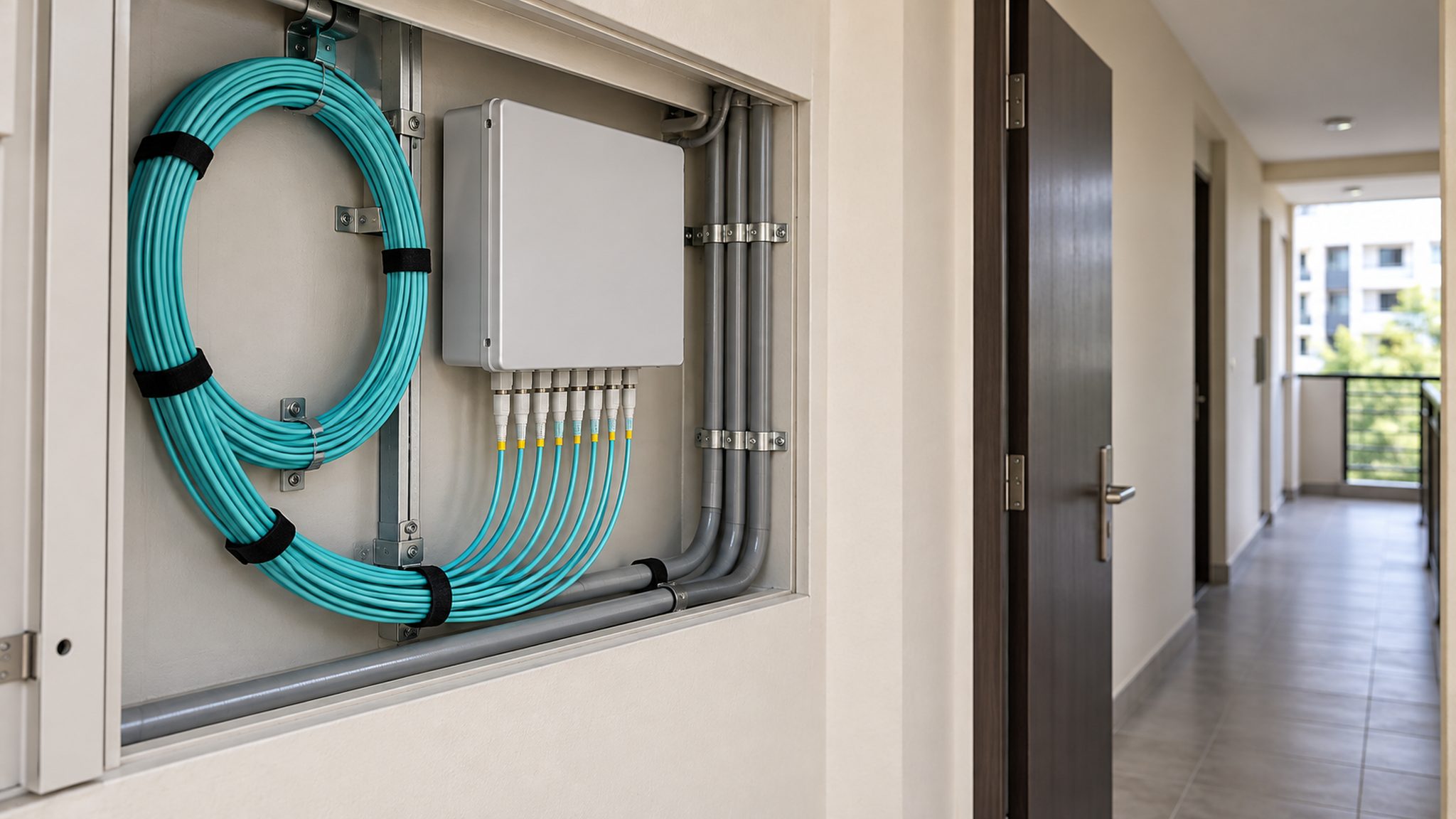
How applications become verifiable evidence
The digital workflow connects information supplied by property managers with agency assessment, supporting documents and the rating certificate eventually made available to consumers.
- The property manager registers the premises, provides prescribed information and documents, submits a rating application and selects a registered agency. This establishes an application record, but the application itself is not a completed rating.
- The rating agency undertakes the assessment, records its observations and test results, and manages supporting documentation. Its role is to evaluate the assigned property through the prescribed framework, not simply reproduce a marketing claim.
- A dedicated field-assessment application supports authorised in-building measurements. Data captured during assessment synchronises with property information supplied through the web interface, connecting the evaluation record with the specific property under review rather than an unrelated site.
- The workflow covers assessment, reporting, certification and publication. Keeping these stages connected allows a consumer to examine a published result supported by a recorded process, rather than a claim detached from its assessment documentation.
- Digital signatures and certificate verification help authenticate the record presented to a consumer. The platform also stores test results, supporting records and audit logs, providing an evidence trail behind the visible rating and its certificate.
What the rating establishes and what it does not
The value lies in comparable property information; its limits matter because a building assessment cannot answer every question about an individual user’s internet experience.
- The system supports both constructed and under-construction properties. Existing properties can be assessed for infrastructure and connectivity performance, while property development creates an opportunity to plan connectivity infrastructure before the premises enter regular use.
- A property rating differs from an individual service subscription. Consumers should still examine their chosen service and contractual terms; a building’s certificate does not itself set the price or speed promised under a subscriber’s plan.
- Certificate authenticity answers whether a document corresponds to the official rating record. It should not be confused with a guarantee that every future call, download or online session will achieve an identical level of performance.
- The framework already existed under the 2024 regulations, with subsequent amendments and a rating manual. The new platform operationalises assessment and public visibility; the launch is not evidence that every property has already been rated.
- Public search enables consumers to find rated properties, examine certificates and compare premises of interest. The announcement does not establish universal mandatory coverage, a new nationwide operator ranking or proven improvements across all participating buildings.
Way Forward
Make the assessment useful at the property decision
- Keep property identity, certificate authenticity and assessment documentation clearly connected, so consumers can verify that a cited rating belongs to the premises being considered.
- Encourage early infrastructure planning during development, while using field evidence to identify limitations in existing buildings.
- Explain rating scope plainly alongside results, helping consumers distinguish building connectivity information from subscription terms and guarantees that the assessment does not provide.
Conclusion
- Property connectivity ratings make a previously difficult-to-check building attribute more visible through structured assessment and verifiable documentation. Their policy value is stronger consumer information and better infrastructure planning, not an automatic promise of perfect connectivity everywhere.
- For UPSC answers, connect physical infrastructure with trustworthy digital records: property information, field measurement and certificate verification serve different purposes. Preserve that distinction when discussing transparency, regulatory implementation and informed consumer decisions in digital service markets.
UPSC Practice Questions
Prelims MCQ 1
With reference to TRAI’s Digital Connectivity Rating framework, consider the following statements:
- Its assessment includes fibre readiness and Wi-Fi infrastructure.
- The assessment workflow supports both constructed and under-construction properties.
- A published rating fixes the internet subscription price for every resident.
How many of the above statements are correct?
(a) Only one (b) Only two (c) All three (d) None
Answer: (b) Only two
Explanation:
The first two statements are correct. A property connectivity rating is not an individual subscriber’s service contract and does not fix subscription prices.
Prelims MCQ 2
Which is the primary purpose of verifying a digitally signed property rating certificate?
(a) To guarantee identical speeds for every device (b) To authenticate the rating document against its record (c) To replace the need for field assessment (d) To assign a nationwide rank to a mobile operator
Answer: (b) To authenticate the rating document against its record
Explanation:
Certificate verification establishes authenticity. It does not replace measurements or guarantee every user’s future connectivity performance.
UPSC Mains Questions
- How can property-level digital connectivity assessments improve consumer choice and infrastructure planning? Explain the limits of such ratings.
- Distinguish property information, field-test evidence and certificate authentication in a digital regulatory workflow. Why must these functions remain connected?
Source: PIB, Ministry of Communications.
Frequently Asked Questions
What does a Digital Connectivity Rating assess?
It assesses a property’s digital connectivity under the prescribed framework. Major parameter groups include fibre readiness, mobile network availability, in-building solutions and Wi-Fi infrastructure, with applicable benchmarks for different property categories.
Who applies for and conducts the assessment?
A property manager submits the application and prescribed documents and selects a registered Digital Connectivity Rating Agency. The agency undertakes assessment, records observations and test results, and completes the prescribed rating process.
Does a rating guarantee the speed of my internet plan?
No such guarantee is established by the launch announcement. The rating concerns the property’s assessed connectivity and infrastructure; an individual subscription’s price, contractual terms and promised service remain separate questions.
How can consumers verify the published rating?
Consumers can find rated properties through the public interface and inspect digitally signed certificates. The certificate’s QR code supports authenticity verification, helping connect a presented document with the relevant property’s rating record.