Protecting Elephant Corridors in India
Why in News?
Recently, the Supreme Court has directed the Union government to undertake a fresh nationwide survey of elephant corridors and submit a comprehensive status report within eight weeks.
- The Court held that States cannot erect walls, trenches or other obstacles on traditional elephant routes merely to prevent crop damage.
- It also sought enforcement of its 2018 prohibition on the barbaric and illegal use of fireballs, burning torches and spikes by hula parties to drive away elephants.
| UPSC Relevance: GS-3 Environment: Biodiversity, Conservation Prelims: Elephant Corridors, Asiatic Elephants |
What are Elephant Corridors?
- Elephant corridors are narrow stretches of land connecting two or more larger elephant habitats. They enable herds to move between forests in search of food, water and breeding grounds. Disrupting them can not only spark human-elephant conflict but pose a threat to the animals themselves.
- India has 150 scientifically validated elephant corridors across 15 States and 33 Elephant Reserves. India is also home to nearly 60% of the world’s wild Asian elephant population.
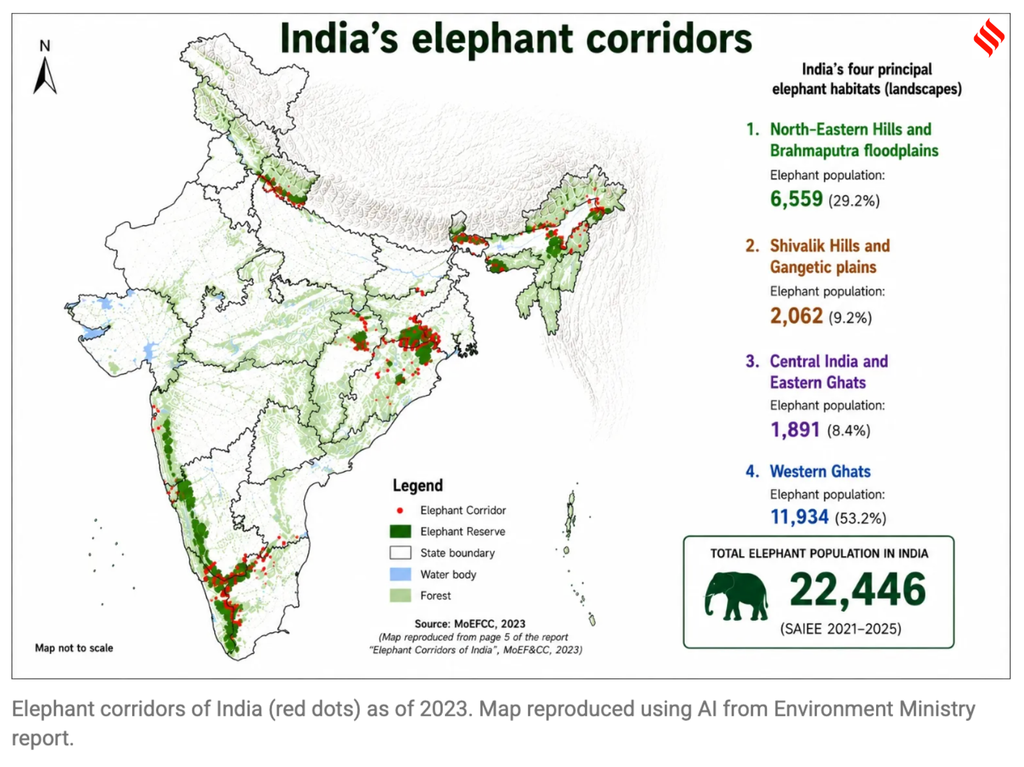
- India has four principal elephant population landscapes:
- Western Ghats
- North-Eastern Hills and Brahmaputra floodplains
- Shivalik Hills and Gangetic plains
- Central India and Eastern Ghats.
- More than 50% of India’s 22,446 elephants are distributed in the Western Ghats across Karnataka (6,013), Tamil Nadu (3,136) and Kerala (2,785).
But the habitat of the once-contiguous Western Ghats population is rapidly getting fragmented owing to changing land use, coffee and tea plantations, invasive plants, and farmland fencing.
Why do Elephants move long distances?
- Asian elephants are highly mobile and social mammals. A male elephant’s average home range (the area it typically uses for food, water and shelter) extends between 50 and 300 square kilometres, but can increase depending on the availability of resources.
- Elephants can move through their range in herds or individually. These home ranges can also vary depending on habitat type, food availability, water sources, population density and human disturbances.
- Elephant movements are strongly influenced by the seasonal and spatial distribution of food, water and habitat. For instance, seasonal migrations into Kerala are common during the dry months as elephants seek water and food in the relatively moist forests of the Western Ghats. Climate change and drought have played a role in forcing migration.
In all this, corridors play a crucial role, allowing elephants to move for food, for natural dispersal and everyday movement. Now, the migratory routes are also increasingly being influenced by infrastructure construction, mining and farmland.
Why are Corridors Important?
- Genetic connectivity: They prevent elephant populations from becoming isolated and genetically unviable.
- Reduction of conflict: Predictable, unobstructed routes reduce the likelihood that elephants enter villages and agricultural fields.
- Landscape conservation: Elephants are a keystone and umbrella species; protecting their movement routes benefits several other species.
- Climate resilience: Connected habitats allow wildlife to adjust its range in response to changing rainfall, water availability and vegetation.
- To provide Inter-State connectivity, as Elephant movement is ecological rather than administrative.
Major Threats:
- Elephant corridors are fragmented by construction/ expansion of highways, railway lines, mines, dams, settlements, resorts, agricultural expansion and transmission infrastructure.
- Fences, trenches and walls erected to protect crops may divert elephants towards densely populated areas, thereby worsening human-elephant conflict.
Inclusion in an official corridor inventory does not automatically provide the same statutory protection as a National Park or Wildlife Sanctuary, particularly where corridors pass through private or revenue land.
Legal Protection:
- The Asiatic elephant is listed in Schedule I of the Wildlife (Protection) Act, 1972, and receives the highest level of domestic legal protection.
- IUCN status: Endangered
- CITES: Appendix I
- Project Elephant, launched in 1992, supports habitat and corridor conservation and the mitigation of human-elephant conflict.
- Articles 48A and 51A(g) of the Constitution create obligations for environmental and wildlife protection.
Significance of the Court’s Direction:
- The order adopts a landscape-based approach to conservation. It recognises that wildlife corridors cannot be managed independently by individual States.
- It also shifts conflict mitigation away from coercive blockades towards scientific habitat management, cooperative federalism and humane coexistence.
Way Forward:
- Map corridors using satellite imagery, camera traps, Global Positioning System telemetry and local ecological knowledge.
- Provide corridor-specific legal protection through Eco-Sensitive Zones, conservation reserves, land acquisition or voluntary conservation agreements.
- Construct scientifically designed underpasses and overpasses across highways and railway lines.
- Undertake cumulative environmental impact assessments for infrastructure passing through elephant landscapes.
- Develop interoperable early-warning systems and inter-State rapid-response teams.
- Ensure prompt and transparent compensation for crop, property and human losses.
- Promote non-lethal deterrents, crop insurance and less elephant-attractive crops along conflict-prone boundaries.
- Restore degraded forests, water sources and fragmented corridors instead of merely driving elephants away.
Human-elephant conflict cannot be solved by obstructing the animal’s traditional right of passage. Securing connected habitats, protecting local livelihoods and coordinating conservation across State boundaries constitute the most durable path towards coexistence.