PSLV-C62/EOS-N1 Mission Anomaly: Lessons for India’s Commercial Space Program
ISRO’s PSLV-C62/EOS-N1 mission in January 2026 became important for an uncomfortable reason: the mission encountered an anomaly at the end of the PS3 phase. The official mission page noted that detailed analysis had been initiated.
For UPSC, a space anomaly is often more useful than a routine success. It allows candidates to discuss reliability, transparency, commercial launch credibility, failure analysis, institutional learning and the maturing of India’s private and public space ecosystem.
This article treats PSLV-C62 not as a failure headline, but as an exam-worthy window into India’s launch-vehicle architecture and space-sector governance.
Quick Facts
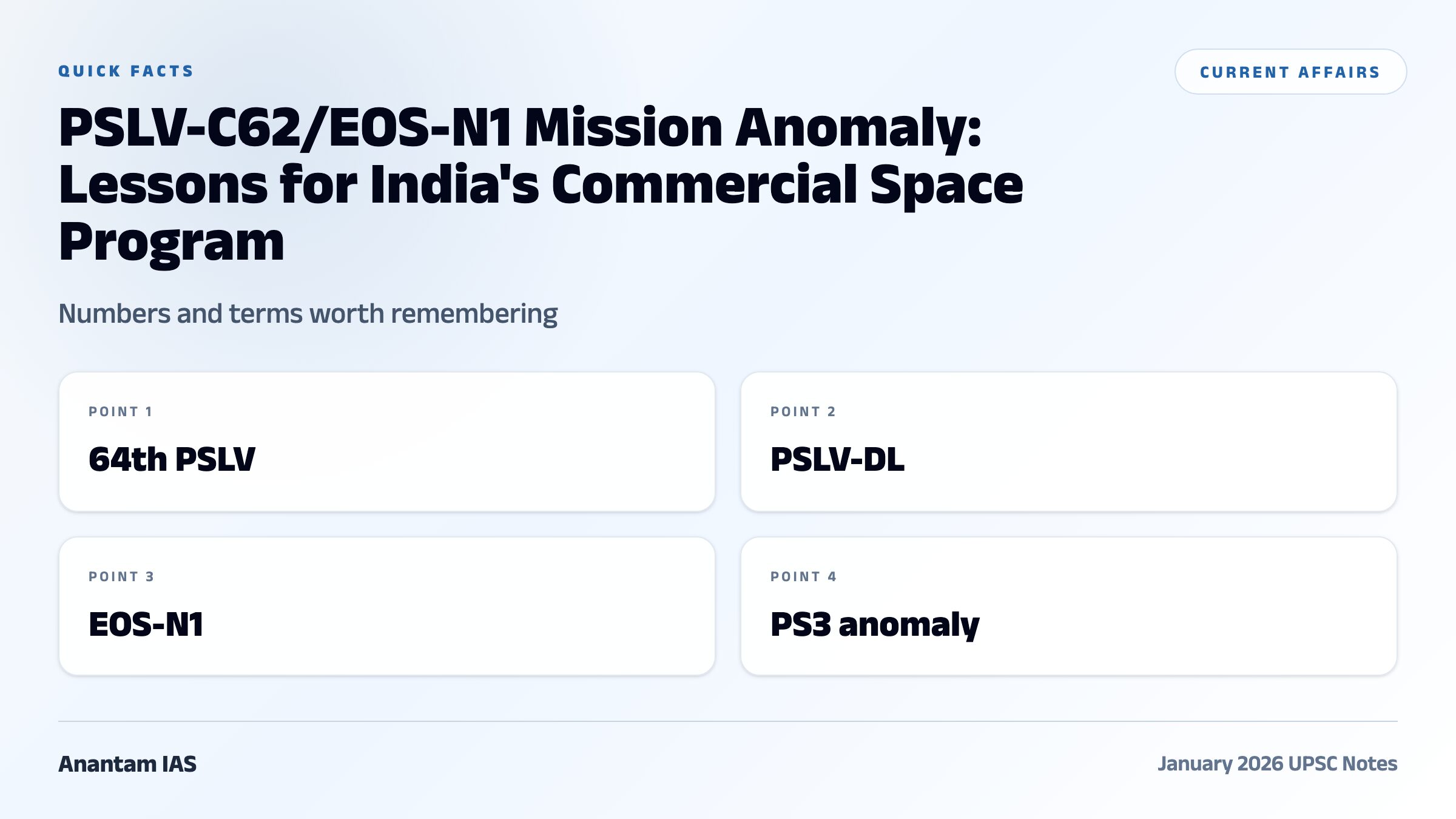
- PSLV-C62 was planned as the 64th mission of the Polar Satellite Launch Vehicle.
- It used the PSLV-DL configuration with two strap-on boosters.
- The primary payload was EOS-N1, along with 15 co-passenger satellites.
- It was described as the ninth dedicated commercial mission facilitated by NSIL.
- The mission also carried a KID demonstration payload.
- The official page reported an anomaly at the end of the PS3 phase and noted that analysis had begun.
- Official source: ISRO mission page.
What Just Happened
The PSLV-C62 mission attempted to launch EOS-N1 and co-passenger satellites in January 2026. ISRO later reported that an anomaly occurred at the end of the third stage, triggering a detailed technical review.
The immediate news value lies in the mission outcome. The deeper policy value lies in the credibility of failure reporting. A mature space agency does not hide anomalies. It investigates, fixes and returns with a more reliable launch system.
The mission also matters because it was linked to commercial launch services through NSIL. Commercial customers do not expect perfection, but they do expect transparency, predictable timelines and credible failure analysis.
Background and Historical Context
PSLV is India’s workhorse launch vehicle. It has launched Indian remote-sensing satellites, lunar and Mars mission payloads and many international satellites. Its reputation rests on reliability across decades.
The space-sector reforms of 2020 created a larger role for NSIL, IN-SPACe and private firms. ISRO is expected to focus more on advanced missions and technology while commercial and private actors take on routine services over time.
Mission anomalies are common in global space programs. What matters is whether the institutional response improves design, testing, quality assurance and launch-readiness protocols.
Key Features of PSLV-C62/EOS-N1
The core policy architecture can be read through these features.
- Launch vehicle: PSLV, India’s proven four-stage launch system.
- Configuration: PSLV-DL uses two strap-on boosters.
- Primary payload: EOS-N1, an Earth observation satellite.
- Commercial angle: the mission was facilitated through NSIL as a dedicated commercial launch.
- Co-passengers: 15 additional satellites were listed.
- Anomaly point: ISRO reported the issue at the end of PS3, the third stage.
Why It Matters
This is a high-yield UPSC topic because it joins current news with durable syllabus themes.
- It gives GS-III material on space technology, commercialisation and institutional learning.
- It helps aspirants distinguish launch vehicles, stages, payloads and governance institutions.
- It shows why reliability is central to the economics of commercial launch markets.
- It gives Essay material on failure, transparency and scientific temper.
Detailed Analysis: Space Lens
Reliability is a national asset. PSLV’s reputation took decades to build. A single anomaly does not erase that record, but it does demand a transparent technical review.
Commercialisation raises the stakes. When private and foreign customers are involved, launch risk becomes a market issue. Insurance, contracts, timelines and customer confidence all depend on credible post-flight analysis.
Failure data is valuable. A space program that learns from anomalies improves more than one that treats every mission as a publicity event. This is the scientific-temper angle UPSC can test.
Comparative Perspective
A comparison helps prevent the answer from becoming a one-dimensional news summary.
- NASA: major failures such as Challenger and Columbia led to institutional reforms and safety reviews.
- SpaceX: rapid testing and visible failures are part of an iterative engineering model.
- ESA: Ariane launch issues have affected European commercial-launch timelines.
- ISRO: historically combines conservative engineering with gradual capability expansion.
Challenges
The policy or institutional promise runs into recurring constraints.
- Failure analysis must be technically deep and publicly credible without compromising sensitive details.
- Commercial customers need predictable corrective timelines.
- Private-sector participation requires clear liability, insurance and quality-control frameworks.
- India must maintain PSLV reliability while developing newer vehicles and private launch capacity.
- Public communication should avoid both hype and silence.
Prelims Pointers
- PSLV has four stages using alternating solid and liquid propulsion.
- PSLV-DL refers to a configuration with two strap-on boosters.
- NSIL is NewSpace India Limited, a commercial arm under the Department of Space.
- IN-SPACe authorises and promotes private participation in the space sector.
- Earth observation satellites support mapping, agriculture, disaster management and security applications.
- A launch anomaly is not the same as a complete vehicle design failure.
Mains Questions
- Space mission anomalies can strengthen institutional credibility when handled transparently. Discuss with reference to India’s space sector. (GS Paper III, 250 words)
- Examine the role of NSIL and IN-SPACe in India’s space-sector reforms. (GS Paper III, 150 words)
- Reliability is the core currency of the commercial launch market. Analyse in the Indian context. (GS Paper III, 250 words)
- How should India balance public-sector space expertise with private participation? (GS Paper III, 250 words)
Way Forward
ISRO should complete and communicate the technical review in a way that preserves mission confidence while respecting engineering confidentiality.
Commercial launch governance needs clear contracts, insurance rules and customer communication protocols for anomalies.
The larger reform lesson is simple: India should not fear visible failure in space. It should fear unexamined failure.
The examiner is unlikely to reward a bare fact dump here. The better answer connects the January 2026 event to institutional design, implementation capacity and India’s long-term development priorities.
Frequently Asked Questions
What was PSLV-C62?
It was a January 2026 PSLV mission carrying EOS-N1 and co-passenger satellites, with a commercial-launch angle through NSIL.
What happened to PSLV-C62?
ISRO’s mission page reported an anomaly at the end of the PS3 phase and said detailed analysis had been initiated.
What is PSLV-DL?
It is a PSLV configuration with two strap-on boosters.
Why is this important for UPSC?
It connects space technology with commercialisation, institutional transparency, public-sector reform and scientific temper.
What is NSIL?
NewSpace India Limited is the commercial arm under the Department of Space.
Does one anomaly mean PSLV is unreliable?
No. PSLV has a long record of reliability. A single anomaly matters because the response can improve future reliability.