Purchasing Power Parity

Why in news:
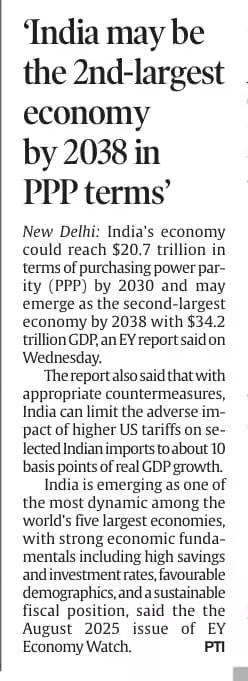
According to the EY Economy Watch (August 2025 edition), India is projected to become the second-largest economy in the world in Purchasing Power Parity (PPP) terms by 2038, with a GDP of $34.2 trillion. By 2030, India’s GDP in PPP terms is expected to touch $20.7 trillion.
UPSC Relevance:
UPSC asks key terminologies in economy.
UPSC PYQ 2019:
Q. Consider the following statements:
- Purchasing Power Parity (PPP) exchange rates are calculated by comparing the prices of the same basket of goods and services in different countries.
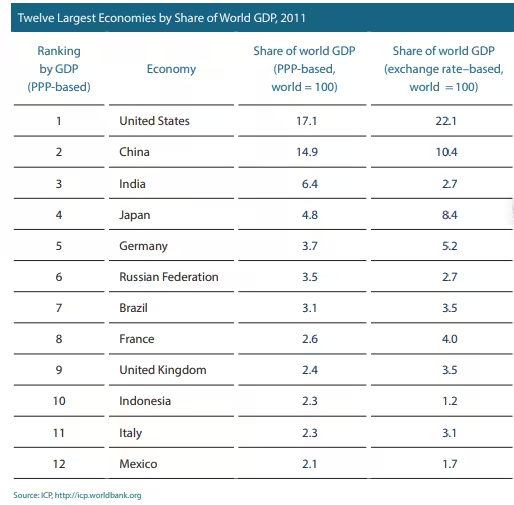
- In terms of PPP dollars, India is the sixth largest economy in the world.
Which of the statements given above is/are correct?
(a) 1 only
(b) 2 only
(c) Both 1 and 2
(d) Neither 1 nor 2
About PPP:
- PPPs are the rates of currency conversion that equalize the purchasing power of different currencies by eliminating the differences in price levels between countries.
- In their simplest form, PPPs are simply price relatives that show the ratio of the prices in national currencies of the same good or service in different countries.
How PPPs are calculated?
First stage:
It is at the product level, where price relatives are calculated for individual goods and services.
A simple example would be a litre of Coca-Cola. If it costs 2.3 euros in France and 2.00$ in the United States then the PPP for Coca-Cola between France and the USA is 2.3/2.00, or 1.15. This means that for every dollar spent on a litre of Coca-Cola in the USA, 1.15 euros would have to be spent in France to obtain the same quantity and quality – or, in other words, the same volume – of Coca-Cola.
Second Stage:
The second stage is at the product group level, where the price relatives calculated for the products in the group are averaged to obtain unweighted PPPs for the group. Coca-cola is for example included in the product group “Softdrinks and Concentrates”.
Third stage
It is at the aggregation levels, where the PPPs for the product groups covered by the aggregation level are weighted and averaged to obtain weighted PPPs for the aggregation level up to GDP (in our example, aggregated levels are Non-alcoholic beverages, Food…). The weights used to aggregate the PPPs in the third stage are the expenditures on the product groups as established in the national accounts.
Uses of PPPs?
The major use of PPPs is as a first step in making inter-country comparisons in real terms of gross domestic product (GDP) and its component expenditures.
What are the products included in the basket of goods and services used for the calculation of PPPs:
The basket of goods and services priced for the PPP exercise is a sample of all goods and services covered by GDP. The final product list covers around 3,000 consumer goods and services, 30 occupations in government, 200 types of equipment goods and about 7 construction projects.