Pygmy Hog: An Indicator of Healthy Grasslands
Why in News?
Assam’s pygmy hog conservation efforts have drawn attention to a central challenge: captive breeding can prevent immediate extinction, but long-term survival requires restoration of alluvial grasslands.
| UPSC Relevance: GS-3 Environment and Biodiversity: Species in News, Conservation Prelims: Pygmy Hog |
About Pygmy Hog:
The Pygmy Hog is the smallest and rarest wild pig in the world and is endemic to India. Its last remaining wild population survives in the tall wet grasslands of the Himalayan foothills, primarily inside Manas National Park, Assam.
- Identity: World’s smallest wild pig. Adults stand approximately 25 cm tall.
- Native range: Southern Himalayan foothill grasslands of the Indian subcontinent. Its historical range likely extended from Uttar Pradesh through southern Nepal to Assam, possibly southern Bhutan.
- Present distribution: Surviving populations are restricted to Assam. Manas National Park holds the last surviving original wild population.
- Habitat: Dense, tall alluvial grasslands, providing food, nesting material and concealment.
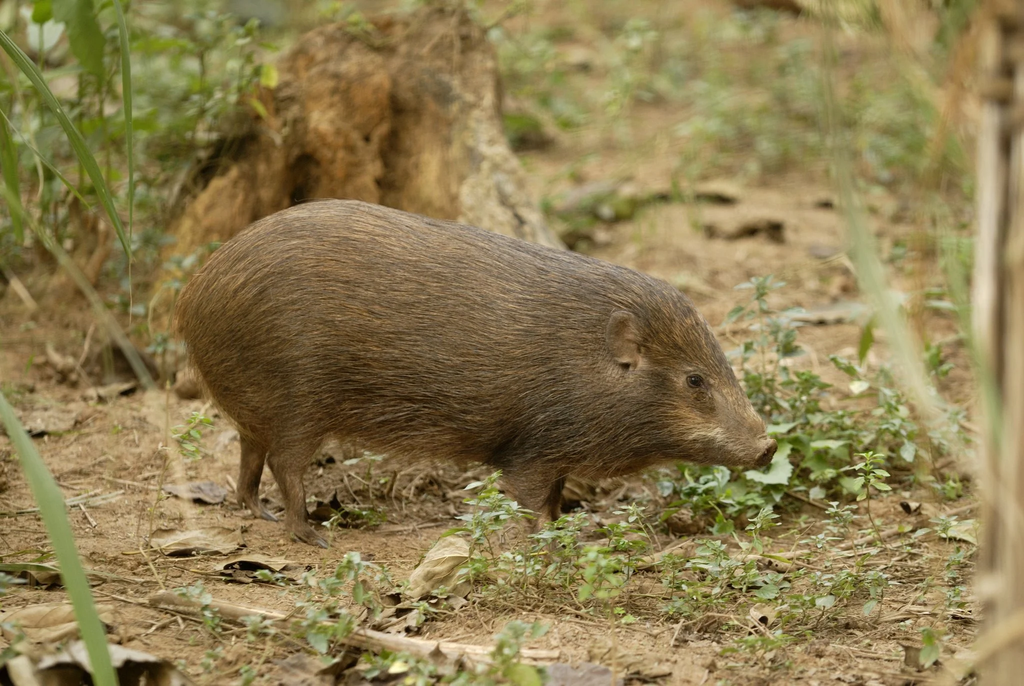
Behavioural Traits:
- Primarily diurnal: Active during daylight, with reduced activity during intense midday heat.
- Social organisation: Females and young form small family groups, generally 4-6 individuals; adult males are usually solitary.
- Nest-building: Builds grass nests for shelter, temperature regulation and protection of young.
- Omnivorous: Eats roots, tubers, shoots and invertebrates, occasionally small vertebrates; uses its snout to forage through soil and vegetation.
Protection Status:
- IUCN Red List: Endangered
- Wildlife (Protection) Act, 1972: Schedule I
- CITES: Appendix I
Ecological Importance:
- Indicator species: Its dependence on undisturbed grass cover makes its decline an early warning of grassland degradation.
- Wider conservation benefits: Protecting its habitat also safeguards species such as the Bengal florican, hispid hare, hog deer and greater one-horned rhinoceros.
- Evolutionary significance: Its extinction would eliminate an entire surviving genus.
Threats and Conservation Priorities:
- Habitat degradation: Agricultural conversion, overgrazing, invasive plants and altered flood regimes reduce suitable grasslands.
- Unscientific burning: Extensive dry-season fires destroy nests and protective cover; unchecked woody growth can also replace grassland.
- Small-population risks: Inbreeding and diseases transmitted through contact with domestic pigs threaten recovery.
- Conservation programme: Rediscovered in 1971; the Pygmy Hog Conservation Programme was formed in 1995, combining breeding, reintroduction and habitat management.
Practice MCQ:
Q. Consider the following statements about the pygmy hog:
- It is a herbivorous and primarily nocturnal mammal.
- It inhabits dense, tall alluvial grasslands.
- It is currently classified as Endangered by the IUCN.
Which of the statements given above are correct?
(a) 1 and 2 only
(b) 1 and 3 only
(c) 2 and 3 only
(d) 1, 2 and 3
Answer: (c). Statement 1 is incorrect: the pygmy hog is omnivorous and primarily diurnal.
UPSC PYQ 2013
Q. Consider the following:
1. Star tortoise
2. Monitor lizard
3. Pygmy hog
4. Spider monkey
Which of the above are naturally found in India?
(a) 1, 2 and 3 only
(b) 2 and 3 only
(c) 1 and 4 only
(d) 1, 2, 3 and 4
Answer: (a)