Drug Track-and-Trace: QR codes extended to vaccines, antimicrobials and cancer medicines
Why in News?
The Ministry of Health and Family Welfare has amended the Drugs Rules, 1945 to widen the QR-code / barcode track-and-trace regime, which until now applied only to the country’s top 300 drug brands. The amendment brings several high-risk categories of medicines under mandatory traceability for the first time.
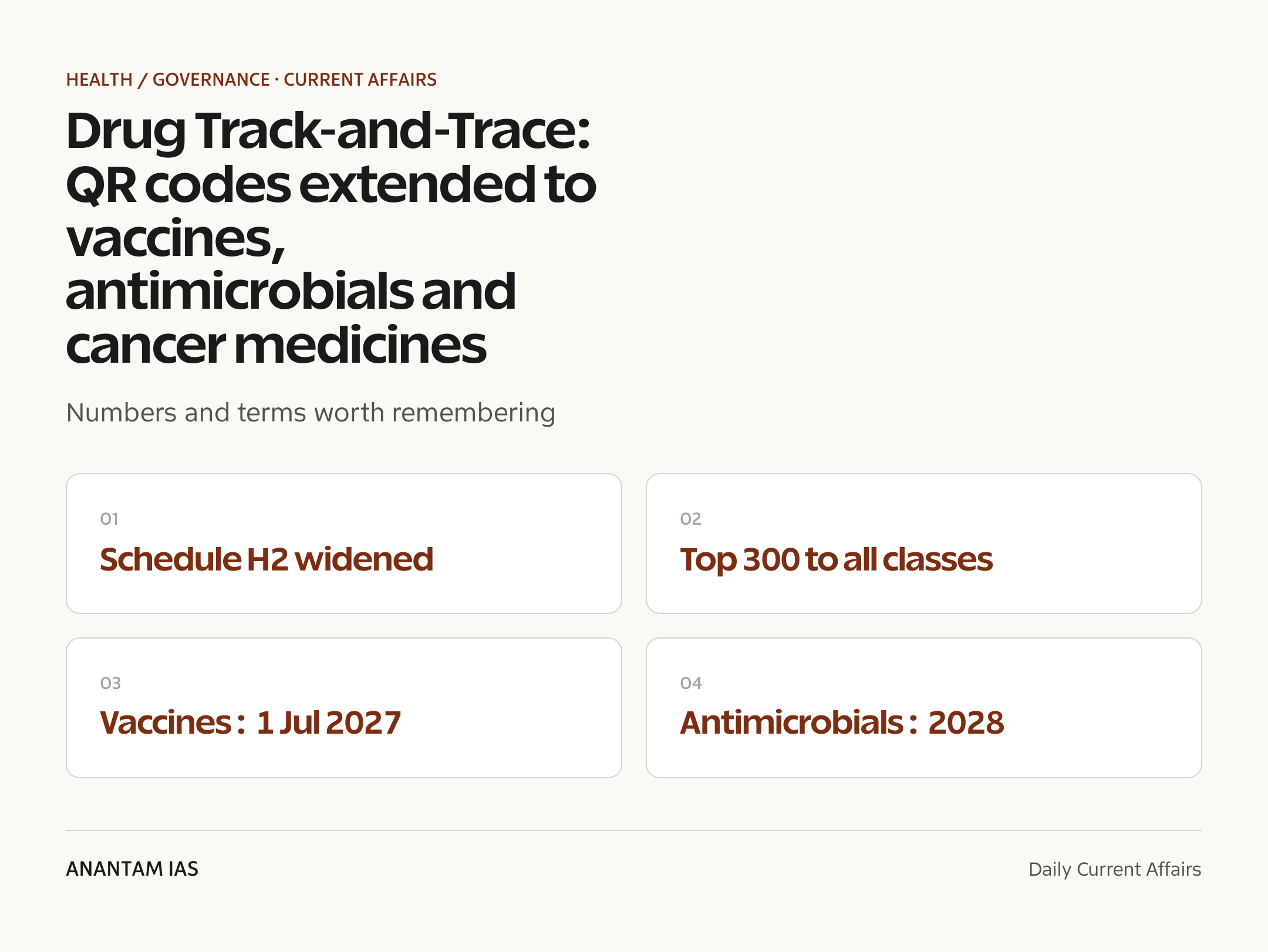
All vaccines, antimicrobials, narcotic and psychotropic drugs under the NDPS Act, 1985, and all anti-cancer drugs have been added to Schedule H2, requiring a scannable code that carries a unique product code, batch, and manufacturing and expiry details.
- New categories added to Schedule H2: all vaccines, all antimicrobials, all anti-cancer drugs, and NDPS-listed narcotic and psychotropic medicines.
- Staggered rollout – vaccines, anti-cancer and NDPS drugs from 1 July 2027; antimicrobials from 1 July 2028.
- Manufacturers must print or affix the Bar Code or QR Code on the primary packaging label, or on the secondary label where space is inadequate.
- The code stores the unique product identification code, generic and brand names, manufacturer name and address, batch number, manufacturing and expiry dates, and licence number.
- Earlier, Schedule H2 (added by the Drugs (Eighth Amendment) Rules, 2022) covered only the top 300 brands from 1 August 2023.
The development matters in the context of:
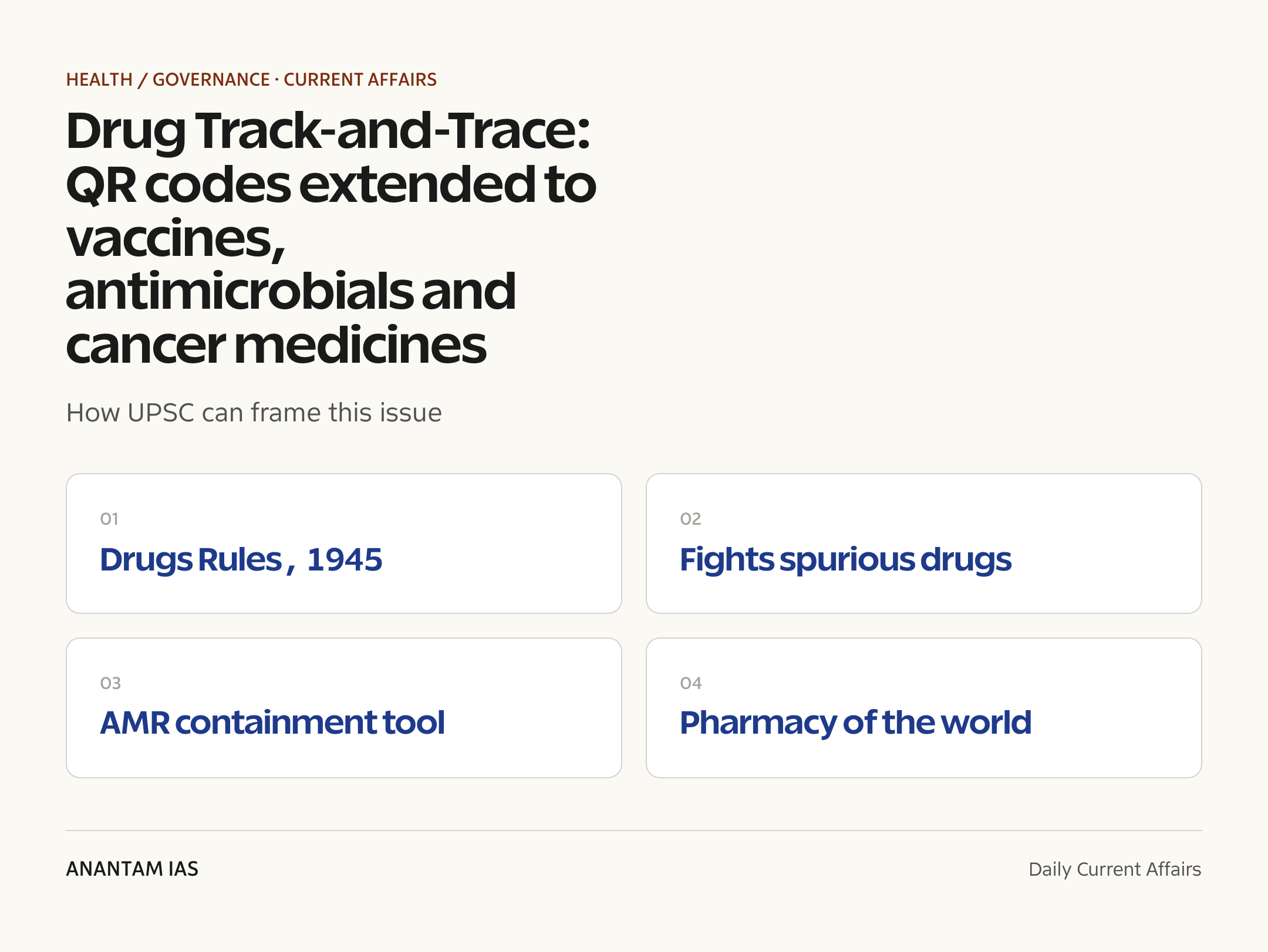
- India is the ‘pharmacy of the world’ – the largest supplier of generic medicines – so traceability is central to its export credibility.
- Spurious, falsified and Not of Standard Quality (NSQ) drugs erode patient safety and public trust in the supply chain.
- Self-medication and counterfeit antibiotics are a major driver of Antimicrobial Resistance (AMR); serialising antimicrobials helps detect substandard products.
- A scannable code lets patients, chemists and regulators verify authenticity at the point of sale and trace recalls batch-by-batch.
UPSC Relevance
Prelims Relevance
- Schedule H2 of the Drugs Rules, 1945 – the schedule listing drugs requiring barcode/QR traceability.
- Drugs (Eighth Amendment) Rules, 2022 – introduced Schedule H2 for the top 300 brands.
- Parent law: Drugs and Cosmetics Act, 1940 and the Drugs Rules, 1945.
- Regulator: CDSCO (Central Drugs Standard Control Organisation) under the DCGI.
- NDPS Act, 1985 governs narcotic and psychotropic substances now covered.
- Rollout dates: vaccines / anti-cancer / NDPS from 1 July 2027; antimicrobials from 1 July 2028.
- QR data fields: unique product code, batch number, manufacturing and expiry dates.
- Antimicrobial Resistance (AMR) and ‘Not of Standard Quality’ (NSQ) are key linked concepts.
- India is the world’s largest supplier of generic medicines by volume.
Mains Relevance
GS Paper 2
- Regulation of the pharmaceutical sector and the State’s role in ensuring access to safe, quality medicines as a dimension of the right to health.
- Governance and transparency – how digital traceability strengthens institutional oversight of the drug supply chain.
GS Paper 3
- Science and technology in service delivery – using serialisation, QR codes and GS1-style standards to secure supply chains.
- Antimicrobial Resistance as a One Health challenge and the role of drug traceability in containing it.
Essay
- Technology as a guardian of public trust – from blind faith to verifiable medicine.
- Health security and the cost of counterfeit goods in a globalised supply chain.
Background and Context
What the amendment does
The Health Ministry has expanded an existing barcode mandate to cover the most safety-critical drug classes.
- Amends the Drugs Rules, 1945 (framed under the Drugs and Cosmetics Act, 1940) to enlarge Schedule H2.
- Adds all vaccines, all antimicrobials, all anti-cancer drugs, and narcotic and psychotropic drugs under the NDPS Act, 1985.
- Manufacturers must print or affix a Bar Code or QR Code on the primary packaging label, shifting to the secondary label only when space is inadequate.
- Scanning reveals the unique product identification code, generic and brand names, manufacturer name and address, batch number, manufacturing and expiry dates, and the manufacturing licence number.
From top-300 brands to whole categories
Traceability in India began narrow and is now being scaled to entire therapeutic classes.
- Schedule H2 was first introduced by the Drugs (Eighth Amendment) Rules, 2022, notified in November 2022.
- It mandated a barcode or QR code on the top 300 drug brands by sales value from 1 August 2023.
- Big-selling brands like common painkillers, antacids and vitamins were the first to carry the codes.
- The new step moves from a curated brand list to category-wide coverage of vaccines, antimicrobials, anti-cancer and NDPS drugs.
Staggered timeline and who it hits
The rollout is phased to give manufacturers time to retool packaging lines.
- 1 July 2027 – vaccines, anti-cancer medicines, and NDPS narcotic and psychotropic drugs come under the QR mandate.
- 1 July 2028 – antimicrobials (including antibiotics) become subject to mandatory coding.
- The phasing reflects the larger number of antimicrobial SKUs and the line-side serialisation burden.
- Both domestic and foreign manufacturers supplying these categories in India must comply.
Why spurious drugs and AMR make this urgent
Traceability is a frontline tool against fake medicines and drug resistance.
- Counterfeit, falsified and Not of Standard Quality (NSQ) medicines undermine treatment and can be fatal.
- Sub-potent or fake antibiotics fuel Antimicrobial Resistance (AMR) by exposing pathogens to inadequate doses.
- Vaccines and anti-cancer drugs are high-value, cold-chain-sensitive products where authenticity directly affects survival.
- Serialisation supports faster, batch-level recalls and lets chemists and patients verify a pack before use.
India as the 'pharmacy of the world'
Traceability protects both domestic patients and India’s export reputation.
- India is the largest global supplier of generic medicines by volume and a major vaccine producer.
- Verifiable, serialised packaging strengthens trust in ‘Made in India’ medicines abroad.
- It aligns India with global serialisation norms used in regulated export markets.
- Stronger traceability complements regulator CDSCO in policing the supply chain end to end.
Way Forward
Build the digital backbone
- Move toward an interoperable, centrally readable traceability database so codes are verifiable nationwide, not just printed.
- Adopt consistent global standards (such as GS1-style identifiers) to ease exports and avoid duplicate coding systems.
Close enforcement and awareness gaps
- Equip chemists, hospitals and patients with simple scan-to-verify apps and run awareness drives.
- Pair traceability with stronger penalties for spurious and NSQ drugs and routine risk-based inspections by CDSCO and state drug controllers.
Support small manufacturers
- Offer technical and financial support to MSME drug makers to install serialisation lines before the 2027-28 deadlines.
- Extend coverage progressively to more categories once compliance stabilises.
Conclusion
Extending QR-code traceability from a top-300 brand list to whole classes of vaccines, antimicrobials, anti-cancer and NDPS medicines marks a shift from selective oversight to systemic supply-chain transparency. For a country that medicates much of the world, every fake or sub-standard pack is both a patient-safety failure and a reputational risk.
The real test lies in execution – a readable, interoperable verification system, support for smaller manufacturers, and tough enforcement against spurious drugs. Done well, the 2027-28 rollout can make authenticity checkable at the chemist’s counter and turn traceability into a quiet but powerful weapon against drug resistance.
UPSC Practice Questions
Prelims MCQ 1
With reference to the QR-code / barcode traceability regime for medicines in India, consider the following statements:
- Schedule H2 of the Drugs Rules, 1945 lists drugs required to carry a barcode or QR code.
- The mandate originally applied only to the top 300 drug brands before being expanded.
- The framework is administered under the Narcotic Drugs and Psychotropic Substances Act, 1985.
How many of the above statements are correct?
(a) Only one (b) Only two (c) All three (d) None
Answer: (b) Only two
Explanation:
Statements 1 and 2 are correct – Schedule H2 lists the drugs and first covered the top 300 brands. Statement 3 is wrong: the regime sits under the Drugs and Cosmetics Act, 1940 and Drugs Rules, 1945, not the NDPS Act (though NDPS-listed drugs are now included).
Prelims MCQ 2
Under the 2026 expansion, which category of drugs is scheduled to come under the QR-code mandate LAST?
(a) Vaccines (b) Anti-cancer drugs (c) Antimicrobials (d) Narcotic and psychotropic drugs
Answer: (c) Antimicrobials
Explanation:
Vaccines, anti-cancer and NDPS narcotic/psychotropic drugs come under the mandate from 1 July 2027, while antimicrobials follow later, from 1 July 2028.
UPSC Mains Questions
- Spurious and Not of Standard Quality medicines threaten both patient safety and India’s standing as the ‘pharmacy of the world’. Examine how QR-code-based drug traceability can address this challenge, and the institutional and technological gaps that may limit its success. (250 words)
- Antimicrobial Resistance is a One Health crisis that no single intervention can solve. Discuss the role of pharmaceutical supply-chain traceability, alongside other measures, in India’s strategy to contain AMR. (250 words)
Sources: The Hindu and Business Standard.
Frequently Asked Questions
What exactly has the Health Ministry changed?
It amended the Drugs Rules, 1945 to expand Schedule H2, bringing all vaccines, all antimicrobials, all anti-cancer drugs and NDPS narcotic and psychotropic medicines under mandatory barcode or QR-code traceability, beyond the earlier top-300 brand list.
What is Schedule H2?
Schedule H2 of the Drugs Rules, 1945 lists drug formulations whose packaging must carry a barcode or QR code storing traceability data. It was introduced by the Drugs (Eighth Amendment) Rules, 2022 and initially covered only the top 300 brands from 1 August 2023.
When do the new rules take effect?
The rollout is staggered: vaccines, anti-cancer medicines and NDPS narcotic and psychotropic drugs come under the mandate from 1 July 2027, while antimicrobials follow from 1 July 2028, giving manufacturers time to upgrade packaging lines.
What information does the QR code carry?
Scanning the code reveals the unique product identification code, generic and brand names, the manufacturer’s name and address, the batch number, manufacturing and expiry dates, and the manufacturing licence number, allowing point-of-sale verification.
How does this help fight Antimicrobial Resistance?
Fake or sub-potent antibiotics expose bacteria to inadequate doses, accelerating resistance. Mandating QR codes on antimicrobials helps identify and weed out counterfeit and substandard products, supporting India’s broader AMR containment efforts.
Who regulates drug quality and traceability in India?
The Central Drugs Standard Control Organisation (CDSCO), headed by the Drugs Controller General of India (DCGI), administers the Drugs and Cosmetics Act, 1940 and Drugs Rules, 1945, working with state drug controllers on enforcement.