Quantum Entanglement Loss: Timing as a Control Resource
Why in News?
A Raman Research Institute-led optical experiment showed that a correctly timed single local population flip can avoid, delay or hasten entanglement sudden death.
- The team used photon polarisation to emulate two-level quantum systems undergoing dissipative evolution in a controlled optical setup.
- A local sigma-x operation swapped the populations associated with the ground and excited states without changing the external environment.
- The operation’s timing redirected the subsequent entanglement trajectory, showing that when to act can be a quantum-control resource.
- The peer-reviewed study appeared in Physical Review A and demonstrated avoidance, delay and hastening within one displaced-Sagnac photonic platform.
- This is a laboratory result and possible quantum-information technique, not a production-ready quantum computer, complete error-correction system or universal cure for decoherence.
- Entanglement supports quantum communication, teleportation and distributed information processing, but environmental interaction can degrade the correlations that these tasks require.
- The experiment is valuable because it changes the trajectory of loss through control timing rather than demanding a different physical environment.
- Practical value will depend on transfer to real hardware, calibration accuracy, noise diversity, scalability and compatibility with other control operations.
UPSC Relevance
Prelims Relevance
- Quantum entanglement: non-classical correlations between parts of a composite quantum system.
- Decoherence: degradation of quantum coherence through interaction with uncontrolled environmental degrees of freedom.
- Entanglement sudden death: entanglement reaches zero after a finite time even though local physical decay may remain incomplete.
- Amplitude damping: a noise model describing energy loss from an excited state toward a ground state.
- Sigma-x operation: a local unitary bit-flip operation that interchanges the populations of two basis states.
- Photon polarisation: the light degree of freedom used in the experiment to represent a controllable two-level system.
Mains Relevance
GS Paper 3
- Quantum information, decoherence control and the path from laboratory demonstrations to reliable quantum technologies
- India’s research ecosystem, including RRI and support under the National Quantum Mission
GS Paper 2
- Public funding for foundational science and international research collaboration
Essay
- In complex systems, the timing of an intervention can matter as much as its strength.
Background and Context
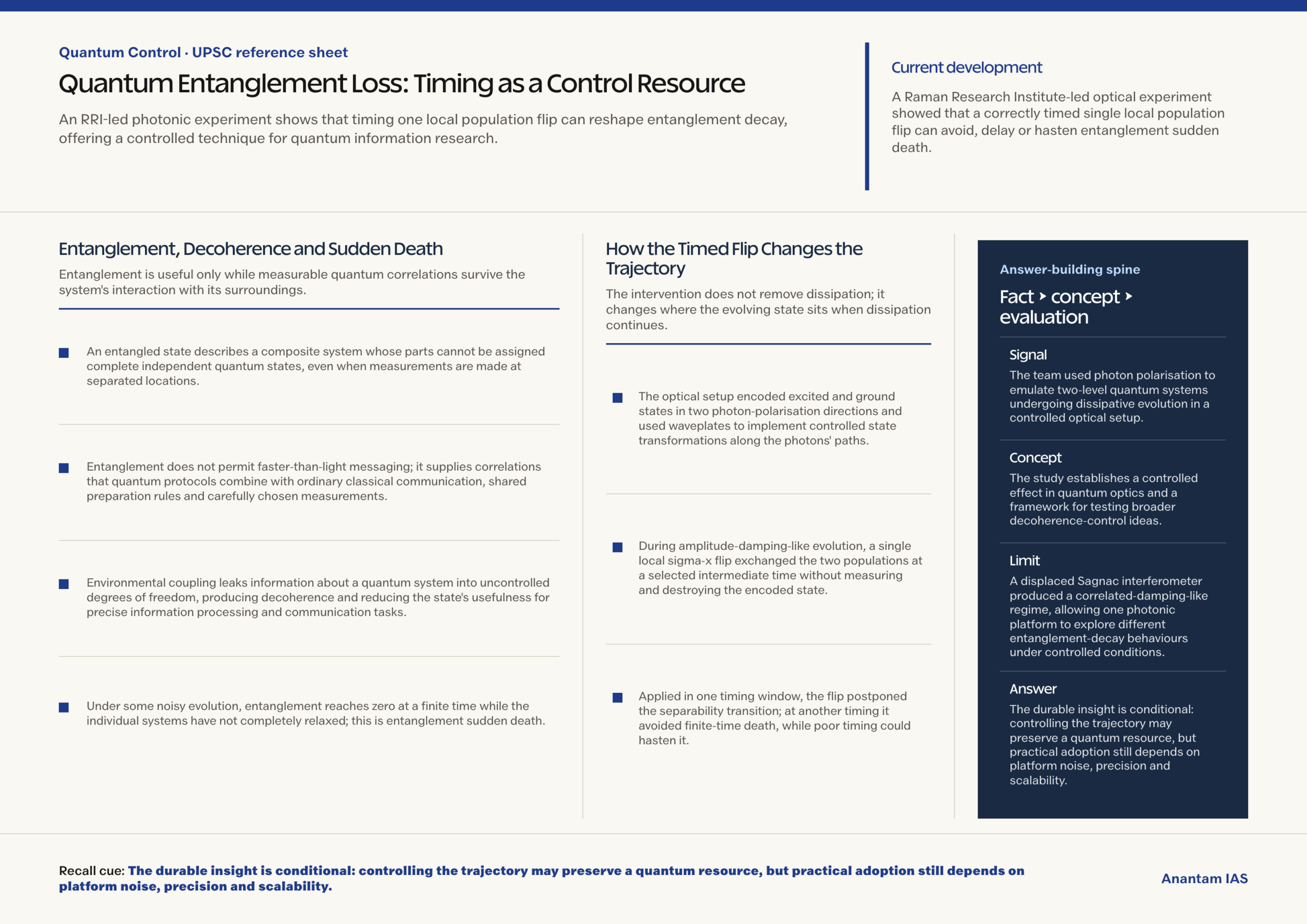
Entanglement, Decoherence and Sudden Death
Entanglement is useful only while measurable quantum correlations survive the system’s interaction with its surroundings.
- An entangled state describes a composite system whose parts cannot be assigned complete independent quantum states, even when measurements are made at separated locations.
- Entanglement does not permit faster-than-light messaging; it supplies correlations that quantum protocols combine with ordinary classical communication, shared preparation rules and carefully chosen measurements.
- Environmental coupling leaks information about a quantum system into uncontrolled degrees of freedom, producing decoherence and reducing the state’s usefulness for precise information processing and communication tasks.
- Under some noisy evolution, entanglement reaches zero at a finite time while the individual systems have not completely relaxed; this is entanglement sudden death.
- Sudden death differs from a slow asymptotic fade because a usable shared quantum resource disappears abruptly before all local excitation has vanished.
How the Timed Flip Changes the Trajectory
The intervention does not remove dissipation; it changes where the evolving state sits when dissipation continues.
- The optical setup encoded excited and ground states in two photon-polarisation directions and used waveplates to implement controlled state transformations along the photons’ paths.
- During amplitude-damping-like evolution, a single local sigma-x flip exchanged the two populations at a selected intermediate time without measuring and destroying the encoded state.
- Applied in one timing window, the flip postponed the separability transition; at another timing it avoided finite-time death, while poor timing could hasten it.
- The operation redirects the state’s dissipative path rather than cancelling noise, reversing time or permanently isolating the photons from their environment.
- This makes timing a control parameter: the same physical operation can produce different entanglement outcomes depending on the system’s state when it is applied during ongoing controlled evolution.
Experimental Value and Limits
The study establishes a controlled effect in quantum optics and a framework for testing broader decoherence-control ideas.
- A displaced Sagnac interferometer produced a correlated-damping-like regime, allowing one photonic platform to explore different entanglement-decay behaviours under controlled conditions.
- The theoretical framework connects independent and correlated amplitude-damping descriptions through a tunable family of effective maps, matching intermediate behaviour that neither limiting textbook model alone captured.
- The authors also showed an operational advantage for a teleportation use case, indicating how preserved entanglement might improve an information task within the studied conditions.
- The result does not demonstrate a fault-tolerant processor, long-distance quantum network or hardware-independent guarantee; those systems combine many noise channels and control constraints.
- Translation requires tests on other physical platforms, imperfect controls, many qubits, repeated operations and realistic environments before the method can support a reliable deployable architecture.
Way Forward
Test the Control Resource Beyond the Optical Demonstration
- Reproduce timing-dependent control across trapped ions, superconducting circuits, solid-state spins and communication links with platform-specific noise.
- Measure gains against calibration errors, control-pulse cost and additional decoherence introduced by the intervention itself.
- Combine timed local control with error correction, dynamical decoupling and feedback instead of treating it as a substitute for the full reliability stack.
- Develop scalable diagnostics that identify the useful intervention window without requiring complete reconstruction of a large quantum state.
Conclusion
- The experiment shows that a simple local flip can steer entanglement decay when its timing is matched to the system’s dissipative evolution.
- For Mains answers, present timing as a low-overhead control resource while separating a photonic proof of principle from production-scale quantum computing.
- The durable insight is conditional: controlling the trajectory may preserve a quantum resource, but practical adoption still depends on platform noise, precision and scalability.
UPSC Practice Questions
Prelims MCQ 1
With reference to entanglement sudden death and the RRI-led optical experiment, consider the following statements:
- Entanglement sudden death can occur before the local excited-state populations have completely decayed.
- The experiment prevented dissipation by replacing the optical hardware during evolution.
- The timing of a local population flip could delay, avoid or hasten the loss of entanglement.
How many of the above statements are correct?
(a) Only one (b) Only two (c) All three (d) None
Answer: (b) Only two
Explanation:
Statements 1 and 3 are correct. The same optical platform and dissipative environment were retained; the intervention redirected the trajectory through a timed local flip.
Prelims MCQ 2
Which one of the following best describes the sigma-x operation used in the experiment?
(a) A local unitary operation that swaps two basis-state populations (b) A measurement that copies an unknown quantum state (c) A signal enabling faster-than-light communication (d) A cooling process that removes every environmental interaction
Answer: (a) A local unitary operation that swaps two basis-state populations
Explanation:
The sigma-x operation acts like a quantum bit flip, interchanging the two basis states; it neither clones an unknown state nor eliminates the environment.
UPSC Mains Questions
- Explain entanglement sudden death and examine how a timed local operation can act as a control resource in dissipative quantum systems.
- Why should promising quantum-optics experiments be distinguished from production-ready quantum computing? Discuss the scientific and engineering steps between proof of principle and deployment.
Sources: PIB, Department of Science and Technology and Physical Review A.
Frequently Asked Questions
What is entanglement sudden death?
It is the disappearance of entanglement after a finite period of noisy evolution, potentially occurring before the individual quantum systems have completed their local energy decay.
What operation did the researchers apply?
They applied a single local sigma-x operation, which swapped the populations of two polarisation-encoded basis states at a selected point during dissipative evolution.
Why did the timing of the flip matter?
The flip redirected the evolving state’s later path through the noisy channel, so different intervention times could avoid, delay or hasten the separability transition.
Did the experiment eliminate quantum decoherence?
No. It controlled the trajectory of entanglement under a studied form of dissipative evolution; it did not remove the environment or solve every source of decoherence.
Is this a production-ready quantum-computing technology?
No. It is a controlled photonic demonstration and possible quantum-information technique that still requires validation across realistic hardware, larger systems and more varied noise.