Rakhigarhi Ancient DNA: What Harappan Skeletons Reveal About India’s Ancestry
Why in News?
Rakhigarhi, in Hisar district of Haryana, is back in focus as the Archaeological Survey of India (ASI) continues a multidisciplinary study of skeletons recovered from one of the largest Indus Valley Civilisation (IVC) sites — combining excavation, physical anthropology, ancient DNA (aDNA) and facial reconstruction of individuals who lived around 5,000 years ago.
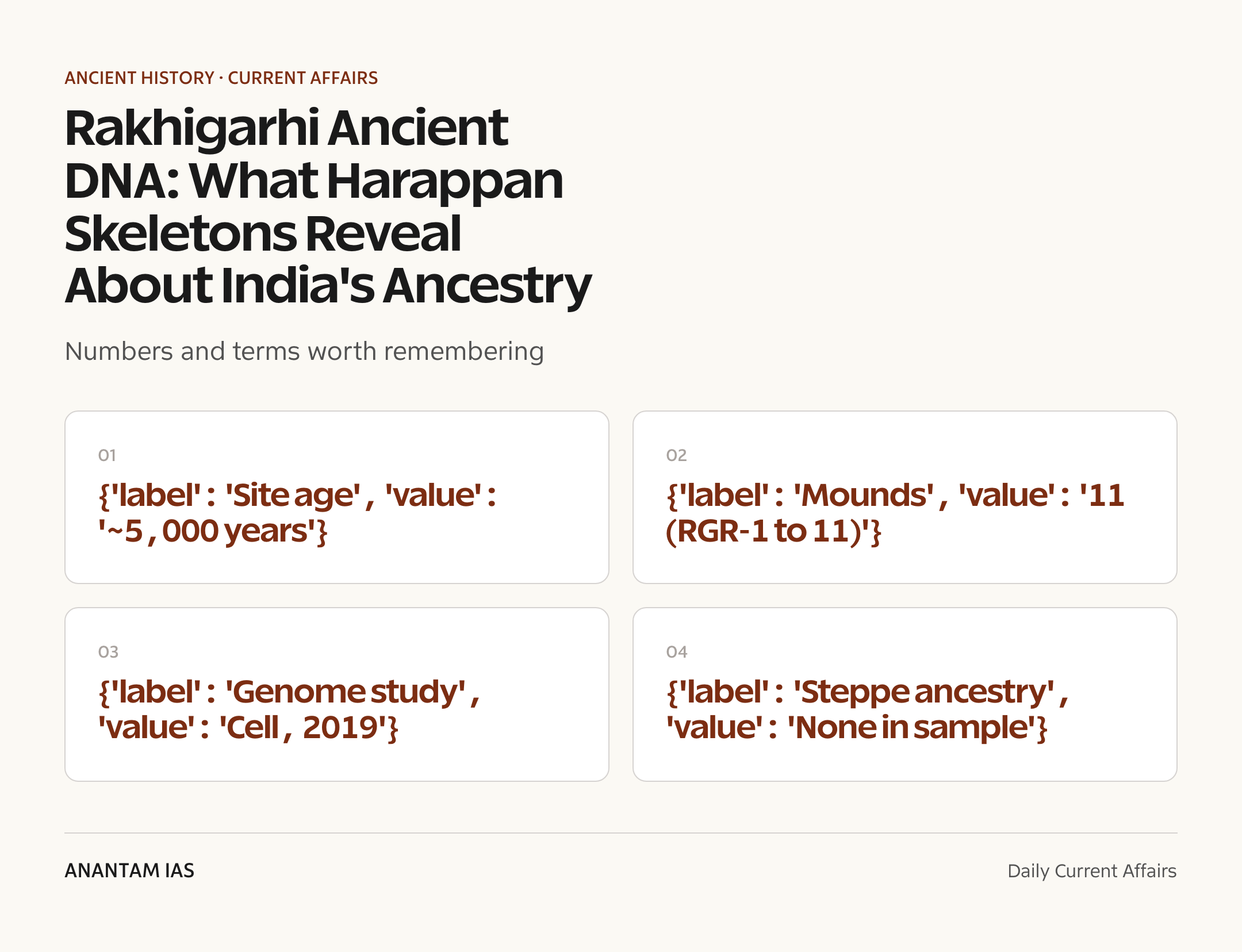
The work revives the long-running Harappan-ancestry and Aryan-migration debate. The landmark 2019 genome study of a single Rakhigarhi individual, published in the journal Cell by Vasant Shinde, David Reich and colleagues, found a mix of Iranian-related ancestry and a deep South-Asian hunter-gatherer lineage, with no Central-Asian Steppe ancestry in the Indus sample.
- Rakhigarhi is among the largest IVC sites excavated so far, with eleven mounds (labelled RGR-1 to RGR-11) on the Ghaggar plain of Haryana.
- aDNA stands for ancient DNA — genetic material extracted from skeletal remains, here primarily from the dense petrous (inner-ear) bone, which preserves DNA well.
- The 2019 Cell paper (Shinde et al.) and the companion 2019 Science paper (Narasimhan et al.) together placed the Rakhigarhi genome within a wider study of ancient South and Central Asian populations.
- The Rakhigarhi individual’s ancestry profile is described as the single largest source for present-day South Asians, linking the IVC directly to modern Indian populations.
- ASI excavations resumed at the site from 2021, and facial reconstruction of two individuals has been attempted to visualise Harappan people.
- The findings feed the peopling of India theme — a durable UPSC topic spanning prehistory, the IVC and later migrations.
The development matters in the context of:
- The IVC (c. 2600-1900 BCE for its Mature phase) was one of the world’s earliest urban civilisations, alongside Mesopotamia and Egypt; Rakhigarhi shows pre-Harappan, Early Harappan and Mature Harappan layers.
- The genome studies are based on a very small number of usable ancient samples, so conclusions are framed cautiously by the researchers themselves and remain open to revision as more data emerge.
UPSC Relevance
Prelims Relevance
- Rakhigarhi: IVC site in Hisar district, Haryana; among the largest Harappan sites; eleven mounds (RGR-1 to RGR-11).
- Located on the Ghaggar (Ghaggar-Hakra) plain, often linked in literature with the hypothesised Saraswati river.
- Excavated by ASI under Amarendra Nath (1997-2000) and by Deccan College under Vasant Shinde (2011-2016); ASI work resumed from 2021.
- Other major IVC sites: Harappa, Mohenjo-daro, Dholavira, Lothal, Kalibangan, Banawali, Ropar.
- aDNA: ancient DNA, often extracted from the petrous bone of the skull.
- Shinde et al. (Cell, 2019): single Rakhigarhi genome; Narasimhan et al. (Science, 2019): companion ancient South/Central Asia study.
- Key finding: Iranian-related ancestry + Ancient Ancestral South Indian (AASI / South-Asian hunter-gatherer); no Steppe ancestry in the IVC sample.
- The Iranian-related lineage is argued to have split before the spread of farming in the Fertile Crescent, implying farming was adopted locally or by cultural diffusion, not by mass farmer migration.
Mains Relevance
GS Paper 1
- Indus Valley Civilisation: salient features, town planning, and the value of multidisciplinary archaeology (excavation + aDNA + anthropology).
- Peopling of India and the Aryan-migration debate: how genetic evidence reshapes earlier philological and archaeological arguments.
- Use of science and technology (genomics, facial reconstruction) in reconstructing ancient Indian history, and the limits of small-sample inference.
- Heritage management: conserving and interpreting major sites like Rakhigarhi while balancing local livelihoods and tourism.
Essay
- Science as a lamp on the past: what genomes can and cannot tell us about who we are
Background and Context
Rakhigarhi: One of the Largest Harappan Sites
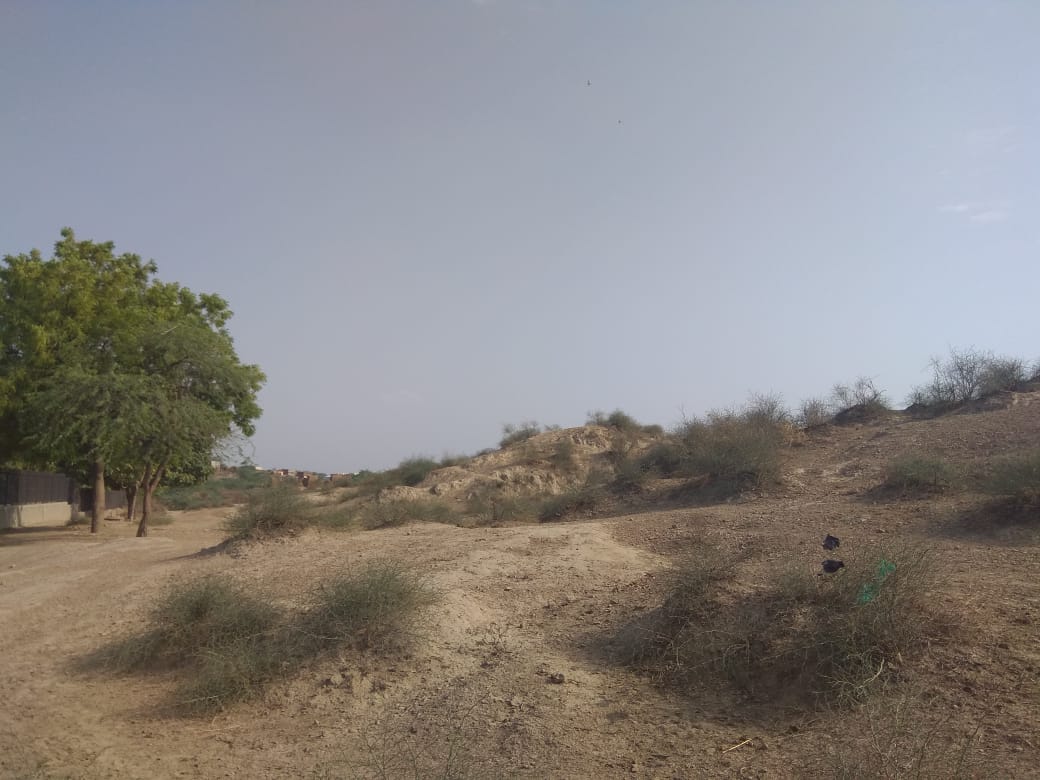
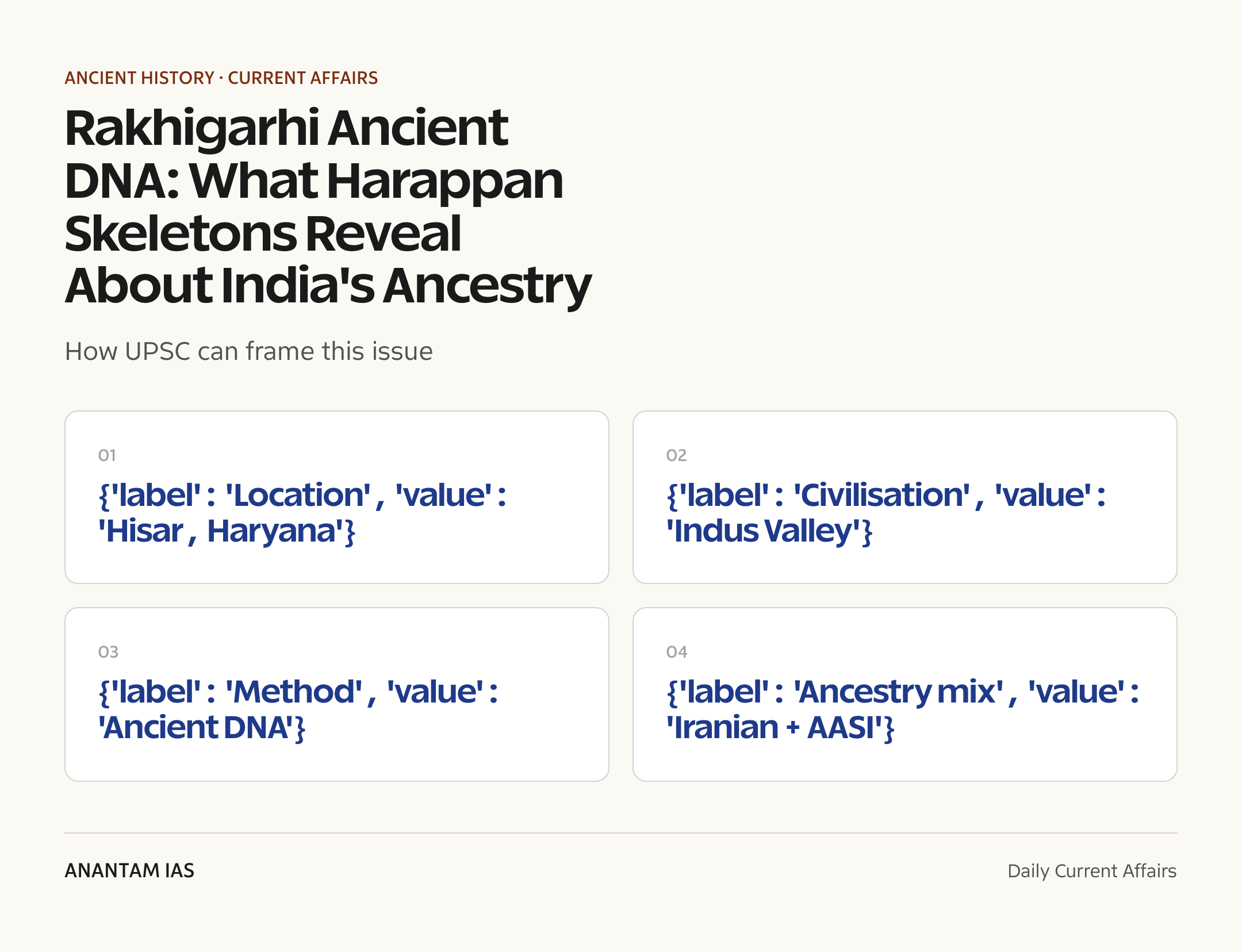
Rakhigarhi sits in Hisar district, Haryana, roughly 150 km north-west of Delhi on the Ghaggar plain, and ranks among the largest known IVC settlements.
- The site comprises eleven mounds (RGR-1 to RGR-11); estimates of its extent range widely, with some scholars putting the core at 80-100+ hectares and others claiming a much larger spread after later surveys.
- It preserves a long sequence: pre-Harappan, Early Harappan and Mature Harappan phases, making it valuable for studying the civilisation’s origins as well as its peak.
- Excavations span decades: initial digs in the 1960s, an ASI campaign under Amarendra Nath (1997-2000), Deccan College work under Vasant Shinde (2011-2016), and renewed ASI excavation from 2021.
- Finds include planned streets, drainage, kilns, seals, beads and a cemetery — and skeletal remains that became the raw material for the ancient-DNA work.
- Its setting on the Ghaggar-Hakra system is significant, as this seasonal river is often identified in the literature with the hypothesised Saraswati, placing Rakhigarhi within a major cluster of Harappan settlements east of the Indus.
What Ancient DNA Adds
Ancient DNA (aDNA) is genetic material recovered from old skeletal remains; it lets researchers read ancestry directly rather than infer it from pottery, language or skull shape.
- DNA in tropical conditions degrades fast, so usable Rakhigarhi data came mainly from the dense petrous (inner-ear) bone, after screening many samples.
- Only a very small number of individuals yielded enough authentic DNA — the headline 2019 study rests on essentially a single genome, a key caveat.
- aDNA complements traditional archaeology: it tests, rather than assumes, whether cultural change came with people moving or with ideas spreading.
- It also enables facial reconstruction, where forensic modelling on a skull produces an approximate likeness of a long-dead individual for public engagement.
- Authenticating the data is itself demanding: scientists must rule out modern contamination and degraded fragments, which is why so many samples are screened before a usable genome emerges.
The 2019 Genome Findings
The 2019 Cell paper by Shinde, Reich and colleagues, alongside the Science paper led by Narasimhan, described the genetic make-up of the Rakhigarhi individual and its wider implications.
- The Indus individual carried a mix of an Iranian-related lineage and a deep South-Asian hunter-gatherer component (often termed Ancient Ancestral South Indian, AASI).
- Crucially, the sample showed no Steppe (Central-Asian pastoralist) ancestry — the component associated in later periods with the spread of Indo-European languages.
- The Iranian-related ancestry is argued to have diverged early — before farming spread in the Fertile Crescent — suggesting agriculture in South Asia was adopted locally or by cultural transmission, not chiefly by migrating farmers.
- The researchers describe this IVC ancestry as the single largest source for present-day South Asians, tying living Indians to the Harappans.
- The companion Science study placed this single genome in a much larger sample of ancient South and Central Asians, strengthening confidence in the broad ancestry pattern while still resting on limited Indus data.
The Migration-vs-Indigenous Debate
The Rakhigarhi data sit at the centre of a contested question: did later Steppe-related populations migrate into South Asia, and how does that square with an indigenous Harappan core?
- One reading: because the IVC sample lacks Steppe ancestry while many later and modern North Indians carry some, a migration of Steppe-related groups after the IVC’s decline (roughly second millennium BCE) is inferred — a position many geneticists hold.
- An alternative public reading stresses cultural and demographic continuity from the Harappans into later India, citing the absence of Steppe ancestry in the IVC individual itself.
- The careful position: the single Indus genome shows no Steppe ancestry at that time and place; it does not by itself settle the timing, scale or direction of every later movement.
- The debate intertwines genetics with archaeology, linguistics and politics, so claims should be read as evolving science built on still-limited ancient samples.
Why It Matters for the Syllabus
Rakhigarhi is a model case of history meeting hard science, and a recurring touchpoint for the IVC and peopling-of-India themes.
- It demonstrates how genomics can refine, support or challenge older narratives based on pottery styles, skeletal measurements or language.
- It reinforces understanding of the IVC’s geography, including major sites such as Mohenjo-daro, Harappa, Dholavira, Lothal and Kalibangan.
- It illustrates the importance of institutions like the ASI and research universities in protecting and interpreting heritage.
- It models academic humility: strong claims rest on small datasets, and good answers acknowledge uncertainty rather than overstate.
Way Forward
Expand the Genetic Record
- Sequence more individuals from Rakhigarhi and other IVC sites so conclusions rest on populations, not single genomes.
- Build shared, well-documented ancient-DNA datasets with transparent methods to reduce overreach in interpretation.
Protect and Interpret the Site
- Strengthen conservation, site museums and signage at Rakhigarhi while supporting the surrounding villages and responsible tourism.
- Pair excavation with public communication that explains both the findings and their limits, keeping the science separate from polemics.
Conclusion
Rakhigarhi is where India’s deep past is being read at the level of bone and gene. The 2019 genome — an Iranian-related lineage layered over a deep South-Asian hunter-gatherer ancestry, with no Steppe component in the Indus sample — links living Indians directly to the Harappans and reframes how the IVC’s origins are understood.
For the exam, the lesson is twofold: command the durable facts about the IVC and the peopling of India, and treat the migration debate with academic balance. A single ancient genome is a powerful clue, not a final verdict, and the strongest answers respect both the evidence and its limits.
UPSC Practice Questions
Prelims MCQ 1
With reference to the Rakhigarhi archaeological site, consider the following statements: 1. It is located in the Hisar district of Haryana. 2. It is one of the largest sites of the Indus Valley Civilisation. 3. The Archaeological Survey of India is associated with its excavation. Which of the statements given above are correct?
1 and 2 only 2 and 3 only 1 and 3 only 1, 2 and 3
Answer: 1, 2 and 3
Explanation:
Rakhigarhi is in Hisar district, Haryana, ranks among the largest IVC sites, and has been excavated under the ASI (notably by Amarendra Nath, 1997-2000) and by Deccan College under Vasant Shinde, with ASI work resuming from 2021. All three statements are correct.
Prelims MCQ 2
The 2019 ancient-DNA study of the Rakhigarhi individual (Shinde et al., Cell) is best summarised by which of the following?
It found substantial Central-Asian Steppe ancestry in the Indus sample. It found a mix of Iranian-related ancestry and a deep South-Asian hunter-gatherer lineage, with no Steppe ancestry in the sample. It proved that farming reached South Asia through a mass migration of Fertile Crescent farmers. It established that the Indus people had no genetic link to present-day South Asians.
Answer: It found a mix of Iranian-related ancestry and a deep South-Asian hunter-gatherer lineage, with no Steppe ancestry in the sample.
Explanation:
The study reported an Iranian-related lineage combined with an Ancient Ancestral South Indian (South-Asian hunter-gatherer) component and no Steppe ancestry in the Indus individual. It also argued the Iranian-related lineage split before farming spread in the Fertile Crescent, implying local adoption or cultural transmission of agriculture, and described this ancestry as a major source for modern South Asians.
UPSC Mains Questions
- The Rakhigarhi ancient-DNA findings have reshaped the debate on the peopling of India. Examine how genetic evidence complements traditional archaeology, and discuss why such conclusions must be read with academic caution. (250 words)
- Discuss the salient features of the Indus Valley Civilisation with reference to a major site such as Rakhigarhi. How does multidisciplinary research enrich our understanding of early urbanism in the subcontinent? (250 words)
- What does the absence of Steppe ancestry in the Indus genome imply for the Aryan-migration debate? Present a balanced view. (150 words)
Sources: The Indian Express and Cell (Shinde et al., 2019).
Frequently Asked Questions
Where is Rakhigarhi located?
Rakhigarhi is in the Hisar district of Haryana, on the Ghaggar plain about 150 km north-west of Delhi. It is one of the largest sites of the Indus Valley Civilisation, with eleven mounds labelled RGR-1 to RGR-11.
What did the 2019 Rakhigarhi DNA study find?
The study (Shinde et al., published in Cell) found that the Rakhigarhi individual carried a mix of an Iranian-related lineage and a deep South-Asian hunter-gatherer component, with no Central-Asian Steppe ancestry in the Indus sample. It described this ancestry as a major source for present-day South Asians.
What is ancient DNA (aDNA)?
Ancient DNA is genetic material recovered from old skeletal remains. At Rakhigarhi, usable DNA came mainly from the dense petrous (inner-ear) bone, which preserves DNA better than most bones in hot climates.
Does the study settle the Aryan-migration debate?
Not on its own. The single Indus genome shows no Steppe ancestry at that time and place, which many researchers read as evidence that Steppe-related groups arrived after the IVC’s decline. Because the conclusion rests on very few samples, it should be treated as evolving science rather than a final verdict.
Who excavated Rakhigarhi?
The Archaeological Survey of India excavated under Amarendra Nath (1997-2000), and Deccan College excavated under Vasant Shinde (2011-2016). ASI work resumed at the site from 2021.
What is facial reconstruction in this context?
It is a forensic technique that builds an approximate likeness of a person from their skull. Researchers attempted reconstructions of Rakhigarhi individuals to help visualise Harappan people, though such models are interpretive rather than exact portraits.