MTP Access for Rape Survivors: When Court Approval Is Not Required
Why in News?
The Hindu reported the Madhya Pradesh High Court’s clarification that a survivor of sexual assault, rape or incest does not need a High Court order to obtain a lawful medical termination of pregnancy when the gestation is within 24 weeks.
- A Division Bench of the Madhya Pradesh High Court had settled divergent directions in In Reference (Suo Motu) v. State of Madhya Pradesh, decided on 20 February 2025.
- The Bench held that up to 20 weeks, one registered medical practitioner may form the required good-faith opinion; from over 20 weeks to 24 weeks, two registered medical practitioners are required for women covered by the.
- Rule 3B of the Medical Termination of Pregnancy Rules includes survivors of sexual assault, rape or incest among those eligible for the 20-to-24-week window.
- In July 2026, the High Court again questioned why officials were seeking judicial permission in a case involving a minor survivor whose pregnancy was below 24 weeks, and asked State health authorities to prevent repeated, unnecessary.
- The legal point is not that every requested termination is automatic. The required practitioner opinion, consent, approved facility and other safeguards under the Act and Rules still apply.
- Abortion access in India is structured through a medical-opinion model, not an unrestricted request model. Courts should not be converted into a routine approval layer that Parliament did not prescribe.
- For a survivor, delay can deepen trauma, raise medical complexity and push the pregnancy beyond a statutory threshold. Administrative hesitation can operate like a denial even without a written refusal.
- The subject joins constitutional values under Articles 14 and 21 with public-health capacity, survivor-centred criminal justice and the practical accountability of hospitals, police and district authorities.
UPSC Relevance
Prelims Relevance
- The Medical Termination of Pregnancy Act, 1971 is the central statute governing lawful termination by registered medical practitioners.
- The Medical Termination of Pregnancy (Amendment) Act, 2021 revised the gestational framework and added an express privacy protection in Section 5A.
- Under Section 3(2)(a), a pregnancy not exceeding 20 weeks may be terminated on the good-faith opinion of one registered medical practitioner when a statutory ground is satisfied.
- Under Section 3(2)(b), a pregnancy exceeding 20 weeks but not exceeding 24 weeks requires the good-faith opinion of at least two registered medical practitioners and applies to categories prescribed by rules.
- Rule 3B includes survivors of sexual assault, rape or incest, minors, specified changes in marital status, women with specified disabilities, specified foetal malformations and women in declared humanitarian or emergency settings.
- When pregnancy is alleged to have resulted from rape, the Act presumes the resulting anguish to constitute grave injury to mental health for the relevant statutory assessment.
Mains Relevance
GS Paper 2
- Examine reproductive choice as part of personal liberty, privacy, dignity and bodily autonomy under Article 21.
- Assess how a needless judicial-permission practice creates a gap between statutory rights and access to public services.
GS Paper 2: Social Justice
- Connect survivor-centred healthcare with gender justice, child protection, legal aid, privacy and trauma-informed administration.
- Evaluate barriers such as delayed detection, provider shortages, unclear referral chains, fear of liability and weak awareness of the amended law.
Essay
- A right measured in weeks can be defeated by a system that measures action in files and referrals.
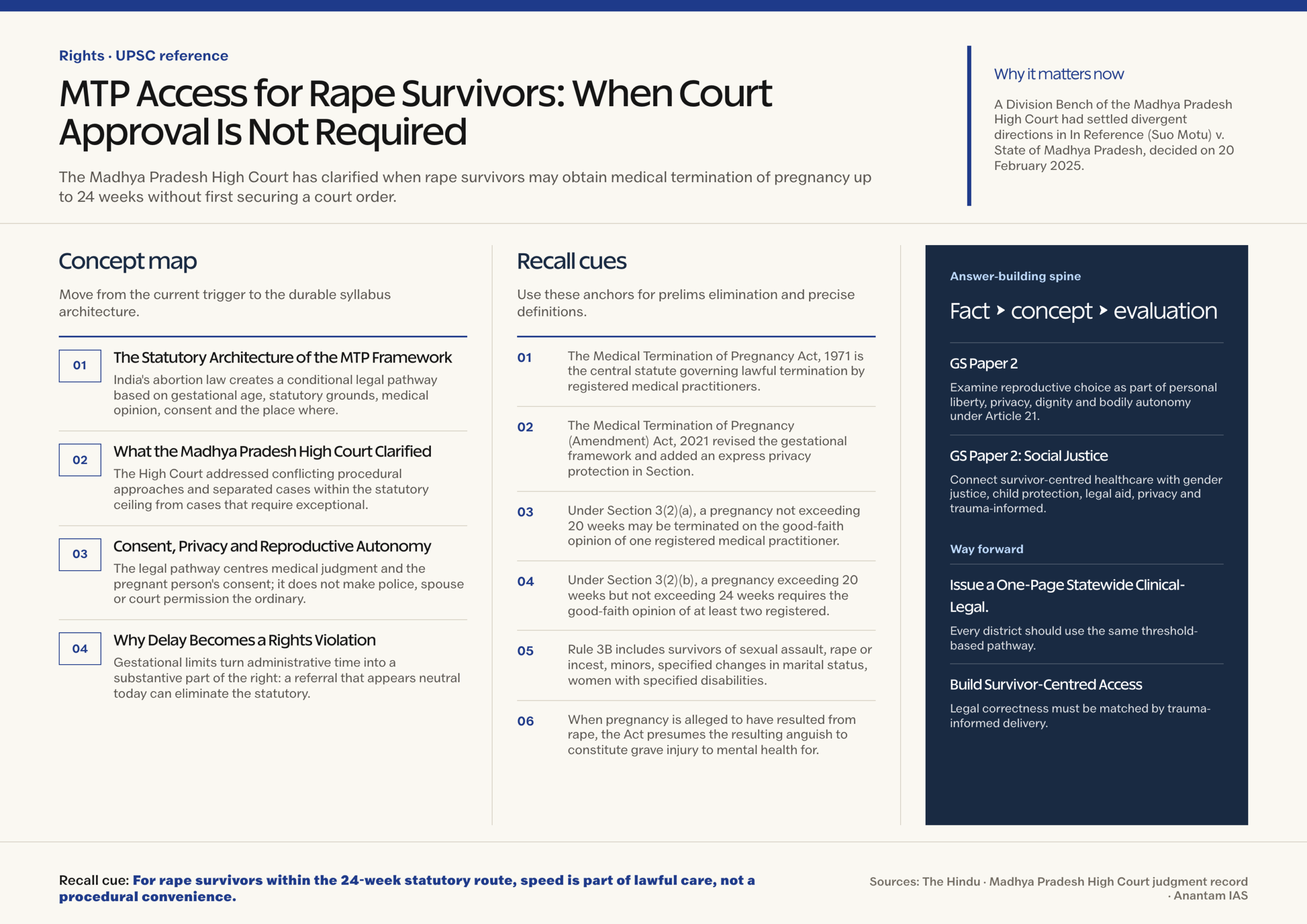
Background and Context
The Statutory Architecture of the MTP Framework
India’s abortion law creates a conditional legal pathway based on gestational age, statutory grounds, medical opinion, consent and the place where the procedure is performed.
- Section 3 protects a registered medical practitioner from criminal liability when a termination is performed in accordance with the Act. It is an enabling and protective provision, but only within its stated conditions.
- Up to 20 weeks, one practitioner must form a good-faith opinion that continuation risks the woman’s life, causes grave injury to physical or mental health, or that the child, if born, would face a substantial risk.
- From over 20 weeks through 24 weeks, the same core grounds apply, but at least two practitioners must form the opinion and the woman must fall within a category prescribed by Rule 3B.
- The rape-related presumption matters because the statute directs the medical assessment to treat anguish from a pregnancy alleged to have been caused by rape as grave injury to mental health. The survivor is not required to.
- Section 4 also limits where termination may be performed, including government hospitals and places approved for the purpose. The absence of a court-order requirement does not remove clinical safety or facility requirements.
What the Madhya Pradesh High Court Clarified
The High Court addressed conflicting procedural approaches and separated cases within the statutory ceiling from cases that require exceptional judicial consideration.
- In its 20 February 2025 suo motu decision, the Division Bench said survivors of sexual assault, rape or incest may obtain termination up to 20 weeks through one registered medical practitioner and from over 20 weeks.
- The Bench expressly said such within-limit cases do not require recourse to the High Court under Article 226. This prevents an extra approval barrier from being added by administrative practice.
- The Court framed standard operating procedures for cases up to 24 weeks and for cases exceeding 24 weeks. For the first category, the medical officer or board was expected to examine the survivor expeditiously and, where.
- For pregnancies beyond 24 weeks arising from sexual assault, the Court contemplated a medical report followed by reference to the High Court. Such cases sit outside the ordinary Rule 3B route unless another statutory exception, such.
- The Court also directed post-operative care and preservation of foetal material for DNA examination where relevant to the criminal case. This shows that healthcare access and evidence preservation can proceed together rather than one being used.
Consent, Privacy and Reproductive Autonomy
The legal pathway centres medical judgment and the pregnant person’s consent; it does not make police, spouse or court permission the ordinary source of authority.
- For an adult with decision-making capacity, her own consent is required. The law does not prescribe spousal consent as a condition for termination.
- For a person below 18 years, the guardian-consent rule applies. Child survivors also require a coordinated response under the POCSO framework, but emergency medical care should not be held back for want of legal or magisterial.
- Section 5A provides a specific confidentiality safeguard by prohibiting a registered medical practitioner from revealing identifying particulars except to a person authorised by law. Breach can attract imprisonment up to one year, a fine, or both.
- In X v. Principal Secretary, Health and Family Welfare Department (2022), the Supreme Court read the MTP framework in a purposive, rights-based way, rejected an artificial married-unmarried distinction for access under Rule 3B and linked reproductive.
- Privacy is operational, not symbolic. Hospitals need restricted records, discreet counselling, protected communication and clear rules on who may receive information. A survivor should not be made to repeat intimate facts across avoidable desks and hearings.
Why Delay Becomes a Rights Violation
Gestational limits turn administrative time into a substantive part of the right: a referral that appears neutral today can eliminate the statutory option days later.
- Sexual-assault survivors may discover pregnancy late because of trauma, fear, isolation, young age, irregular cycles or lack of access to confidential care. The system must respond to that vulnerability rather than add sequential permissions.
- Unclear responsibility encourages risk-shifting: police refer to district courts, courts seek medical reports, hospitals wait for orders and the survivor bears the delay. A written protocol should identify who examines, decides, records consent and arranges.
- Delay can increase clinical complexity, travel costs, exposure of identity and emotional distress. It can also move a case from the ordinary two-practitioner route into a legally and medically harder beyond-24-week category.
- A court order obtained after avoidable delay does not cure the institutional failure that caused the delay. Accountability should examine referral timestamps, reasons for refusal, availability of qualified staff and whether a higher facility was contacted.
- The correct administrative lesson is not to eliminate medical scrutiny. It is to make the scrutiny fast, competent and lawful, with escalation used only when the statute or the clinical situation calls for it.
Way Forward
Issue a One-Page Statewide Clinical-Legal Protocol
- State health departments should circulate the Section 3, Rule 3B, Section 5 and consent requirements in a simple flow that clearly states when court approval is not required.
- The protocol should name 24-hour nodal officers and referral hospitals, specify maximum response times and require reasons for any refusal or transfer.
- Provide private counselling, interpreters where needed, safe transport, post-procedure care, mental-health support and a single point of contact so the survivor does not repeatedly narrate the assault.
- Keep consent informed and voluntary. Explain the procedure, risks, alternatives and likely timelines in accessible language without moral judgment.
Conclusion
- The Madhya Pradesh High Court’s central message is administratively simple: where the MTP Act and Rules authorise qualified medical practitioners to decide, a hospital cannot invent a routine court-permission requirement.
- A balanced policy protects autonomy, safety and accountability together.
UPSC Practice Questions
Prelims MCQ 1
With reference to the Medical Termination of Pregnancy framework in India, consider the following statements:
- A pregnancy exceeding 20 weeks but not exceeding 24 weeks may require the opinion of at least two registered medical practitioners for prescribed categories of women.
- Rule 3B includes survivors of sexual assault, rape or incest among the categories eligible for termination up to 24 weeks.
- Every termination sought by a rape survivor within 24 weeks requires prior permission from the High Court.
How many of the above statements are correct?
(a) Only one (b) Only two (c) All three (d) None
Answer: (b) Only two
Explanation:
Statements 1 and 2 reflect Section 3(2)(b) and Rule 3B. Statement 3 is incorrect: when the statutory conditions are satisfied, prior High Court permission is not an additional requirement for the within-24-week route.
Prelims MCQ 2
Which provision of the Medical Termination of Pregnancy Act specifically protects the identity and particulars of a woman whose pregnancy has been terminated?
(a) Section 3(2B) (b) Section 4 (c) Section 5A (d) Section 8
Answer: (c) Section 5A
Explanation:
Section 5A restricts a registered medical practitioner from revealing the woman’s name and other particulars except to a person authorised by law, and provides a penalty for contravention.
UPSC Mains Questions
- Administrative delay can convert a legally available medical service into a denial of reproductive autonomy. Discuss with reference to the MTP framework and the Madhya Pradesh High Court’s directions.
- Explain the legal pathways for termination of pregnancy up to 20 weeks, from over 20 to 24 weeks, and beyond 24 weeks. Why must medical safeguards not be confused with a universal requirement of judicial permission?
Sources: The Hindu and Madhya Pradesh High Court judgment record.
Frequently Asked Questions
Do rape survivors need court permission for MTP up to 24 weeks?
No prior High Court order is ordinarily required when the pregnancy is within 24 weeks and the case satisfies the MTP Act and Rules. Up to 20 weeks, one registered medical practitioner forms the required opinion; from over 20 to.
Does the 24-week rule mean termination is automatic?
No. The appropriate registered medical practitioner or practitioners must form the statutory good-faith opinion, valid consent must be obtained, and the procedure must occur at a lawful facility. The court’s clarification removes an extra judicial-permission barrier; it does not remove.
Why are rape survivors covered under Rule 3B?
Rule 3B expressly lists survivors of sexual assault, rape or incest among the categories eligible for the over-20-to-24-week pathway. The Act also presumes that anguish caused by a pregnancy alleged to result from rape constitutes grave injury to the pregnant.
Whose consent is required for termination?
An adult pregnant woman’s consent is central, and spousal consent is not prescribed. When the pregnant person is below 18 years, or falls within the Act’s specified category concerning mental illness, written guardian consent is required. Counselling should inform the.
What happens when pregnancy exceeds 24 weeks?
The ordinary Rule 3B pathway no longer applies. The Act permits a Medical Board route for qualifying substantial foetal abnormalities and contains a separate life-saving exception. Constitutional courts have also considered exceptional petitions, including sexual-assault cases, using medical evidence and.