Rare dragonfly resurfaces in Arunachal after 110 years
Why in News?
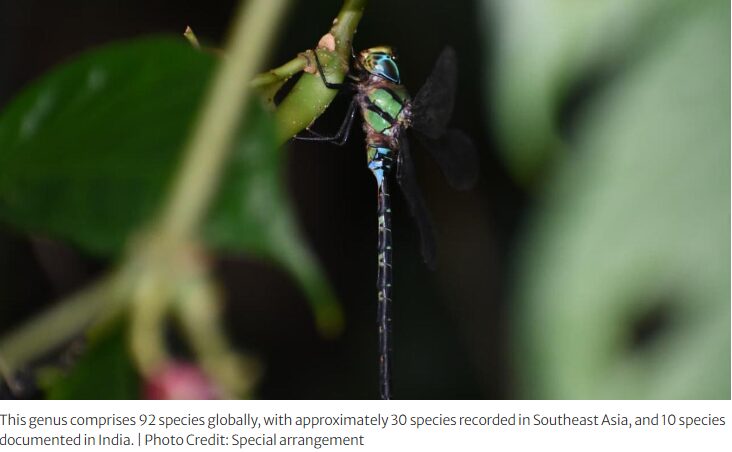
A rare dragonfly species, Gynacantha khasiaca, has been rediscovered in Arunachal Pradesh’s Changlang district after more than 110 years. The species was recorded from Namdapha National Park and Tiger Reserve by a group of citizen scientists, highlighting the ecological importance of India’s northeastern biodiversity hotspots and the need for sustained habitat conservation.

UPSC Relevance
Prelims: Odonata, dragonflies and damselflies, Namdapha National Park, biodiversity hotspots, citizen science, Eastern Himalayas.
Mains:
GS III – Biodiversity conservation, ecosystem monitoring, protected areas, citizen participation in conservation, environmental governance.
Background/Context
The long-tailed duskhawker was last scientifically recorded in 1914 from the erstwhile Abor Hills region. Its rediscovery after more than a century has attracted scientific attention because species once believed to be extremely rare or locally extinct may continue to survive in relatively undisturbed ecosystems.
The rediscovery was documented through a study published in the Journal of Threatened Taxa by a group of citizen scientists from different parts of India.
The observation was made at Deban within the Namdapha landscape in October 2024, where the dragonfly was seen patrolling and defending its territory along the Miao–Vijoynagar Road.
About the Long-tailed Duskhawker
Gynacantha khasiaca belongs to the genus Gynacantha, a group of large dragonflies known for their pale brown-green colouration and crepuscular behaviour, meaning they are most active during dawn and dusk.
One of the remarkable features of dragonflies is their highly advanced visual system. Their compound eyes contain thousands of tiny lenses and photoreceptor units, enabling near-360° vision and highly efficient detection of movement. They are also capable of hovering almost motionlessly in the air, making them effective aerial predators.
The species has earlier been recorded from:
- Assam
- Meghalaya
- Uttarakhand
- Maharashtra
- West Bengal
Outside India, sightings have been reported from Bangladesh, Myanmar and Nepal.
Dragonflies and the Order Odonata
Dragonflies and damselflies belong to the order Odonata.
These insects play a crucial ecological role in freshwater ecosystems because they function both as predators and prey within aquatic food chains.
Ecological importance
- Dragonfly larvae help regulate mosquito populations and other aquatic insects.
- Adult dragonflies act as predators of small flying insects.
- They serve as bioindicators of freshwater ecosystem health because many species are highly sensitive to pollution and habitat degradation.
Globally, the order Odonata includes more than 6,400 species across nearly 700 genera. India hosts: 504 species, 27 subspecies, 152 genera, 18 families
Arunachal Pradesh alone supports around 110 species, reflecting the ecological richness of the Eastern Himalayan region.
What is the Importance of Namdapha National Park?
Namdapha National Park and Tiger Reserve is one of India’s largest protected areas and forms part of the Eastern Himalayan biodiversity hotspot.
Ecological significance
The park contains diverse ecosystems ranging from tropical rainforests to temperate forests and alpine vegetation. Such ecological variation supports rich faunal diversity, including: Tigers, Clouded leopards, Red pandas, Hoolock gibbons, Numerous bird and insect species
The rediscovery of rare insect species further reinforces the park’s importance as a refuge for poorly documented and endemic biodiversity.
Role of Citizen Science in Conservation
The rediscovery was made by citizen scientists rather than a formal government-led survey. This highlights the growing role of citizen science in biodiversity documentation and environmental monitoring.
Citizen science contributes through:
- Wider geographical observation networks
- Faster biodiversity reporting
- Public participation in conservation
- Supplementing scientific research efforts
Such collaborations are increasingly important in documenting lesser-known species such as insects, amphibians and reptiles.
Why Rediscoveries Matter in Conservation
Rediscovery of rare species has broader ecological significance.
Indicator of habitat quality
The survival of sensitive species often indicates that habitats remain relatively undisturbed and ecologically functional.
Strengthening conservation priorities
Rediscoveries can help prioritise habitat protection and scientific monitoring in ecologically fragile areas.
Expanding scientific knowledge
Many insect groups in India remain poorly studied. Rediscoveries help improve understanding of species distribution, ecology and evolutionary diversity.
Importance for climate change studies
Changes in species distribution patterns may provide insights into ecological responses to climate change and habitat alteration.
Challenges in Insect Conservation
Limited scientific documentation
Insects receive comparatively less conservation attention than large mammals despite their ecological importance.
Habitat degradation
Deforestation, infrastructure development and pollution threaten freshwater and forest ecosystems supporting dragonflies.
Climate change
Temperature changes and altered rainfall patterns may affect breeding habitats and species distribution.
Data deficiency
Many insect species remain under-documented, making conservation planning difficult.
Way Forward
Strengthen biodiversity surveys
Systematic surveys and long-term ecological monitoring should be expanded, especially in biodiversity-rich northeastern States.
Promote citizen science initiatives
Local communities, students and amateur naturalists can be integrated into biodiversity documentation programmes.
Protect freshwater ecosystems
Conservation of streams, wetlands and forest water systems is essential for sustaining Odonata diversity.
Improve taxonomic research
India needs greater investment in taxonomy, entomology and ecological research to address knowledge gaps regarding insect biodiversity.
Conclusion
The rediscovery of the long-tailed duskhawker after more than a century is not merely a scientific curiosity; it highlights the extraordinary biodiversity richness of northeastern India and the importance of sustained conservation efforts. At a time when insect populations globally are facing ecological pressures, such rediscoveries underline the need to strengthen habitat protection, biodiversity monitoring and public participation in conservation science.
Practice Questions
Prelims Question 1 (Inference-based)
Consider the following statements with reference to dragonflies and biodiversity conservation:
I. Dragonflies are considered important indicators of freshwater ecosystem health because many species are sensitive to habitat disturbance and pollution.
II. Rediscovery of rare insect species in protected areas may indicate the continued ecological integrity of such habitats.
III. Citizen science initiatives can contribute significantly to biodiversity monitoring and species documentation.
Which of the following relationships among the above statements is/are correct?
- Statement II extends the ecological implication of Statement I by linking species survival to habitat quality.
- Statement III supports the practical application of biodiversity monitoring implied in Statements I and II.
- Statement I contradicts Statement III because biodiversity assessment requires only formal institutional research.
(a) 1 only
(b) 1 and 2
(c) 2 and 3
(d) 3 only
Answer: (b)
Explanation: Statement II logically extends Statement I by connecting sensitive species survival with ecosystem integrity. Statement III further supports how biodiversity monitoring and rediscovery efforts can be strengthened through citizen participation. Statement 3 is incorrect because citizen science complements formal scientific research.
Prelims Question 2
Consider the following pairs:
| Item | Associated significance |
|---|---|
| 1. Odonata | Order comprising dragonflies and damselflies |
| 2. Namdapha National Park | Part of the Eastern Himalayan biodiversity hotspot |
| 3. Gynacantha khasiaca | Endemic mammal species of Arunachal Pradesh |
Which of the pairs given above are correctly matched?
(a) 1 and 2 only
(b) 2 and 3 only
(c) 1 and 3 only
(d) 1, 2 and 3
Answer: (a)
Explanation: Pair 3 is incorrect because Gynacantha khasiaca is a dragonfly species and not a mammal.
Mains Questions
- Discuss the ecological significance of insects as bioindicators with reference to dragonflies and freshwater ecosystems.
- Examine the role of citizen science in biodiversity conservation and ecological monitoring in India.