Rare-Earth Permanent Magnet Scheme Draws 20 Bids
Why in News?
The Ministry of Heavy Industries reported that its global tender under the Scheme to Promote Manufacturing of Sintered Rare Earth Permanent Magnets received 20 bids for projects intended to create integrated domestic manufacturing capacity.
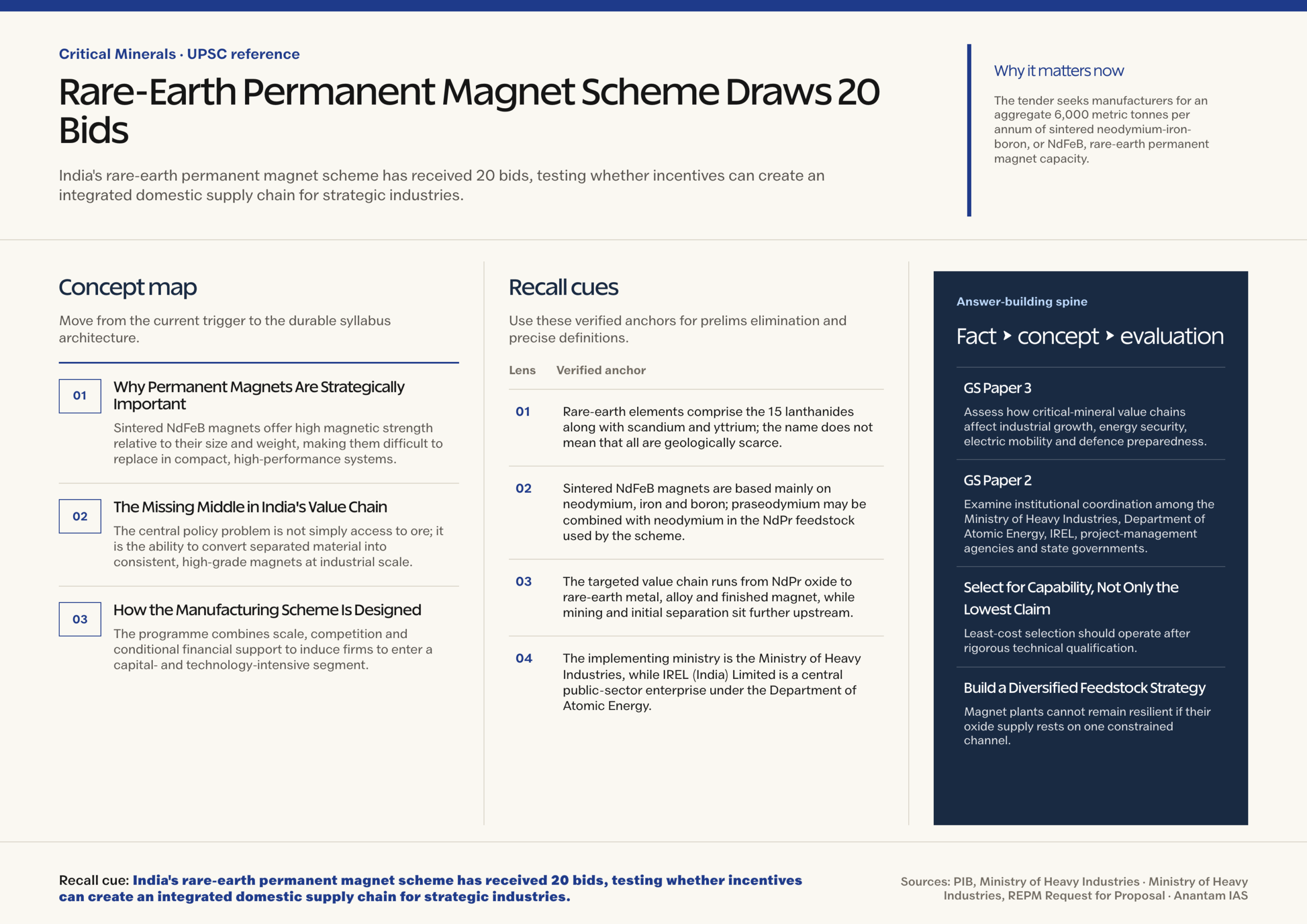
- The tender seeks manufacturers for an aggregate 6,000 metric tonnes per annum of sintered neodymium-iron-boron, or NdFeB, rare-earth permanent magnet capacity.
- The scheme permits a maximum of five beneficiaries; each selected project may receive an allocation from 600 MTPA to 1,200 MTPA in multiples of 100 MTPA.
- Selection follows a Least Cost System with technical and financial bid envelopes, so receipt of 20 bids begins evaluation rather than completing beneficiary selection.
- The Union Cabinet approved the scheme on 26 November 2025, and the Ministry notified it on 15 December 2025 before issuing the RFP on 20 March 2026.
- The approved scheme has a stated outlay of ₹7,280 crore, including sales-linked incentives and capital subsidy for qualifying integrated facilities.
- Permanent magnets are small components with system-wide importance: a supply interruption can affect traction motors, generators, sensors and precision equipment across several strategic sectors.
- India has capabilities in mining, separation and oxide refining, but the official RFP identifies a missing industrial chain for oxide-to-metal, metal-to-alloy and alloy-to-magnet conversion.
- The scheme is an example of mission-oriented industrial policy: public support is tied to building a new technological capability rather than merely importing finished components.
UPSC Relevance
Prelims Relevance
- Rare-earth elements comprise the 15 lanthanides along with scandium and yttrium; the name does not mean that all are geologically scarce.
- Sintered NdFeB magnets are based mainly on neodymium, iron and boron; praseodymium may be combined with neodymium in the NdPr feedstock used by the scheme.
- The targeted value chain runs from NdPr oxide to rare-earth metal, alloy and finished magnet, while mining and initial separation sit further upstream.
- The implementing ministry is the Ministry of Heavy Industries, while IREL (India) Limited is a central public-sector enterprise under the Department of Atomic Energy.
- The scheme targets 6,000 MTPA of aggregate integrated manufacturing capacity through no more than five beneficiaries.
- An individual beneficiary may be allocated 600-1,200 MTPA, in multiples of 100 MTPA.
Mains Relevance
GS Paper 3
- Assess how critical-mineral value chains affect industrial growth, energy security, electric mobility and defence preparedness.
- Evaluate the strengths and limits of combining capital subsidy with sales-linked incentives to establish technologically complex manufacturing.
GS Paper 2
- Examine institutional coordination among the Ministry of Heavy Industries, Department of Atomic Energy, IREL, project-management agencies and state governments.
- Discuss how transparent tender design, milestone verification and disclosure can improve accountability in large industrial incentive programmes.
Essay
- Strategic autonomy is a value-chain capability, not simply possession of raw materials.
Background and Context
Why Permanent Magnets Are Strategically Important
Sintered NdFeB magnets offer high magnetic strength relative to their size and weight, making them difficult to replace in compact, high-performance systems.
- In electric and hybrid vehicles, permanent magnets are commonly used in high-torque traction motors; their compactness and efficiency help improve vehicle performance.
- In renewable energy, they can be used in wind-turbine generators, while electronics, robotics, precision sensors, aerospace systems and defence platforms create additional demand.
- A magnet may form a small share of a final product’s value, yet its absence can interrupt an entire assembly line. This makes it a classic critical input whose strategic importance exceeds its physical size.
- Substitution is application-specific. Ferrite magnets or rare-earth-free motor designs may reduce exposure in some products, but performance, size, efficiency, redesign time and cost can constrain rapid replacement.
The Missing Middle in India's Value Chain
The central policy problem is not simply access to ore; it is the ability to convert separated material into consistent, high-grade magnets at industrial scale.
- The official RFP divides the chain into upstream mining and refining of rare-earth ores into high-purity oxides, followed by midstream conversion of oxide to metal, metal to alloy and alloy to magnet.
- IREL has upstream experience in mining and separating rare-earth-bearing mineral sands and refining oxides, but the RFP records a gap in industrial-scale midstream capacity for sintered NdFeB magnets.
- Magnet production requires controlled metallurgy, powder preparation, alignment, pressing, sintering, machining, coating and testing. Process know-how and quality assurance are as important as raw-material availability.
- The policy objective is consequently an integrated facility that starts from NdPr oxide and performs the intermediate stages in-house, instead of a finishing operation dependent on imported alloy or magnet blocks.
How the Manufacturing Scheme Is Designed
The programme combines scale, competition and conditional financial support to induce firms to enter a capital- and technology-intensive segment.
- The scheme’s aggregate target is 6,000 MTPA. A beneficiary must establish at least 600 MTPA and may receive up to 1,200 MTPA, limiting excessive concentration while preserving industrial scale.
- The RFP envisages no more than five selected beneficiaries. Twenty bids indicate competition for a smaller number of awards, subject to responsiveness and technical qualification.
- The stated ₹7,280-crore outlay includes a pool of sales-linked incentives for five years and capital support for new facilities. Incentive payments remain subject to RFP conditions and ceilings.
- Capital subsidy equals 15% of eligible investment and is reimbursed after commissioning of the entire allocated capacity and issue of a Completion Certificate. Capacity-linked caps range from ₹75 crore for 600 MTPA to ₹150 crore for 1,100 or 1,200 MTPA.
- Sales support depends on actual eligible magnet sales and is capped under the RFP. Linking support to output reduces upfront fiscal exposure, though monitoring sales, quality and related-party transactions remains important.
What the 20 Bids Do and Do Not Show
Bidder interest is a useful market signal, but it should not be confused with completed factories or proven supply-chain resilience.
- The bid count suggests that policy support has attracted firms or consortia willing to compete. It may improve price discovery under the Least Cost System and give the government alternatives during selection.
- A bid must still pass checks relating to eligibility, technical capability, financing, project design and compliance. The technically qualified field, not the headline bid count alone, will reveal the depth of credible capacity.
- Letters of Intent and Award will be followed by land, permits, equipment procurement, technology absorption, construction, trials and certification. Execution risk remains after selection.
- UPSC answers should separate four stages: interest, award, commissioning and commercial output. Only verified production and sales demonstrate that the industrial-policy objective is being realised.
Way Forward
Select for Capability, Not Only the Lowest Claim
- Test bidders’ technology access, financial closure, qualified teams, integrated-process plans, feedstock contracts, environmental compliance and realistic commissioning schedules.
- Publish clear reasons for selection within procurement rules and disclose beneficiary capacity, milestones and incentive ceilings to strengthen public accountability.
- Expand responsible domestic separation and refining, establish transparent IREL allocation rules, support magnet and motor recycling, and secure long-term supplies through multiple overseas partners.
- Maintain traceability and environmental standards so supply security does not shift ecological and social costs to mining and processing communities.
Conclusion
- Twenty bids give India’s rare-earth permanent magnet programme a competitive starting point.
- The scheme should be judged by verified capability across the value chain , responsible feedstock, technology learning and durable commercial production.
UPSC Practice Questions
Prelims MCQ 1
With reference to India’s Scheme to Promote Manufacturing of Sintered Rare Earth Permanent Magnets, consider the following statements:
- It targets an aggregate integrated manufacturing capacity of 6,000 MTPA.
- It is implemented by the Ministry of Mines.
- An individual beneficiary may be allocated between 600 MTPA and 1,200 MTPA.
How many of the above statements are correct?
(a) Only one (b) Only two (c) All three (d) None
Answer: (b) Only two
Explanation:
Statements 1 and 3 are correct. The scheme targets 6,000 MTPA in aggregate, with 600-1,200 MTPA per beneficiary. The implementing ministry is the Ministry of Heavy Industries, not the Ministry of Mines.
Prelims MCQ 2
Which one of the following best describes the integrated manufacturing chain targeted by the scheme?
(a) Lithium brine to battery-grade lithium carbonate (b) Iron ore to electrical steel laminations (c) NdPr oxide to metal, alloy and finished sintered NdFeB magnet (d) Silica sand to photovoltaic wafers
Answer: (c) NdPr oxide to metal, alloy and finished sintered NdFeB magnet
Explanation:
The RFP targets integrated domestic conversion from NdPr oxide through metal and alloy stages to finished sintered NdFeB rare-earth permanent magnets.
UPSC Mains Questions
- India’s critical-mineral security depends as much on midstream manufacturing capability as on access to mineral resources. Discuss with reference to rare-earth permanent magnets. (250 words)
- Evaluate the design of India’s scheme for sintered rare-earth permanent magnets. How can the government convert strong bidder interest into a competitive and resilient domestic ecosystem? (250 words)
Sources: PIB, Ministry of Heavy Industries and Ministry of Heavy Industries, REPM Request for Proposal.
Frequently Asked Questions
What are rare-earth permanent magnets?
Rare-earth permanent magnets are high-strength magnets made from alloys containing rare-earth elements. The scheme focuses on sintered NdFeB magnets, based mainly on neodymium, iron and boron. Their high strength-to-weight performance supports compact motors, generators, sensors, electronics, aerospace equipment and defence.
Why has India’s rare-earth magnet scheme received attention?
The Ministry of Heavy Industries reported 20 bids for a programme that can select no more than five beneficiaries. This indicates industry interest and may strengthen competition, but every bid must still pass technical and financial evaluation before projects are.
What capacity does the scheme aim to create?
The target is 6,000 metric tonnes per annum of integrated sintered NdFeB magnet capacity. Each selected beneficiary may receive an allocation between 600 and 1,200 MTPA, in multiples of 100 MTPA, with a maximum of five beneficiaries under the RFP.
What does integrated manufacturing mean in this scheme?
It means performing the intermediate conversion stages within India, beginning with NdPr oxide and moving through rare-earth metal and alloy to a finished sintered NdFeB magnet. The objective is to close the midstream capability gap rather than merely assemble or.
Why are rare-earth magnets important for clean energy?
High-performance permanent magnets are widely used in electric-vehicle traction motors and some wind-turbine generators because they provide strong magnetic performance in compact systems. Securing their supply can support electrification and renewable manufacturing, though recycling, alternative motor designs and responsible sourcing.