RBI Bank Shareholding Rules: One-Time Approval for Repeat Acquisitions
Why in News?
On 1 October 2026, the RBI issued immediately effective final directions allowing eligible institutional investors to seek one-time approval for subsequent acquisitions of major shareholding in the same banking company.
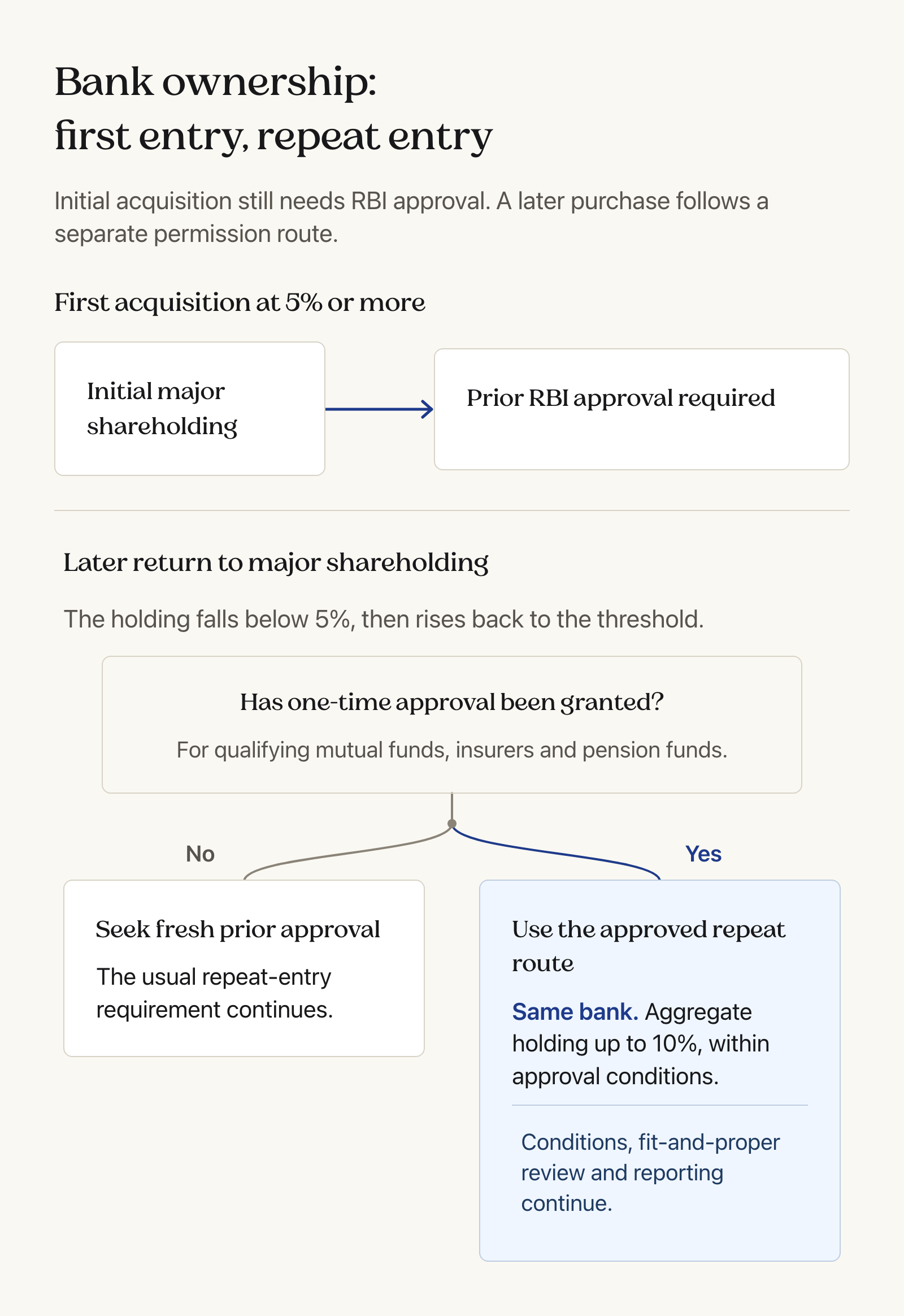
- Initial acquisition still requires prior RBI approval; the change concerns later acquisitions by eligible investors.
- The repeat-acquisition route covers aggregate holdings up to 10%, subject to approval conditions.
- Crossings of the major-shareholding threshold must be reported within three working days.
- Bank shares confer an economic interest and potentially voting influence; ownership oversight addresses who can exercise that influence.
- Administrative simplification can reduce repeated applications while retaining scrutiny of the investor and the bank relationship.
UPSC Relevance
Prelims Relevance
- Prior approval for initial major shareholding
- Qualifying mutual funds, insurance companies and pension funds
- Aggregate shareholding and voting rights
- Fit-and-proper assessment and reporting obligations
Mains Relevance
GS Paper 3
- Balance institutional investment flexibility with banking governance safeguards.
- Distinguish reduced approval friction from relaxed prudential supervision.
GS Paper 2
- Delegated regulation, reasoned discretion and continuing accountability.
Essay
- Simpler procedures can coexist with stronger accountability.
Background and Context
What changes when an investor returns above the threshold?
The reform addresses repeat threshold crossings after an investor has already obtained approval for an initial major holding.
- Major shareholding is the regulatory trigger being monitored, rather than every purchase of bank shares. Under the previous arrangement, falling below five percent meant fresh prior approval before a subsequent major acquisition.
- Initial entry remains subject to prior approval. An eligible investor cannot treat its institutional registration, investment expertise or expectation of future approval as permission to cross the initial major-shareholding threshold without RBI scrutiny.
- Subsequent acquisitions can use a one-time approval granted for the same banking company. This reduces repeated application requirements when a qualifying investor adjusts its portfolio after the initial acquisition, within the approved conditions.
- Application is not approval: the RBI may grant the permission at its discretion, and the concerned banking company must provide comments. Neither submission of documents nor satisfaction of one eligibility criterion guarantees acceptance.
- Immediate effect describes the final directions issued on 1 October, following consultation on a July draft. It does not retrospectively approve a particular transaction or mean every potentially eligible institution already holds permission.
Which investors qualify, and what remains controlled?
The permission attaches to a defined investor-bank relationship and a bounded holding, with continuing conditions after the approval is issued.
- Qualifying institutions include mutual funds registered with SEBI, insurance companies registered with IRDAI and pension funds registered with PFRDA. Registration alone does not establish entitlement to one-time approval.
- Aggregate holding matters for the permission covering acquisitions up to ten percent of paid-up share capital or voting rights. Splitting an economic position across transactions does not create a separate allowance for each purchase.
- Approval conditions and the other applicable ownership directions continue to govern the investor. The simplified procedure is not a general entitlement to unlimited holdings, control of the bank or unrestricted exercise of voting rights.
- Fit-and-proper scrutiny survives the procedural change. The RBI can revoke permission for non-compliance with its terms or if the qualifying person, or an associated person, is subsequently found not fit and proper.
- Ownership supervision differs from product-level depositor protection. The Nidhi deposit-insurance distinction illustrates why an institution’s legal category matters; this RBI amendment addresses bank shareholders rather than creating a new guarantee for depositors.
Why permission, reporting and voting influence are different
Simplifying approval does not remove the information that supervisors need to track changes in ownership and assess the people behind them.
- Threshold reporting follows subsequent movements below or above the major-shareholding level. Investors with one-time approval must inform both the RBI and the concerned banking company within three working days of the relevant event.
- Continuous monitoring extends to qualifying persons holding one-time approval even when they are not currently major shareholders. Oversight can follow the continuing permission, rather than disappearing merely because the current holding has fallen.
- Portfolio advice need not automatically count as indirect acquisition by the manager. The client must own the shares and voting entitlement, receive only non-binding advice, and specifically mandate any voting exercised by the manager.
- Approval ceilings answer how far this particular permission extends; voting rules answer how influence may be exercised. An investor must satisfy the applicable requirements together, rather than treating one approval as cancellation of other safeguards.
- Regulatory purpose determines the relevant safeguard. Unlike draft money-mule controls on suspect transactions, this final amendment concerns ownership influence and repeated approvals; neither topic should be mistaken for a blanket relaxation of banking oversight.
Way Forward
Make simplified permission auditable
- Investors should reconcile aggregate holdings before transactions and assign responsibility for timely threshold-crossing reports.
- Banks should retain evidence supporting comments on applications and track the continuing conditions attached to an approval.
- Supervisory reviews should distinguish fewer repeat applications from weaker scrutiny of ownership, association and control.
Conclusion
- One-time approval changes the procedure for eligible repeat acquisitions, while initial permission, bounded aggregate holdings and continuing supervision remain central to the framework. It should not be described as unrestricted institutional ownership of banks.
- For an answer, separate eligibility, permission and monitoring: who may apply, what the RBI has actually authorised, and which obligations continue afterwards. That distinction explains how procedural ease can coexist with safeguards against unsuitable influence.
UPSC Practice Questions
Prelims MCQ 1
With reference to the RBI’s October 2026 bank-shareholding amendment, consider the following statements:
- Prior approval continues to be required for an initial acquisition of major shareholding.
- One-time approval for eligible subsequent acquisitions is discretionary.
- Such approval removes all continuing fit-and-proper requirements.
How many of the above statements are correct?
(a) Only one (b) Only two (c) All three (d) None
Answer: (b) Only two
Explanation:
The first two statements are correct. Approval remains subject to conditions and may be revoked for non-compliance or adverse fit-and-proper findings.
Prelims MCQ 2
Which distinction best explains the purpose of the new one-time approval route?
(a) It replaces registration of mutual funds with bank registration. (b) It guarantees returns on institutional bank investments. (c) It simplifies eligible repeat acquisitions while retaining ownership oversight. (d) It permits every investor to acquire unlimited bank voting rights.
Answer: (c) It simplifies eligible repeat acquisitions while retaining ownership oversight.
Explanation:
The amendment addresses repeat acquisition approvals for qualifying institutions, subject to aggregate limits, conditions and reporting; it does not guarantee returns or permit unlimited control.
UPSC Mains Questions
- How can bank-ownership regulation reduce procedural burdens without weakening supervision of influence and control? Discuss with reference to the RBI’s repeat-acquisition approval framework.
- Distinguish eligibility to apply, regulatory approval and continuing compliance in financial-sector regulation. Why does the distinction matter for institutional accountability?
Sources: Reserve Bank of India and RBI press release.
Frequently Asked Questions
When did these RBI directions take effect?
The final amendment directions were issued on 1 October 2026 with immediate effect. The publication date of this study note does not change the legal commencement date or automatically approve individual acquisitions.
Does initial major shareholding still need RBI approval?
Yes. Prior RBI approval remains mandatory for the initial acquisition of major shareholding. The one-time route concerns subsequent acquisitions by qualifying institutional investors in the same banking company, subject to the approved conditions.
Which institutional investors are covered?
The definition includes appropriately registered mutual funds, insurance companies and pension funds, with an investee-bank group exclusion. Eligibility must be read with the applicable directions and approval conditions, rather than inferred from the investor’s name.
Can the RBI revoke a one-time approval?
Yes. The RBI may revoke permission for non-compliance with approval terms or where the qualifying person or an associated person is subsequently found not fit and proper. The simplified procedure retains continuing oversight.