RBI Holds Repo Rate as Inflation Risks Persist
Why in News?
The Reserve Bank of India’s Monetary Policy Committee , meeting from August 3 to 5, 2026, unanimously kept the policy repo rate unchanged at 5.25% and retained a neutral stance.
- The August meeting was the 62nd meeting of the six-member MPC and was chaired by RBI Governor Sanjay Malhotra.
- With the repo rate unchanged, the Standing Deposit Facility rate remained at 5.00%, while the Marginal Standing Facility rate and Bank Rate remained at 5.50%.
- The RBI projected real GDP growth for 2026-27 at 6.7%, with quarterly growth of 7.0%, 6.4%, 6.5% and 6.8% from Q1 to Q4.
- It projected CPI inflation at 5.0% for 2026-27, with Q2 at 4.7%, Q3 at 5.9% and Q4 at 5.5%; Q1 of 2027-28 was projected at 5.3%.
- June 2026 CPI inflation rose to 4.4% after remaining below the 4% target for 16 consecutive months, mainly because of higher food and fuel inflation.
- A rate hold is an active policy choice: it preserves the current degree of monetary restraint while the MPC observes how earlier decisions transmit to credit, demand and prices.
- The distinction between headline inflation and core inflation excluding food, fuel and precious metals helps identify whether a price shock is broad-based or concentrated in volatile supply-sensitive items.
- A neutral stance gives the MPC room to raise, cut or hold rates as data evolve; it is not a promise of an imminent move in either direction.
UPSC Relevance
Prelims Relevance
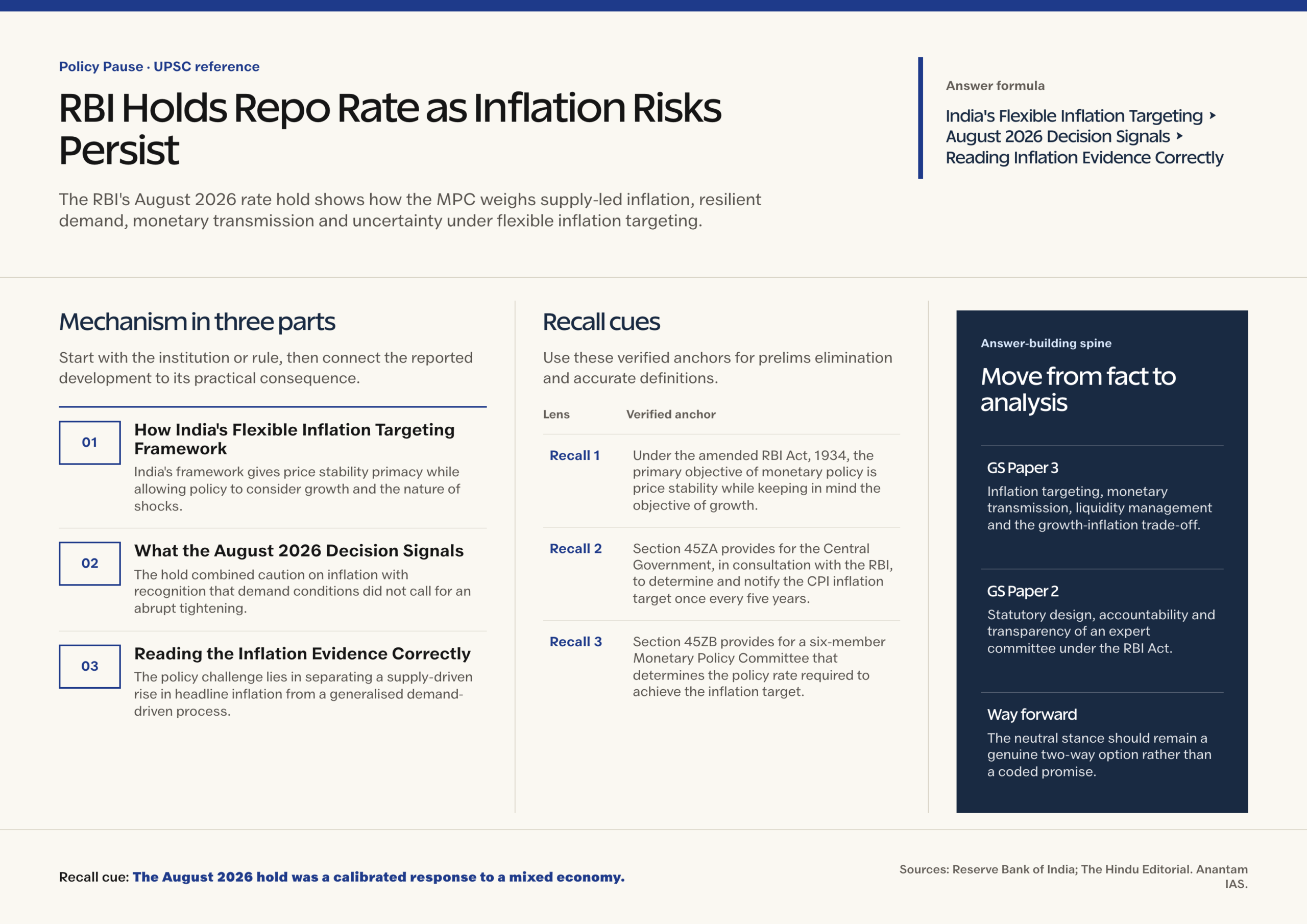
- Under the amended RBI Act, 1934, the primary objective of monetary policy is price stability while keeping in mind the objective of growth.
- Section 45ZA provides for the Central Government, in consultation with the RBI, to determine and notify the CPI inflation target once every five years.
- Section 45ZB provides for a six-member Monetary Policy Committee that determines the policy rate required to achieve the inflation target.
- The inflation target is 4% CPI inflation, with a tolerance band of 2% to 6%; the target is distinct from the edges of the tolerance band.
- The repo rate is the rate at which the RBI supplies short-term liquidity to banks against eligible collateral under the liquidity adjustment facility.
- The uncollateralised Standing Deposit Facility forms the floor of the policy corridor, while the Marginal Standing Facility forms its upper bound.
Mains Relevance
GS Paper 3
- Inflation targeting, monetary transmission, liquidity management and the growth-inflation trade-off.
- Imported inflation through oil, exchange-rate and supply-chain channels, along with food inflation arising from weather and agricultural supply shocks.
GS Paper 2
- Statutory design, accountability and transparency of an expert committee under the RBI Act.
- Institutional balance between an independent central bank, a government-notified inflation target and elected-government supply measures.
Essay
- Economic stability often requires patience under uncertainty: credible institutions must distinguish temporary shocks from persistent trends before acting.
Background and Context
How India's Flexible Inflation Targeting Framework Works
India’s framework gives price stability primacy while allowing policy to consider growth and the nature of shocks.
- The 2016 amendments to the RBI Act placed flexible inflation targeting and the MPC on a statutory footing, replacing sole-person discretion over the policy rate with committee-based decision-making.
- The numerical anchor is headline Consumer Price Index inflation of 4%, not simply any reading within 2% to 6%. The tolerance band recognises measurement uncertainty and supply shocks but does.
- The MPC has three RBI representatives and three external members appointed by the Central Government. Each member has one vote; the Governor has a casting vote in case of a tie.
- If average inflation is above 6% or below 2% for three consecutive quarters, the framework treats it as a failure to meet the target and requires the RBI to explain the causes.
- Publication of the resolution, vote and later individual statements improves accountability. It also helps households and markets understand the reaction function rather than treating the repo rate as an isolated number.
What the August 2026 Decision Signals
The hold combined caution on inflation with recognition that demand conditions did not call for an abrupt tightening.
- The unanimous decision left the repo rate at 5.25% and kept the corridor symmetric: the SDF was 25 basis points below the repo rate and the MSF and Bank Rate were 25 basis points.
- A neutral stance preserves two-way flexibility. The committee can respond to fresh inflation or growth evidence without a prior commitment to easing or tightening.
- The RBI assessed domestic demand as steady: private consumption remained robust, investment indicators linked to construction, capital goods and bank credit were resilient, and services exports stayed healthy.
- The 2026-27 GDP projection of 6.7% was paired with evenly balanced risks. This matters because resilient growth gives the MPC space to wait for clearer inflation evidence rather than using an immediate cut as.
- A pause also allows the effects of earlier monetary decisions to pass through bank deposit rates, lending rates, bond yields, borrowing decisions and aggregate demand. Transmission operates with lags and is rarely uniform across borrowers.
Reading the Inflation Evidence Correctly
The policy challenge lies in separating a supply-driven rise in headline inflation from a generalised demand-driven process.
- Headline CPI inflation rose to 4.4% in June 2026, mainly due to food and fuel. Food price pressure was broad-based during May and June, while retail fuel revisions followed a spike in international.
- Core inflation excluding food and fuel remained at 3.9% in May and June. When precious metals were also excluded, the RBI placed core inflation at only 2.3% to 2.5%, suggesting contained demand pressure at that stage.
- The RBI expected headline inflation to peak at 5.9% in Q3 of 2026-27 before moderating. A projected peak below the 6% upper tolerance limit still demands attention because the operational aim is.
- A temporary relative-price shock need not justify the same response as persistent generalised inflation. Yet repeated food and fuel shocks can raise transport, restaurant, wage and input costs, creating second-round effects and unanchoring expectations.
- The committee’s wait for clarity is best read as risk management, not complacency: cutting too soon could amplify pass-through, while tightening against a temporary supply shock could impose avoidable costs on investment and employment.
Supply Shocks and the Limits of the Repo Rate
Interest rates influence aggregate demand and expectations, but cannot directly produce food, improve rainfall or increase imported energy supply.
- An uneven south-west monsoon under El Niño conditions can reduce crop yields, affect reservoir conditions and rural income, and raise food prices across regions. Adequate grain stocks and timely releases can soften, but not erase, these.
- Volatile global oil prices can create imported inflation through fuel, freight, fertiliser, petrochemicals and exchange-rate channels. A weaker rupee can raise the domestic cost of dollar-priced imports.
- Higher interest rates can restrain credit-financed demand and help anchor expectations. They are less effective against the first-round impact of a failed crop or an external oil shock, so an excessive response may hurt output without.
- The correct policy mix includes monetary credibility alongside buffer-stock operations, better logistics, calibrated trade measures, energy diversification and targeted fiscal support that does not create broad demand pressure.
- Distribution matters: food and fuel occupy a larger share of poorer households’ budgets, while rate changes affect borrowers, savers, MSMEs, housing demand and public borrowing differently.
Way Forward
Keep Policy Data-Dependent and Symmetric
- Track sequential momentum, diffusion across CPI groups, household expectations, wages and core inflation excluding precious metals before changing the rate.
- Explain which evidence would make a supply shock persistent enough to require monetary action, improving predictability without surrendering flexibility.
- Avoid overreacting to favourable base effects or a single monthly print; place greater weight on the durability and breadth of disinflation.
Conclusion
- The August 2026 hold was a calibrated response to a mixed economy: resilient demand and moderate underlying inflation on one side, rising food-fuel pressure and unusually uncertain global and monsoon conditions on the other.
- The larger lesson is that credible monetary policy cannot substitute for food, energy and logistics reform.
UPSC Practice Questions
Prelims MCQ 1
With reference to India’s monetary policy framework, consider the following statements:
- The Monetary Policy Committee is a six-member body constituted under the Reserve Bank of India Act, 1934.
- The Standing Deposit Facility rate normally forms the ceiling of the liquidity adjustment facility corridor.
- The weighted average call rate is the operating target of monetary policy.
How many of the above statements are correct?
(a) Only one (b) Only two (c) All three (d) None
Answer: (b) Only two
Explanation:
Statements 1 and 3 are correct. The MPC has six members, and liquidity management seeks to align the weighted average call rate with the repo rate. The SDF is the floor of the corridor; the MSF is its ceiling.
Prelims MCQ 2
Which one of the following best describes a neutral monetary policy stance?
(a) A binding commitment to reduce the repo rate at the next meeting (b) A policy of maintaining surplus liquidity regardless of inflation (c) Flexibility to move the policy rate in either direction as the outlook evolves (d) Suspension of the inflation target during supply shocks
Answer: (c) Flexibility to move the policy rate in either direction as the outlook evolves
Explanation:
A neutral stance preserves two-way flexibility. It neither promises a cut nor rules out a hike, and it does not suspend the statutory inflation-targeting framework.
UPSC Mains Questions
- The RBI’s August 2026 policy pause highlights both the value and the limits of interest-rate policy against supply-led inflation. Discuss.
- Explain the institutional design of India’s flexible inflation-targeting framework. How do transparency and committee-based decisions strengthen monetary policy credibility?
Sources: Reserve Bank of India and The Hindu Editorial.
Frequently Asked Questions
What did the RBI decide in August 2026?
The six-member Monetary Policy Committee unanimously kept the repo rate at 5.25% and retained a neutral stance. The SDF stayed at 5.00%, while the MSF and Bank Rate remained at 5.50%. The decision preserved flexibility while the RBI assessed inflation.
Why did the RBI hold the repo rate despite rising inflation?
June inflation rose mainly because of food and fuel, while core inflation excluding precious metals remained low. Growth was resilient and the outlook uncertain. The MPC chose to wait for evidence on whether supply costs would spread into broader prices.
What is the difference between the 4% inflation target and the 2%-6% band?
Four per cent is the medium-term CPI inflation anchor. The 2%-6% range is a tolerance band that recognises shocks and uncertainty; it is not a zone in which every outcome is equally desirable. Policy remains focused on durable alignment of.
How does a repo rate hold affect borrowers?
A hold means the RBI has not changed its benchmark lending rate, so there is no automatic policy-driven reset. Actual loan rates can still change with funding costs, benchmark-reset dates, competition and liquidity. Repo-linked floating loans generally transmit policy changes.
Why is food inflation difficult for monetary policy to control?
Food prices often rise because of rainfall, crop loss, storage, transport or supply restrictions. A higher repo rate can restrain demand and expectations but cannot directly create crops or repair logistics. Supply management and agricultural resilience are needed alongside credible.