RBI MPC December 2025: Repo Rate Cut to 5.25%
Why in News?
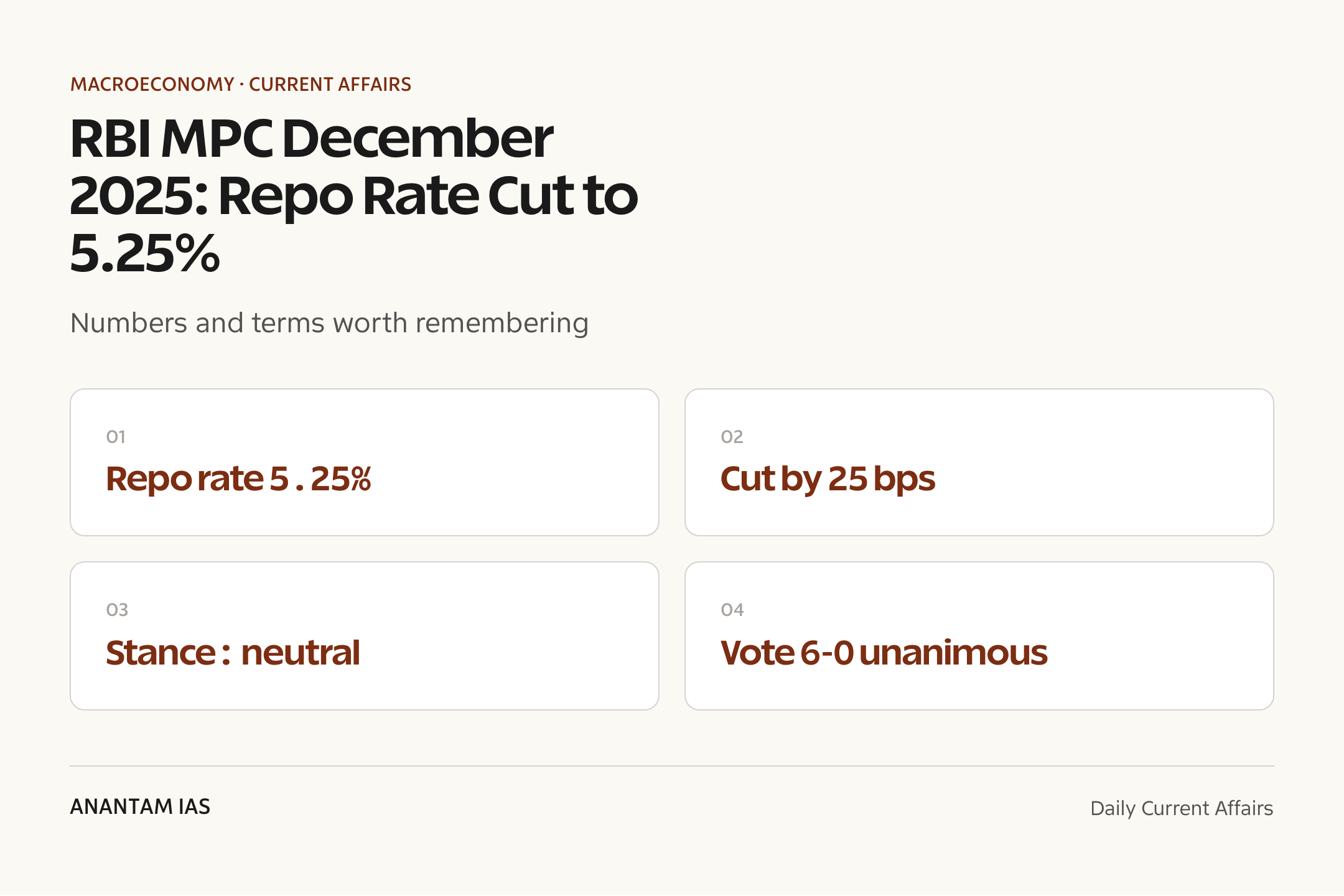
At its meeting held over December 3-5, 2025, the Reserve Bank of India‘s six-member Monetary Policy Committee (MPC), chaired by Governor Sanjay Malhotra, announced its decision on December 5. The committee cut the policy repo rate while keeping the stance neutral, against a backdrop of unusually soft inflation and firm growth.
The MPC voted unanimously (6-0) to lower the policy repo rate by 25 basis points to 5.25% — the lowest in over three years — citing headline retail inflation near a record low and resilient domestic activity.
- Repo rate cut 25 bps to 5.25%; the SDF at 5.00% and the MSF and Bank Rate at 5.50%.
- Stance retained at neutral (data-dependent, no preset bias to cut or hike).
- Takes the cumulative 2025 easing to about 125 bps.
- Drew on a sharp inflation fall — combined CPI was a record-low 0.25% in October 2025, ticking up to 0.71% in November.
- FY26 real GDP growth retained around 7.3%; FY26 CPI projected near 2.0%.
- Governor Malhotra described the mix of benign inflation and ~8% first-half growth as a rare Goldilocks phase.
The development matters in the context of:
- Why it matters: the repo rate is the RBI’s principal policy lever, transmitting to EMIs, deposit and lending rates, and bond yields.
- It anchors India’s flexible inflation targeting regime — a 4% target with a 2-6% tolerance band, statutorily fixed under the amended RBI Act.
- A near-zero CPI print is itself a policy puzzle, raising questions about deflation risk and the durability of the disinflation.

UPSC Relevance
Prelims Relevance
- Repo rate = the LAF overnight lending rate at which RBI lends to banks against government securities.
- SDF (Standing Deposit Facility) is the floor of the LAF corridor; MSF is the ceiling.
- Corridor symmetry: SDF = repo minus 25 bps; MSF = repo plus 25 bps.
- The MPC has six members — three from RBI (Governor, a Deputy Governor, one officer) and three external members appointed by the Centre.
- The Governor chairs the MPC and holds a casting vote in a tie.
- MPC meets at least four times a year; quorum is four members.
- Inflation target: 4% CPI with a +/- 2% band, set by the Centre in consultation with RBI every five years.
- Statutory basis: the Reserve Bank of India Act, 1934, amended in 2016 via the Finance Act to create the MPC.
- A failure to meet the target (CPI outside 2-6% for three straight quarters) obliges RBI to report to the government.
- CRR (Cash Reserve Ratio) and SLR are reserve requirements, distinct from the policy rate.
Mains Relevance
GS Paper 3
- Monetary policy framework: instruments, the LAF corridor, and the conduct of flexible inflation targeting.
- Monetary transmission — why repo-rate changes pass through to bank lending rates with lags and frictions.
- Managing a low-inflation, firm-growth phase: balancing demand support against financial-stability and asset-price risks.
GS Paper 2
- Statutory and institutional design of the MPC — accountability, autonomy, and the government-RBI relationship in setting the inflation target.
Essay
- Price stability and growth: the trade-offs at the heart of central banking.
- Institutions and credibility — how rules-based frameworks shape economic outcomes.
Background and Context
What the December 2025 MPC decided
The headline action and the full rate corridor.
- Repo rate cut by 25 bps to 5.25%, the lowest in more than three years.
- SDF at 5.00%; MSF and the Bank Rate at 5.50% — keeping the LAF corridor symmetric.
- CRR left unchanged at 3.0% of net demand and time liabilities; SLR unchanged.
- Decision was unanimous across all six members; the stance stayed neutral.
The repo rate and the LAF corridor
Defining the central instrument of modern Indian monetary policy.
- The repo rate is the rate at which RBI lends overnight to banks under the Liquidity Adjustment Facility (LAF) against government securities (a repurchase agreement).
- It sits between two bounds: the SDF (the floor, at which banks park surplus funds with RBI without collateral) and the MSF (the ceiling, an emergency borrowing window).
- Moving the repo rate shifts the entire corridor, steering short-term money-market rates toward the policy rate.
- A cut lowers banks’ cost of funds, intended to feed through to cheaper loans and revive demand.
Flexible inflation targeting framework
The legal mandate that governs every MPC decision.
- Since 2016, India follows flexible inflation targeting under the amended RBI Act, 1934.
- The Centre, in consultation with RBI, sets the target every five years — currently 4% CPI with a 2-6% tolerance band.
- “Flexible” means the RBI also weighs growth while pursuing price stability, rather than targeting inflation rigidly.
- If CPI stays outside 2-6% for three consecutive quarters, it is treated as a failure and RBI must report the reasons and remedial steps to the government.
- CPI (combined), compiled by the National Statistical Office, is the nominal anchor — not WPI.
Composition and mandate of the MPC
Who decides, and how the rule-based body is structured.
- The MPC has six members: the Governor (chair), a Deputy Governor in charge of monetary policy, one RBI officer, and three external members appointed by the Centre.
- Each member has one vote; in a tie the Governor casts a second, deciding vote.
- It must meet at least four times a year, with a quorum of four; minutes and the vote split are published.
- The December panel under Governor Sanjay Malhotra included external members Nagesh Kumar, Saugata Bhattacharya and Ram Singh, with Poonam Gupta (Deputy Governor) and Indranil Bhattacharyya from RBI.
The data that drove the cut
Inflation at record lows alongside robust output.
- Combined CPI inflation fell to 0.25% in October 2025 — the lowest in the current series — before edging up to 0.71% in November, well under the 4% target.
- The softness was led by a sustained decline in food prices, helped by a favourable monsoon and the GST rationalisation effects feeding through.
- Growth held firm, with the economy expanding around 8% in the first half of FY26.
- RBI projected FY26 real GDP near 7.3% and FY26 CPI close to 2.0%, leaving room to support demand without breaching the mandate.
Monetary transmission and limits
Why a rate cut does not act instantly or fully.
- Transmission is the pass-through of policy-rate changes to deposit and lending rates and, ultimately, to spending and investment.
- Banks reprice External Benchmark Lending Rate (EBLR) loans quickly, but legacy MCLR-linked loans adjust with lags.
- Surplus liquidity, competition for deposits, and the credit cycle all shape how much of a cut reaches borrowers.
- The neutral stance signals the RBI will stay data-dependent, watching whether disinflation and growth hold before acting again.
Way Forward
Watch the data, not the calendar
- Track the durability of low food inflation and any reversal in core prices before the next move.
- Guard against reading near-zero prints as durable deflation versus a temporary, base-effect-driven dip.
Strengthen transmission
- Keep liquidity adequate so the rate cut reaches borrowers via EBLR and deposit repricing.
- Monitor financial-stability risks — asset prices and unsecured credit — that low rates can fuel.
With inflation comfortably inside the band and growth firm, the calibrated cut keeps policy supportive while preserving optionality; communication and credible data will matter more than the size of any single move.
Conclusion
The December 2025 cut to 5.25% caps a year of substantial easing, framed by the RBI as a once-rare alignment of soft inflation and strong growth.
By holding a neutral stance, the MPC signals it is supporting demand without committing to a path — a textbook expression of flexible inflation targeting under the amended RBI Act.
For UPSC, the episode is a clean case study of the policy-rate instrument, the LAF corridor, the inflation-targeting mandate, and the institutional design of the MPC.
UPSC Practice Questions
Prelims MCQ 1
With reference to India’s monetary policy framework, consider the following statements:
- The Monetary Policy Committee has six members, of whom three are appointed by the Central Government.
- The inflation target of 4% with a +/- 2% band is fixed by the Reserve Bank of India alone.
- The Standing Deposit Facility rate forms the floor of the liquidity adjustment facility corridor.
How many of the above statements are correct?
(a) Only one (b) Only two (c) All three (d) None
Answer: (b) Only two
Explanation:
Statements 1 and 3 are correct. The target is set by the Central Government in consultation with the RBI (not by RBI alone), so statement 2 is wrong. The SDF is the corridor floor; the MSF is the ceiling.
Prelims MCQ 2
Which of the following statements about the repo rate is most accurate?
(a) It is the rate at which banks lend to the RBI without collateral. (b) It is the rate at which the RBI lends overnight to banks against government securities under the LAF. (c) It is the proportion of deposits banks must keep as cash reserves with the RBI. (d) It is the long-term rate at which the RBI rediscounts bills of exchange.
Answer: (b) It is the rate at which the RBI lends overnight to banks against government securities under the LAF.
Explanation:
The repo rate is the LAF overnight lending rate against G-secs. Option (c) describes the CRR; (d) loosely describes the Bank Rate; (a) is incorrect for the repo.
UPSC Mains Questions
- Discuss the instruments and institutional design of India’s flexible inflation-targeting framework. How does a 25-basis-point repo-rate cut transmit through the economy, and what factors weaken that transmission?
- A period of record-low inflation alongside firm growth poses distinct challenges for a central bank. Examine the trade-offs the Monetary Policy Committee must weigh in such a phase, and the case for a neutral stance.
Sources: Reserve Bank of India and Business Standard.
Frequently Asked Questions
What did the RBI MPC decide in December 2025?
At its December 3-5, 2025 meeting, the six-member Monetary Policy Committee announced on December 5 a unanimous 25-basis-point cut in the policy repo rate to 5.25%, the lowest in over three years, while keeping the policy stance neutral. The move drew on inflation at a record low and resilient growth.
What is the repo rate?
The repo rate is the interest rate at which the RBI lends money overnight to commercial banks against government securities under the Liquidity Adjustment Facility, through a repurchase agreement. It is the central instrument of monetary policy and influences the broader structure of interest rates, including loan EMIs and deposit rates.
What is the LAF corridor after the cut?
With the repo rate at 5.25%, the Standing Deposit Facility (the floor at which banks park surplus funds with the RBI) stood at 5.00%, and the Marginal Standing Facility and Bank Rate (the ceiling) at 5.50%. The corridor stays symmetric, 25 basis points on either side of the repo rate.
What is flexible inflation targeting?
Under the amended RBI Act, 1934, India targets a 4% Consumer Price Index inflation rate with a tolerance band of 2-6%, set by the government in consultation with the RBI every five years. “Flexible” means the RBI also supports growth while pursuing price stability, rather than chasing the target rigidly.
Who are the members of the Monetary Policy Committee?
The MPC has six members: the RBI Governor as chairperson, a Deputy Governor in charge of monetary policy, one RBI officer, and three external members appointed by the Central Government. Each has one vote, and the Governor holds a casting vote in case of a tie.
Why did the RBI cut rates despite firm growth?
Headline retail inflation had fallen to a record low — combined CPI was 0.25% in October 2025 — leaving inflation well below the 4% target. With prices benign and growth around 8% in the first half of FY26, the RBI judged it could support demand with a calibrated cut while staying within its mandate.