RBI’s Upper-Layer NBFC Rules: What They Mean for Tata Sons’ Listing
Why in News?
The Reserve Bank of India (RBI) has revised the criteria for classifying Non-Banking Financial Companies (NBFCs) in the Upper Layer of its Scale-Based Regulation (SBR) framework, switching to a simple asset-size test of Rs 1 lakh crore and above. Indian Express reported that the change has reopened the long-running debate over whether Tata Sons, the holding company of the Tata group, must list its shares on a stock exchange.
A Non-Banking Financial Company is a firm that lends, invests, or holds financial assets without being a bank, so it cannot accept ordinary demand deposits but still does credit-like business. Because the largest NBFCs can pose systemic risk, RBI places the biggest ones in the Upper Layer and requires them to list within three years of being identified. The revision keeps that mandate alive for a holding company that has been seeking to step outside the net.
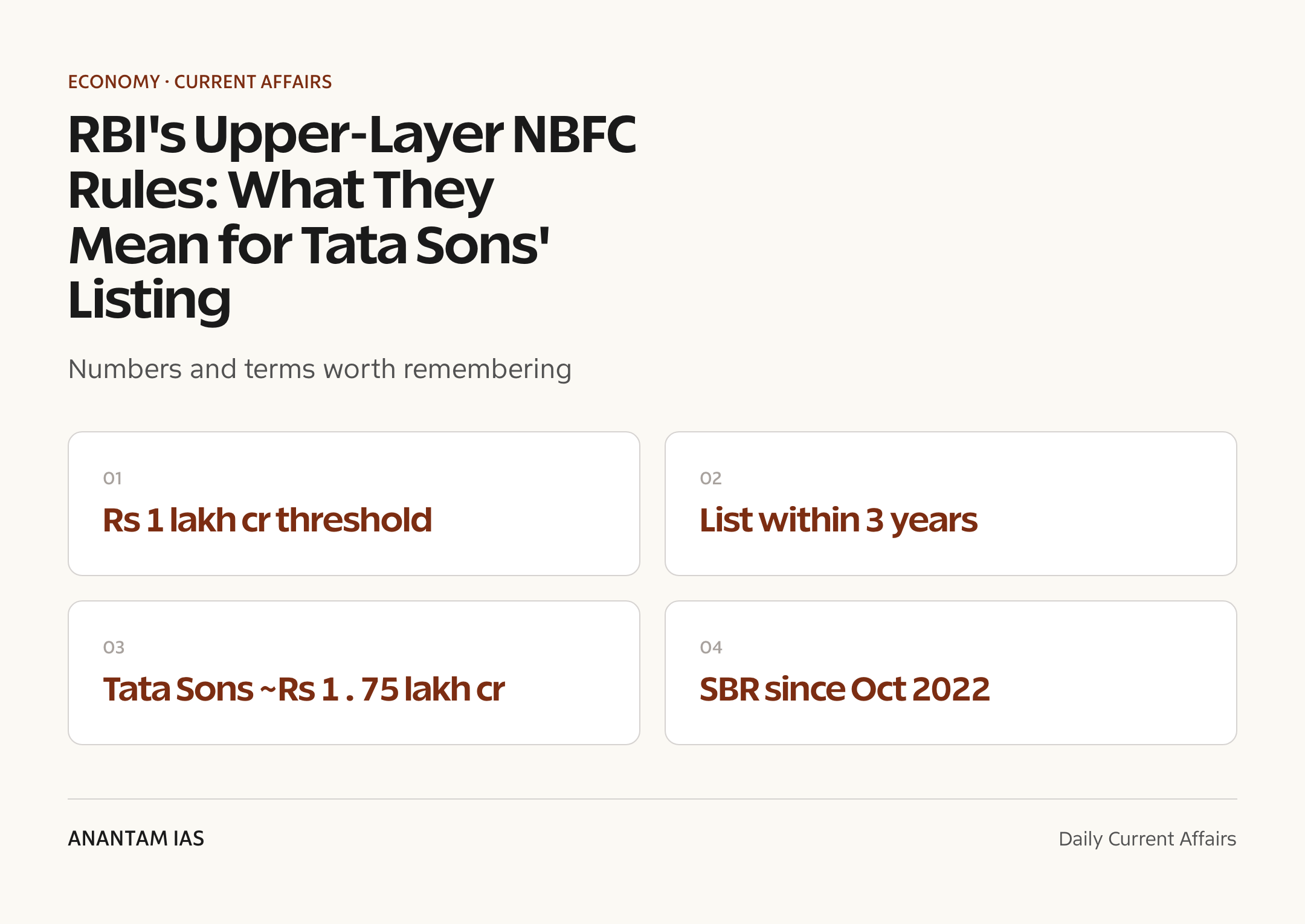
- RBI replaced the earlier parametric scoring method with a single clear rule: any NBFC with assets of Rs 1 lakh crore or more is an Upper-Layer NBFC (NBFC-UL).
- All NBFC-UL entities must get listed within three years of identification, a rule that brings Tata Sons back into focus.
- NBFCs that are fully owned and controlled by the government have been exempted from the mandatory listing requirement.
- The Rs 1 lakh crore threshold will now be reviewed every three years, instead of the five-year interval floated in the draft.
- Tata Sons, with an estimated asset base of around Rs 1.75 lakh crore, comfortably crosses the bar and is likely to stay in the Upper Layer.
The development matters in the context of:
- Tata Sons is registered as a Core Investment Company (CIC), a special kind of NBFC that mainly holds shares in group companies rather than lending to the public.
- Tata Sons had earlier applied to deregister itself as an Upper-Layer NBFC-CIC, a request still pending with RBI; the new norms make that exit harder to assume.
- The listing debate matters because a public float would force fuller disclosure, market valuation, and exit options for shareholders such as the Shapoorji Pallonji group.
UPSC Relevance
Prelims Relevance
- Scale-Based Regulation (SBR) for NBFCs was notified by RBI on 22 October 2021 and came into effect from 1 October 2022.
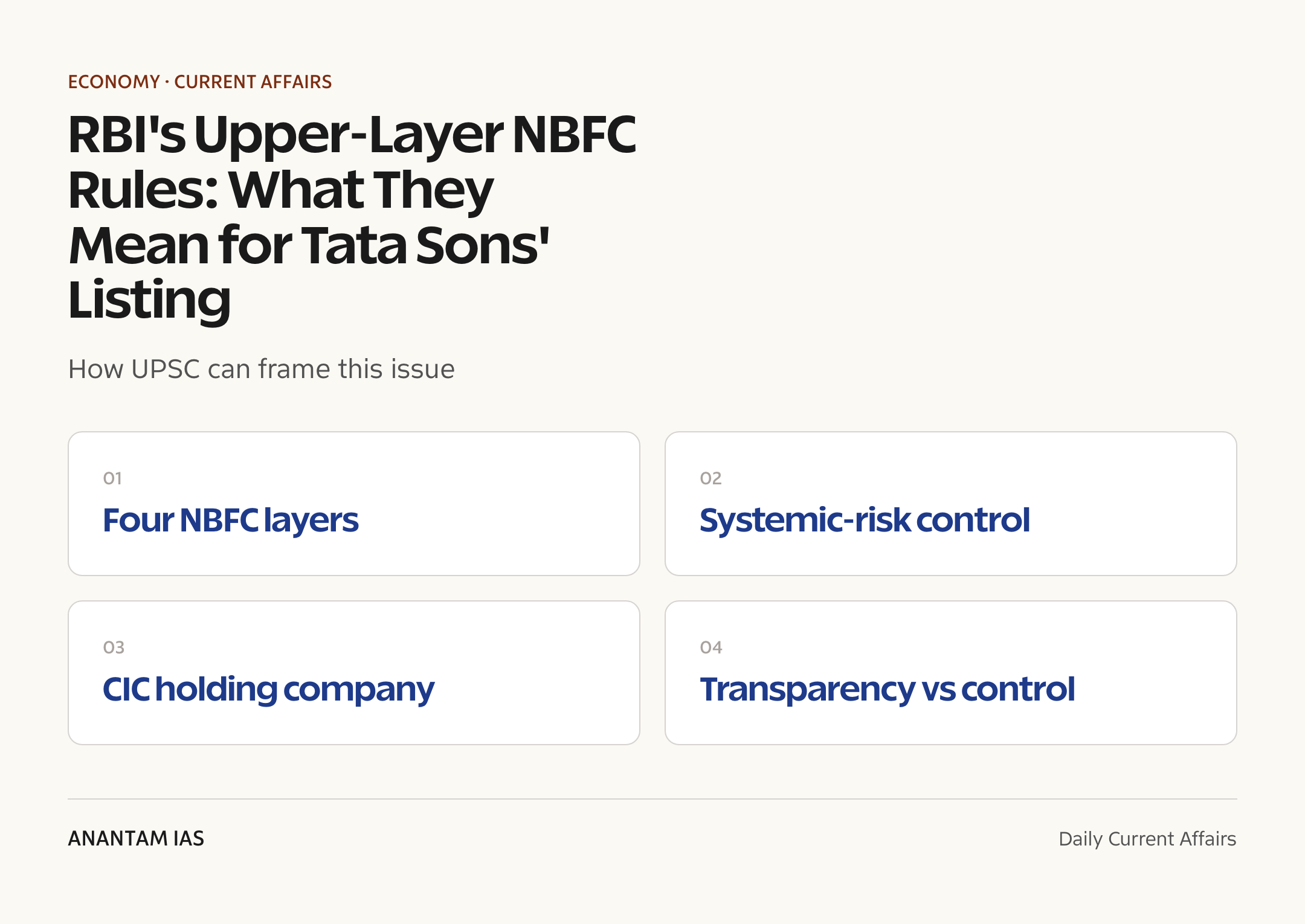
- The SBR framework sorts NBFCs into four layers: Base Layer, Middle Layer, Upper Layer, and Top Layer, by size, activity, and perceived riskiness.
- The Base Layer holds smaller non-deposit-taking NBFCs, peer-to-peer lenders, and account aggregators; the Middle Layer holds deposit-taking NBFCs, housing finance companies, and core investment companies.
- The Upper Layer holds NBFCs deemed systemically significant; the Top Layer is normally empty and reserved for entities posing extreme systemic risk.
- Under the revised rule, the Upper Layer is identified by a single threshold: assets of Rs 1 lakh crore and above as per the latest audited balance sheet.
- Every NBFC-UL must be listed within three years of identification; government-owned NBFCs are exempt.
- A Core Investment Company (CIC) is an NBFC that holds at least 90% of its net assets as investments in group companies, with at least 60% in equity, and does not trade these holdings except for block sale.
- Tata Sons is a CIC and the principal holding company of the Tata group; Tata Trusts hold the majority stake in it.
Mains Relevance
GS Paper 3
- Regulation of the financial sector: how RBI’s Scale-Based Regulation balances ease of doing business against systemic-risk oversight of large shadow-banking entities.
- Corporate governance and transparency: whether mandatory listing of large holding companies improves disclosure and minority-shareholder protection, using Tata Sons as a live case.
Essay
- Regulation versus enterprise: how a maturing economy designs rules that contain systemic risk without smothering large private institutions.
Background and Context
What the Scale-Based Regulation framework is
RBI moved from a one-size-fits-all rulebook to a layered, risk-proportionate one.
- An NBFC is a company that does lending, investment, or financial holding business without a banking licence, so it cannot take ordinary demand deposits.
- After the IL&FS and DHFL stress episodes exposed how large NBFCs can shake the wider system, RBI tightened oversight of the biggest players.
- The Scale-Based Regulation (SBR) framework, notified on 22 October 2021, sorts NBFCs into four layers so that bigger and riskier firms face stricter rules.
- The guiding idea is proportionality: light-touch rules for small NBFCs, bank-like rigour for the systemically significant ones.
The four layers and what the Upper-Layer listing rule requires
The Upper Layer carries the heaviest obligations, including a forced market listing.
- Base Layer: smaller non-deposit-taking NBFCs, peer-to-peer lending platforms, and account aggregators, under the lightest regulation.
- Middle Layer: all deposit-taking NBFCs, plus housing finance companies, standalone primary dealers, and core investment companies.
- Upper Layer: NBFCs judged systemically significant; under the new norm, every firm with assets of Rs 1 lakh crore or more sits here.
- Top Layer: kept empty unless a firm grows to pose extreme systemic risk, when it would face the most intensive supervision.
- Each NBFC-UL must follow bank-like norms on capital, leverage, and governance, and must get its shares listed within three years of being identified.
Why Tata Sons, a Core Investment Company, is affected
Tata Sons is the Tata group’s holding company, and its size keeps it inside the Upper Layer.
- A Core Investment Company (CIC) is an NBFC that mainly holds equity in its own group companies rather than lending to the public; Tata Sons is registered as one.
- With an estimated asset base of about Rs 1.75 lakh crore, Tata Sons comfortably crosses the Rs 1 lakh crore line and stays classified as an NBFC-UL.
- Tata Sons featured on RBI’s earlier Upper-Layer list, so the three-year listing clock already applies to it on paper.
- Tata Sons had sought to deregister as an NBFC-CIC, partly by paring debt and reorganising, so that the listing mandate would no longer bind it; that application is still pending with RBI.
The revised rules and the exemption debate
RBI simplified the test, set a review cycle, and carved out the government’s own NBFCs.
- The old method used a parametric scoring exercise across a sample of NBFCs; the revision replaces it with a flat Rs 1 lakh crore asset threshold.
- The threshold will be reviewed every three years, tighter than the five-year cycle proposed in the draft guidelines.
- NBFCs that are fully owned and controlled by the government are exempted from the mandatory listing rule, narrowing the obligation to private players.
- Because no private exemption was offered, the move leaves Tata Sons facing the listing question unless its deregistration plea succeeds, a reprieve that remains uncertain.
The systemic-risk rationale and the case for listing
Forced listing is meant to bring transparency and discipline to firms large enough to matter to the system.
- Large NBFCs borrow heavily from banks, mutual funds, and bond markets, so distress at one can spread through the financial system, the lesson of IL&FS.
- A stock-market listing forces continuous disclosure, independent valuation, and analyst scrutiny, which can flag trouble earlier than private accounts.
- Listing also gives existing shareholders, such as the Shapoorji Pallonji group in Tata Sons, a transparent route to value and exit.
- Critics counter that a pure holding company has no public deposits at risk, so forcing it to list may be a heavy answer to a limited systemic concern.
Significance and criticism
The revision is cleaner to administer but reopens a politically and commercially sensitive choice.
- Switching to an asset-size threshold makes Upper-Layer classification predictable and transparent, reducing discretion.
- Tata Sons has resisted a public float, valuing the privacy and control that an unlisted holding structure gives the group.
- The government-only exemption draws a sharp line: state NBFCs escape the listing rule while large private holding companies do not.
- The outcome will signal how firmly RBI is willing to push transparency and systemic discipline against the preferences of a marquee private conglomerate.
Way Forward
Resolve the deregistration question quickly
- RBI should decide Tata Sons’ pending CIC deregistration plea on clear, published criteria so the market is not left guessing.
- Any exit route from NBFC-UL status should rest on genuine reduction of systemic footprint, not merely on accounting reorganisation.
Keep thresholds proportionate and reviewed
- The three-year review of the Rs 1 lakh crore line should track financial-sector growth so the Upper Layer captures the genuinely systemic, not the merely large.
- RBI can pair the listing mandate with calibrated relief on timelines where a firm demonstrably reduces leverage and interconnectedness.
Strengthen disclosure as the real goal
- Where listing is genuinely unsuitable, RBI could mandate listing-equivalent disclosure for large CICs to capture transparency without a forced float.
- Coordination with SEBI can ensure that any listing protects minority and legacy shareholders rather than triggering disputes.
Conclusion
RBI’s switch to a Rs 1 lakh crore asset threshold makes Upper-Layer classification cleaner and harder to argue around, and it keeps the three-year listing mandate squarely over large private NBFCs. For Tata Sons, the simplification removes the ambiguity it might have used to slip out of the net, leaving its pending deregistration plea as the main escape hatch.
The episode is a useful study of how a regulator weighs systemic-risk control and transparency against the autonomy of a large private institution. How RBI handles the Tata Sons case will set a marker for the credibility and even-handedness of the Scale-Based Regulation framework.
UPSC Practice Questions
Prelims MCQ 1
With reference to the RBI’s Scale-Based Regulation (SBR) framework for NBFCs, consider the following statements:
- The framework classifies NBFCs into four layers: Base, Middle, Upper, and Top.
- Core Investment Companies are placed by default in the Top Layer.
- Under the revised norms, an NBFC with assets of Rs 1 lakh crore and above is classified in the Upper Layer.
How many of the above statements are correct?
(a) Only one (b) Only two (c) All three (d) None
Answer: (b) Only two
Explanation:
Statements 1 and 3 are correct. The SBR framework has four layers and the revised Upper-Layer test is a Rs 1 lakh crore asset threshold. Statement 2 is wrong: Core Investment Companies sit in the Middle Layer, and the Top Layer is normally empty, reserved for entities posing extreme systemic risk.
Prelims MCQ 2
Which of the following best describes a Core Investment Company (CIC) under RBI norms?
(a) An NBFC that primarily accepts public demand deposits and lends to retail borrowers (b) An NBFC that mainly holds equity and debt in its own group companies and does not trade these investments except for block sale (c) A commercial bank that invests its surplus in government securities (d) A microfinance institution lending only to self-help groups
Answer: (b) An NBFC that mainly holds equity and debt in its own group companies and does not trade these investments except for block sale
Explanation:
A CIC is an NBFC that holds at least 90% of its net assets as investments in group companies (at least 60% in equity) and does not trade them except for block sale. Tata Sons is a registered CIC. NBFCs cannot take ordinary demand deposits, ruling out option (a).
UPSC Mains Questions
- The Scale-Based Regulation framework reflects a shift toward proportionate, risk-based regulation of NBFCs. Examine its rationale and assess whether the mandatory listing of Upper-Layer NBFCs strengthens financial-sector transparency. (GS Paper 3)
- Large holding companies and Core Investment Companies sit at the intersection of corporate control and systemic risk. Discuss, with reference to the Tata Sons listing debate, how RBI should balance regulatory discipline against private enterprise. (GS Paper 3)
Source: Indian Express.
Frequently Asked Questions
What is an NBFC-Upper Layer (NBFC-UL)?
An NBFC-UL is a non-banking financial company that RBI treats as systemically significant. Under the revised rule, any NBFC with assets of Rs 1 lakh crore or more falls in the Upper Layer and must follow stricter, bank-like norms, including listing within three years of identification.
What is the Scale-Based Regulation (SBR) framework?
SBR is RBI’s layered rulebook for NBFCs, notified on 22 October 2021 and effective from 1 October 2022. It sorts NBFCs into four layers, Base, Middle, Upper, and Top, by size, activity, and perceived riskiness, so larger and riskier firms face tougher regulation.
Why might Tata Sons have to list its shares?
Tata Sons is a Core Investment Company with an estimated asset base of about Rs 1.75 lakh crore, well above the Rs 1 lakh crore threshold. As an Upper-Layer NBFC, it is required to list within three years of identification, unless its pending plea to deregister succeeds.
What is a Core Investment Company (CIC)?
A CIC is an NBFC that mainly holds shares in its own group companies rather than lending to the public. It must hold at least 90% of net assets as group investments, with at least 60% in equity, and cannot trade these holdings except for block sale.
Are any NBFCs exempt from the listing rule?
Yes. NBFCs that are fully owned and controlled by the government have been exempted from the mandatory listing requirement. The obligation now applies mainly to large private NBFCs in the Upper Layer.
How often is the Rs 1 lakh crore threshold reviewed?
RBI will review the Rs 1 lakh crore asset threshold every three years, a tighter cycle than the five-year interval that had been proposed in the draft guidelines.