Reducing India’s exposure to the U.S. Tariff Risks
Context:
The U.S. Senate has passed the Lindsey O. Graham Sanctioning Russia and Iran Act, 2026, which authorises tariffs of up to 100% on countries among the five largest importers of Russian crude oil or natural gas.
The Bill, however, is not yet law: it requires approval by the House of Representatives and presidential assent, while the final tariff rate would depend on executive implementation and possible waivers.
Reducing India’s Exposure to U.S. Tariff Risks:
India’s growing dependence on Russian oil and its simultaneous reliance on the U.S. export market create a significant geoeconomic vulnerability.
India’s growing dependence on Russian oil:
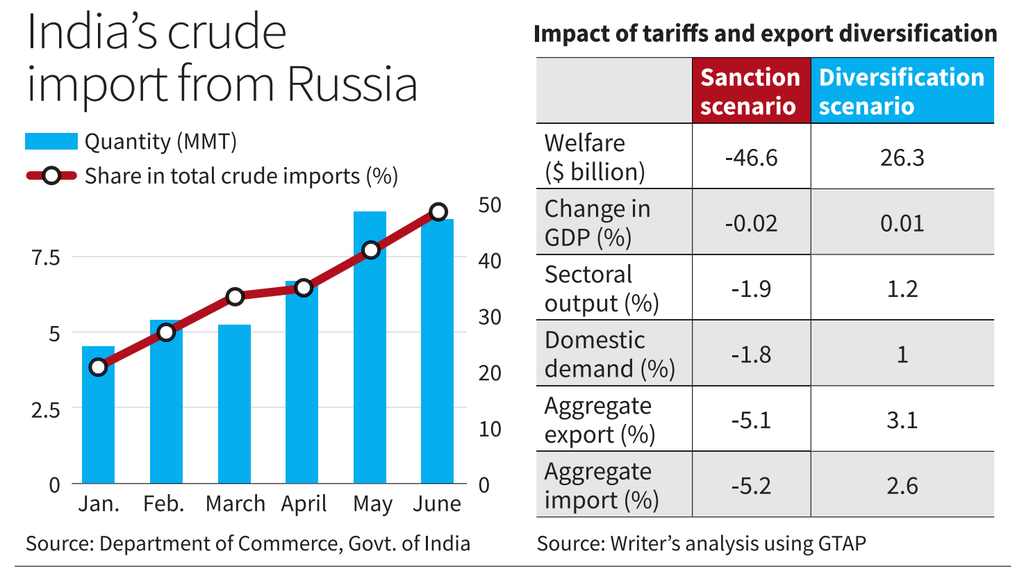
- Russia-Ukraine war has increased India’s dependence on Russian crude: Russian oil’s share in India’s crude imports rose from about 2% before the war to nearly 50%, helping India secure cheaper and diversified energy supplies.
Growing U.S. Tariff Risk:
- The proposed Lindsey O. Graham Sanctioning Russia and Iran Act, 2026 could authorise tariffs of up to 100% on countries that continue purchasing Russian crude. Combined with existing U.S. tariffs, India could face cumulative tariffs of around 110%.
- Potential economic impact: It is estimated that a 110% U.S. tariff could:
- Reduce India’s economic welfare by nearly $47 billion.
- Lower exports by 5.1% and imports by 5.2%.
- Contract GDP, domestic demand and output.
Export Diversification as a solution:
- A functional India-EU FTA was used as a proxy for diversification. Under this scenario:
- Welfare could improve by $26.3 billion.
- Exports could rise by 3.1%.
- GDP, output and domestic demand could recover.
- Imports could increase by a moderate 2.6%.
Way Forward for India:
India should pursue export-market diversification while retaining energy-security flexibility in sourcing Russian crude. This should be complemented by:
- Reducing non-tariff barriers
- Improving trade facilitation and logistics
- Harmonising with international product standards
- Moving up the quality/value chain in exports
- Expanding FTAs and access to EU and other alternative markets.
India cannot eliminate geopolitical tariff risks, but greater export diversification and domestic competitiveness can substantially reduce its vulnerability to U.S. trade pressure.