Reform Utsav: Building a Citizen-to-Policy Governance Pipeline
Why in News?
The Indian Express reported on August 15, 2026 that the Union government plans to launch a three-month initiative called Reform Utsav to collect citizen suggestions and convert selected ideas into actionable reforms.
- According to the report, the initiative would aim to institutionalise reform through citizen participation and create a responsive pipeline from suggestion to action.
- The reported three stages are Jan Manthan or discovery, Vimarsh or deliberation, and Samadhan and Sankalp Siddhi or resolution.
- The first stage would reportedly begin on October 2, 2026 and run for one month, using a designated portal, public meetings and webinars to gather suggestions. The date and activities are plans described by newspaper sources.
- The report says artificial intelligence would sort submissions and that a multilingual call centre might be established. It does not publish the AI model, data policy, audit method or final decision rule.
- In the second stage, officials would reportedly identify quick-win reforms and prepare roadmaps for structural changes.
- Participatory governance is more than receiving comments. It requires accessible entry points, representative participation, reasoned consideration, feedback to contributors and evidence that public input changed a decision or its implementation.
- India already has distinct participation channels: MyGov for engagement, CPGRAMS for service-delivery grievances, pre-legislative consultation for draft laws, Gram Sabhas for local participation and statutory social audits in programmes such as MGNREGA.
- A new pipeline should complement these mechanisms rather than collect the same submission in several portals with different tracking numbers and no clear institutional owner.
UPSC Relevance
Prelims Relevance
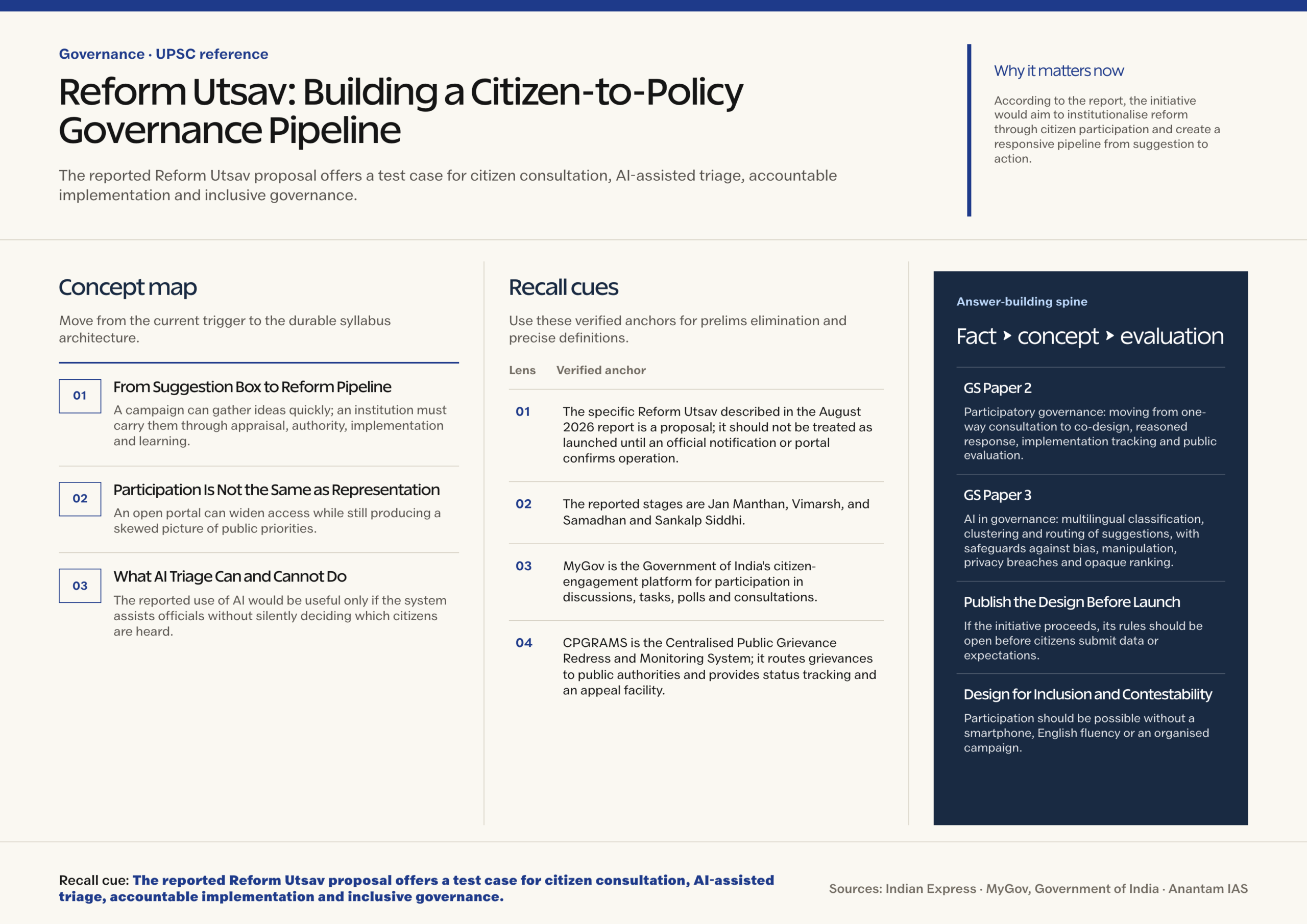
- The specific Reform Utsav described in the August 2026 report is a proposal; it should not be treated as launched until an official notification or portal confirms operation.
- The reported stages are Jan Manthan, Vimarsh, and Samadhan and Sankalp Siddhi.
- MyGov is the Government of India’s citizen-engagement platform for participation in discussions, tasks, polls and consultations.
- CPGRAMS is the Centralised Public Grievance Redress and Monitoring System; it routes grievances to public authorities and provides status tracking and an appeal facility.
- The Pre-legislative Consultation Policy, 2014 calls for proposed legislation or key information about it to be placed in the public domain, ordinarily for at least 30 days, with a summary of feedback placed before the approving.
- Article 243A of the Constitution allows a Gram Sabha to exercise powers and perform functions at village level as a State legislature provides by law.
Mains Relevance
GS Paper 2
- Participatory governance: moving from one-way consultation to co-design, reasoned response, implementation tracking and public evaluation.
- Transparency and accountability: publishing selection criteria, responsible departments, deadlines, budgets, progress and reasons for accepting or rejecting proposals.
GS Paper 3
- AI in governance: multilingual classification, clustering and routing of suggestions, with safeguards against bias, manipulation, privacy breaches and opaque ranking.
- Digital public infrastructure: interoperable case identifiers, consent-based data sharing, audit logs and secure links between consultation and departmental workflow systems.
Essay
- Participation becomes democratic power only when institutions listen, explain and act.
Background and Context
From Suggestion Box to Reform Pipeline
A campaign can gather ideas quickly; an institution must carry them through appraisal, authority, implementation and learning.
- The first step is intake: a citizen should be able to describe a problem, affected group, location, proposed change and supporting evidence without navigating bureaucratic categories.
- The second step is triage: submissions should be checked for duplicates, classified by theme and jurisdiction, separated from personal grievances, and routed to the office capable of acting.
- The third step is appraisal. Officials need to test legality, fiscal cost, distributional impact, administrative capacity, environmental effects, federal competence and interaction with existing policy.
- The fourth step is a reasoned decision: adopt, pilot, merge, refer, defer or reject. Each outcome should have a short public explanation rather than an unexplained status label.
- The final step is implementation and evaluation: assign an owner, milestone, resources, success measure and review date, then report whether the promised outcome occurred.
Participation Is Not the Same as Representation
An open portal can widen access while still producing a skewed picture of public priorities.
- People with reliable internet, spare time, formal education and organised networks can submit more frequently and frame requests in administrative language. Submission volume is not a representative sample of public opinion.
- A coordinated campaign may generate thousands of near-identical messages. Those messages show mobilisation, but counting each as an independent policy argument can crowd out quieter groups.
- Women, migrant workers, persons with disabilities, remote communities, linguistic minorities and people affected by digital exclusion need offline and assisted participation routes.
- Public meetings can surface local context that a web form misses, but they need advance notice, accessible venues, facilitation and records that prevent dominant speakers from controlling the agenda.
- A sound design combines open participation with targeted outreach, stakeholder mapping, representative sampling where suitable, and consultation through elected local institutions.
What AI Triage Can and Cannot Do
The reported use of AI would be useful only if the system assists officials without silently deciding which citizens are heard.
- Language models can cluster similar suggestions, detect probable duplicates, produce draft summaries, identify departments and surface recurring themes. These functions can reduce manual workload in a high-volume campaign.
- Models may perform unevenly across Indian languages, dialects, code-mixed text, voice transcripts and low-literacy expression. Fluent official prose may be ranked as clearer even when a brief local-language submission identifies a serious problem.
- Summarisation can erase qualifiers, merge incompatible proposals or convert an experience into a recommendation the citizen did not make. Officials should retain access to the original submission.
- Automated popularity scores can amplify organised campaigns and penalise novel issues with few submissions. Urgency, rights impact and severity require separate signals from frequency.
- The system should disclose where AI is used, record model and prompt versions, measure routing errors, permit human correction and periodically audit outcomes across language and social groups.
Accountability Must Close the Feedback Loop
Citizens lose trust when participation ends with a thank-you message and no visible consequence.
- Each accepted submission should receive a trackable identifier, subject classification, responsible office and current stage, while personal data remain protected.
- Departments should publish common reasons for merger, referral, rejection or delay. A reasoned response makes constraints visible and allows citizens to challenge a factual or jurisdictional error.
- A quick win should not mean a symbolic announcement. It should have a baseline, deadline, named owner, measurable service or compliance improvement and a public completion record.
- Structural reform needs a roadmap that distinguishes study, consultation, legal amendment, budget approval, technology build, field implementation and independent evaluation.
- Bi-weekly review, if adopted as reported, would improve internal follow-up only when decisions, bottlenecks and revised dates are recorded. A meeting count is not an outcome metric.
Way Forward
Publish the Design Before Launch
- Issue an official framework setting out scope, stages, decision rights, participating governments, timelines, privacy terms, moderation rules and the relationship with MyGov and CPGRAMS.
- Publish selection criteria for quick wins and structural reforms, including legality, public value, equity, cost, feasibility and strength of supporting evidence.
- Conduct a data-protection and algorithmic-impact assessment covering call recordings, sensitive narratives, multilingual models, third-party access and data retention.
Conclusion
- Reform Utsav, as reported, could create a useful bridge between scattered citizen input and cross-government action.
- Its success would depend less on the festival label or the volume of suggestions than on a durable citizen-to-policy chain : inclusive participation, transparent triage, reasoned decisions, lawful authority, named implementation owners and publicly verifiable outcomes.
UPSC Practice Questions
Prelims MCQ 1
With reference to citizen participation mechanisms in India, consider the following statements:
- CPGRAMS is primarily a platform for lodging and tracking public grievances concerning service delivery.
- Article 243A allows a Gram Sabha to exercise powers and perform functions at village level as provided by State law.
- The Pre-legislative Consultation Policy requires every public suggestion to be accepted into the final law.
How many of the above statements are correct?
(a) Only one (b) Only two (c) All three (d) None
Answer: (b) Only two
Explanation:
Statements 1 and 2 are correct. Pre-legislative consultation provides an opportunity for comments and requires consideration and documentation; it does not compel the government to accept every suggestion.
Prelims MCQ 2
In a large-scale citizen consultation, which one of the following is the most appropriate role for artificial intelligence?
(a) Automatically reject suggestions submitted by very few people (b) Make final policy decisions without departmental review (c) Cluster, summarise and route submissions subject to human oversight and audit (d) Replace statutory consultation and legislative scrutiny
Answer: (c) Cluster, summarise and route submissions subject to human oversight and audit
Explanation:
AI can assist high-volume administrative triage, but public authorities retain responsibility for legality, rights, fiscal choices and final decisions. Human review, access to original submissions, bias testing and correction mechanisms remain essential.
UPSC Mains Questions
- Participatory governance begins with consultation but succeeds only when the feedback loop is closed. Design an accountable citizen-to-policy pipeline for India. (250 words)
- Artificial intelligence can help governments hear more voices while making some voices easier to ignore. Examine the opportunities and safeguards for AI-assisted citizen consultation. (250 words)
Sources: Indian Express and MyGov, Government of India.
Frequently Asked Questions
Has Reform Utsav been officially launched?
Not on the evidence reviewed for this note. The Indian Express reported that the Union government planned a three-month initiative expected to begin on October 2, 2026. No official launch notification or operational portal for this specific campaign was identified.
What are the proposed stages of Reform Utsav?
The report describes Jan Manthan for discovery, Vimarsh for deliberation, and Samadhan and Sankalp Siddhi for resolution. Citizens would reportedly submit ideas during the first stage, officials would identify quick wins and structural roadmaps during the second, and a coordination.
How is a reform suggestion different from a grievance?
A grievance usually seeks redress for a specific service failure or administrative wrong, as through CPGRAMS. A reform suggestion proposes a systemic change affecting rules, processes or institutions. Repeated grievances may reveal a reform need, but shifting them into a.
What could AI do in a citizen-suggestion system?
AI could detect probable duplicates, cluster themes, identify language, draft summaries and route submissions to departments. It should not decide policy merit by popularity or reject citizens without review. Original submissions, audit logs, bias tests, human correction and a clear.
How can the government prevent consultation from becoming tokenistic?
It can publish selection criteria, give each shortlisted proposal a responsible office and timeline, explain acceptance or rejection, disclose progress and commission independent outcome checks. Citizens need to see not only that a comment was received but how it affected.