Remittances Anchor the Rupee and India’s External Balances
Why in News?
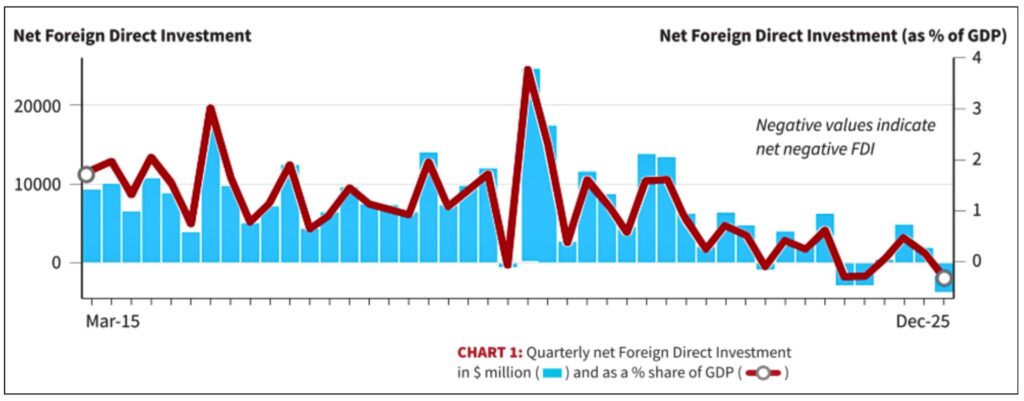
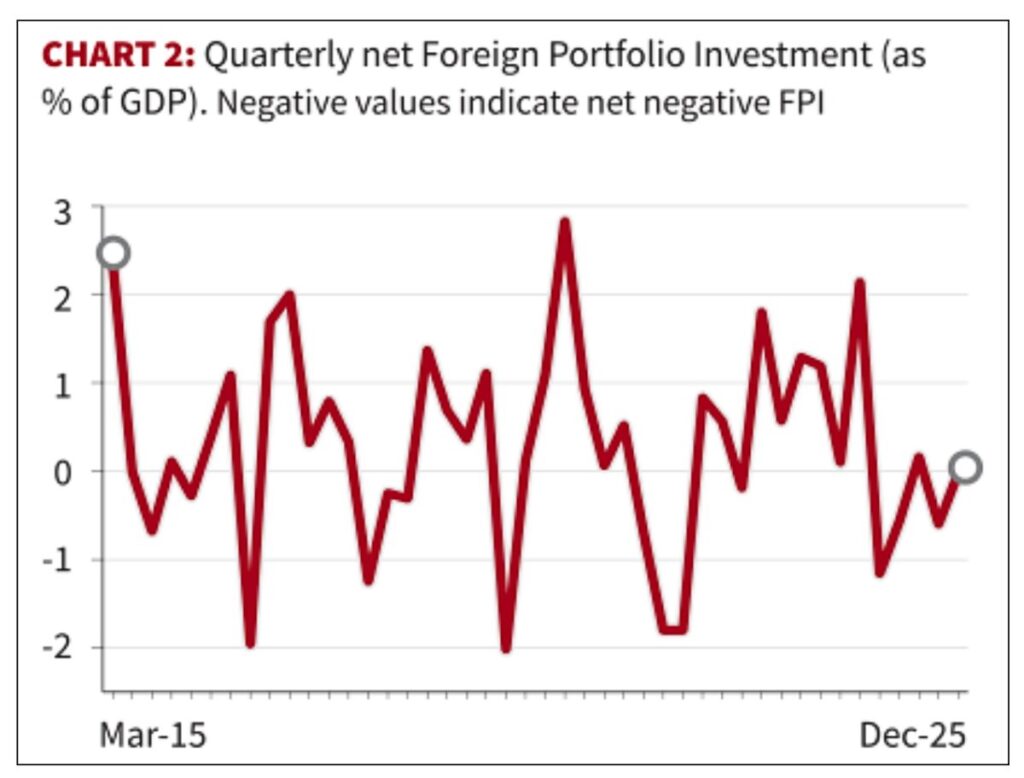
The Indian rupee has depreciated significantly against the U.S. dollar since 2025, amid declining net Foreign Direct Investment (FDI) and Foreign Portfolio Investment (FPI) inflows. Simultaneously, remittances have played a crucial role in financing India’s external deficit and supporting the rupee.
| UPSC Relevance: GS-3 Economy: Balance of Payments, External Sector Prelims: Current Account Deficit (CAD), Balance of Payments (BoP), FDI, FPI, Remittances, Net Primary Income (NPI), Net Secondary Income (NSI) |
India’s Balance of Payments (BoP):
The Balance of Payments (BoP) is a comprehensive record of all economic transactions between the residents of a country and the rest of the world in a given period of time.
| Structure of India’s Balance of Payments (BoP) | |
| Current Account | Capital Account |
| Exports/Imports Net Primary Income (interest, dividends, profits, compensation) Net Secondary Income (remittances, gifts, grants) | Foreign Direct Investment (FDI) Foreign Portfolio Investment (FPI) External Commercial Borrowings (ECBs) Non-Resident Indian (NRI) deposits Foreign aid, loans and other capital flows |
India typically experiences a Current Account Deficit (CAD) because its imports of goods and services consistently exceed its exports. This consistent shortfall is primarily driven by a heavy reliance on importing essential commodities like crude oil, natural gas, gold, and electronics.
If the capital account surplus does not cover the current account deficit, it can lead to a negative Balance of Payments (BoP), resulting in a depletion of forex reserves.
In FY 2025, India maintained its position as the world’s largest recipient of remittances with inflows reaching USD 135.4 billion. These massive remittance inflows, combined with record services exports, helped to stabilise the current account, despite the merchandise trade deficit.
What are Remittances?
- Remittances are cross-border transfers of money or goods sent by foreign workers to individuals in their home countries.
- Remittance forms a part of the transfer payment category in the Current Account of the Balance of Payments (BoP).
- Transfer payments are the receipts which the residents of the country get for free, without having to provide any goods and services in return.
Importance of Remittances for an Economy:
Remittances are the silent stabiliser of India’s Balance of Payments and the rupee.
- Reduces Current Account Deficit (CAD): Remittances generate a large surplus under Net Secondary Income, and help offset India’s persistent trade deficit. Along with services exports, they significantly reduce the Current Account Deficit, thereby lowering dependence on volatile foreign capital inflows.
- Provides Stable Foreign Exchange Inflows: Remittances are a major source of foreign exchange earnings. Unlike portfolio investments, they are driven by family and household needs and therefore remain relatively stable even during periods of global economic uncertainty.
- More Reliable than Capital Flows: Remittance inflows are generally less volatile than FDI and especially FPI flows. They are often counter-cyclical, increasing during economic hardships, natural disasters, or crises when households require additional support.
- Supports Balance of Payments Stability: By bringing in foreign exchange without creating repayment obligations, remittances help finance imports, reduce external sector vulnerabilities, and strengthen the Balance of Payments position.
- Supports Exchange Rate Stability: By increasing the supply of foreign currency in the domestic market, remittances help moderate depreciation pressures on the national currency and contribute to exchange rate stability.
- Non-debt-creating source of External Finance: Unlike external borrowings, remittances do not create future repayment obligations, interest liabilities, or profit repatriation requirements, making them one of the most sustainable sources of foreign exchange.
- Boosts Domestic Consumption and Demand: Remittances increase household spending on food, housing, healthcare, education, and consumer goods, thereby stimulating domestic demand and supporting economic growth.
Policy Measures to Sustain Remittance Flows:
- Enhance Engagement with the Indian Diaspora: Strengthen overseas welfare mechanisms. Expand diaspora investment channels & promote Skilled Migration. Higher-skilled migrants generally send larger remittances.
- Reduce transaction costs by encouraging Digital payment platforms, UPI-linked cross-border transfers and Fintech innovations, which can improve remittance efficiency.
- Deepen NRI Investment Instrument: NRI deposits, Diaspora bonds, and Infrastructure investment vehicles can channel overseas savings into productive sectors.
UPSC PYQ 2019:
Q. In the context of India, which of the following factors is/are contributor/contributors to reducing the risk of a currency crisis?
1. The foreign currency earnings of India’s IT sector
2. Increasing the government expenditure
3. Remittances from Indians abroad
Select the correct answer using the code given below:
(a) 1 only
(b) 1 and 3 only
(c) 2 only
(d) 1, 2 and 3
Answer: (b)