Health Ministry convenes monitoring group as respiratory illness cases rise in China
Why in News?
Rising respiratory-illness reports from China prompted India to convene a Joint Monitoring Group under DGHS to review surveillance, laboratory and clinical preparedness and to coordinate with WHO and national agencies.
- Cross-border risk: Reports of increased respiratory illnesses in China present potential transmission risk to India through travel and trade.
- Rapid response: The Joint Monitoring Group (JMG) is a mechanism to align surveillance, diagnostics and clinical response across agencies.
- Interagency coordination: WHO, IDSP, NCDC, ICMR and major hospitals were involved to ensure technical alignment and information sharing.
- Public-health preparedness: The meeting rechecked laboratory capacity, reporting pathways and surge clinical-management plans.
- Surveillance vigilance: Emphasis on strengthening early detection at points of entry and in community surveillance systems.
The development matters in the context of:
- Recent situation: Chinese health authorities reported a rise in respiratory-illness cases in late 2024 and early 2025, creating international monitoring needs.
- India’s exposure pathways: High travel volumes, migrant flows and trade between India and China increase the chance of imported cases if the agent is transmissible.
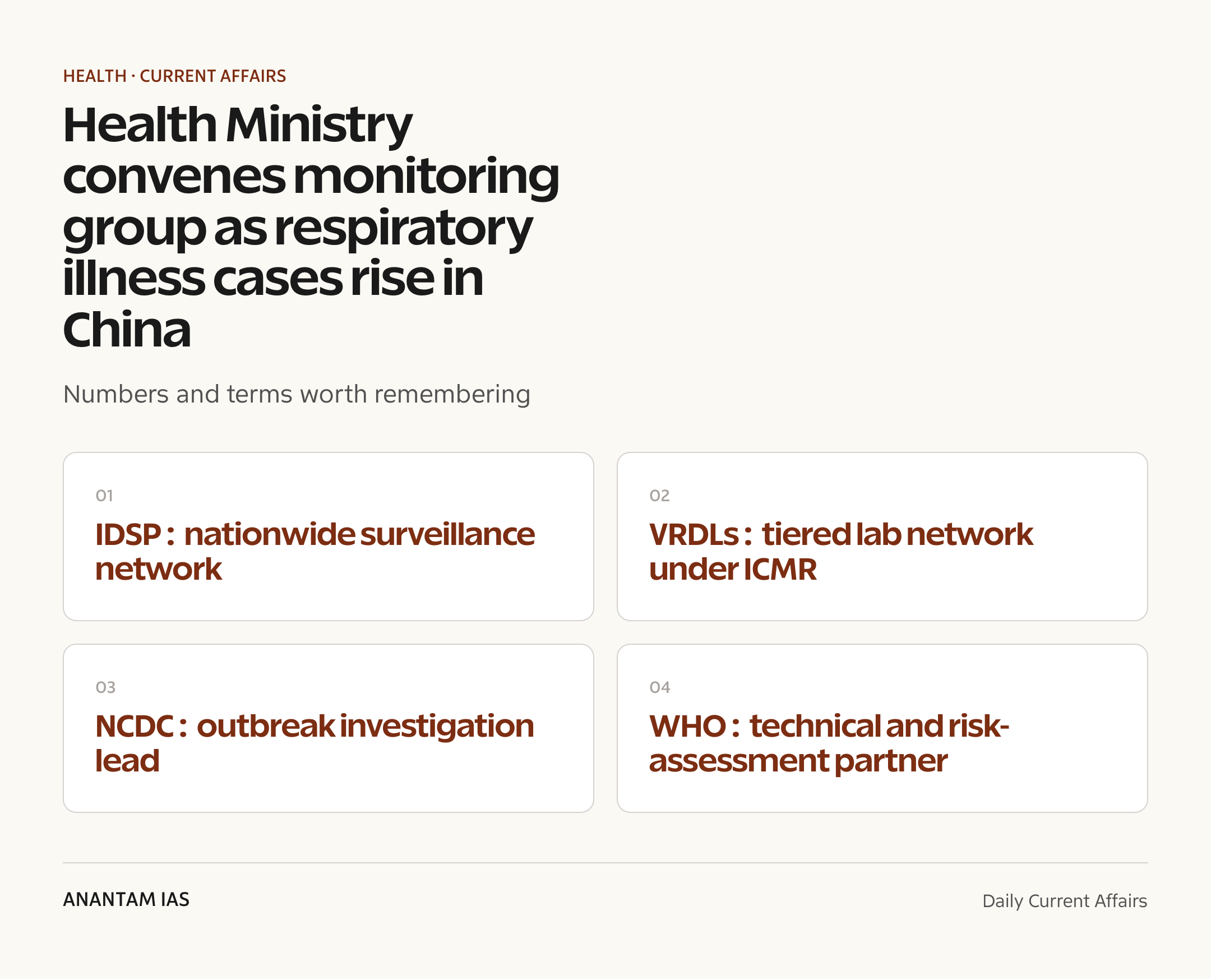
- Existing architecture: The Integrated Disease Surveillance Programme (IDSP), NCDC and ICMR laboratories form the core of India’s surveillance and testing network.
- Global health mechanisms: WHO provides technical guidance and risk assessments; countries use WHO updates to calibrate national responses.
- Post-pandemic vigilance: Systems and protocols established during the COVID-19 response are now being applied to other respiratory threats.
- Risk communication: Timely public information reduces panic and boosts compliance with prevention measures such as testing and isolation.

UPSC Relevance
Prelims Relevance
- IDSP: Know the role of the Integrated Disease Surveillance Programme in epidemic detection and reporting.
- NCDC: Understand the National Centre for Disease Control’s functions in outbreak investigation and laboratory coordination.
- WHO: Recognize WHO’s advisory role and how member states use global risk assessments.
- JMG: Be aware that Joint Monitoring Group meetings are convened to coordinate multiagency responses.
Mains Relevance
GS3 Economy
- Public-health system strength: Discuss the adequacy of India’s surveillance, laboratory networks and clinical surge capacity in detecting and responding to cross-border outbreaks.
- International cooperation: Evaluate how cooperation with WHO and neighbouring countries can improve early warning and joint response to infectious disease threats.
- Policy lessons: Analyse lessons from COVID-19 to propose sustainable reforms in epidemic preparedness, including financing and human resources.
Essay
- Health and governance: Use this episode to discuss the role of governance and public institutions in pandemic preparedness and resilient health systems.
- Global health security: Link to arguments on the need for strengthened global surveillance, equitable lab access and transparent data sharing.
Background and Context
Integrated Disease Surveillance Programme (IDSP)
Core early-warning network for epidemic-prone diseases in India.
- Purpose: Continuous monitoring to detect outbreaks at peripheral and district levels and trigger rapid public-health action.
- Structure: State and district surveillance units feed line lists and weekly reports to central units like NCDC.
- Data flows: Syndromic and laboratory-confirmed data are routed through IDSP channels to inform national situational analysis.
- Challenges: Reporting delays, under-notification from private sector and variable laboratory coverage in remote areas.
- Strengthening measures: Integration with ICMR networks and digital reporting tools has improved timeliness since 2020.
National Centre for Disease Control (NCDC)
Key agency for outbreak investigation, technical guidance and laboratory coordination.
- Mandate: Lead epidemiological investigations, provide standard case definitions and coordinate central response teams.
- Rapid response teams: NCDC deploys field epidemiologists and laboratory specialists for outbreak verification and containment.
- Training: Runs capacity-building for states in surveillance and event-based reporting.
- Lab linkage: Coordinates with ICMR and state public-health labs to ensure confirmatory testing.
- Information products: Issues advisories and situational bulletins to inform stakeholders and clinicians.
Indian Council of Medical Research (ICMR) and laboratory preparedness
National reference labs and research networks support diagnostics and genomic surveillance.
- Network: ICMR runs a tiered laboratory network from VRDLs to apex reference labs.
- Diagnostic capacity: Capability to test for multiple respiratory pathogens, including influenza and SARS-related viruses.
- Genomic surveillance: Sequencing platforms detect variants and inform transmission and vaccine considerations.
- Testing surge: Protocols exist to scale testing via public and accredited private labs during spikes.
- Quality assurance: External quality assessments and standardized protocols ensure result reliability.
Role of WHO and global coordination
Provides technical guidance, risk assessment and platforms for data sharing among states.
- Technical support: WHO shares case definitions, laboratory algorithms and clinical management guidance.
- Risk assessment: Global risk categorization guides national responses and travel guidance when needed.
- Information platforms: WHO event information systems and newsletters signal emerging threats to member states.
- Capacity building: WHO supports surveillance strengthening and laboratory training in low-resource settings.
- Constraints: WHO’s recommendations depend on data sharing from affected countries; transparency gaps can limit response speed.
Points of entry and travel-related surveillance
First line of defence against importation of new respiratory pathogens.
- Screening: Health screening at airports and seaports focuses on symptomatic travellers and enhanced information collection.
- Coordination: Port health offices coordinate with customs, immigration and airlines for follow-up of suspect travellers.
- Contact tracing: Mechanisms exist to trace and notify contacts of incoming travellers carrying infectious agents.
- Limitations: Asymptomatic transmission and incubation periods reduce the sensitivity of entry screening.
- Augmentation: Pre-departure testing, digital passenger locator forms and targeted sequencing can improve early detection.
Clinical management and hospital preparedness
Ensuring hospitals can manage a surge of respiratory cases without disrupting routine care.
- Clinical protocols: Standardized case management guides for mild to severe respiratory illness reduce variability in care.
- Capacity planning: Hospitals maintain ICU beds, oxygen supplies and trained staff for surge scenarios.
- Infection control: Strict nosocomial infection protocols protect staff and other patients.
- Referral networks: Clear pathways between primary care, district hospitals and tertiary centres ensure timely escalation.
- Supply chains: Stockpiles of PPE, medicines and oxygen should be maintained and monitored for shortages.
Way Forward
Strengthen surveillance and reporting
- Real-time integration: Link IDSP with airport screening and hospital EMRs for faster alerts.
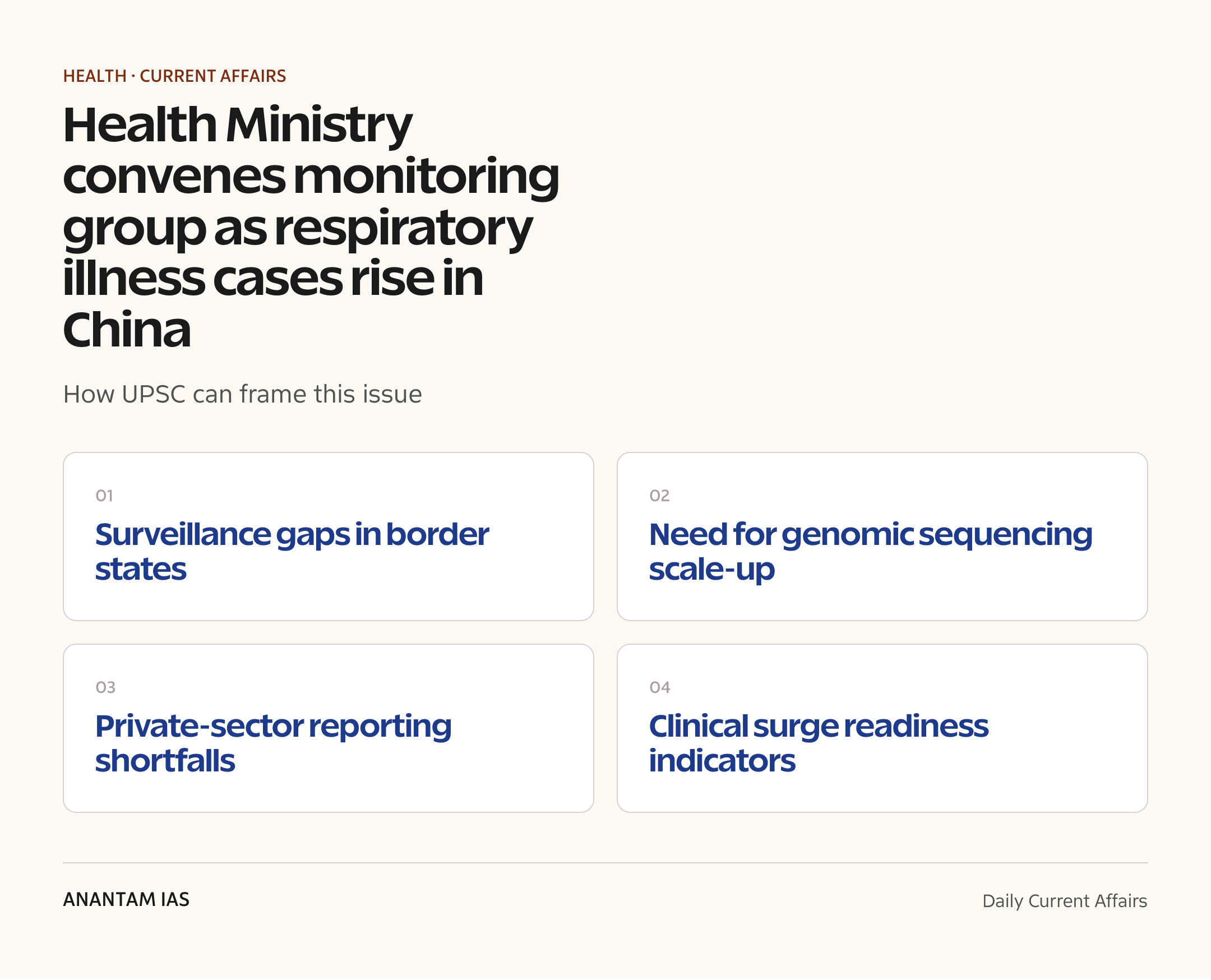
- Private sector reporting: Mandate timely case reporting from private hospitals with enforceable timelines.
- Event-based surveillance: Expand community event reporting lines to capture unusual respiratory clusters.
- Digital tools: Use mobile reporting and dashboards to visualise hotspots and laboratory backlogs.
Enhance laboratory and genomic capacity
- Expand VRDL reach: Add targeted labs in border states and high-traffic hubs for faster turnaround.
- Sequencing scale-up: Prioritise sequencing of suspect clusters to detect novel agents or variants.
- Quality networks: Strengthen proficiency testing and inter-lab data sharing protocols.
- Public-private collaboration: Engage accredited private labs in surge testing under standard reporting SLAs.
Improve clinical readiness and supply chains
- Surge protocols: Predefine triage algorithms and critical care surge staffing models for respiratory waves.
- Supply monitoring: Maintain central dashboards for oxygen, ventilators and essential drugs across states.
- Training: Rapid refresher training for frontline clinicians on updated respiratory-management algorithms.
- Referral clarity: Map and publicise referral centres for severe respiratory cases by district.
Bolster international coordination and risk communication
- WHO liaison: Keep active channels with WHO for situational updates and technical advisories.
- Regional diplomacy: Use bilateral health channels to seek timely data from affected neighbours.
- Transparent communication: Issue clear advisories to public and clinicians to reduce misinformation.
- Travel guidance: Calibrate passenger advisories and testing recommendations based on evolving risk.
Conclusion
The JMG meeting reflects a precautionary, structured approach to a cross-border respiratory signal. Sustained vigilance, faster data flows between surveillance and labs, clinical surge preparedness and active international coordination will reduce importation risk and protect public health in India.
UPSC Practice Questions
Prelims MCQ 1
Which agency is primarily responsible for outbreak investigation and coordination of central rapid response teams in India?
(a) A. Integrated Disease Surveillance Programme (IDSP) (b) B. National Centre for Disease Control (NCDC) (c) C. Indian Council of Medical Research (ICMR) (d) D. World Health Organization (WHO)
Answer: B
Explanation:
NCDC leads epidemiological investigations and coordinates central rapid response teams and technical guidance during outbreaks. IDSP is the surveillance network that feeds data to NCDC, while ICMR focuses on laboratory and research support.
Prelims MCQ 2
The Integrated Disease Surveillance Programme (IDSP) primarily collects which type of data for early outbreak detection?
(a) A. Genomic sequencing data (b) B. Syndromic and routine surveillance data (c) C. International travel manifests (d) D. Vaccine coverage surveys
Answer: B
Explanation:
IDSP focuses on syndromic and routine surveillance data from peripheral health facilities and districts to detect unusual increases in disease and trigger investigations.
UPSC Mains Questions
- {‘question’: ‘Analyse the strengths and weaknesses of India’s existing surveillance and laboratory networks in detecting and responding to cross-border respiratory disease threats. Suggest reforms to enhance early detection and response.’, ‘model_answer_points’: [‘Strengths: Tiered laboratory network under ICMR and VRDLs; established IDSP reporting channels; NCDC rapid response teams; experience from COVID-19 improved capacities.’, ‘Weaknesses: Delays in private-sector reporting; uneven lab coverage in remote and border regions; limited routine genomic sequencing capacity; data fragmentation across systems.’, ‘Reforms: Mandate integrated digital reporting across public and private sectors; expand sequencing hubs in strategic states; invest in workforce for field epidemiology; ensure sustainable financing for surveillance.’, ‘Implementation: Set SLAs for test turnaround and reporting; create legal provisions for event-based reporting; incentivise state-level investments in public-health labs.’]}
- {‘question’: ‘Discuss the role of international cooperation in managing potential respiratory outbreaks originating in neighbouring countries. How should India balance public-health measures and economic/travel considerations?’, ‘model_answer_points’: [‘Role: Timely data sharing, joint investigations, technical assistance and resource mobilisation through WHO and bilateral channels improve situational awareness.’, ‘Balancing: Risk-based travel advisories, targeted testing and quarantine for high-risk travellers protect health while minimising broad economic disruption.’, ‘Diplomacy: Use health diplomacy to obtain transparent information and coordinate cross-border case management and contact tracing.’, ‘Policy: Adopt flexible measures that can be scaled up or down by epidemiological triggers to reduce unnecessary trade or travel restrictions.’]}
Source: PIB, Ministry of Health & Family Welfare.
Frequently Asked Questions
q
a
q
a
q
a
q
a
q
a
q
a