Right to Menstrual Health: Toward a Constitutional Guarantee
Why in News?
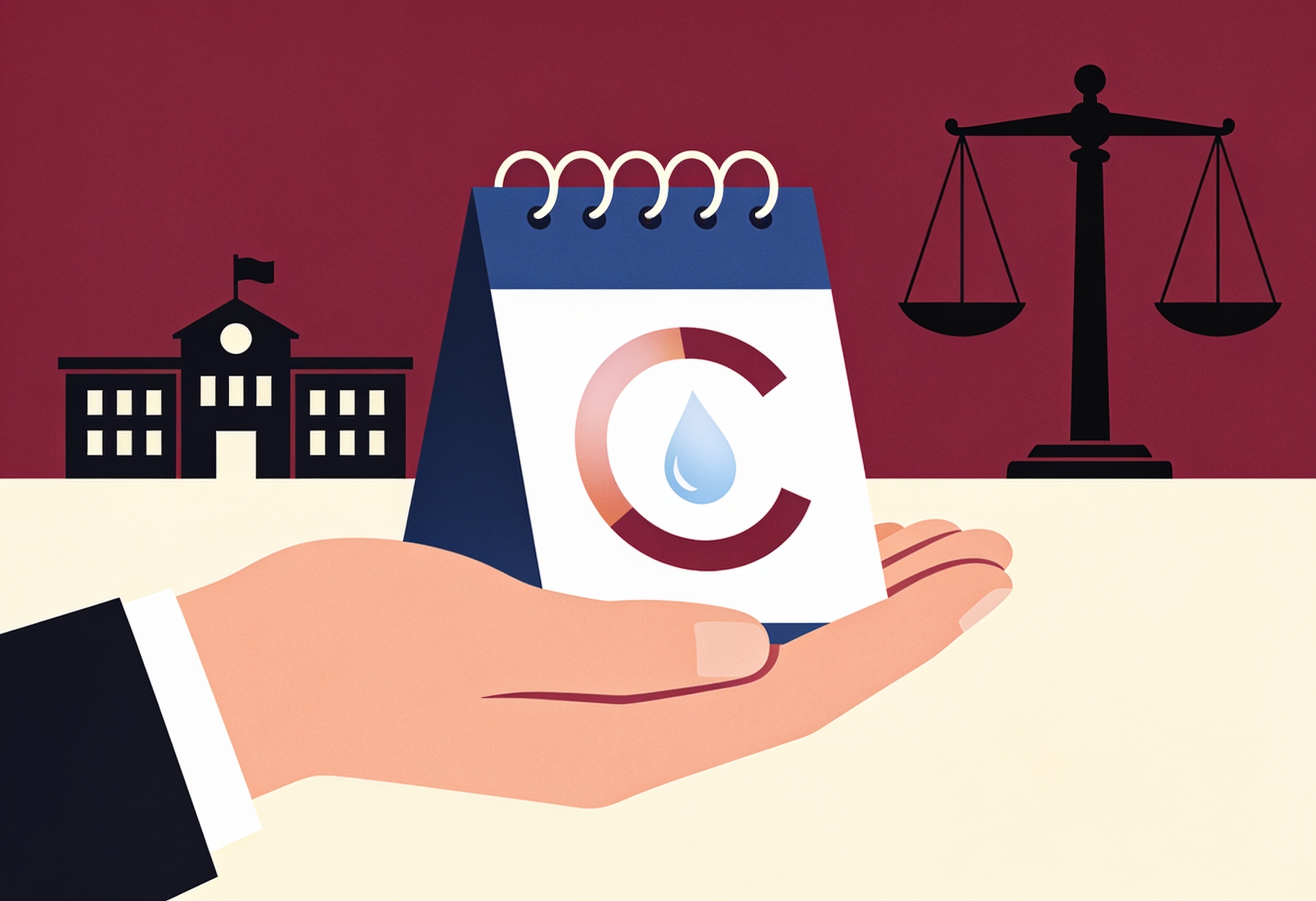
A growing line of judicial reasoning and policy debate has begun to frame menstrual health not as a private inconvenience but as a constitutional entitlement flowing from the Article 21 right to life, dignity and health, read with Article 15(3) which permits special provisions for women and children.
The Supreme Court of India directed the Union and the States to frame a uniform national menstrual-hygiene policy for school-going girls, covering access to products, disposal infrastructure and awareness, pushing the issue from welfare scheme to enforceable right.
- The Court treated menstrual hygiene as part of the guarantees of health, dignity and education, not optional charity.
- It sought a national policy on menstrual-hygiene management (MHM) for adolescent girls across government and aided schools.
- Directions touched separate functional toilets, sanitary-pad access and safe disposal, linking the issue to school retention.
- The debate widened to menstrual leave, free product access and de-stigmatisation in workplaces and public institutions.
The development matters in the context of:
- This matters because roughly one in five adolescent girls is reported to drop out of school around menarche, tying menstruation to the right to education under Article 21A.
- It sits at the intersection of reproductive health, gender equity and the directive-principles vision of a welfare state.
- It also engages India’s commitments under the Sustainable Development Goals 3 (health), 5 (gender equality) and 6 (water and sanitation).
UPSC Relevance
Prelims Relevance
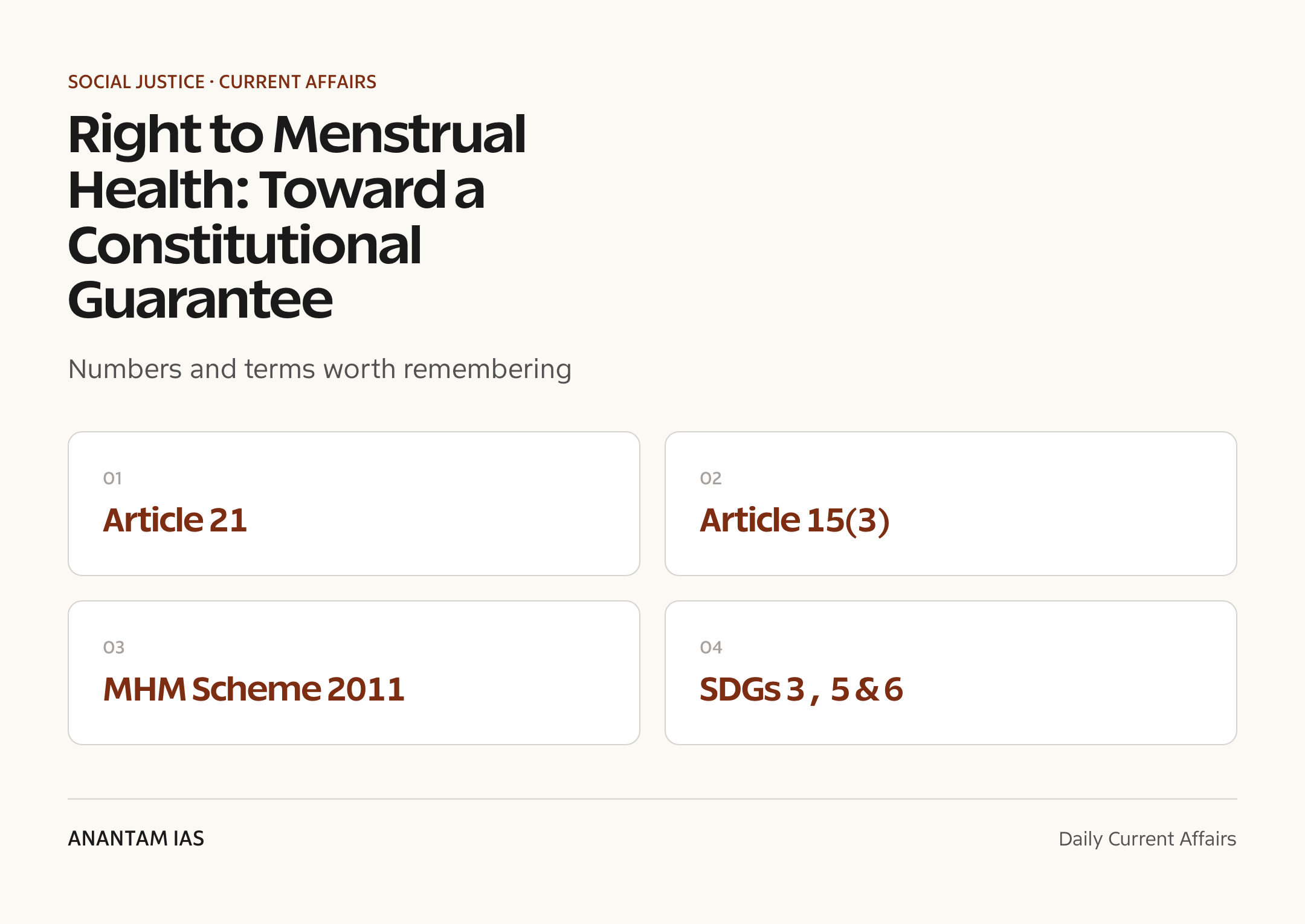
- Article 21 — right to life, expanded to include health and human dignity
- Article 15(3) — special provisions for women and children
- Article 21A and the link between menstruation and school dropout
- Menstrual Hygiene Scheme (2011) under the National Health Mission
- Swachh Bharat Mission and school sanitation / separate toilets
- Pradhan Mantri Bhartiya Janaushadhi Pariyojana — low-cost ‘Suvidha’ sanitary pads
- RMNCH+A framework and the adolescent-health programme RKSK
- SDGs 3, 5 and 6 and their relevance to menstrual health
- Difference between menstrual hygiene management and menstrual health (a wider WHO concept)
Mains Relevance
GS Paper 2
- How the judiciary has read socio-economic entitlements like menstrual health into Article 21, and the limits of such judicial direction.
- Welfare schemes versus rights: assessing the Menstrual Hygiene Scheme and product-access programmes against an enforceable-right standard.
GS Paper 1
- Menstrual stigma as a marker of gender inequality and a barrier to women’s participation in education and the workforce.
Essay
- Dignity is not a privilege: making the invisible needs of women a public concern.
- A society is judged by how it treats its most ordinary biological realities.
Background and Context
The constitutional foundation
The case for a right to menstrual health is built on rights the Constitution already guarantees, not a new fundamental right.
- Article 21 has been read by courts to include the right to life, the right to health and to live with human dignity (a line running from Francis Coralie Mullin onward).
- Article 15(3) expressly allows the State to make special provisions for women and children, giving constitutional cover to targeted menstrual schemes.
- Article 21A guarantees free and compulsory education up to 14; menstruation-linked dropout directly undercuts this promise.
- Article 47, a Directive Principle, casts a duty on the State to raise nutrition and public health — the policy backbone for menstrual welfare.
From scheme to right — the policy ladder
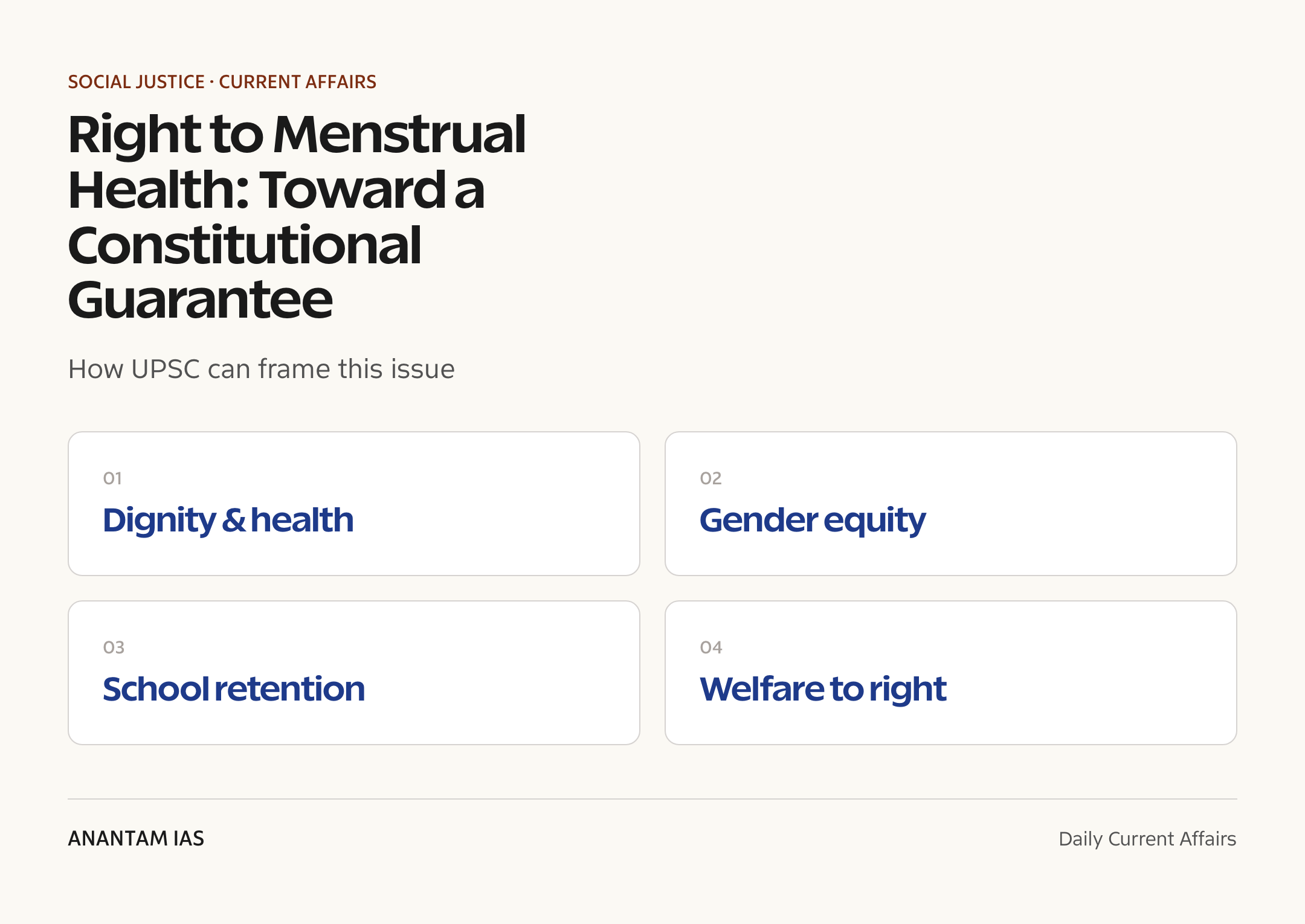
India already runs a stack of programmes; the shift is from discretionary welfare to a justiciable guarantee.
- The Menstrual Hygiene Scheme (2011) under the National Health Mission subsidises sanitary napkins for rural adolescent girls through ASHA workers.
- Swachh Bharat Mission built school toilets and pushed separate, functional toilets for girls as a retention measure.
- Pradhan Mantri Bhartiya Janaushadhi Pariyojana sells ‘Suvidha’ pads at a low fixed price through Janaushadhi Kendras.
- Adolescent care also flows through the RKSK programme and the wider RMNCH+A strategy under the Ministry of Health.
The gaps the right is meant to close
Access, disposal, affordability and stigma remain uneven, which is why courts treat the issue as unfinished.
- Disposal infrastructure — incinerators and safe waste handling — lags far behind product distribution, raising health and environmental costs.
- Affordability and continuity of supply varies; stock-outs in schools and kendras blunt the schemes’ reach.
- Stigma and silence keep many girls from seeking facilities, so infrastructure alone does not guarantee use.
- Data and standards differ across States, which is why the Court pressed for one national policy baseline.
The contested frontier — menstrual leave
Beyond schools, the debate has moved to the workplace, where opinion is genuinely divided.
- Some States and employers have introduced menstrual leave, framing it as dignity and health support.
- Critics warn it can become a pretext for workplace discrimination in hiring and pay, harming the very group it protects.
- A middle view favours flexible leave and facilities over a separate mandatory category, keeping the choice with the worker.
- Courts have so far been cautious about a blanket judicial mandate, treating leave as a policy question for the legislature.
Menstrual hygiene versus menstrual health
The vocabulary itself is shifting, and that shift carries the rights argument.
- Menstrual hygiene management (MHM) focuses narrowly on products, water and disposal.
- Menstrual health, as framed by the WHO, is broader — covering information, care, a supportive environment and freedom from coercion or stigma.
- The wider framing maps neatly onto Article 21‘s dignity standard, strengthening the constitutional claim.
- It also reframes the issue as one of autonomy and equality, not merely sanitation.
The global benchmark
India’s move sits within a recognisable international trend that examiners may ask you to compare.
- Scotland became the first country to make period products legally free for all who need them.
- Several countries have cut or removed the ‘tampon tax’, treating products as essentials, not luxuries.
- The SDGs bind menstrual health to gender equality (5) and water-sanitation (6), giving India a reporting yardstick.
- UN bodies increasingly classify menstrual health as a human-rights issue, mirroring India’s Article-21 reasoning.
Way Forward
Codify a national baseline
- Frame the national menstrual-hygiene policy the Court sought, with enforceable minimum standards for schools and public institutions.
- Tie disbursal to outcomes — functional toilets, stock continuity and disposal — not just product counts.
Close the disposal and supply gap
- Invest in safe disposal (incinerators, biodegradable products) alongside distribution.
- Strengthen Janaushadhi and NHM supply chains to end stock-outs in rural areas.
Treat stigma as policy, not afterthought
- Embed menstrual health education for all genders in the school curriculum to break silence.
- Approach menstrual leave through flexible, non-stigmatising design that protects against workplace discrimination.
Conclusion
Reading menstrual health into Article 21 reframes a routine biological reality as a question of dignity, equality and the right to education. It pushes the State from charitable distribution toward an enforceable guarantee, with the schools where girls drop out as the first test of intent.
The hard work now lies in execution — disposal, supply continuity, education and sensitively designed workplace policy. A right is only as real as the toilet that works and the silence that breaks; the constitutional promise will be measured there, not in the judgment alone.
UPSC Practice Questions
Prelims MCQ 1
With reference to the constitutional basis for menstrual health in India, consider the following statements:
- The right to health has been read by courts into the right to life under Article 21.
- Article 15(3) permits the State to make special provisions for women and children.
- The right to menstrual health is enumerated as a distinct fundamental right in Part III of the Constitution.
How many of the above statements are correct?
(a) Only one (b) Only two (c) All three (d) None
Answer: (b) Only two
Explanation:
Statements 1 and 2 are correct — courts have read health and dignity into Article 21, and Article 15(3) allows special provisions for women and children. Statement 3 is wrong: there is no separately enumerated fundamental right to menstrual health; the claim is derived from Article 21 read with 15(3).
Prelims MCQ 2
Under which scheme are low-cost ‘Suvidha’ sanitary napkins made available through dedicated outlets?
(a) Menstrual Hygiene Scheme (b) Swachh Bharat Mission (c) Pradhan Mantri Bhartiya Janaushadhi Pariyojana (d) Rashtriya Kishor Swasthya Karyakram
Answer: (c) Pradhan Mantri Bhartiya Janaushadhi Pariyojana
Explanation:
‘Suvidha’ biodegradable sanitary napkins are sold at a low fixed price through Janaushadhi Kendras under the PM Bhartiya Janaushadhi Pariyojana. The Menstrual Hygiene Scheme (2011) subsidises napkins for rural adolescent girls via the NHM but is a separate programme.
UPSC Mains Questions
- Indian courts have progressively read socio-economic entitlements into the right to life under Article 21. Examine this trend with reference to menstrual health, and discuss the limits of securing such rights through judicial direction. (250 words)
- “Menstrual health is a question of dignity and equality, not merely sanitation.” Critically evaluate India’s policy framework for menstrual health and suggest measures to make it a substantive guarantee. (250 words)
- Discuss whether mandatory menstrual leave advances or undermines gender equity in the workplace, and recommend a balanced policy approach. (150 words)
Sources: Supreme Court of India and Ministry of Health and Family Welfare.
Frequently Asked Questions
Is there a fundamental right to menstrual health in India?
There is no separately enumerated fundamental right to menstrual health. Courts derive it from the right to life under Article 21, which has been read to include health and human dignity, combined with Article 15(3) that allows special provisions for women and children. So it is a derived, judicially recognised entitlement rather than a distinct named right in Part III.
What did the Supreme Court direct on menstrual hygiene?
The Supreme Court asked the Union and the States to frame a uniform national menstrual-hygiene policy for school-going girls. The directions covered access to sanitary products, separate functional toilets and safe disposal infrastructure, treating these as part of the rights to health, dignity and education rather than as optional welfare measures.
Which schemes support menstrual hygiene in India?
Key programmes include the Menstrual Hygiene Scheme (2011) under the National Health Mission, which subsidises napkins for rural adolescent girls, the Swachh Bharat Mission for school sanitation and separate toilets, and the Pradhan Mantri Bhartiya Janaushadhi Pariyojana, which sells low-cost ‘Suvidha’ pads. Adolescent care also flows through the RKSK programme.
How does menstrual health link to school dropout?
Inadequate toilets, products and information lead many adolescent girls to miss classes or leave school around menarche. Because Article 21A guarantees free and compulsory education up to 14, this dropout connects menstrual health directly to the right to education, which is why courts and policymakers treat schools as the first place to act.
Why is menstrual leave a contested issue?
Supporters see paid menstrual leave as dignity and health support. Critics fear it may be used as a pretext to discriminate against women in hiring and pay, harming the group it aims to help. A middle path favours flexible leave and better facilities over a separate mandatory category, and courts have largely left it to the legislature as a policy choice.
How does this connect to the Sustainable Development Goals?
Menstrual health sits across three SDGs: Goal 3 on good health and well-being, Goal 5 on gender equality, and Goal 6 on clean water and sanitation. Framing menstruation as a health and equality issue, rather than just sanitation, aligns India’s domestic policy with its international reporting commitments under the 2030 Agenda.