Right to Walk on Safe Footpaths: Supreme Court Reads Pedestrian Access into Article 21
Why in News?
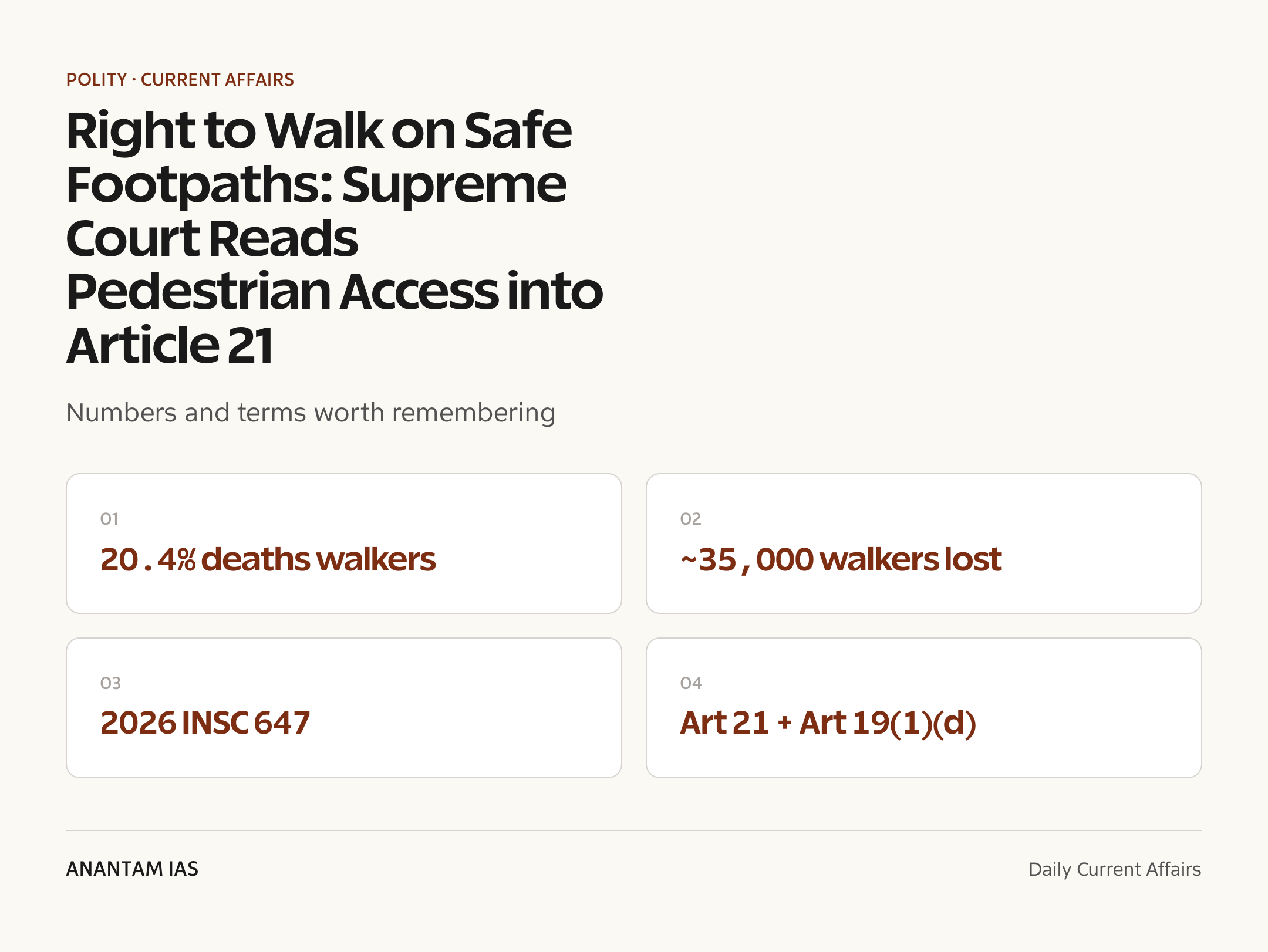
On 19 June 2026, the Supreme Court held that the right to walk on safe, demarcated and obstruction-free footpaths is a fundamental right flowing from Article 21 (right to life and personal liberty) and Article 19(1)(d) (freedom of movement). The ruling came in Maniyar Iliyaz @ Shaik Riyaz v. P. Ayyappan, reported as 2026 INSC 647, decided by a Bench of Justice P.S. Narasimha and Justice Atul S. Chandurkar.
The Court converted the proceedings into a writ petition under Article 32 and asked the Union Ministries handling urban, rural and road-transport affairs to frame a statutory framework and a dedicated regulator for pedestrian infrastructure. The Hindu’s editorial flagged this as a landmark recognition that the pedestrian’s right of way takes precedence over the motorist’s convenience, while the Indian Express explained how citizens may now enforce a restitutionary remedy when footpaths are encroached or absent.
- Right to walk on demarcated footpaths recognised as part of Article 21 and Article 19(1)(d).
- Case: Maniyar Iliyaz @ Shaik Riyaz v. P. Ayyappan, 2026 INSC 647 (19 June 2026); Bench of Justices P.S. Narasimha and Atul S. Chandurkar.
- Proceedings converted into an Article 32 petition; Union Ministries of Housing and Urban Affairs, Rural Development and Road Transport asked to build a statutory regulator.
- Citizens may seek a restitutionary remedy against municipal bodies and authorities under the Specific Relief Act, 1963 (Sections 38-40), distinct from Motor Vehicles Act compensation.
- Pedestrian right of way held to override the privilege of a motorised vehicle on the public way.
The development matters in the context of:
- Footpaths in most Indian cities are encroached by parking, vendors, signage and utility boxes, pushing pedestrians onto carriageways.
- Pedestrians accounted for about 20.4% of India’s road-accident deaths in 2023, roughly 35,000 fatalities out of 1,72,890 total deaths (MoRTH).
- The judgment continues the post-Maneka Gandhi (1978) expansion of Article 21 into a guarantee of dignified, safe living, not bare survival.
UPSC Relevance
Prelims Relevance
- Article 21 — right to life and personal liberty; judicially expanded to cover health, dignity, clean environment and now safe pedestrian access.
- Article 19(1)(d) — freedom to move freely throughout the territory of India.
- Article 32 — right to constitutional remedies; used to convert the matter into a writ petition.
- Maneka Gandhi v. Union of India (1978) — procedure affecting life and liberty must be fair, just and reasonable; foundation of expansive Article 21.
- Olga Tellis v. Bombay Municipal Corporation (1985) — right to livelihood read into Article 21; parallel logic of dignified urban life.
- Specific Relief Act, 1963 (Sections 38-40) — perpetual and mandatory injunctions, basis of the restitutionary remedy.
- Rights of Persons with Disabilities Act, 2016 — mandates accessible public spaces and barrier-free footpaths.
- Case citation format: INSC = Indian Supreme Court neutral citation (here 2026 INSC 647).
Mains Relevance
GS Paper 2
- Judicial expansion of Article 21 as a source of socio-economic and infrastructural rights, and the limits of reading positive duties into fundamental rights.
- Enforceability of welfare directions against municipal bodies and the role of the judiciary in urban governance vis-a-vis the executive.
GS Paper 1
- Urbanisation and its problems: encroachment, poor last-mile mobility, and the marginalisation of pedestrians, the elderly and persons with disabilities in Indian city design.
Essay
- Rights without infrastructure are promises without delivery: the gap between constitutional guarantees and the lived city.
- Designing cities for people, not just vehicles.
Background and Context
What the Court actually held
The ruling locates the pedestrian’s right of way firmly within Part III of the Constitution.
- Safe, demarcated and obstruction-free footpaths are integral to Article 21 and the freedom of movement under Article 19(1)(d).
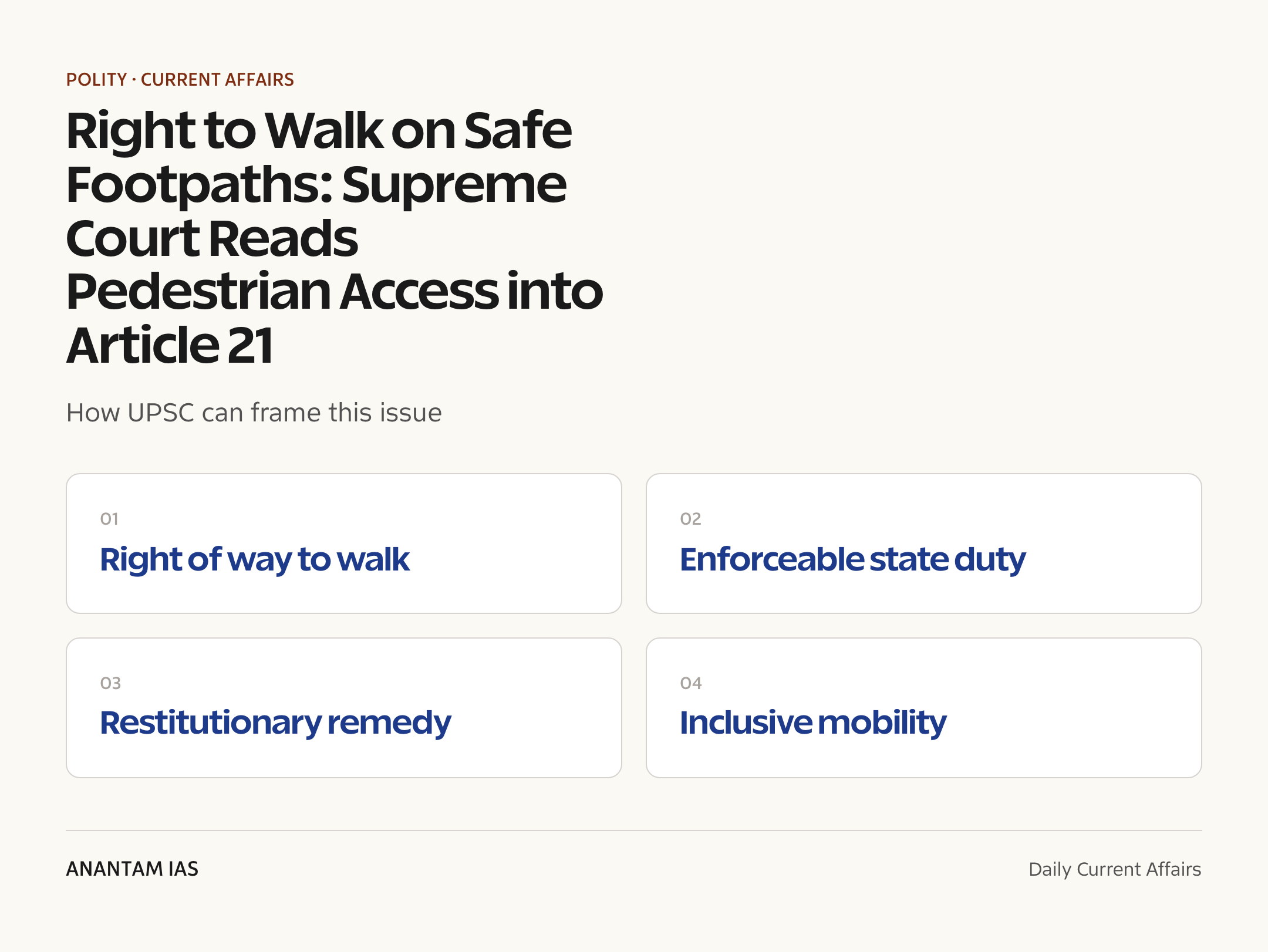
- The right carries a corresponding state duty on municipalities, development authorities and panchayats to provide and maintain usable footpaths.
- Where footpaths are absent or encroached, a citizen can seek a restitutionary remedy to restore the public way, enforced through injunctions under the Specific Relief Act, 1963.
- The Court clarified that the pedestrian’s right overrides the convenience of motorists, reversing the usual hierarchy of the road.
The Article 21 jurisprudence behind it
The judgment sits in a long line of cases that turned the right to life into a right to dignified life.
- Maneka Gandhi (1978) opened Article 21 to substantive review, requiring any deprivation to be fair, just and reasonable.
- Later rulings read health, clean environment, shelter and livelihood into the right to life, including Olga Tellis (1985) on pavement dwellers’ livelihood.
- Safe mobility now joins this cluster: the ability to move through the city without bodily risk is treated as part of a dignified existence.
- The reasoning converts an aspirational welfare goal into a justiciable, enforceable claim against the state.
Why footpaths are a road-safety emergency
Pedestrians are among the most exposed and least protected users of Indian roads.
- Pedestrians made up roughly 20.4% of road-accident deaths in 2023, around 35,000 lives, the second-highest category after two-wheeler riders (MoRTH).
- India recorded about 4,80,583 accidents and 1,72,890 deaths in 2023, among the highest road-death tolls in the world.
- Missing or blocked footpaths force walkers onto fast carriageways, where the speed differential makes collisions lethal.
- Safe footpaths align with India’s commitment to SDG 11.2 (safe, accessible transport) and the broader goal of halving road deaths.
Accessibility and inclusive urban mobility
A footpath that excludes the wheelchair user or the visually impaired is not truly a footpath.
- The Court stressed that footpaths must be usable by persons with disabilities, the elderly and children.
- This echoes the Rights of Persons with Disabilities Act, 2016, which mandates barrier-free access to public spaces and infrastructure.
- Universal-design features such as tactile paving, ramps, continuous gradients and adequate width become legal expectations, not optional add-ons.
- Walkability also supports public health, lower emissions and equitable access for those who cannot afford private vehicles.
Enforcement, remedies and the proposed regulator
The ruling tries to bridge the familiar gap between fine principles and ground reality.
- Proceedings were converted into an Article 32 petition so the issue can be supervised as a continuing matter.
- The Court asked the Ministries of Housing and Urban Affairs, Rural Development and Road Transport and Highways to design a statutory framework for pedestrian planning.
- It recommended a dedicated regulator to set standards, audit footpaths and enforce maintenance.
- The restitutionary remedy gives individual citizens a direct lever against local bodies that fail to act, beyond writ petitions.
Way Forward
Codify a national pedestrian-rights framework
- Enact the suggested statutory framework with enforceable minimum standards for footpath width, continuity and surface quality.
- Set up the proposed regulator with audit and penalty powers over defaulting urban local bodies.
Reclaim and design for the pedestrian
- Embed complete-streets and universal-design norms in master plans and municipal building bye-laws.
- Balance encroachment removal with vendor rehabilitation so livelihoods and walkability are reconciled, not traded off.
Fund, audit and digitise
- Tie urban-mission grants to footpath audits and pedestrian-death reduction targets.
- Use GIS mapping and citizen-reporting apps to track encroachments and maintenance backlogs transparently.
Conclusion
By reading the right to walk into Articles 21 and 19(1)(d), the Supreme Court has turned a basic civic expectation into an enforceable constitutional duty, placing the pedestrian, long the afterthought of Indian road design, at the centre of urban governance.
The harder task now lies with the executive: a right that depends on demarcated, maintained and accessible footpaths will be real only when budgets, regulators and municipal accountability catch up with the judgment’s promise.
UPSC Practice Questions
Prelims MCQ 1
With reference to the Supreme Court’s 2026 ruling on the right to walk on footpaths, consider the following statements:
- The right was located within Article 21 and Article 19(1)(d) of the Constitution.
- The Court directed that pedestrian rights would override the privilege of a motorised vehicle.
- The judgment created an entirely new fundamental right not derived from any existing Article.
How many of the above statements are correct?
(a) Only one (b) Only two (c) All three (d) None
Answer: (b) Only two
Explanation:
Statements 1 and 2 are correct. The Court read the right into the existing Articles 21 and 19(1)(d) and held that the pedestrian right of way takes precedence over motorists. Statement 3 is wrong: the Court did not create a new free-standing right; it interpreted existing fundamental rights to include safe pedestrian access.
Prelims MCQ 2
The restitutionary remedy recognised by the Supreme Court for the violation of the right to walk on demarcated footpaths is primarily anchored in which of the following?
(a) The Motor Vehicles Act, 1988 (b) The Specific Relief Act, 1963 (c) The Rights of Persons with Disabilities Act, 2016 (d) The Disaster Management Act, 2005
Answer: (b) The Specific Relief Act, 1963
Explanation:
The Court grounded the restitutionary remedy, enforceable against municipal bodies and authorities, in the injunction provisions (Sections 38-40) of the Specific Relief Act, 1963. This remedy is distinct from compensation claims under the Motor Vehicles Act, 1988.
UPSC Mains Questions
- The Supreme Court has read the right to safe, demarcated footpaths into Article 21. Examine how the expansion of Article 21 jurisprudence converts welfare aspirations into enforceable state duties, and discuss the challenges of implementing such rights through municipal governance.
- Indian cities are designed for vehicles, not people. In light of the Supreme Court’s pedestrian-rights ruling, critically analyse the road-safety, accessibility and inclusive-mobility dimensions of urban planning in India and suggest a way forward.
Sources: The Hindu and Indian Express Explained.
Frequently Asked Questions
What did the Supreme Court rule about footpaths in June 2026?
In Maniyar Iliyaz @ Shaik Riyaz v. P. Ayyappan (2026 INSC 647), decided on 19 June 2026, the Court held that the right to walk on safe, demarcated and obstruction-free footpaths is a fundamental right flowing from Article 21 and Article 19(1)(d). It made providing and maintaining usable footpaths an enforceable duty of the state and local bodies.
Which constitutional Articles did the Court rely on?
The Court relied on Article 21, the right to life and personal liberty, and Article 19(1)(d), the freedom to move freely throughout India. It also converted the proceedings into a writ petition under Article 32, the right to constitutional remedies, so the matter could be supervised as a continuing issue.
Did the Court create a brand-new fundamental right?
No. The Court did not invent a new free-standing right. Following the post-Maneka Gandhi (1978) line of cases, it interpreted the existing right to life under Article 21 to include safe, dignified pedestrian movement. This is the same technique used to read health, environment and livelihood into Article 21.
What is the restitutionary remedy for citizens?
If footpaths are absent or encroached, a citizen can seek restoration of the public way through injunctions under the Specific Relief Act, 1963 (Sections 38-40), enforceable against municipal bodies, development authorities and panchayats. This remedy is separate from compensation claims under the Motor Vehicles Act.
Why is footpath safety a serious road-safety issue in India?
Pedestrians made up roughly 20.4% of road-accident deaths in 2023, about 35,000 of the 1,72,890 total fatalities recorded across some 4,80,583 accidents (MoRTH). Missing or blocked footpaths push walkers onto fast carriageways, where collisions with vehicles are far more likely to be fatal.
How does the ruling connect to accessibility and disability rights?
The Court stressed that footpaths must be usable by persons with disabilities, the elderly and children. This reinforces the Rights of Persons with Disabilities Act, 2016, which mandates barrier-free public spaces, making universal-design features such as tactile paving, ramps and adequate width legal expectations rather than optional extras.