RK-251 Shows How Tumour-Activated Cancer Drugs Work
Why in News?
The Ministry of Science and Technology reported on 19 August 2026 that Indian researchers developed RK-251, a tumour-activated drug candidate studied in breast-cancer cells and zebrafish embryos.
- RK-251 is designed as a reactive-oxygen-species-activated candidate rather than a medicine that remains equally active throughout the body.
- Higher ROS conditions trigger RK-251 to release NBDHEX, the anticancer payload examined by the researchers.
- The reported evidence covers aggressive triple-negative breast-cancer cells and behavioural observations in zebrafish embryos.
- The work is preclinical; it has not established safety, efficacy, dosage or benefit in human patients.
- The study illustrates how a prodrug can use a biological condition near diseased cells as an activation switch.
- It also shows why promising laboratory selectivity must be separated from claims about clinical treatment or replacing chemotherapy.
UPSC Relevance
Prelims Relevance
- Meaning of a prodrug and stimulus-responsive drug activation
- Role of reactive oxygen species in cellular signalling and oxidative stress
- Difference between in vitro cell studies, animal-model work and human clinical trials
- Basic features of triple-negative breast cancer
- Research role of zebrafish embryos in early biomedical studies
Mains Relevance
GS Paper 3
- Potential of stimulus-responsive prodrugs in precision medicine
- Scientific and regulatory steps between preclinical findings and patient use
GS Paper 2
- Public-health importance of communicating biomedical evidence without overstating readiness
Essay
- Scientific progress depends as much on disciplined evidence as on inventive laboratory design.
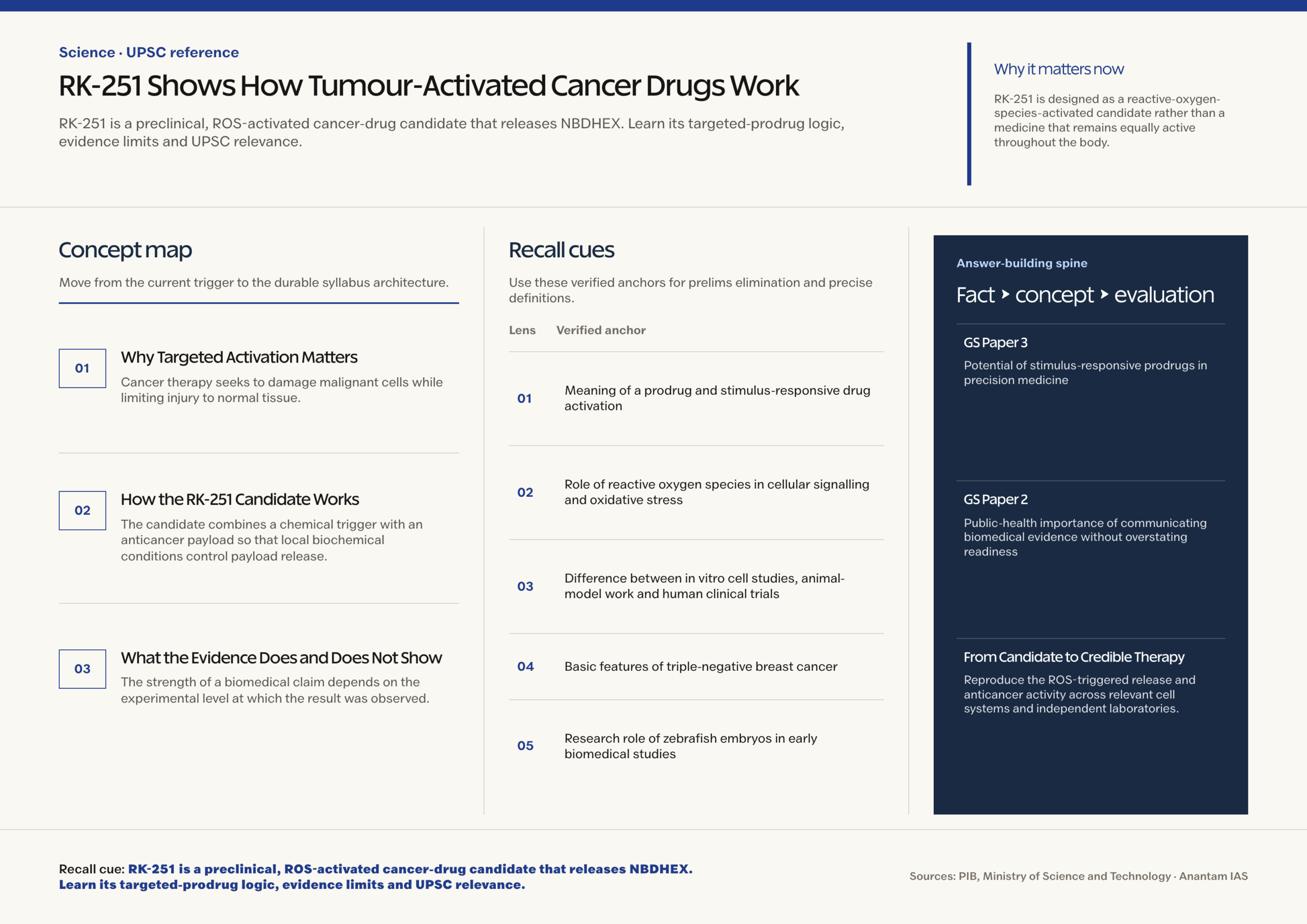
Background and Context
Why Targeted Activation Matters
Cancer therapy seeks to damage malignant cells while limiting injury to normal tissue, but biological differences are rarely absolute.
- Conventional anticancer drugs may affect both tumour and healthy cells because many targets involved in growth or division are not confined to cancer.
- A targeted prodrug addresses this problem by circulating in a less active form and releasing its active payload under a selected biological condition, adding a chemical control step before action.
- The activation condition must differ enough between target and non-target environments to create a useful therapeutic window without assuming perfect selectivity.
- RK-251 uses elevated reactive oxygen species as its proposed trigger, linking drug activation to a biochemical feature observed in many cancer cells.
- This design is a research strategy, not proof that every tumour has the same ROS level or that normal tissues never experience oxidative stress.
How the RK-251 Candidate Works
The candidate combines a chemical trigger with an anticancer payload so that local biochemical conditions control payload release.
- Reactive oxygen species are oxygen-containing molecules formed during metabolism; excessive production or weak antioxidant control can create oxidative stress.
- When exposed to higher ROS conditions, RK-251 undergoes activation and releases NBDHEX, rather than relying only on passive accumulation near a tumour.
- The PIB account says NBDHEX blocks proteins that cancer cells may use for survival and treatment resistance, supplying the candidate’s intended anticancer action.
- The trigger-payload arrangement makes RK-251 a useful example of stimulus-responsive drug delivery, where chemistry links a measurable condition to local drug action rather than assuming the payload can distinguish cells alone.
- Aspirants should distinguish the mechanism hypothesis from a clinical outcome: showing activation and cell-level activity does not establish patient benefit.
What the Evidence Does and Does Not Show
The strength of a biomedical claim depends on the experimental level at which the result was observed.
- Researchers reported activity against aggressive triple-negative breast-cancer cells; such cell work helps test mechanism and selectivity under controlled laboratory conditions before more complex whole-organism questions are addressed in subsequent research stages.
- Triple-negative disease lacks the commonly tested oestrogen, progesterone and HER2 targets, which makes new treatment approaches scientifically important but not automatically effective.
- In zebrafish embryos, researchers observed desired fluorescence in the presence of ROS and no obvious toxicity signs under the reported study conditions.
- An embryo observation cannot establish human safety, long-term toxicity, pharmacokinetics, dosage, tumour response or survival benefit; each requires further staged investigation.
- No human trial, regulatory approval or established clinical efficacy was reported, so RK-251 cannot presently be described as a replacement for chemotherapy.
Way Forward
From Candidate to Credible Therapy
- Reproduce the ROS-triggered release and anticancer activity across relevant cell systems and independent laboratories.
- Study absorption, distribution, metabolism, excretion and toxicity in suitable preclinical models before proposing human exposure.
- Determine whether tumour ROS variability permits reliable activation without harmful release in inflamed or oxidatively stressed normal tissues.
- Advance to regulated clinical trials only after adequate preclinical evidence supports a justified starting dose and monitoring plan.
Conclusion
- RK-251 demonstrates a promising design principle: use a tumour-associated chemical condition to activate a drug candidate and release its payload closer to intended cells.
- In a Mains answer, pair this precision-medicine promise with the evidence ladder: cell work and zebrafish observations precede, but cannot substitute for, human trials.
- The correct conclusion is cautious: RK-251 merits further validation, while present evidence supports neither clinical safety claims nor replacement of chemotherapy.
UPSC Practice Questions
Prelims MCQ 1
With reference to RK-251, consider the following statements:
- It is designed for activation under elevated reactive-oxygen-species conditions.
- Its activation releases the anticancer compound NBDHEX.
- Its safety and efficacy have been established through human clinical trials.
How many of the above statements are correct?
(a) Only one (b) Only two (c) All three (d) None
Answer: (b) Only two
Explanation:
Statements 1 and 2 describe the reported mechanism. Statement 3 is incorrect because the evidence is preclinical and includes breast-cancer cell work and zebrafish embryos, not human trials.
Prelims MCQ 2
Which one of the following best describes a stimulus-responsive prodrug?
(a) A drug that remains equally active in every tissue (b) A vaccine that creates antibodies against a chemical trigger (c) A candidate designed to release an active payload under a selected biological condition (d) A medicine approved without preclinical testing
Answer: (c) A candidate designed to release an active payload under a selected biological condition
Explanation:
A stimulus-responsive prodrug links activation or payload release to a condition such as a chemical feature in the target environment.
UPSC Mains Questions
- Explain how stimulus-responsive prodrugs could improve the selectivity of cancer treatment. What scientific limitations must be resolved before clinical use?
- Preclinical promise should not be confused with therapeutic readiness. Discuss with reference to the development of RK-251.
Source: PIB, Ministry of Science and Technology.
Frequently Asked Questions
What is RK-251?
RK-251 is a preclinical cancer-drug candidate designed to activate under higher reactive-oxygen-species conditions and release the anticancer compound NBDHEX.
How is RK-251 intended to become active?
Its chemical design responds to elevated reactive oxygen species, triggering release of NBDHEX. This stimulus-responsive mechanism aims to concentrate activity under selected cellular conditions.
What evidence has been reported for RK-251?
Researchers reported activity in triple-negative breast-cancer cell work and observations in zebrafish embryos. These are preclinical findings, not evidence of benefit in patients.
Can RK-251 currently replace chemotherapy?
No. It has no reported human trial evidence or regulatory approval. More preclinical validation and regulated clinical testing are required before any treatment comparison is justified.