RTI Second Appeals: The Central Information Commission Rebuilds Its Case System
Why in News?
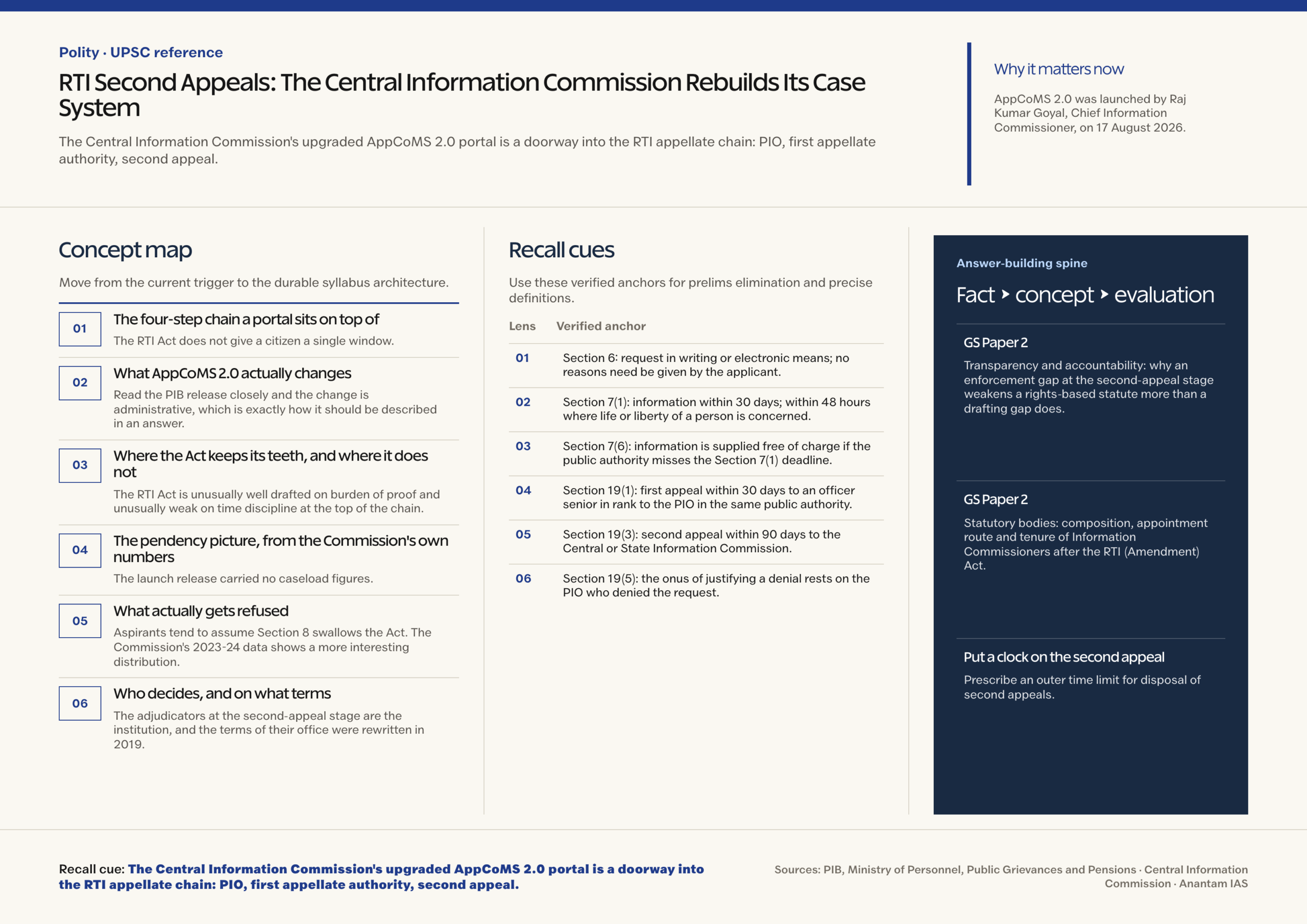
The Central Information Commission launched an upgraded Appeal and Complaint Management System, AppCoMS 2.0, on 17 August 2026.
- The original AppCoMS, from September 2016, already handled online second appeals and complaints.
- Version 2.0 adds user accounts, visible timelines, and digitally signed notices and orders.
- It creates no new right, changes no limitation period, and adds no disposal deadline.
- The useful syllabus object is the second-appeal stage of the RTI Act, 2005.
- The Act works through a chain, not a single counter. A portal at the top cannot repair the tiers below.
- The second appeal is the stage with enforcement power and no statutory outer clock.
- GS2 will ask about transparency and capacity, not about a software build.
UPSC Relevance
Prelims Relevance
- Section 6: request in writing or electronic form; the applicant need give no reasons.
- Section 7(1): 30 days, or 48 hours where life or liberty is at stake.
- Section 19(1): first appeal within 30 days to an officer senior to the PIO.
- Section 19(3): second appeal to the Information Commission within 90 days.
- Section 19(5): the PIO who denied the request bears the burden of justifying the denial.
- Section 20(1): penalty of Rs 250 a day, capped at Rs 25,000.
Mains Relevance
GS Paper 2
- Why an enforcement gap at the second appeal weakens a rights statute more than a drafting gap does.
- What a case-management platform can fix, and what only a statutory deadline can fix.
Essay
- A right without a deadline is a queue.
Background and Context
The four-step chain under the portal
The RTI Act gives a sequence. Each step has its own officer, clock and failure mode.
- Section 6: apply to the PIO. No reasons required.
- Section 7: the PIO must give or refuse information in 30 days. Silence is a deemed refusal.
- Section 19(1): first appeal inside the same public authority, to a senior officer, with a 30-to-45 day clock.
- Section 19(3): second appeal to the Central or State Information Commission within 90 days.
- Section 18 is a parallel complaint track. AppCoMS handles both. See our RTI Act explainer.
What AppCoMS 2.0 actually changes
The change is administrative. Describe it that way in an answer.
- Applicants get accounts, timelines, and downloads of notices and orders.
- The Commission can issue digitally signed notices, shortening the postal lag.
- CPIOs get accounts to file the official record, which citizen portals often omit.
- Limitation periods, exemptions and the Commission’s powers stay exactly where the Act left them.
- A cleaner queue is still a queue if nobody has to decide by a date.
Where the Act has teeth, and where it does not
The statute is strong on burden of proof and weak on time at the top of the chain.
- Section 19(5) reverses the ordinary burden: the refusing PIO must justify the refusal.
- The Commission’s decision is binding, and it can order disclosure, compensation and penalties.
- Sections 7 and 19(6) bind the PIO and the first appellate authority to deadlines.
- Section 19 sets no outer time limit for the Commission to decide a second appeal.
- That asymmetry is the exam point, not the name of the new portal.
Independence after the 2019 rewrite
Who sits on the Commission, and on what terms, is the other half of the second-appeal story.
- The CIC is a Chief Information Commissioner plus not more than ten Information Commissioners.
- The RTI (Amendment) Act, 2019 moved tenure and salary from the statute to central rules.
- The RTI Rules, 2019 prescribe a three-year term, with the age cap of 65 years kept.
- Critics read that as weaker independence. The official defence is alignment with other statutory bodies.
- A full-strength Commission still cannot outrun a stage that has no disposal clock.
Way Forward
Put a clock on the second appeal
- Prescribe an outer disposal limit for second appeals, matching the first-appeal discipline.
- Publish ageing of pending cases, not only opening and closing counts.
- Make first appellate authorities a named, reported role so fewer cases reach the Commission.
- Keep offline and assisted filing, so an account-based portal does not become the only door.
Conclusion
- A better CIC portal is worth having. It shortens the distance between a decision and the citizen waiting for it.
- It is not the missing reform. Until the second appeal has a deadline, the right still arrives late.
UPSC Practice Questions
Prelims MCQ 1
With reference to the appellate mechanism under the Right to Information Act, 2005, consider the following statements:
- A first appeal lies to an officer senior in rank to the Public Information Officer within the same public authority.
- A second appeal to the Information Commission must ordinarily be filed within ninety days.
- In appeal proceedings, the onus to prove that a denial was justified lies on the appellant.
How many of the above statements are correct?
(a) Only one (b) Only two (c) All three (d) None
Answer: (b) Only two
Explanation:
Statements 1 and 2 are correct. Section 19(5) puts the burden on the PIO, so statement 3 is wrong.
Prelims MCQ 2
AppCoMS 2.0, seen in the news, is best described as:
(a) A new statutory right of third appeal under the RTI Act (b) The Central Information Commission’s upgraded system for second appeals and complaints (c) A replacement of Section 8 exemptions (d) A time limit of 30 days imposed on the Central Information Commission
Answer: (b) The Central Information Commission's upgraded system for second appeals and complaints
Explanation:
It is case-management software. It does not create a new appeal, rewrite exemptions, or add a CIC deadline.
UPSC Mains Questions
- The RTI Act binds the PIO and the first appellate authority to time, then falls silent at the Commission. Examine the consequences. (250 words)
- Digitising a queue is not the same as enforcing a right. Discuss with reference to the Central Information Commission. (150 words)
Sources: PIB, Ministry of Personnel, Public Grievances and Pensions and Central Information Commission.
Frequently Asked Questions
What is AppCoMS 2.0?
The CIC’s upgraded online system for filing and processing second appeals and complaints. It adds accounts, timelines and digital signatures. It does not change the Act.
What is a second appeal under RTI?
An appeal to the Central or State Information Commission under Section 19(3), ordinarily within 90 days of the first-appeal decision or non-decision.
Who must prove that a denial was lawful?
The PIO who refused, under Section 19(5). The appellant does not carry that burden.
Is there a deadline for the Information Commission?
The Act sets none for deciding a second appeal. That is the structural gap a portal cannot close.
What penalty can the Commission impose?
Rs 250 per day of default, capped at Rs 25,000, after a hearing, and it may also recommend disciplinary action.