Rural Internal Audit Portal: AI for Accountable Rural Development
Why in News?
PIB said Union Rural Development Minister Shivraj Singh Chouhan launched the AI-enabled Rural Internal Audit Portal during the Rashtriya Gramin Vikas Sammelan at Pusa Campus, New Delhi.
The portal is a first-of-its-kind unified digital platform for end-to-end management of internal audits, covering both risk-based audits and compliance audits across Rural Development programmes.
- The launch was reported by PIB on June 28, 2026, a day before the June 29 ministerial session of the two-day rural development conference.
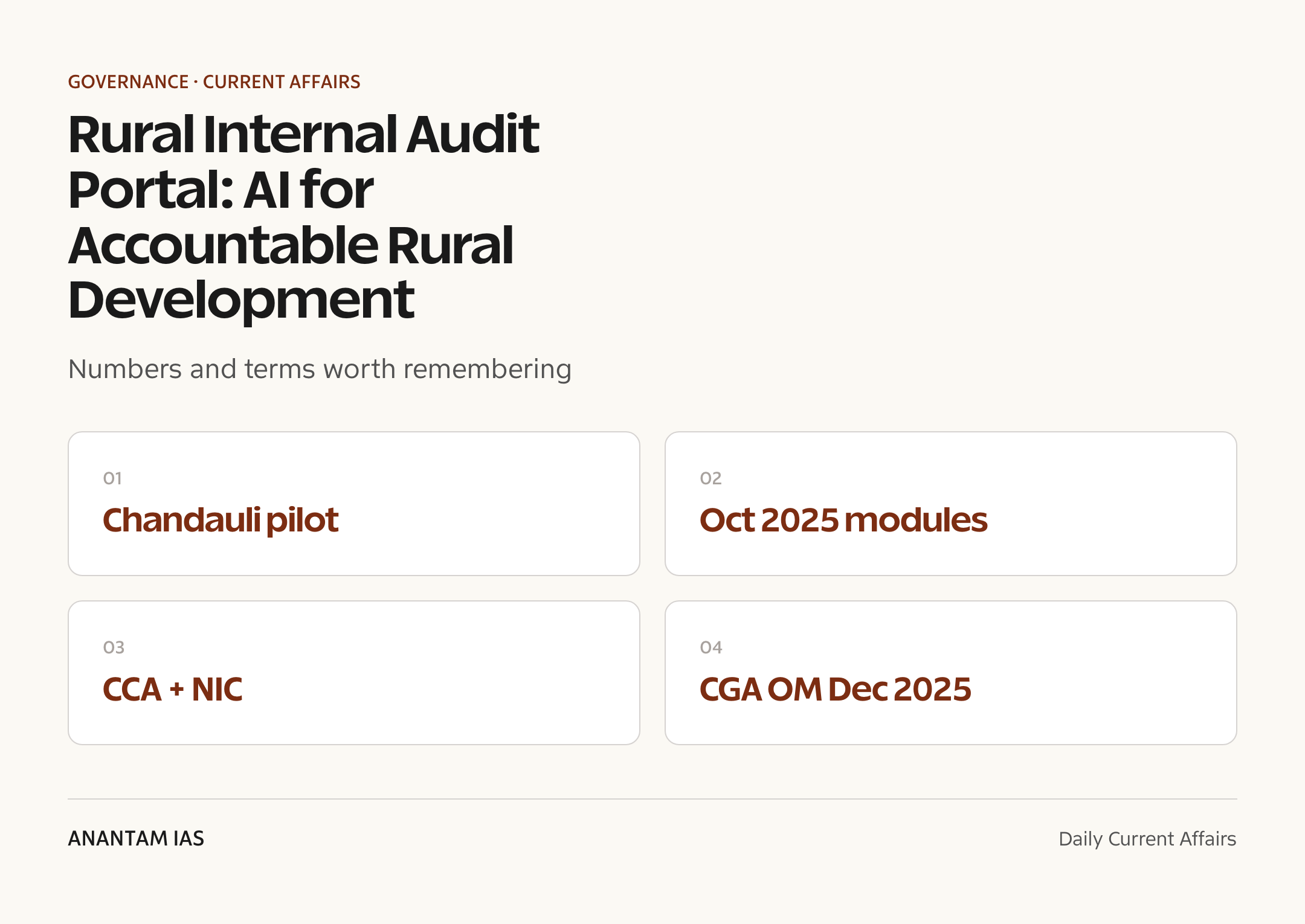
- The portal was conceived by the Office of the Chief Controller of Accounts, Ministry of Rural Development, and developed with the National Informatics Centre.
- PIB says a pilot began in Chandauli district, Uttar Pradesh, on April 1, 2025, and all core modules became operational from October 2025.
- The platform brings audit planning, audit execution, report generation, Action Taken Reports, para settlement, monitoring and analytics into one digital ecosystem.
- The Ministry is progressively integrating AI-enabled functionalities for intelligent audit planning, high-risk entity identification, predictive analytics and pattern recognition.
The development matters in the context of:
- This matters in the context of public finance accountability, because rural schemes involve large transfers, local implementation and many audit units.
- It is not only an AI story; it is a case of digital public management where audit evidence, compliance status and decision dashboards are meant to reduce opacity.
- It also helps compare social audit, CAG audit and internal audit as different accountability layers.
UPSC Relevance
Prelims Relevance
- Rural Internal Audit Portal: AI-enabled audit management platform of the Ministry of Rural Development.
- Risk-based audit: audit prioritization based on likelihood and impact of implementation risks.
- Compliance audit: checking whether rules, approvals, expenditure norms and reporting requirements are followed.
- Office of Chief Controller of Accounts: the accounting and internal audit authority that conceived the portal for the Ministry.
- National Informatics Centre: the government technology body that helped develop the platform.
- Action Taken Report: the response filed by an auditee on audit observations and corrective action.
- Para settlement: closure of audit paragraphs after compliance is examined and accepted.
- Map View Module: geospatial view that can show audit coverage, team deployment, para settlement status and audit units never audited.
Mains Relevance
GS Paper 2
- Good governance through transparency, accountability, institutional memory and faster compliance monitoring.
- Centre-State and district-level coordination in rural development schemes, especially where programme divisions, State governments and field users must work on the same system.
- Ethical use of AI in governance: explainability, human oversight, grievance channels and protection against algorithmic bias.
GS Paper 3
- Public financial management, expenditure tracking and better identification of systemic risks in welfare and infrastructure spending.
- Science and technology in governance, including predictive analytics, dashboards, API integrations and cybersecurity.
GS Paper 4
- Probity in public life, audit trails, administrative responsibility and the ethics of data-driven decision-making.
- Balancing efficiency with fairness when automated systems rank audit units or flag high-risk entities.
Essay
- Technology improves governance only when institutions, incentives and accountability improve with it.
- The future of the welfare state is auditability, not only delivery.
- Data can reveal leakages, but trust still depends on fair process.
Background and Context
What The Portal Changes
The portal shifts internal audit from scattered files and delayed correspondence to a single digital audit management system.
- PIB describes the older process as fragmented, paper-intensive and largely manual, with dispersed records, manual correspondence and delayed reporting.
- The new system creates a centralized repository of audit units, audit observations, Action Taken Reports and audit records.
- It integrates audit planning, engagement approvals, audit memoranda, observations, report preparation, approvals, record management and archival.
- For administrators, the value is not just digitization; it is a shift from post-facto file checking to live oversight of audit progress and compliance status.
- For UPSC answers, frame it as a state-capacity tool: better records, faster feedback loops, stronger compliance follow-up and more usable evidence for decision-makers.
Institutional Design
The portal sits at the intersection of financial control, technology architecture and rural development programme management.
- The platform was conceived by the Office of the Chief Controller of Accounts, Ministry of Rural Development, giving it a public-finance accountability base.
- The National Informatics Centre supported development and hosting, which places the system within the Government of India’s digital governance infrastructure.
- PIB says the portal has separate Development, User Acceptance Testing and Production environments, which supports controlled deployment of updates.
- The role-based governance model gives dedicated access to auditors, auditees, approving authorities, programme divisions, State governments, district-level users and certified internal auditors.
- This matters because rural programmes are implemented across levels; audit workflows fail when every level maintains its own record without a common compliance trail.
Audit Lifecycle And Compliance
The strongest exam point is the portal’s coverage of the full audit lifecycle, not only data display.
- Audit planning can be digitized so units, teams and priorities are assigned through a trackable workflow.
- Audit observations can be recorded in a standard format, reducing variation across districts, schemes and audit teams.
- Auditees can file Action Taken Reports with supporting documents through the portal, making compliance claims easier to examine.
- Auditors can review replies, communicate objections and complete para settlement when corrective action is accepted.
- Digital processing creates an audit trail: who raised the issue, who replied, what evidence was filed, when a para was settled and which observations recur.
Dashboards, Map View And Risk-Based Audit
The portal uses dashboards and geospatial views to move audit from random coverage to risk-informed coverage.
- Interactive dashboards show audit coverage, pending observations, ATR compliance, financial irregularities, audit performance and implementation trends.
- The Map View Module provides geospatial visualization of audit activities across India, including team deployment and compliance response status.
- PIB specifically says the module identifies audit units never audited, which can guide targeted interventions and better resource deployment.
- Risk-based audit means limited audit capacity is directed first toward units with higher exposure, weaker compliance, repeated observations or unusual implementation patterns.
- This connects naturally with the Panchayat Development Index logic: local data is useful only when it guides action and accountability.
AI And Algorithmic Governance
The AI layer should be read as decision support for audit planning, not as a substitute for administrative judgment.
- PIB says AI-enabled functions are expected to support intelligent audit planning, high-risk entity identification, predictive analytics, pattern recognition and evidence-based decision-making.
- Potential gains include quicker detection of recurring observations, unusual expenditure patterns, delayed compliance and weak audit coverage.
- But AI in audit can create risks if the model’s variables, training data or scoring logic are opaque to officials and auditees.
- A high-risk flag should trigger human review, reasoned audit planning and documentation, not automatic stigma for a district or programme unit.
- For Mains, link it with algorithmic governance and bias: accuracy, explainability, contestability and proportionality matter.
Security And Data Governance
An audit platform is only as strong as its security, access control and data-quality practices.
- PIB lists role-based access control, centralized monitoring, secure API-based integrations, automated exception handling and complete audit logging as security features.
- The portal also includes periodic security assessments, daily backups and disaster recovery protocols for continuity of critical audit data.
- Data quality is a governance issue: inaccurate audit-unit records, duplicate observations or weak document tagging can weaken the same dashboards meant to improve oversight.
- Access must be need-based because audit records may include financial irregularities, scheme weaknesses, field-level correspondence and compliance evidence.
- Good design needs retention rules, access logs, cyber incident response and periodic third-party review so the portal does not become a new single point of failure.
Wider Public Finance Significance
The Rural Internal Audit Portal can become a model for civil ministries because internal audit is a core public financial management function.
- PIB says the Controller General of Accounts issued an Office Memorandum dated December 9, 2025, giving in-principle approval to implement the Internal Audit Module across civil ministries and departments.
- The memorandum recognized the portal’s coverage of audit planning, engagement approvals, audit memoranda, real-time observation management, para-wise financial tracking and digital ATR processing.
- This widens the topic beyond one ministry: it becomes a public financial management reform for the Union government.
- If scaled carefully, the model can help ministries identify repeated compliance failures before they become major expenditure leakages.
- The key caution is capacity: smaller offices need training, stable connectivity, clear help desks and time-bound escalation, or the digital workflow can become another compliance burden.
Way Forward
Make AI Explainable And Auditable
- Publish internal guidance on what factors shape risk scoring, who can override a score and how such overrides are recorded.
- Keep human approval mandatory for audit prioritization decisions that affect field units, districts or programme divisions.
- Test the model for bias against smaller, remote or low-capacity units that may look risky because data reporting is weak.
Strengthen Field Capacity
- Train auditors, auditees and district users on ATR filing, evidence uploads, para settlement and dashboard interpretation.
- Create help desks and standard operating procedures for States, districts and certified internal auditors.
- Use simple multilingual workflows so the portal works for field administration, not only central dashboards.
Link Audit With Corrective Action
- Convert recurring audit observations into scheme-level reform notes for programme divisions.
- Track whether audit findings lead to rule changes, training, recovery, process simplification or stronger local supervision.
- Integrate internal audit insights with social audit and performance review without mixing their distinct roles.
Protect Data And Trust
- Run periodic security audits, access reviews and disaster recovery drills for the portal.
- Log every major workflow action so responsibility is clear and retrospective manipulation becomes difficult.
- Give auditees a clear channel to correct records, upload missing evidence and contest wrongly tagged observations.
Conclusion
The Rural Internal Audit Portal is important because it makes audit a continuous management function, not only a compliance ritual after expenditure has already occurred.
Its success will depend on whether dashboards, AI flags and digital ATRs lead to better decisions in rural programmes. Technology can make weak signals visible, but accountable officials must still act on them.
For UPSC, use this case as a balanced example of digital governance: it can improve transparency and public financial management, but only with explainable algorithms, trained field users and strong data protection.
UPSC Practice Questions
Prelims MCQ 1
With reference to the Rural Internal Audit Portal, consider the following statements:
- It was conceived by the Office of the Chief Controller of Accounts, Ministry of Rural Development.
- It covers both risk-based audits and compliance audits.
- It replaces the Comptroller and Auditor General of India for rural development schemes.
How many of the above statements are correct?
(a) Only one (b) Only two (c) All three (d) None
Answer: (b) Only two
Explanation:
Statements 1 and 2 are correct as per the PIB release. Statement 3 is incorrect because internal audit does not replace the constitutional audit role of the CAG.
Prelims MCQ 2
Which one of the following best describes the Map View Module mentioned in relation to the Rural Internal Audit Portal?
(a) A satellite imagery tool for mapping rural roads (b) A geospatial visualization tool for audit coverage and compliance status (c) A land records platform for digitizing village property cards (d) A beneficiary mapping tool for Direct Benefit Transfer payments
Answer: (b) A geospatial visualization tool for audit coverage and compliance status
Explanation:
PIB says the Map View Module visualizes audit coverage, audit team deployment, para settlement status and compliance responses, and can identify audit units never audited.
UPSC Mains Questions
- The Rural Internal Audit Portal shows how digital systems can strengthen accountability in welfare spending. Discuss its potential for rural development governance, along with the safeguards needed for explainable and fair AI-based audit prioritization.
- Differentiate between internal audit, social audit and CAG audit in India’s accountability framework. How can digital audit platforms improve public financial management without weakening local participation and human oversight?
- Data-driven governance can improve last-mile delivery only when it is matched by institutional capacity. Examine this statement with reference to the AI-enabled Rural Internal Audit Portal.
Sources: PIB, Ministry of Rural Development and PIB, Ministry of Rural Development.
Frequently Asked Questions
What is the Rural Internal Audit Portal?
The Rural Internal Audit Portal is an AI-enabled digital platform of the Ministry of Rural Development for managing internal audits. It covers audit planning, execution, observations, reports, Action Taken Reports, para settlement, monitoring and analytics in one system.
Who developed the portal?
PIB says the portal was conceived by the Office of the Chief Controller of Accounts, Ministry of Rural Development, and developed in collaboration with the National Informatics Centre. The design places financial accountability and government technology support in the same workflow.
Why is it important for UPSC?
It is a strong GS2 example of digital governance, transparency and accountability. It also connects with GS3 public financial management and science-tech in governance because the portal uses dashboards, predictive analytics and AI-assisted risk identification.
How is internal audit different from social audit?
Internal audit is an administrative and financial control mechanism used inside government to check compliance, risks and corrective action. Social audit is community-facing and checks implementation through public participation, beneficiary verification and local accountability.
What risks does AI create in audit?
AI can help identify high-risk units and recurring patterns, but it can also create opaque scoring, bias and over-reliance on automated flags. Human review, explainable criteria, audit trails and grievance channels are needed.
What is the way forward?
The portal should be backed by field training, strong cybersecurity, clear risk-scoring rules and regular review of AI outputs. Audit findings should feed scheme reforms, not remain limited to dashboards or pending compliance lists.