Rural-Urban Divide in Female Labour Force Participation
Why in News?
The Periodic Labour Force Survey (PLFS) 2025 shows a substantial post-2019-20 rise in India’s Female Labour Force Participation Rate (FLFPR), with rural areas recording much stronger growth than urban areas.
| UPSC Relevance: GS-2 Social Justice: Human Development, Women; GS-3 Economy: Employment, inclusive growth Prelims: Key Trends (PLFS, LFPR, WPR and Unemployment Rate) Mains: Female employment, rural-urban disparities, quality of work and care economy |
What is Female Labour Force Participation Rate?
- The Female Labour Force Participation Rate refers to women (over 15 years) who are either employed or unemployed but seeking or available for work.
- It is different from the Worker Population Ratio (WPR), which covers only those actually employed.
Key Findings of PLFS 2025:
According to the PLFS 2025 released by the Ministry of Statistics and Programme Implementation (MoSPI), for women aged 15 years and above under the usual-status approach (principal plus subsidiary status), all-India LFPR stood at 40%, the Worker Population Ratio (WPR) was 38.8%, and the Unemployment Rate (UR) was 3.1%.
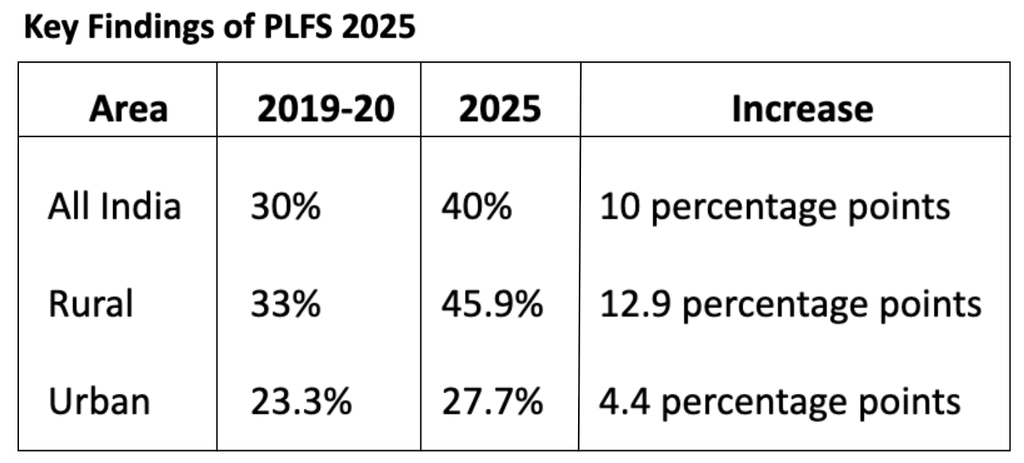
- Overall FLFPR for women aged 15+ rose from 30% in 2019-20 to 40% in 2025.
- Rural FLFPR: increased sharply from 33% to 45.9%.
- Urban FLFPR: rose more modestly from 23.3% to 27.7%.
Thus, the pace of improvement has been substantially higher in rural than urban areas.
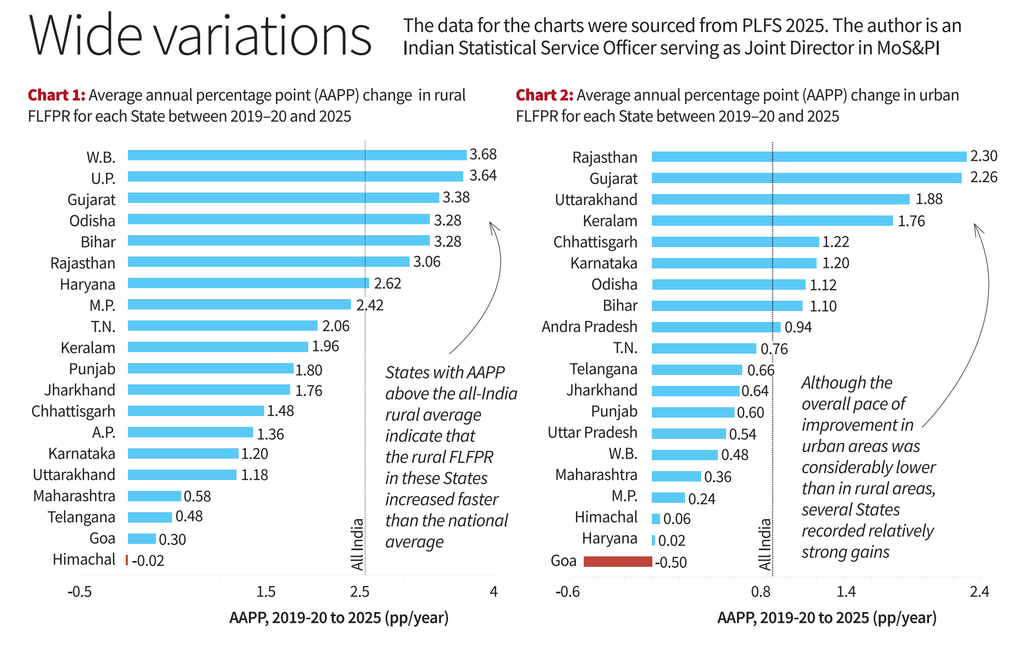
Significant Inter-State Variations:
The Average Annual Percentage Point change (AAPP) indicates the yearly pace at which FLFPR increased.
- Rural areas: Bihar, Uttar Pradesh and West Bengal combined a low initial FLFPR with rapid improvement. Gujarat, Odisha and Rajasthan registered strong growth despite starting from relatively higher baselines.
- Urban areas: Keralam, Karnataka, Chhattisgarh, Odisha and Andhra Pradesh combined relatively high initial participation with above-average improvement. In contrast, Goa recorded a decline, while Haryana and Himachal Pradesh saw negligible urban growth.
The data also shows that high growth is not necessarily linked to a low starting base. For example, Odisha, Gujarat and Rajasthan had relatively higher initial rural FLFPR but still recorded rapid improvement.
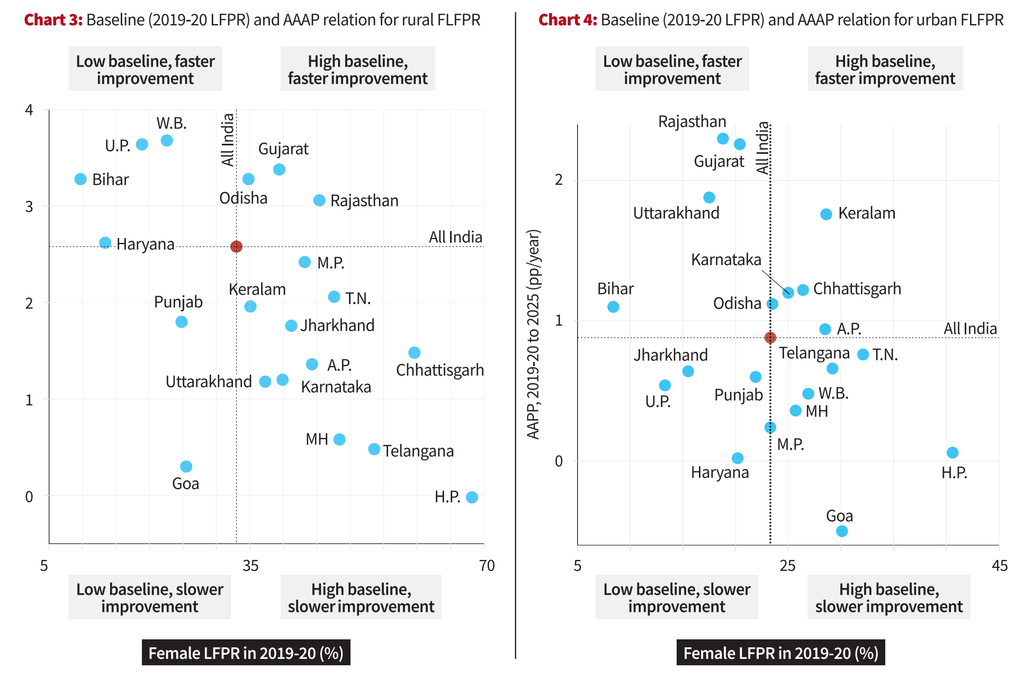
Why the Baseline Matters?
The article cautions against judging States solely by the Average Annual Percentage Point (AAPP) change.
- Low baseline + rapid improvement: Bihar, Uttar Pradesh and West Bengal in rural areas.
- Low baseline + slow improvement: Goa and Punjab.
- High baseline + rapid improvement: Gujarat, Odisha and Rajasthan in rural areas; Kerala, Karnataka and others in urban areas.
Therefore, both the level of participation and its rate of improvement must be considered when assessing women’s labour-market outcomes. Thus, a State with a lower AAPP may still have a higher absolute FLFPR.
Why Has Rural FLFPR Increased Faster?
- Greater absorption of women in agriculture, livestock and allied activities
- Expansion of self-employment and unpaid family work
- DAY-NRLM-supported Self-Help Groups and women-led microenterprises
- MGNREGS and other public employment opportunities
- Post-pandemic livelihood pressures encouraging additional household members to work
- Greater statistical recognition of women’s subsidiary economic activities; and
- Male migration leaving women with greater responsibility for farms and family enterprises.
Therefore, the rise may represent both greater economic agency and, in some cases, a distress-driven entry into low-productivity work.
Why does Urban FLFPR Remain Low?
- Scarcity of suitable and secure jobs for educated women
- Skill-employment mismatch
- Safety concerns and unreliable public transport
- High commuting and housing costs
- Marriage and motherhood-related withdrawal from employment
- Inadequate childcare and eldercare facilities
- Lack of flexible work arrangements
- Occupational segregation and gender discrimination; and
- Social norms that discourage women from accepting certain jobs.
In 2025, 44.4% of women outside the labour force cited childcare, personal commitments or homemaking as their main reason, highlighting the central role of unpaid care work.
Participation Does Not Necessarily Mean Empowerment:
The increase in FLFPR must be assessed alongside the quality of employment:
- In 2025, 64.2% of employed women were self-employed, while only 18.2% had regular wage or salaried employment.
- Average female self-employment earnings were about ₹6,374, compared with ₹17,914 for men.
- Women also worked fewer paid hours, partly reflecting their disproportionate unpaid-care burden.
Thus, higher participation may coexist with Informality, Unpaid family labour, Underemployment, Low productivity, Gender wage gaps and Absence of social security.
Way Forward:
- Diversify rural employment towards food processing, manufacturing, digital services and the care economy.
- Expand affordable crèches through Palna and workplace childcare facilities.
- Improve safe transport, working-women hostels and street lighting.
- Provide market, credit and technology linkages to women’s SHGs and enterprises.
- Promote flexible work without weakening wages or social security.
- Strengthen gender-responsive skilling in STEM, green jobs and emerging services.
- Recognise, reduce and redistribute unpaid care work.
- Publish State-wise data on wages, hours worked, formality and occupational status—not only participation rates.
The rise in female labour force participation is encouraging, but its rural concentration reveals a divided employment transition.
India must move from merely bringing more women into the labour force to ensuring that they obtain productive, remunerative, secure and dignified employment. Only then will higher FLFPR translate into genuine economic empowerment and inclusive growth.
UPSC PYQ 2023:
Q. Distinguish between ‘care economy’ and ‘monetized economy’. How can care economy be brought into monetized economy through women empowerment? (GS III)