Sal Borer Control: Why Trapping and Sanitation Felling Differ
Why in News?
An Indian Express report on 4 October 2026 described ongoing sal borer control in Madhya Pradesh’s Dindori forests, combining adult beetle collection with sanitation felling of infested trees.
- The report says felling of 1.47 lakh infested sal trees was approved a couple of weeks earlier; it does not announce a fresh approval today.
- Villagers collect adult beetles from specially prepared trap trees, while a separate operation removes already-infested standing trees.
- The Forest Research Institute identifies trap-tree operations as a major control practice developed to capture adult sal heartwood borers.
- Forest health involves both pest suppression and protecting the living canopy, regeneration and forest-dependent livelihoods.
- The central policy question is whether targeted intervention prevents further damage while avoiding unnecessary loss of healthy trees.
UPSC Relevance
Prelims Relevance
- Sal heartwood borer: an insect pest of sal forests.
- Trap-tree operations: capture adult beetles.
- Sanitation felling: removal of identified infested trees.
- Forest Research Institute: forest-pest research and management.
Mains Relevance
GS Paper 3
- Stage-specific forest-pest control and biodiversity trade-offs.
- Evidence, community participation and accountability in sanitation felling.
Essay
- Conservation decisions must assess the consequences of both intervention and inaction.
Background and Context
The Pest, the Tree and the Forest
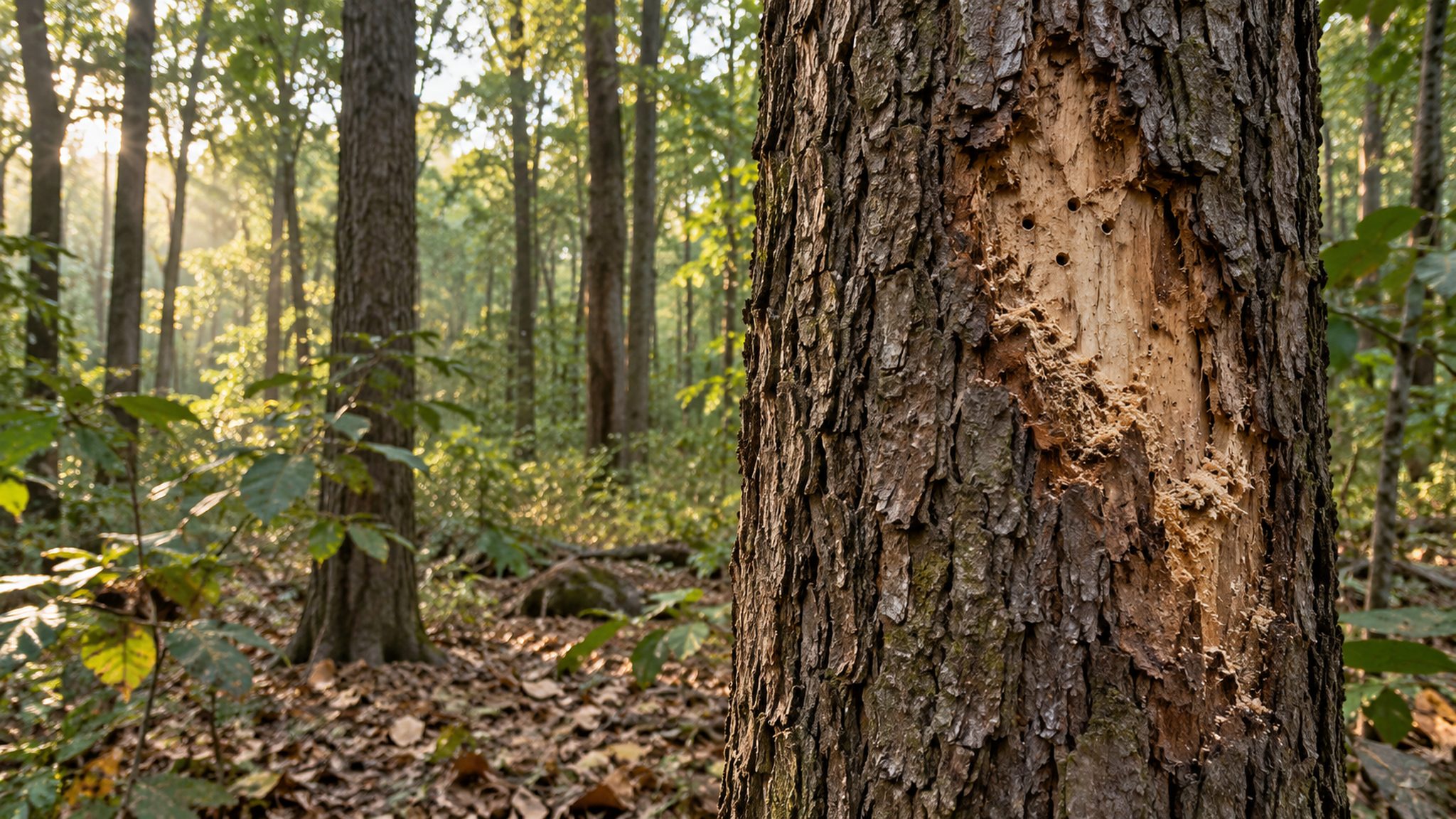
A sal-borer outbreak is a forest-health problem because damage to individual trees can affect habitat, resource use and future regeneration.
- The sal heartwood borer is a longhorn beetle associated with sal forests. Its name describes the wood it damages; it is not a fungal disease or a leaf-eating caterpillar.
- Grubs, the immature stage, occur inside affected trunks. An ICFRE forestry publication records woodpeckers feeding on these grubs, illustrating a natural predator relationship within the forest ecosystem.
- Sal forests provide more than commercial timber. The report describes forest communities using leaves, seeds and resin, so damage to the tree resource can also affect everyday household livelihoods.
- Canopy loss is part of the management trade-off: retaining heavily infested trees may sustain the pest, while removing trees also changes forest structure. Counting trees cut alone cannot establish conservation success.
- Early detection is central to the response described by forestry researchers in the report. Waiting until widespread damage is visible reduces the opportunity for selective action before an outbreak becomes extensive.
Two Interventions, Two Different Targets
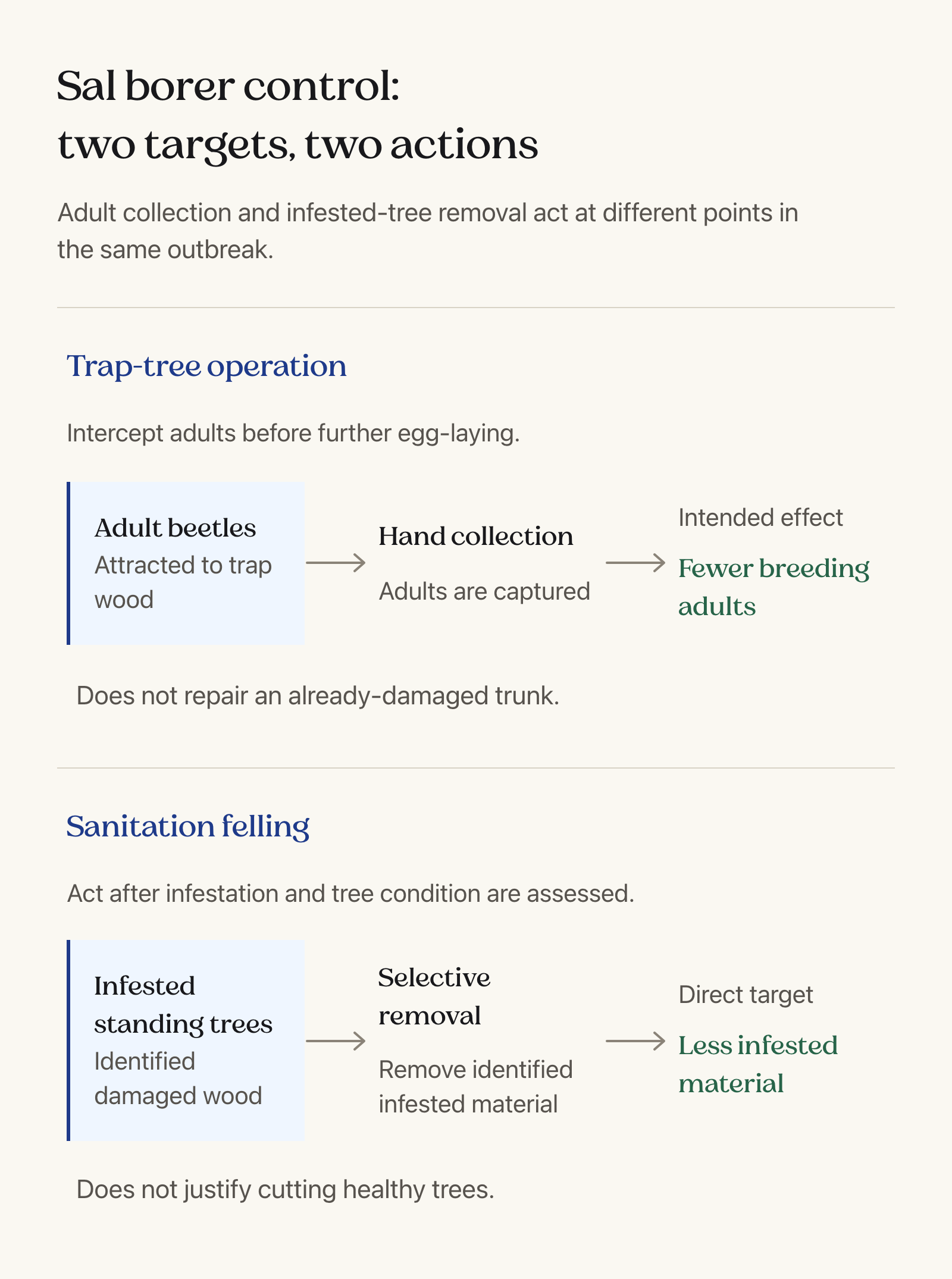
Trapping acts on exposed adults; sanitation acts on infested woody material. They address different points in the same pest problem.
- Trap trees attract adult beetles to selected, prepared wood where collectors can reach them. The Forest Research Institute explicitly describes adult trapping as a major sal-borer control practice.
- The Dindori operation, as reported, uses felled and debarked trap trees, followed by hand collection of beetles. These operational details describe local practice; they are not universal instructions for every forest.
- Removing adult beetles seeks to reduce the breeding population before further egg-laying. It does not repair a damaged trunk or directly remove immature insects already concealed within another infested standing tree.
- Sanitation felling addresses already-infested trees and wood considered beyond saving in the reported operation. Its intended purpose is to remove a source of further infestation, rather than attract exposed adults for collection.
- The comparison is adult interception versus infested-material removal. Trapping and sanitation may operate together, but success in one cannot be assumed to eliminate the need for assessment of the other target.
Why Evidence and Safeguards Matter
A large intervention needs a clear diagnosis and follow-up; neither a dramatic felling total nor a high beetle count proves recovery.
- Tree selection should depend on verified infestation and condition, rather than proximity alone. The existence of a pest outbreak does not justify treating every healthy sal tree as a candidate for removal.
- Outcome monitoring should compare new infestations, surviving trees and regeneration after intervention. Beetles collected measure operational effort, but cannot alone show whether the forest is recovering or the outbreak is controlled.
- Sanitation safeguards should cover identification, marking, removal and handling of infested wood. A documented chain helps distinguish an ecological intervention from timber extraction, especially where the removed wood enters commercial markets.
- Natural enemies may help suppress pests, but that does not establish the safety of deliberate mass releases. The report notes insufficient study of side-effects, supporting caution before biological-control methods are expanded.
- Outbreak timing requires evidence across sites and seasons. A reported recurrence interval is not a fixed biological clock, and an attributed rainfall explanation should not be presented as established causation without supporting analysis.
Way Forward
Make Control Selective and Measurable
- Link field surveillance with expert confirmation of infestation before selecting trees for sanitation.
- Record trap effort and subsequent infestation together, so collection totals are interpreted against outcomes.
- Protect healthy trees and regeneration, and document the handling of removed material.
- Give forest communities clear collection procedures and transparent payment records while tracking effects on their forest-resource access.
Conclusion
- Sal-borer management works through different targets: exposed adults can be trapped, while infested wood may require selective sanitation. The distinction explains why the two operations are complementary rather than interchangeable.
- A sound conservation assessment asks what was diagnosed, why a tree was removed and whether new damage declined. Forest recovery, rather than the volume of timber extracted, should determine whether an intervention achieved its purpose.
UPSC Practice Questions
Prelims MCQ 1
With reference to sal-borer management, consider the following statements:
- Trap-tree operations target adult beetles.
- Sanitation felling and adult trapping necessarily target the same pest stage.
- A large beetle collection alone proves that a forest outbreak has ended.
How many of the above statements are correct?
(a) Only one (b) Only two (c) All three (d) None
Answer: (a) Only one
Explanation:
Trap trees capture adult beetles. Sanitation addresses infested trees or wood, while collection totals require subsequent forest-health monitoring before conclusions about control.
Prelims MCQ 2
Which observation best helps evaluate whether sal-borer control is improving forest health?
(a) Timber revenue from removed trees alone (b) Number of collection centres alone (c) New infestation and tree survival after intervention (d) A presumed fixed interval between outbreaks
Answer: (c) New infestation and tree survival after intervention
Explanation:
These observations measure pest damage and forest outcomes; revenue, facilities or assumed cycles cannot establish ecological recovery.
UPSC Mains Questions
- Explain why adult trapping and sanitation felling are complementary interventions in managing a sal-borer outbreak. (150 words)
- Discuss the ecological and governance safeguards needed when tree removal is proposed as a forest-pest control measure. (250 words)
Sources: Indian Express and Forest Research Institute, ICFRE.
Frequently Asked Questions
What is the sal heartwood borer?
It is a longhorn beetle associated with damage to sal trees. Its immature grubs occur inside affected trunks, while adult beetles can be targeted through trap-tree operations.
How do trap trees differ from sanitation felling?
Trap trees attract adult beetles for collection. Sanitation felling removes identified infested trees or wood that may sustain further infestation. The two interventions target different parts of the pest problem.
Does an outbreak justify cutting every sal tree nearby?
No. The need for sanitation must be assessed through tree condition and verified infestation. A pest outbreak does not by itself justify blanket removal of healthy trees across the surrounding forest.
Was the felling approval issued on 4 October?
The Indian Express report published on 4 October describes ongoing operations. It says approval for felling the infested trees had been given a couple of weeks earlier, rather than that day.