Satellite Internet: Why is Musk taking on Mukesh Ambani over Starlink in India?
Why in News?
Elon Musk’s allegations that Mukesh Ambani is obstructing Starlink’s entry into India have renewed debate over competition, satellite-spectrum allocation and national-security requirements. The government has rejected allegations of discrimination.
Starlink has already secured a Global Mobile Personal Communications by Satellite (GMPCS) licence. However, commercial operations require completion of security compliance and spectrum assignment. A licence alone does not mean that services can immediately begin.
| UPSC Relevance: GS-3 Science and Technology: Space Technology; Internet and Communications Technology Prelims & Mains: Satellite Internet: Applications, Challenges, Policy Regulations |
The Core Issue & Current Licensing Status:
The conflict between foreign satellite operators (E.g., SpaceX’s Starlink) and domestic telecom service providers (E.g., Reliance Jio, Bharti Airtel) centres around market access, spectrum assignment mechanisms, and national security clearances.
Has a license been given? Yes. Starlink, along with domestic competitors Reliance Jio Satcom and Bharti-backed Eutelsat OneWeb, has received a Global Mobile Personal Communications by Satellite (GMPCS) authorisation.
Who provides the license and clearances?
- Department of Telecommunications (DoT): Under the Ministry of Communications, the DoT issues the primary unified telecom and satcom authorisation (GMPCS licence).
- IN-SPACe (Indian National Space Promotion and Authorisation Centre): Acts as the single-window nodal agency under the Department of Space to authorise commercial space activities and foreign satellite constellations operating within Indian territory.
- Ministry of Home Affairs (MHA) & Security Agencies: Responsible for conducting comprehensive security vetting, checking data localisation, lawful interception capabilities, and terminal trackability.
What comes next after the license?
Holding a GMPCS licence alone does not permit commercial launch. An operator must complete the following sequence:
- Final Security Clearances: Demonstrating real-time terminal tracking, setting up local terrestrial gateway earth stations, and ensuring domestic data localisation.
- Pricing Framework Formulation: TRAI must recommend pricing, terms, and conditions for satellite broadband spectrum.
- Spectrum Assignment: The Central Government officially assigns frequencies (provisional/trial spectrum followed by commercial spectrum).
- Commercial Launch: Commercial deployment through enterprise or retail partner channels.
Relevant Regulatory Laws and Frameworks
- The Telecommunications Act, 2023:
- Replaced the colonial Indian Telegraph Act, 1885 and the Indian Wireless Telegraphy Act, 1933.
- Section 4 & First Schedule: Defines spectrum assignment. While auctions remain the default route for terrestrial telecom spectrum, satellite-based services (GMPCS, MSS, FSS) are assigned through an administrative process (non-auction), aligning India with International Telecommunication Union (ITU) standards.
- Indian Space Policy, 2023:
- Opened India’s space economy to non-government entities (NGEs) and private investments.
- Formalised the role of IN-SPACe to regulate and coordinate non-state space operations, ground stations, and orbital slots.
- Digital Personal Data Protection (DPDP) Act, 2023: Requires stringent adherence to user data protection and mandates strict guidelines on processing critical communications data within Indian borders.
Understanding Satellite Internet: LEO vs. GEO
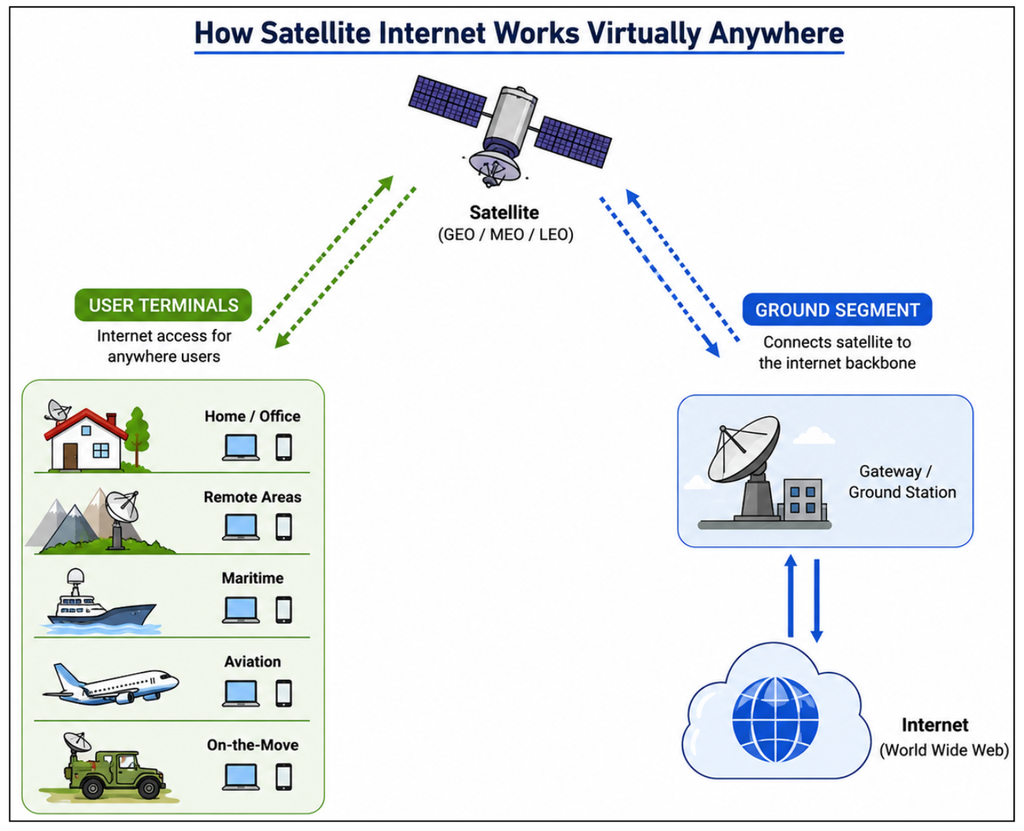
Satellite internet transmits digital data between end-user terminals on the ground, orbital satellites, and connected ground gateway stations. Modern satellite broadband is driven by Low Earth Orbit (LEO) constellations:
| Parameter | Low Earth Orbit (LEO) (e.g., Starlink, OneWeb) | Geostationary Orbit (GEO) (Traditional Satcom) | Terrestrial Broadband (4G/5G, Fibre) |
| Orbital Altitude | 300- 1200 km above Earth | ~35,786 km above Earth | Ground-based (Towers, Undersea/underground cables) |
| Latency | Low (20- 60 ms) | High (500- 700 ms) | Very Low (1- 30 ms) |
| Bandwidth / Throughput | High throughput (25- 220+ Mbps) | Moderate to Low | Very High (up to 1+ Gbps) |
| Real-time Usability | Suitable for VoIP, video conferencing, and live enterprise systems | Unsuitable for real-time interactions due to signal delays | Best suited for heavy mass-market data consumption |
Applications and Benefits of Satellite Internet:
- Bridging the Digital Divide: Satellite internet can reach areas where laying fibre or building towers is expensive or difficult. E.g., Himalayas, islands, deserts, forests and border villages.
- Disaster Resilience: It can maintain connectivity during floods, cyclones, earthquakes or landslides when ground networks fail.
- Defence and Border Connectivity: It can support secure communication in high-altitude posts, maritime zones and forward areas.
- Education and Health: Remote schools and health centres can access online classes, telemedicine and digital services.
- Maritime and Aviation Connectivity: Ships, aircraft and offshore platforms can get broadband access.
- Support for 5G/6G and IoT: Satellite networks can complement terrestrial 5G/6G for non-terrestrial connectivity and the Internet of Things.
- Enterprise & Critical Infrastructure Backhaul: Provides high-reliability, redundant backhaul for offshore oil rigs, border security outposts, remote railway signalling, and automated weather stations.
Key Challenges and Concerns:
- Affordability: User terminals, installation and monthly plans may remain costlier than fibre or mobile broadband.
- Latency: GEO satellites have higher latency, affecting gaming, video calls and real-time services. LEO reduces this but needs large constellations.
- Spectrum and Regulation: Spectrum pricing, licensing, security clearance and coordination with terrestrial operators remain complex.
- Line-of-Sight Requirement: The dish needs a clear view of the sky; dense buildings, mountains, trees or bad weather may affect service.
- Space Debris and Orbital Congestion: LEO mega-constellations contribute thousands of active satellites, accelerating orbital debris risks (Kessler Syndrome) and causing optical and radio interference for ground-based astronomical research.
- Cybersecurity Risks: Satellite links can face jamming, spoofing, hacking and signal interception.
- National Security & Digital Sovereignty:
- Command & Control Risks: A foreign-controlled LEO constellation can remotely turn signals on or off over a territory. During geopolitical crises, foreign-owned critical communications infrastructure creates vulnerabilities.
- Lawful Interception: Domestic agencies require all internet traffic originating from or terminating in India to route through physical earth stations located within India to enable lawful interception and monitoring.
- Fair Competition & Level Playing Field: Domestic telcos argue that satcom operators catering to retail segments should be subject to identical licensing, regulatory burdens, and universal service obligations as terrestrial players to avoid regulatory arbitrage.
Way Forward:
- Institutional Uniformity: The government must maintain a transparent, non-discriminatory security-clearing pipeline under the Telecommunications Act, 2023, to ensure fair market competition while enforcing national security norms.
- Indigenous Satcom Ecosystem: Under the Indian Space Policy, 2023, ISRO and private Indian space startups should be incentivised to build domestic LEO capabilities, reducing dependence on foreign constellations.
- Universal Service Subsidisation: The Universal Service Obligation Fund (now the Digital Bharat Nidhi) can be leveraged to subsidise terminal equipment for public institutions such as primary health centres, rural schools, and border posts, making satellite broadband economically viable where it is needed most.
Mains Practice Question
Q. While satellite communication holds the potential to bridge India’s last-mile digital divide, it presents intricate trade-offs between open market competition, economic viability, and digital sovereignty. Critically examine.