Supreme Court Reviews Polygamy and Personal Law
Why in News?
The Supreme Court sought the Union government’s response to a petition challenging polygamy and asked it to consider suitable legislative measures applicable irrespective of religion.
- The petition asks the Court to examine the constitutional status of polygamy, including its relationship with equality, non-discrimination and dignity.
- It seeks application of Section 82 BNS to plural marriages presently treated as valid under Muslim personal law.
- The Court has sought a response; it has not delivered a judgment, abolished polygamy or finally criminalised the practice.
- Its legislative suggestion asks the Union to consider suitable steps; it is not itself a completed statutory change.
- The dispute tests how a facially general criminal provision operates when the validity of marriage depends on different personal laws.
- It also raises the institutional question of whether reform should come through constitutional adjudication, legislation or a calibrated combination of both.
UPSC Relevance
Prelims Relevance
- Section 82 of the Bharatiya Nyaya Sanhita, 2023
- Articles 14, 15, 21 and 25 of the Constitution
- Personal law and validity of marriage
- Article 25 limitations and social reform
- Judicial review and legislative competence
Mains Relevance
GS Paper 2
- Balancing equality, dignity and religious freedom in personal-law reform
- Limits of judicial review when criminal liability turns on marriage validity
GS Paper 1
- Gender justice, family institutions and the social consequences of unequal marital rights
Essay
- Constitutional reform is strongest when individual dignity, religious liberty and institutional competence are addressed together.
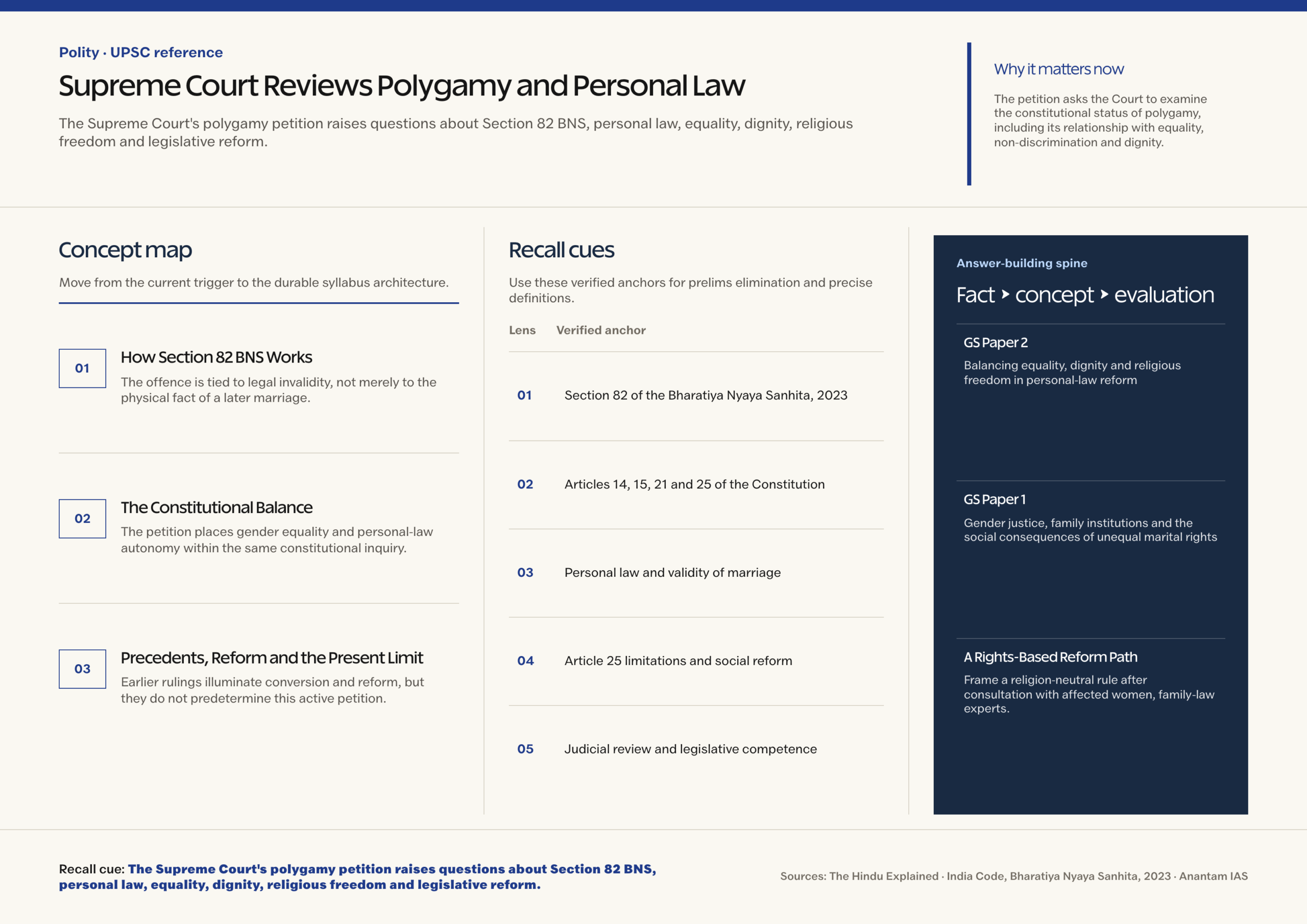
Background and Context
How Section 82 BNS Works
The offence is tied to legal invalidity, not merely to the physical fact of a later marriage.
- Section 82 applies when a person with a living spouse marries again and the later marriage is void because the earlier spouse remains alive. This causal link is the core statutory trigger.
- Sub-section (1) allows imprisonment up to seven years and a fine; concealment of the earlier marriage under sub-section (2) can attract up to ten years.
- The section also recognises limited exceptions, including a court-declared void marriage and a spouse continuously absent and unheard of for seven years, subject to disclosure.
- Its wording makes the applicable matrimonial law crucial: criminal liability arises only when that law treats the later marriage as void for subsistence of the first.
- Calling Section 82 a blanket statutory exemption for one religion is imprecise; the differential operation follows from how personal law validates marriage.
The Constitutional Balance
The petition places gender equality and personal-law autonomy within the same constitutional inquiry.
- Article 14 supports scrutiny of unequal legal consequences and requires any classification to rest on an intelligible basis connected to a legitimate objective. The inquiry examines both classification and legal effect.
- Article 15 bars State discrimination on grounds including religion and sex, strengthening the challenge to State-backed rules that produce gendered marital inequality.
- Article 21 protects life and personal liberty, supplying dignity, autonomy and decisional-privacy arguments for individuals affected by unequal family arrangements.
- Article 25 protects freedom of conscience and religious practice, but expressly subjects that freedom to public order, morality, health and the other Fundamental Rights.
- The Court must still decide threshold questions, including whether the impugned personal-law rule is reviewable as State action and how far religious protection extends.
Precedents, Reform and the Present Limit
Earlier rulings illuminate conversion and reform, but they do not predetermine this active petition.
- In Sarla Mudgal, the Court held that a Hindu marriage is not dissolved merely because one spouse converts to Islam before contracting another marriage. The first marriage continued under its governing statute.
- That ruling prevented conversion from becoming a device to evade the monogamy rule governing the subsisting Hindu marriage; it did not create one uniform marriage code.
- The present petition directly contests the broader differential treatment associated with polygamy and asks for a religion-neutral criminal and constitutional framework.
- A court can test laws and grant constitutional relief, while Parliament can design definitions, transitions, safeguards, remedies and enforcement through a generally applicable statute.
- For exam answers, distinguish the pending proceeding, the Court’s request for a Union response and its suggestion to consider legislation from a final binding holding.
Way Forward
A Rights-Based Reform Path
Any reform should protect affected spouses without creating uncertainty about marital status, children or existing legal rights.
- Frame a religion-neutral rule after consultation with affected women, family-law experts, religious communities and state governments.
- Specify prospective operation, maintenance, inheritance, custody and property consequences so penal reform does not erase civil remedies.
- Use proportionate enforcement and accessible legal aid, while protecting complainants from economic retaliation or abandonment.
- Keep judicial review focused on constitutional injury and leave detailed transitional design to accountable legislation where institutional capacity is stronger.
Conclusion
- The dispute is not simply religion versus reform; it concerns how marriage validity, criminal liability and equal citizenship interact within one constitutional order.
- A strong answer should separate the pending case from settled law, apply Articles 14, 15, 21 and 25, and explain why carefully designed legislation may complement judicial review.
UPSC Practice Questions
Prelims MCQ 1
With reference to Section 82 of the Bharatiya Nyaya Sanhita, 2023, consider the following statements:
- It applies only when the subsequent marriage is void because it occurred during the lifetime of an existing spouse.
- Concealment of the former marriage from the person in the subsequent marriage can attract a higher maximum punishment.
- It contains no exception for a former spouse who has been continuously absent and unheard of for seven years.
How many of the above statements are correct?
(a) Only one (b) Only two (c) All three (d) None
Answer: (b) Only two
Explanation:
Statements 1 and 2 are correct. Section 82 includes a qualified exception for continuous seven-year absence when the former spouse has not been heard of and disclosure is made.
Prelims MCQ 2
Which constitutional provision expressly makes freedom of religion subject to public order, morality, health and the other Fundamental Rights?
(a) Article 14 (b) Article 15 (c) Article 21 (d) Article 25
Answer: (d) Article 25
Explanation:
Article 25 protects freedom of conscience and religious profession, practice and propagation, subject to public order, morality, health and the other provisions of Part III.
UPSC Mains Questions
- The constitutional review of polygamy requires more than a choice between equality and religious freedom. Discuss with reference to Articles 14, 15, 21 and 25.
- Why does the operation of Section 82 of the Bharatiya Nyaya Sanhita depend on the personal law governing marriage validity? Explain the case for legislative clarity.
Sources: The Hindu Explained and India Code, Bharatiya Nyaya Sanhita, 2023.
Frequently Asked Questions
Has the Supreme Court abolished polygamy?
No. The Court has sought the Union government’s response in an active petition and suggested consideration of suitable legislation. No final judgment abolishing or criminalising polygamy has been delivered.
What does Section 82 BNS punish?
It punishes marrying again while a spouse is living when the later marriage is void for that reason. Concealing the earlier marriage can attract a higher maximum sentence.
Does Section 82 expressly exempt Muslim personal law?
No express religion-based exemption appears in its text. Its operation depends on whether the applicable matrimonial law makes the subsequent marriage void while the first marriage subsists.
Which Fundamental Rights are central to the challenge?
Articles 14 and 15 support equality and non-discrimination claims, Article 21 supports dignity and autonomy, and Article 25 protects religious freedom subject to constitutional limits.
Why might legislation still be required?
Legislation can create a general rule while addressing prospective application, marital status, maintenance, inheritance, custody, remedies and enforcement, which a case-specific judicial order may not comprehensively design.