Presidential Reference on Governor’s Role: SC Verdict on Article 200 and State Bills 2025
Introduction
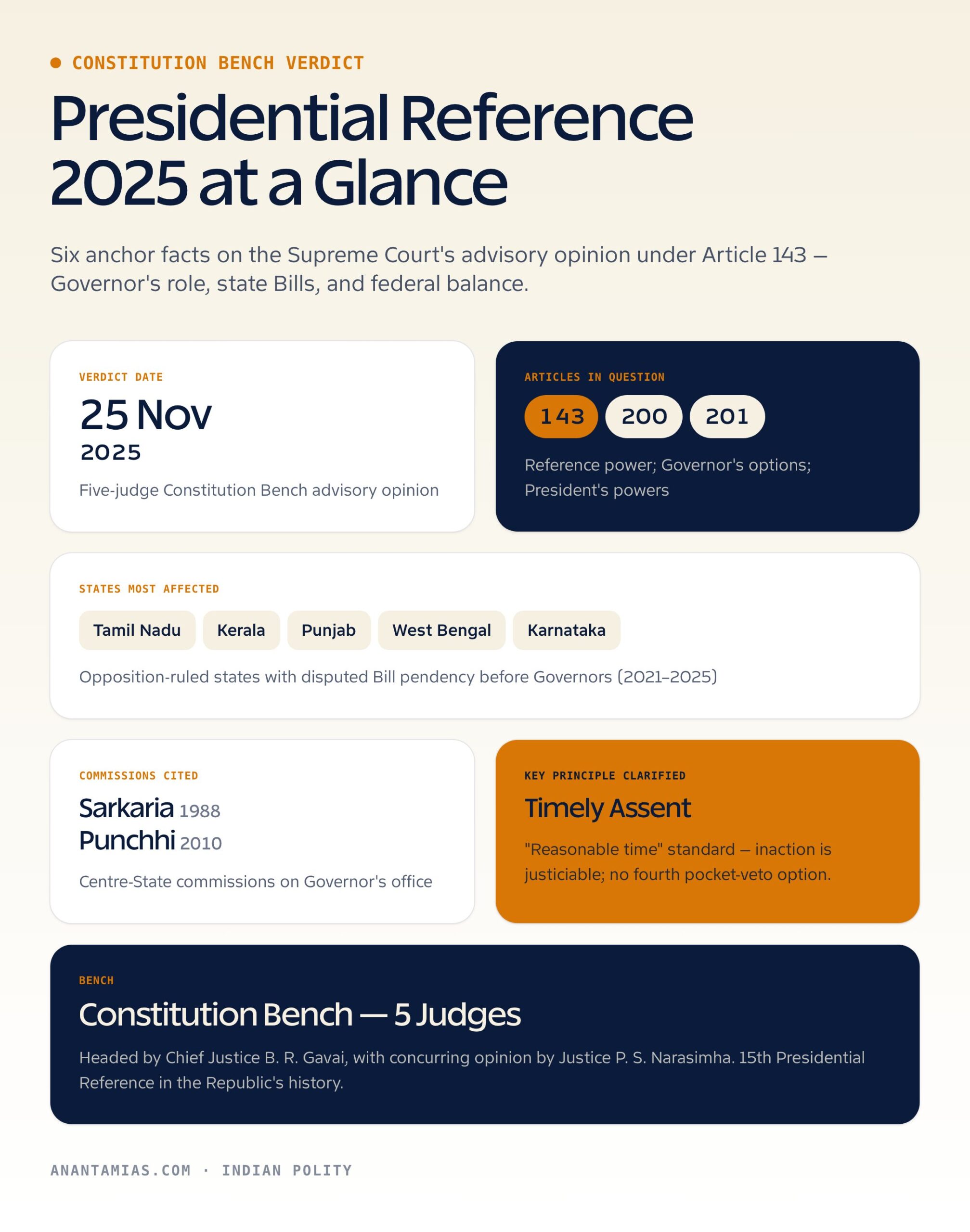
The Presidential Reference on the role of Governors and the President in the assent of state legislation is a constitutional moment in the long arc of Indian federalism. On 25 November 2025, a five-judge Constitution Bench of the Supreme Court of India headed by Chief Justice B. R. Gavai delivered its advisory opinion under Article 143 on a fourteen-question reference made by President Droupadi Murmu in May 2025, in the wake of the Court’s earlier April 2025 ruling in The State of Tamil Nadu v The Governor of Tamil Nadu. The reference asked, in essence, whether the Court could read time-bound deadlines into the constitutional silence of Article 200 and Article 201, whether the doctrine of “deemed assent” was a legitimate judicial innovation, and whether the discretion of the Governor and the President in dealing with state Bills was justiciable at all. For the UPSC aspirant, this single advisory opinion opens a window onto Paper II polity (Articles 143, 200, 201, 154, 163), Paper II federalism (centre-state relations and the Sarkaria–Punchhi continuum), Paper III governance (parliamentary procedure and constitutional offices), and the Essay paper, where the perennial question of whether the Governor is a constitutional sentinel or a political appointee finds fresh material.
The headline of the verdict is that the Constitution Bench struck down the “deemed assent” doctrine that the two-judge bench in the Tamil Nadu case had introduced, refused to read judicially-fixed timelines into Articles 200 and 201, but reaffirmed that prolonged inaction by a Governor or the President is judicially reviewable on the touchstone of mala fides, manifest arbitrariness, or constitutional impropriety. The advisory opinion, running to several hundred pages with a separate opinion by Justice P. S. Narasimha, threads a careful needle between the textualist position favoured by the Union and the federalist anxieties pressed by Tamil Nadu, Kerala, Punjab and West Bengal. This article unpacks the constitutional architecture, the long political prehistory of the dispute, the 25 November 2025 ruling, the federalism implications, and the criticisms that have already begun to crystallise around it.
Quick Facts at a Glance
| Indicator | Value | Source |
|---|---|---|
| Date of Supreme Court advisory opinion | 25 November 2025 | Supreme Court of India, Special Reference No. 1 of 2025 |
| Constitutional provision invoked for the reference | Article 143(1) | Constitution of India |
| Bench strength | Five-judge Constitution Bench | Supreme Court of India |
| Presiding judge | Chief Justice B. R. Gavai | Supreme Court Cause List, November 2025 |
| Number of questions referred by the President | 14 | Presidential Reference, 13 May 2025 |
| Triggering judgment | State of Tamil Nadu v Governor of Tamil Nadu (April 2025) | 2025 SCC OnLine SC 770 |
| Articles centrally interpreted | Articles 200, 201, 143, 163, 361 | Constitution of India |
| Outcome on “deemed assent” doctrine | Overruled / disapproved | Supreme Court Advisory Opinion, 25 November 2025 |
| Outcome on judicial timelines for Governor/President | Not read into the Constitution; reasonable time standard applied | Supreme Court Advisory Opinion, 25 November 2025 |
Background and Historical Context
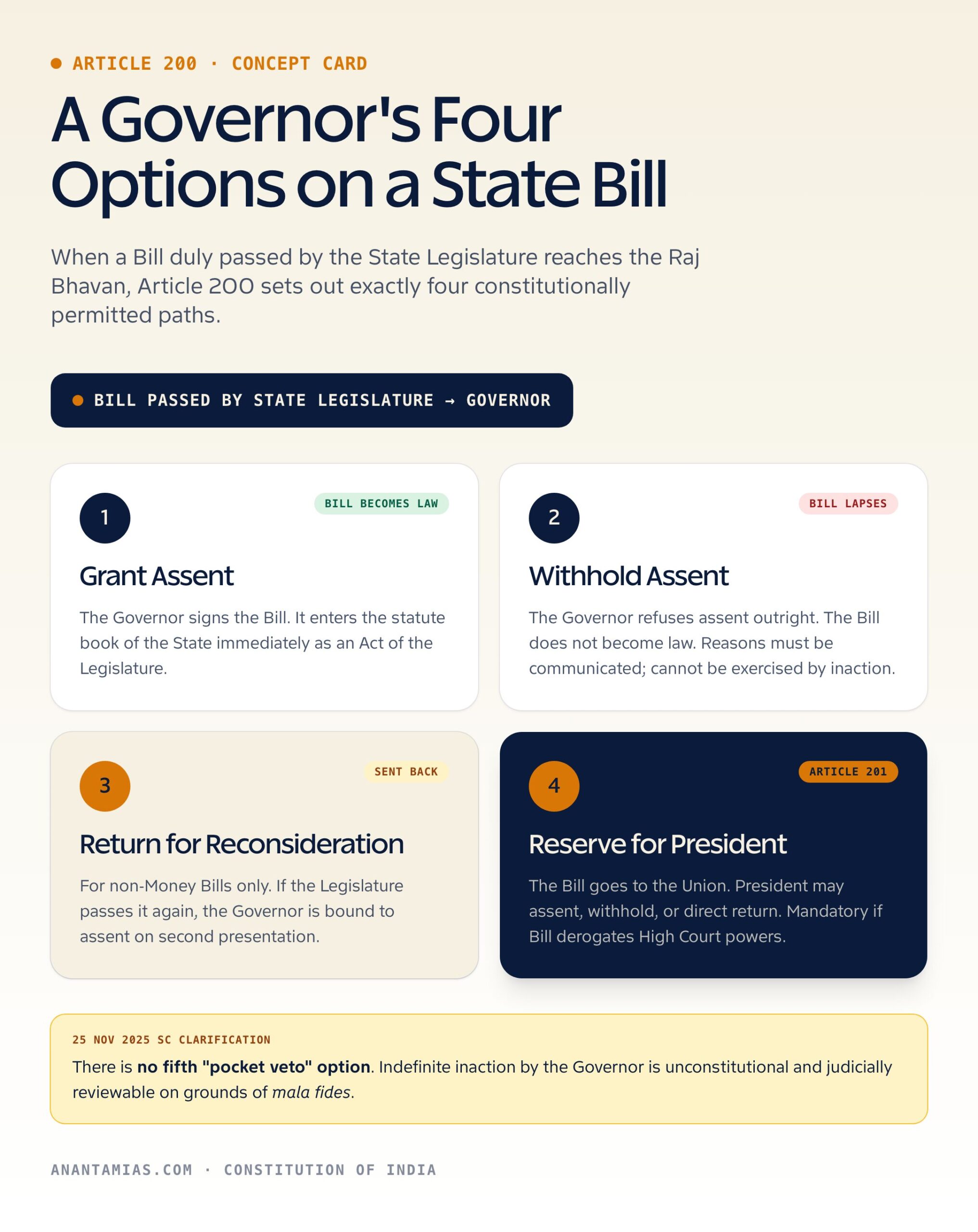
The Indian Constitution’s treatment of the Governor’s office was a deliberate compromise between two traditions: the British Crown’s role in colonial India, where the Governor was an imperial agent, and the federal idea, where the Governor was to function as the constitutional head of an elected state government. Article 200 of the Constitution gives a Governor four options when a Bill duly passed by the State Legislature is presented for assent — assent, withhold assent, return the Bill (if not a Money Bill) for reconsideration, or reserve the Bill for the consideration of the President. Article 201 then governs what happens after reservation: the President may either give assent, withhold assent, or direct the Governor to send the Bill back to the legislature with a message. Crucially, neither Article specifies a timeline. The Constituent Assembly debates of 4 June 1949, in which B. R. Ambedkar, K. M. Munshi, and H. V. Kamath spoke at length, record a conscious decision to leave the matter to convention, on the assumption that Governors would act on the aid and advice of the Council of Ministers under Article 163 and would not behave as obstructionist agents of the Union.
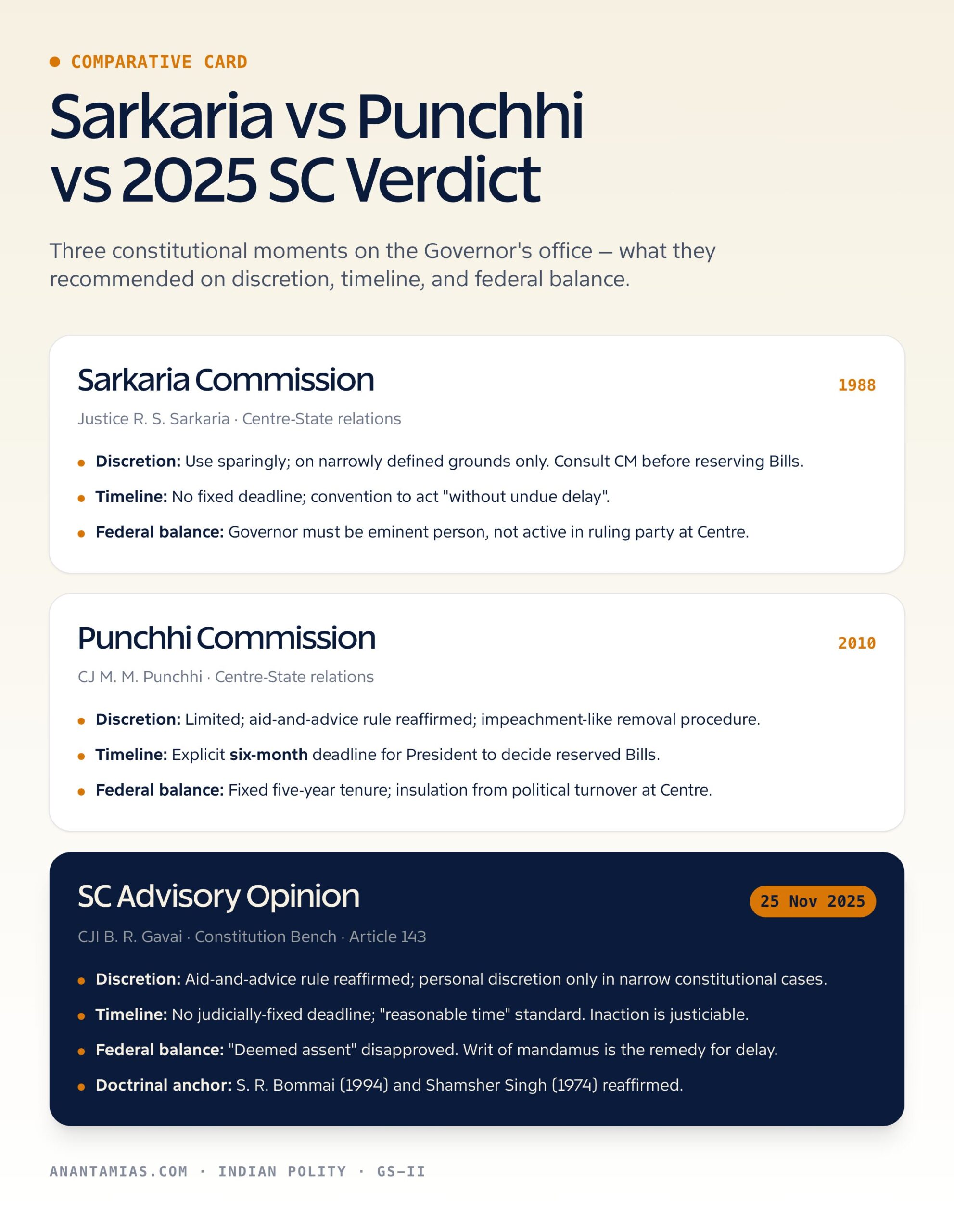
This assumption frayed quickly. From the dismissal of the E. M. S. Namboodiripad ministry in Kerala in 1959 to the use of Article 356 against opposition-ruled states through the 1970s and 1980s, the office of the Governor became a recurring federal flashpoint. The Sarkaria Commission (1983–88), set up by Prime Minister Indira Gandhi and chaired by Justice R. S. Sarkaria, issued a comprehensive report in 1988 recommending that Governors be persons of eminence not actively associated with the ruling party at the Centre, that they consult the Chief Minister before reserving Bills, and that the discretion under Article 200 be used sparingly and on narrowly defined grounds. The Punchhi Commission (2007–10), chaired by former Chief Justice M. M. Punchhi, went further, recommending a fixed five-year tenure, removal only by impeachment-like procedure, and explicit time limits — typically six months — within which the President should decide on a reserved Bill.
The post-2014 cycle saw a fresh round of tensions, this time concentrated in opposition-ruled states. In State of Punjab v Principal Secretary to the Governor of Punjab (November 2023), Chief Justice D. Y. Chandrachud ruled that a Governor could not “sit on” Bills indefinitely and that the phrase “as soon as possible” in the first proviso to Article 200 was a constitutional command, not a courtesy. The dam broke a year later in Tamil Nadu, where Governor R. N. Ravi had withheld action on ten Bills passed by the M. K. Stalin government, some pending for over three years. In its April 2025 verdict, a two-judge bench of Justices J. B. Pardiwala and R. Mahadevan not only held the Governor’s inaction unconstitutional but, in a doctrinal leap, fixed three-month timelines for the Governor and President under Articles 200 and 201, and held that the ten pending Tamil Nadu Bills stood “deemed to have received assent”. The Union, alarmed at what it saw as judicial legislation, persuaded the President to invoke Article 143 — only the fifteenth Presidential Reference in the Republic’s history — and the resulting Constitution Bench hearing through July, August and October 2025 culminated in the 25 November 2025 advisory opinion.
Key Features of the Verdict
Article 200 — Governor’s Options on Bills
Article 200 sets out the three substantive options a Governor exercises on a Bill presented for assent: assent, withholding of assent, or reservation for the consideration of the President. A fourth option — returning a non-Money Bill for reconsideration — is contained in the first proviso, with the legislature’s reconsideration binding the Governor on a second presentation. The Constitution Bench reaffirmed the long-standing constitutional reading that the Governor acts on the aid and advice of the Council of Ministers under Article 163(1), except where the Constitution expressly requires personal discretion. The “second proviso” Bills — those that, if enacted, would derogate from the powers of the High Court under Article 200 — represent the narrow band where mandatory reservation is the only constitutionally permitted course. Beyond this, the bench held, the Governor’s discretion is structurally constrained: there is no fourth, “pocket veto” option of sitting on a Bill indefinitely. Inaction, the Court ruled, is not a constitutional choice.
Article 201 — President’s Powers
Article 201 governs the disposal of a Bill that has been reserved by the Governor. The President may declare that she assents, that she withholds assent, or — if the Bill is not a Money Bill — direct the Governor to return the Bill to the State Legislature with a message recommending reconsideration. If the legislature passes the Bill again, with or without amendment, it is presented again to the President; even then, the Constitution does not bind the President to assent. The Constitution Bench in the 25 November 2025 opinion held that the President, like the Governor, acts on the aid and advice of the Union Council of Ministers under Article 74, and that the executive’s responsibility is therefore collective and political rather than personal. The bench refused to read a hard timeline into Article 201, but held that a “reasonable time” standard applies, and that if the President does not act within a reasonable period — typically benchmarked at three months — the State Government is entitled to seek a writ of mandamus, with the Union required to disclose reasons for the delay.
Article 143 — Presidential Reference Mechanism
Article 143 empowers the President to refer a question of law or fact of “public importance” to the Supreme Court for its advisory opinion. The Court’s opinion under Article 143(1) is not binding on the President, but is treated by all branches as authoritative, and is invariably followed in practice. The mechanism has been invoked sparingly — earlier landmark references include the Delhi Laws Act Reference (1951), the Kerala Education Bill Reference (1958), the Berubari Reference (1960), the Presidential Election Reference (1974), the Special Courts Bill Reference (1978), the Cauvery Reference (1992), the Ayodhya Reference (1994), and the Third Judges Reference (1998). The 2025 Reference was the fifteenth in the Republic’s history and the first to question, head-on, a sitting two-judge bench’s reading of Articles 200 and 201. The Constitution Bench held that an Article 143 reference can examine — and effectively overrule, even though not in form — an earlier judgment of a smaller bench, provided the question raised is of constitutional significance and not merely an attempt to relitigate a decided lis between parties.
The 25 November 2025 SC Verdict
The advisory opinion, authored principally by Chief Justice B. R. Gavai with a concurring opinion by Justice P. S. Narasimha, made four operative findings. First, the doctrine of “deemed assent” introduced by the April 2025 Tamil Nadu judgment was held to be without textual basis in Articles 200 or 201 and was disapproved. Second, judicially-mandated timelines — the three-month windows fixed by the two-judge bench — were held to be impermissible judicial legislation; the Court cannot rewrite a constitutional silence into a constitutional command. Third, the Governor and the President are nevertheless under a constitutional obligation to act within a “reasonable time”, and prolonged or unexplained inaction is justiciable on grounds of mala fides, manifest arbitrariness, or violation of the federal scheme. Fourth, the Court reaffirmed that under Articles 163 and 74 respectively, both the Governor and the President act on the aid and advice of their respective Councils of Ministers, with personal discretion confined to narrow, constitutionally enumerated situations. The verdict thus simultaneously rolled back the most aggressive judicial innovation of April 2025 and preserved the federalist core that prompted the original litigation.
Significance for UPSC and General Knowledge
- Direct GS-II syllabus hit on the Constitution of India, separation of powers, and the role of constitutional functionaries (Governor, President).
- GS-II federalism anchor — the verdict is now the leading authority on centre-state friction in the legislative process and will be cited alongside S. R. Bommai (1994) and NCT of Delhi (2018, 2023).
- Prelims static fodder on Articles 143, 200, 201, 163, 361, plus the Sarkaria and Punchhi Commission recommendations.
- Essay paper data bank on the perennial question of whether the Governor is a constitutional sentinel or a political appointee.
- GS-IV ethics overlap on constitutional morality, propriety of high office, and the duty to act without delay.
- Interview-stage current affairs material on judicial review of executive inaction and the “deemed assent” controversy.
- Linkage with the broader cooperative federalism vocabulary — Inter-State Council, Finance Commission, GST Council — providing a unified federalism story for Mains.
Detailed Analysis: Federalism, Governor’s Role, and the Centre-State Equilibrium
The 25 November 2025 advisory opinion is best read not as a single doctrinal pronouncement but as a recalibration of three federalist debates that have run through Indian constitutional history. The first is the question of discretion: how much room does the Governor have, under Article 163 read with Article 200, to act independently of the State Council of Ministers? The second is the question of timeliness: when constitutional silence collides with political delay, can the judiciary invent a deadline? The third, deeper question is the nature of the office itself: is the Governor primarily a constitutional head of the state, in the Westminster model, or a federal link to the Union, in the colonial-residual model the Constituent Assembly sought to retire but never fully repudiated. The Constitution Bench answered the first two with relative clarity and left the third — necessarily, perhaps — for the political process to settle.
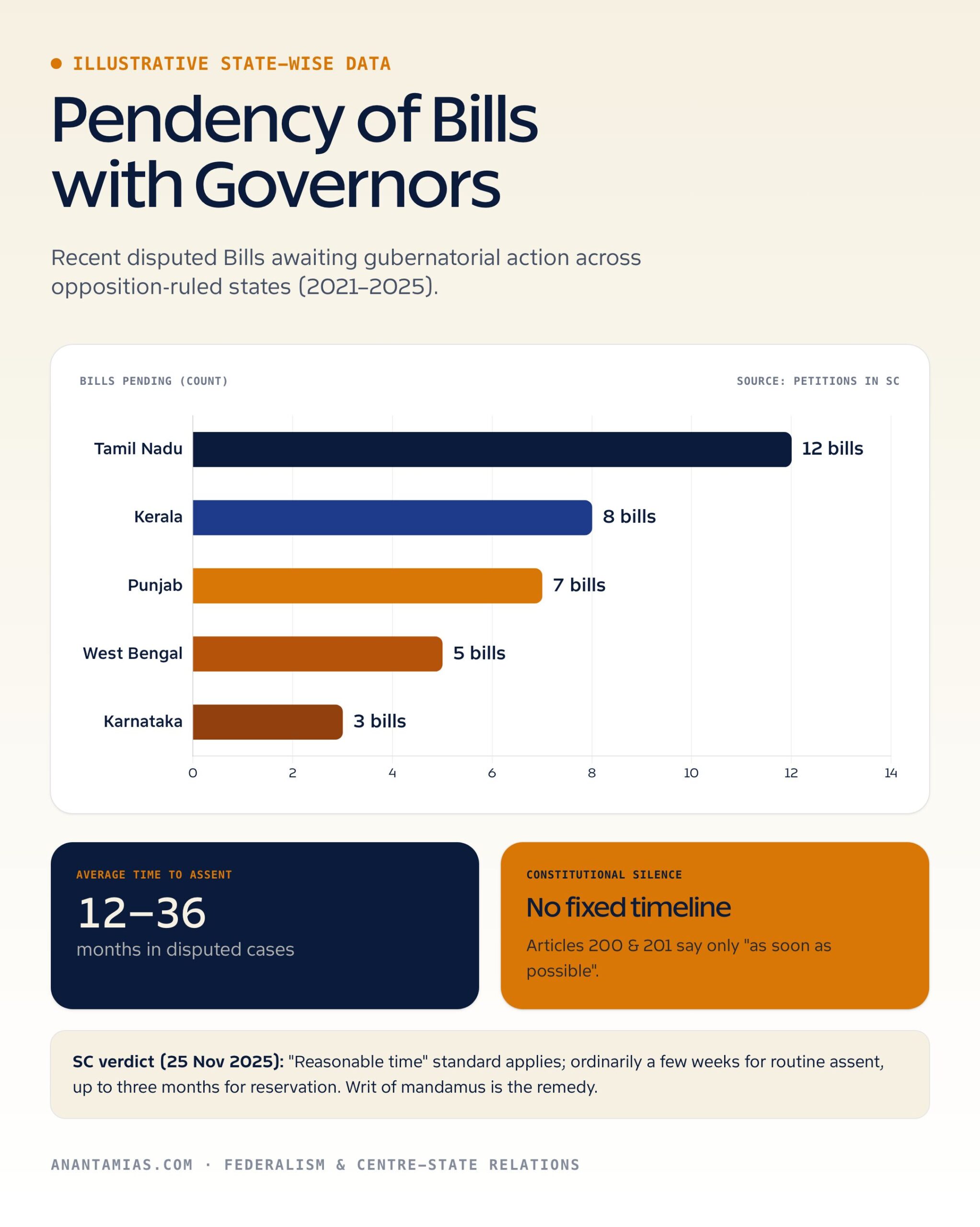
The political record against which the Court was working is dense. Governors and elected state governments have clashed for decades, but the 2014–2025 cycle saw a sharper concentration of disputes in opposition-ruled southern and eastern states. Tamil Nadu under Governor R. N. Ravi sat on multiple Bills passed by the DMK government, including those concerning the appointment of vice-chancellors. Kerala under Governor Arif Mohammed Khan saw similar pendency on Bills relating to Lokayukta powers and university chancellorship. Punjab under Governor Banwarilal Purohit faced delays on a clutch of fiscal Bills, prompting the 2023 ruling. West Bengal saw running disputes between Governors Jagdeep Dhankhar and his successor C. V. Ananda Bose and the Mamata Banerjee government, including over university appointments and bills regulating private universities. Telangana, before its political turnover in late 2023, saw similar friction under Governor Tamilisai Soundararajan. The Court was therefore being asked to adjudicate not an isolated event but a structural pattern.
| State (Governor v Government) | Year(s) | Outcome |
|---|---|---|
| Tamil Nadu (R. N. Ravi v Stalin govt) | 2021–2025 | SC April 2025 ruling deemed 10 Bills assented; overruled in part by 25 Nov 2025 advisory opinion |
| Kerala (Arif Mohammed Khan v Vijayan govt) | 2022–2024 | SC directed Governor and President to act on pending Bills within reasonable time; Lokayukta and University Bills partially returned |
| Punjab (Banwarilal Purohit v Bhagwant Mann govt) | 2022–2023 | SC November 2023 ruling held Governor cannot indefinitely withhold assent; “as soon as possible” read as command |
| West Bengal (Dhankhar / Bose v Banerjee govt) | 2019–2025 | Multiple Bills pending; matters pending before HC and SC; partly subsumed in 25 Nov 2025 opinion |
| Telangana (Tamilisai Soundararajan v KCR govt) | 2022–2023 | SC May 2023 directed Governor to act on Bills within reasonable period; matter resolved post 2023 polls |
| Karnataka (Vajubhai Vala v Kumaraswamy/Yediyurappa) | 2018–2019 | Trust vote disputes; no direct Article 200 issue but bench composition test cited in later cases |
The doctrinal core of the verdict rests on three constitutional pillars. First, the S. R. Bommai (1994) principle that federalism is a basic feature of the Constitution implies that the legislative will of an elected state government cannot be defeated by indefinite executive inaction. Second, the Shamsher Singh v State of Punjab (1974) holding that the President and Governors are bound by the aid and advice of their Councils of Ministers, except in narrowly defined circumstances, was reaffirmed and applied to Article 200 with new clarity. Third, the Rameshwar Prasad (2006) recognition that the Governor’s actions are not immune from judicial review under Article 361, when those actions are alleged to be mala fide or in colourable exercise of power, was extended from dissolution-of-assembly cases to the assent-to-Bills domain. Read together, these three pillars produce a workable rule: Governors and Presidents have constitutional discretion only within the corridor that Articles 163 and 74 carve out, and even within that corridor, prolonged inaction is reviewable.
What the Court explicitly refused to do is equally important. It refused to fix calendar deadlines because, the bench reasoned, every Bill is different — some are routine fiscal authorisations that can be cleared in days, others raise complex constitutional questions where reservation under the second proviso is constitutionally required. A uniform three-month rule, the Court held, would in some cases be unduly generous to delay and in others unfairly compress legitimate executive deliberation. Instead, the bench articulated a structured “reasonable time” standard: ordinarily a few weeks for routine assent, up to three months for reservation decisions, and longer only with reasons recorded in writing. The aggrieved State Government’s remedy is the writ of mandamus, with the Court reserving the power to compel disclosure of reasons but not the power to substitute its own assent for the Governor’s or the President’s.
The federalism implications of the verdict are significant. By disapproving “deemed assent” the Court has restored the constitutional sequence — assent flows from the Governor or the President, never from a judicial fiction — but by also affirming that inaction is justiciable, it has refused to leave state governments without a remedy. The verdict effectively codifies the Sarkaria-Punchhi recommendations as enforceable constitutional norms while stopping short of constitutional amendment. The Court’s invocation of Article 256 (duty of states to comply with Union laws) and Article 257 (limits on Union direction to states) read alongside Articles 200 and 201, also signals that the legislative-executive interface between state legislatures and the Union government is now fully within the federalism canon — not a subordinate adjunct of the Union’s executive prerogative.
The closing analytical observation is structural rather than legal. The Inter-State Council, set up under Article 263 in 1990 on the Sarkaria recommendation, has met irregularly and rarely as a substantive forum. The verdict implicitly invites the political branches to use the Inter-State Council, the NITI Aayog Governing Council, and the Zonal Councils to pre-empt assent disputes by surfacing draft Bills with national implications before they reach the Governor’s desk. Without such forums functioning effectively, every disputed Bill becomes a Supreme Court matter — an architecture that no constitutional design contemplates as the steady state.
Comparative Perspective
India’s Governor sits in a unique constitutional position when compared with the equivalent offices in other Westminster-derived federations. Both the United Kingdom (via the Lord Lieutenant and, more substantively, the devolved settlements) and Australia (via the State Governor appointed on the advice of the State Premier) have evolved towards a strictly ceremonial federal head, with the Westminster convention that no head of state may withhold assent indefinitely treated as inviolable.
| Office | Appointment and Powers on Bills | Federal Character |
|---|---|---|
| Governor of an Indian State | Appointed by the President on Union advice; assents, withholds, returns or reserves Bills (Articles 200, 201) | Federal link with substantive constitutional discretion in narrow cases |
| Lord Lieutenant (United Kingdom) | Personal representative of the Sovereign in a county; no role in Bills; royal assent in UK never refused since 1708 | Purely ceremonial; devolved Parliaments (Scotland, Wales, NI) work through Presiding Officers |
| State Governor (Australia) | Appointed by the Sovereign on advice of State Premier; assent on Bills is by convention automatic; reservation for the Crown is obsolete | Ceremonial in practice; reserve powers theoretically available but politically unusable |
| Lieutenant Governor (Canadian Province) | Appointed by the Governor General on PM’s advice; can assent, withhold or reserve Bills for Governor General; reservation last used in 1961 | Federal link historically, ceremonial today |
| State Governor (United States) | Directly elected; veto/line-item veto powers vary by state; no federal appointment | Independent state executive, not a federal link |
The structural insight from this comparison is that India is alone among the major Westminster federations in retaining substantive — and contested — federal-link powers in the Governor’s office. The British and Australian models have allowed convention to drain the office of operational discretion; the Canadian Lieutenant Governor’s reservation power has fallen into desuetude with the last reservation recorded in 1961; and the American state Governor sits outside this typology altogether by virtue of direct election. India’s hybrid retains the form of viceregal power without the political legitimacy of either election or settled convention — a structural anomaly that the 25 November 2025 verdict patches but does not remove. The aspirant should note that calls for constitutional amendment to align India with the Australian or Canadian convention have been periodic but unsuccessful, and that the Court has thus far held back from constitutionalising what is essentially a political question.
Challenges and Criticisms
The most articulate critique of the verdict has come from constitutional scholars who argue that by discarding the “deemed assent” remedy without supplying an equally effective substitute, the Court has restored constitutional form at the cost of practical efficacy. Professor Faizan Mustafa, writing in The Indian Express, argued that the writ-of-mandamus remedy preserved by the Constitution Bench is procedurally cumbersome — every aggrieved state must approach the Supreme Court afresh — and politically uneven, because only well-resourced state governments will actually litigate, while smaller or politically aligned states will quietly absorb delay. The 1973 work of Granville Austin, The Indian Constitution: Cornerstone of a Nation, is equally apposite here: Austin’s diagnosis that the Indian Constitution attempted “cooperative federalism with a strong centre” depended, he wrote, on the Centre exercising its powers with restraint. The verdict assumes such restraint; the political record over fifty years suggests it is not the natural disposition of any Union government, of any party.
A second strand of critique focuses on the Article 143 mechanism itself. Subhash Kashyap, former Secretary-General of the Lok Sabha and a long-time scholar of parliamentary procedure, has noted that using a Presidential Reference to revisit a sitting two-judge bench’s verdict comes uncomfortably close to converting Article 143 into a constitutional appeals mechanism, undermining the doctrine of finality. The Constitution Bench addressed this concern in its opinion but the criticism — that the Reference route allows the Union to “appeal” to a larger bench when it dislikes a smaller bench’s verdict — will not go away. Constitutional scholar M. P. Singh, writing in the Journal of the Indian Law Institute, has separately argued that the verdict’s “reasonable time” standard is the kind of elastic doctrine that produces predictable outcomes only for litigants with the means to enforce it, and that a constitutional amendment fixing timelines — as recommended by Punchhi — remains the cleaner solution.
A third critique, voiced from within the federalist camp, is that the verdict pulls back from the boldest implication of the April 2025 Tamil Nadu judgment — that the Governor is functionally a ceremonial head — and reinstates a residual zone of personal discretion that, in practice, has historically been exercised in line with the political colour of the Union government. The National Commission to Review the Working of the Constitution (NCRWC, 2002) had recommended that Governors should not be removable except for proven misbehaviour, and that their tenure be insulated from political turnover at the Centre — a recommendation neither implemented nor revived by the verdict. Until the appointment process itself is reformed, critics argue, the assent dispute will recur with each change of government in Raj Bhavan, regardless of how clear the constitutional standard becomes. The verdict is, on this reading, a procedural settlement of a substantive problem.
Prelims Pointers
- The Supreme Court advisory opinion on the Presidential Reference was delivered on 25 November 2025 by a five-judge Constitution Bench headed by Chief Justice B. R. Gavai.
- Article 143(1) empowers the President to seek the Supreme Court’s advisory opinion on questions of law or fact of public importance.
- The 2025 Reference was the fifteenth Presidential Reference under Article 143 in the history of the Republic.
- Article 200 gives the Governor four options on a State Bill: assent, withhold assent, return for reconsideration (non-Money Bill), or reserve for the President.
- Article 201 governs the President’s powers on a reserved State Bill — assent, withhold assent, or direct return to the legislature.
- Article 163(1) requires the Governor to act on the aid and advice of the Council of Ministers except where the Constitution requires personal discretion.
- Article 361 grants the Governor and President immunity from court process for official acts, but does not bar judicial review of those acts.
- The Sarkaria Commission (1983–88) was chaired by Justice R. S. Sarkaria and submitted its report in 1988.
- The Punchhi Commission (2007–10) was chaired by former Chief Justice M. M. Punchhi and recommended a fixed five-year tenure for Governors and time limits on Bills.
- S. R. Bommai v Union of India (1994) established federalism and secularism as basic features of the Constitution and set the standard for judicial review of Article 356.
- Shamsher Singh v State of Punjab (1974) held that Presidents and Governors act on the aid and advice of their Councils of Ministers except in narrow exceptions.
- The November 2023 ruling in State of Punjab v Principal Secretary to the Governor read “as soon as possible” in Article 200 as a constitutional command.
- The April 2025 Tamil Nadu judgment by Justices J. B. Pardiwala and R. Mahadevan introduced “deemed assent” — overruled by the 25 November 2025 opinion.
- The Inter-State Council was set up under Article 263 in 1990 on the Sarkaria Commission’s recommendation.
- The National Commission to Review the Working of the Constitution (NCRWC) was chaired by Justice M. N. Venkatachaliah and submitted its report in 2002.
Mains Practice Questions
- The 25 November 2025 advisory opinion of the Supreme Court on the Presidential Reference under Article 143 has been described as a recalibration rather than a reversal of the Tamil Nadu judgment. Critically examine this characterisation in light of the doctrines of “deemed assent” and “reasonable time”. (15 marks)
- Discuss the constitutional architecture of Articles 200 and 201 of the Indian Constitution. To what extent does the silence of these provisions on timelines reflect a deliberate constitutional choice rather than an oversight? (15 marks)
- The recommendations of the Sarkaria and Punchhi Commissions on the office of the Governor remain partially implemented. Evaluate the extent to which the 25 November 2025 verdict advances or substitutes for these recommendations. (15 marks)
- “The Governor in India occupies a constitutional position that has neither the political legitimacy of election nor the settled convention of ceremonial restraint.” Discuss with reference to recent Centre-State controversies. (10 marks)
- Examine the role of Article 143 in the Indian constitutional scheme. Does its use to revisit a sitting smaller-bench judgment risk converting it into an executive-led appeals mechanism? (10 marks)
- Compare the office of the Indian State Governor with its counterparts in the United Kingdom, Australia and Canada. What structural lessons does this comparison hold for Indian federalism? (15 marks)
- Federalism has been recognised as a basic feature of the Indian Constitution since the S. R. Bommai judgment. Analyse how the 25 November 2025 advisory opinion strengthens or qualifies this constitutional commitment. (15 marks)
- The writ of mandamus has been preserved as the principal remedy for state governments aggrieved by gubernatorial or presidential inaction on Bills. Discuss the practical adequacy of this remedy and suggest constitutional or statutory reforms. (10 marks)
Conclusion
The 25 November 2025 advisory opinion is, when read as a whole, a constitutional negotiation rather than a constitutional verdict. The Constitution Bench refused to legislate from the bench by inventing calendar deadlines, but it equally refused to allow the Governor’s silence to harden into a fourth, unwritten option of indefinite veto. What it produced — a “reasonable time” standard, justiciability of inaction on the touchstone of mala fides, and a clear restatement of the aid-and-advice principle — is the kind of equilibrium that India’s federal architecture has historically found difficult to sustain through political practice alone. The doctrinal innovations of the April 2025 Tamil Nadu judgment have been disapproved, but the federalist intuition behind them has been preserved.
For the year ahead, three watchpoints follow directly from the verdict. The first is the disposal of the ten Tamil Nadu Bills whose “deemed assent” status has now been unwound — whether the Governor and the President will, in practice, act within the “reasonable time” the Court has now articulated, or whether fresh writ proceedings will become necessary. The second is the response of state governments in Kerala, West Bengal, and any future opposition-ruled states to the new standard: will they read it as a victory or as an invitation to litigate every delay? The third is the institutional question of whether the Inter-State Council and the NITI Aayog Governing Council can be revived as substantive forums for pre-empting assent disputes, rather than leaving the Supreme Court as the routine venue for what are, in essence, political negotiations.
For the aspirant, the line worth carrying into the answer booklet is that India’s federal arrangement has always relied on convention to do the work that text was deliberately left silent on; the 25 November 2025 verdict is the Supreme Court’s attempt to reinforce convention with constitutional discipline without pretending to rewrite text. Whether that attempt holds — through the next political cycle, the next disputed Bill, the next change of government in Raj Bhavan — is a question the document cannot answer; it can only ask it more sharply than any verdict before it has.
Frequently Asked Questions
What is a Presidential Reference under Article 143?
Article 143(1) empowers the President to seek the Supreme Court’s advisory opinion on questions of law or fact of public importance. The opinion is advisory but carries strong persuasive weight. The Court’s 25 November 2025 opinion on the Governor’s role is the most consequential reference since the Special Reference No. 1 of 2002 on the Gujarat Assembly.
What are the Governor’s options under Article 200?
Article 200 gives the Governor four options when a state bill is presented for assent: grant assent, withhold assent, return the bill for reconsideration (except a Money Bill), or reserve it for the President’s consideration. The 2025 verdict held that ‘as soon as possible’ must be read as a justiciable timeline — a Governor cannot indefinitely sit on a bill.
What does Article 201 say?
Article 201 governs bills reserved by the Governor for the President. The President may either give assent or withhold it, or in the case of a non-Money Bill, ask the Governor to return it to the State Legislature for reconsideration. The article does not specify a timeline — the SC has now read ‘reasonable time’ into both Articles 200 and 201.
Which states triggered this Presidential Reference?
The reference originated from controversies in Tamil Nadu, Kerala, Punjab and West Bengal, where Governors had withheld or delayed assent on multiple bills passed by elected legislatures. Tamil Nadu Governor v. Tamil Nadu State (2024) and Punjab v. Governor (2023) framed the questions that the Centre then referred to the SC under Article 143.
What did the Sarkaria and Punchhi Commissions recommend?
The Sarkaria Commission (1988) and the Punchhi Commission (2010) both recommended that the Governor should generally act on the advice of the Council of Ministers, that bills should be cleared within a reasonable time, and that the Governor’s discretionary powers should be narrowly construed. The 2025 verdict has now constitutionalised these recommendations as enforceable timelines.
Is the Governor bound by the advice of the State Cabinet?
Generally, yes. Under Articles 163 and 164, the Governor acts on the advice of the Council of Ministers headed by the Chief Minister, except in narrow areas of personal discretion (e.g., reserving a bill for the President under Article 200, or summoning the House when no party has a majority).
What did the 25 November 2025 SC verdict change?
The Court read into Articles 200 and 201 a ‘reasonable time’ obligation, held that prolonged inaction by a Governor or the President is justiciable, and reaffirmed that the Governor’s role is largely titular except in the constitutionally specified discretionary areas. It puts a constitutional clock on what was earlier a political grey zone.
Why is this verdict important for UPSC?
The verdict is core to GS-II Polity, federalism and centre-state relations. It tests Articles 143, 163, 164, 200, 201, the Sarkaria/Punchhi recommendations, and the doctrine of cooperative federalism. Mains questions on Governor’s role almost always anchor on this jurisprudence; Prelims often tests the article numbers and named commissions.