West Bengal madrasas verdict: Why the Supreme Court rejected State-salary claims
Why in News?
The Supreme Court on July 13, 2026 rejected the claims of over 350 teachers and non-teaching staff who sought regularised appointments and State-funded salaries in West Bengal madrasas under the State’s grant-in-aid scheme. The Hindu reported that a Bench headed by Justice Dipankar Datta held that none of the petitioners could persuade the court on the merits of their cases.
More than 40 petitions filed by 361 petitioners traced their appointments to the period after the Calcutta High Court declared the West Bengal Madrasa Service Commission Act, 2008 unconstitutional — a declaration later confirmed within the High Court. The case turned on two threshold questions: whether the madrasas where the petitioners worked were validly recognised by the State, and whether they were run by lawfully constituted managing committees.
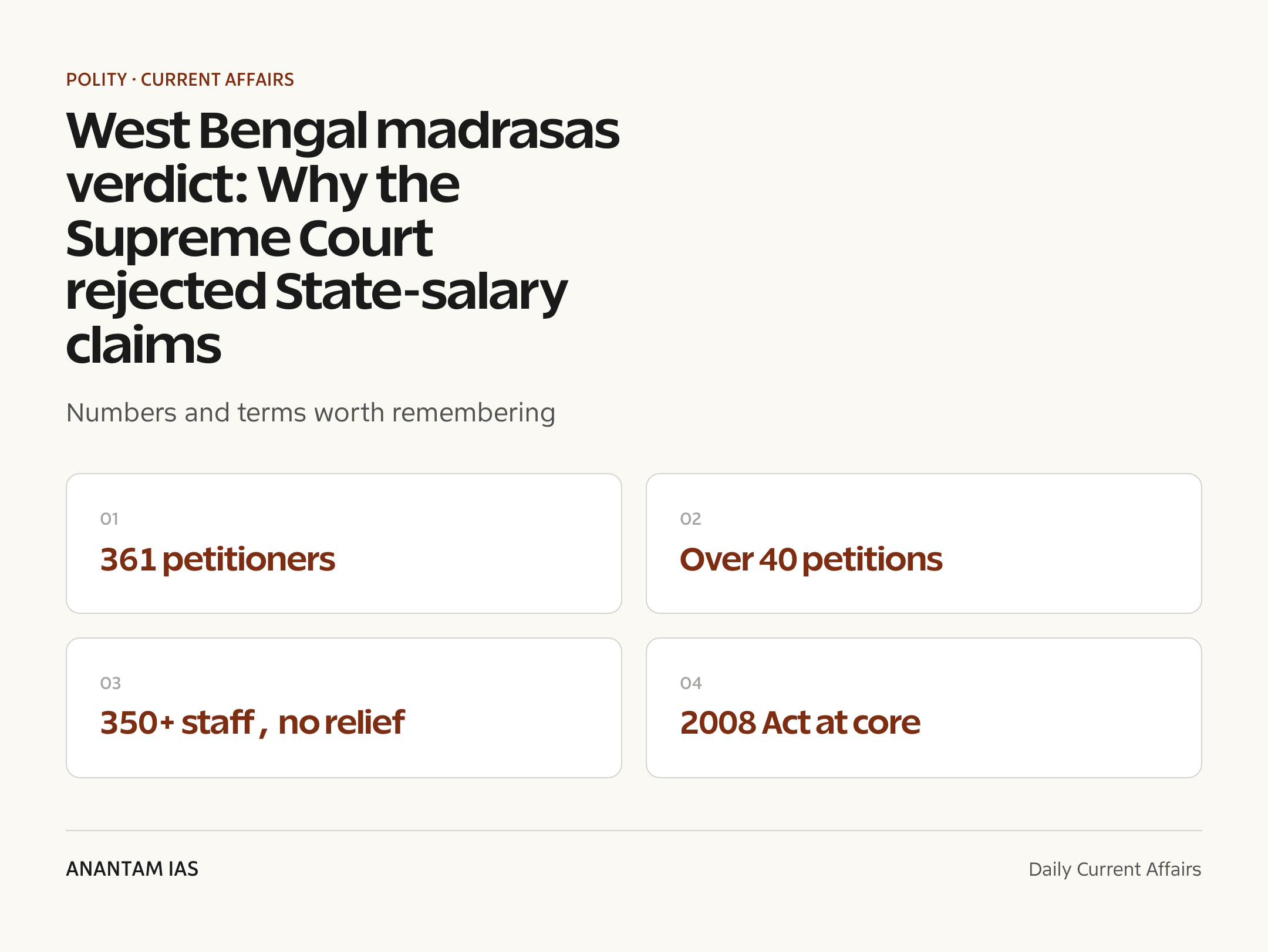
- 361 petitioners across more than 40 petitions sought regularisation of service and State-funded salaries.
- The Bench was headed by Justice Dipankar Datta; the verdict came on July 13, 2026.
- The appointments were made directly by madrasa managing committees during the window when the 2008 Act stood struck down by the Calcutta High Court.
- Two tests framed the case: valid State recognition of each madrasa, and a validly constituted managing committee running it.
- The Supreme Court had already revived Commission-based recruitment by upholding the 2008 Act in SK Md Rafique (2020).
The development matters in the context of:
- The verdict sits at the intersection of Article 30 autonomy for minority institutions and the State’s power to regulate institutions that draw public money.
- It reinforces the rule that salaries from the public exchequer flow only to staff appointed lawfully in recognised institutions.
- It extends the Umadevi (2006) bar on regularising backdoor appointments to the aided-madrasa sector.
- For GS2, it’s a ready case study on how recognition, aid and regulation travel together in education governance.

UPSC Relevance
Prelims Relevance
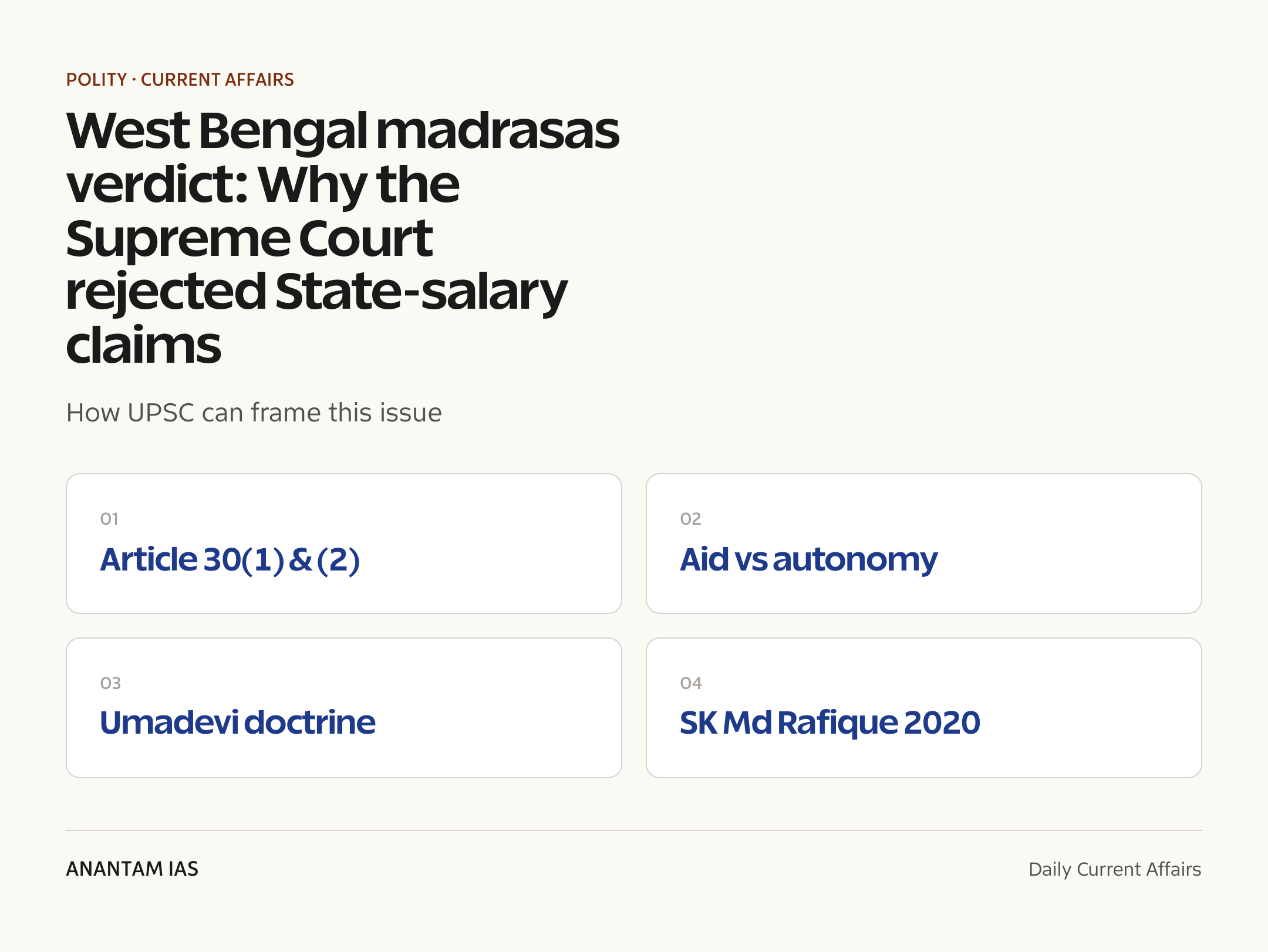
- Article 30(1): right of religious AND linguistic minorities to establish and administer educational institutions of their choice.
- Article 30(2): the State shall not discriminate in granting aid on the ground that an institution is under minority management.
- Article 30(1A) (added by the 44th Amendment, 1978): compensation for compulsory acquisition of minority-institution property.
- West Bengal Madrasa Service Commission Act, 2008: created a Commission whose recommendations bind managing committees of aided madrasas in teacher recruitment.
- SK Md Rafique v. Contai Rahamania High Madrasah (2020): Supreme Court upheld the 2008 Act; Commission recruitment in aided madrasas doesn’t violate Article 30.
- In re Kerala Education Bill (1958): the right to administer is not a right to maladminister.
- TMA Pai Foundation (2002): 11-judge Bench; Article 30 rights aren’t absolute, and aid may carry conditions.
- Secretary, State of Karnataka v. Umadevi (2006): Constitution Bench; backdoor appointments to public posts can’t be regularised as a right.
- Pramati Educational Trust (2014): the RTE Act doesn’t apply to minority institutions, aided or unaided.
- AMU v. Naresh Agarwal (2024): 7-judge Bench laid down the indicia of a minority institution, overruling Azeez Basha (1967).
Mains Relevance
GS Paper 2
- Balancing minority autonomy under Article 30 with the State’s regulatory interest in institutions funded from the exchequer.
- Public-employment discipline: how the Umadevi bar on regularising irregular appointments extends to staff of aided institutions.
- Governance of grant-in-aid: recognition, sanctioned posts and lawful recruitment as preconditions for public salary claims.
- Welfare of minorities: the tension between expanding access to madrasa education and enforcing quality and accountability norms.
GS Paper 1
- Education and minority communities in Indian society: the role of State-aided madrasas in educational access and modernisation.
Essay
- Rights travel with process: autonomy without accountability weakens the very institutions it protects.
- Public money, public trust: why the State must ask hard questions before it pays.
Background and Context
Article 30: the constitutional shield for minority institutions
The dispute sits on one of the Constitution’s most litigated guarantees — the education rights of minorities.
- Article 30(1) gives all minorities — religious and linguistic — the right to establish and administer educational institutions of their choice; see the full text in the Constitution of India.
- Article 30(2) bars the State from discriminating against a minority-managed institution when granting aid — but it doesn’t create a right to receive aid.
- The advisory opinion in In re Kerala Education Bill (1958) settled the founding principle: the right to administer is not a right to maladminister, so reasonable conditions on recognition and aid are valid.
- In Ahmedabad St. Xavier’s College (1974), a nine-judge Bench allowed regulation aimed at educational excellence — qualifications, discipline and similar standards.
- The 11-judge Bench in TMA Pai Foundation (2002) confirmed that Article 30 rights aren’t absolute, and that aided institutions can face tighter conditions than unaided ones. Our Fundamental Rights deep dive maps this case law.
The West Bengal Madrasa Service Commission Act, 2008
The statute at the centre of this litigation replaced committee-level hiring with Commission-based recruitment.
- The Act created the West Bengal Madrasah Service Commission to select teachers for State-aided madrasas through a transparent, merit-based process.
- The Commission’s recommendations were made binding on managing committees — the elected or nominated bodies that run individual madrasas.
- Recognition and curriculum for these institutions run through the West Bengal Board of Madrasah Education, while the State’s grant-in-aid pays salaries in recognised, aided madrasas.
- Managing committees challenged the Act as a violation of Article 30(1), arguing that choosing teachers is the heart of a minority community’s right to administer its institutions.
The litigation arc: strike-down, revival and the 2026 verdict
Today’s ruling closes a loop that began when the High Court took the Commission out of the picture.
- The Calcutta High Court declared the 2008 Act unconstitutional, and the declaration was confirmed within the High Court — creating an interregnum in which managing committees appointed teachers and staff directly.
- In SK Md Rafique v. Managing Committee, Contai Rahamania High Madrasah (2020), the Supreme Court reversed course and upheld the Act, holding that recruitment through an expert Commission serves educational quality and doesn’t destroy minority character.
- That revival left the direct appointees of the interregnum in limbo: they moved the Supreme Court seeking regularisation and State-funded salaries under the grant-in-aid scheme.
- On July 13, 2026, the Bench headed by Justice Dipankar Datta rejected the claims, the case turning on whether the madrasas were validly recognised and run by valid managing committees. Our Supreme Court explainer covers how such disputes reach the apex court.
Recognition and aid: privileges that come with conditions
The verdict restates a quiet but powerful rule of education law — the State pays only where its conditions are met.
- Recognition is the State’s certification that an institution meets prescribed standards; without it, degrees, posts and salary claims lack a legal foundation.
- There is no fundamental right to grant-in-aid: aid is a matter of State policy, and TMA Pai confirmed that a State may attach conditions to it.
- Once an institution accepts aid, it accepts the accompanying regulatory framework — sanctioned posts, prescribed qualifications, Commission-routed recruitment and audits.
- Staff appointed outside this framework — in unrecognised institutions or by invalid committees — can’t convert years of service into an enforceable right to a public salary.
- Article 30(2) operates only as a non-discrimination guarantee: it stops the State from penalising minority management, but it doesn’t excuse non-compliance with recognition norms.
Umadevi and the rule against backdoor entry
The regularisation claims ran into a Constitution Bench precedent that governs all public employment.
- In Secretary, State of Karnataka v. Umadevi (2006), a Constitution Bench held that appointments made outside the constitutional scheme of Articles 14 and 16 confer no right to regularisation.
- The judgment drew a line between irregular appointments (curable defects in a lawful process) and illegal ones (no lawful process at all), allowing only a narrow, one-time window for qualified irregular appointees with long service against sanctioned posts.
- Courts apply this discipline to aided institutions too, since their salary bill is drawn from the public exchequer.
- The West Bengal petitioners’ difficulty was structural: appointments by committees of doubtful validity, in institutions of doubtful recognition, sit on the wrong side of the Umadevi line.
The wider minority-education docket
This case joins a series of rulings that together define how far the State can go inside minority institutions.
- Pramati Educational Trust (2014): a five-judge Bench held that the Right to Education Act doesn’t apply to minority institutions, aided or unaided — autonomy at its widest.
- SK Md Rafique (2020): recruitment through an expert Commission in aided madrasas is valid — autonomy narrows where public money enters.
- AMU v. Naresh Agarwal (2024): a seven-judge Bench laid down the indicia of minority character, overruling the reasoning of Azeez Basha (1967).
- The National Commission for Minority Educational Institutions (NCMEI), set up under a 2004 Act, certifies minority status and hears grievances.
- Article 30 protects linguistic minorities too — a dimension UPSC tests often; see our guide on linguistic minorities in India.
Way Forward
Clean up recognition and records
- A time-bound recognition audit of madrasas, with a public list of recognised and aided institutions, would prevent appointments in grey-zone institutions.
- Digitised records of managing committees — composition, tenure, approvals — would let job-seekers verify a committee’s validity before accepting an appointment.
Institutionalise transparent recruitment
- With the 2008 Act upheld, recruitment should run through the Madrasah Service Commission on a predictable vacancy calendar, cutting the incentive for direct hiring.
- Clear messaging that only Commission-routed appointments against sanctioned posts earn State salaries would stop candidates from investing years in unenforceable jobs.
Protect the human cost
- Many affected staff served in good faith; the State can consider age relaxation or weightage in future Commission recruitment, without breaching the Umadevi line.
- Strengthening madrasa modernisation — infrastructure, teacher training, mainstream curriculum — keeps the welfare goal in view while enforcing process discipline.
Conclusion
The Supreme Court’s rejection of the West Bengal madrasa salary claims isn’t a ruling against minority education — it’s a ruling about process. Article 30 protects a community’s right to run its institutions, but the moment an institution seeks recognition and public money, the State’s conditions on recruitment, posts and committees become part of the bargain.
For aspirants, the case is a compact illustration of three converging doctrines: Article 30 autonomy is real but not absolute, grant-in-aid is a policy privilege and not a right, and public salaries flow only to lawfully made appointments. Institutions that honour all three rules serve their communities best — and their staff most securely.
UPSC Practice Questions
Prelims MCQ 1
With reference to Article 30 of the Constitution of India, consider the following statements:
- Article 30(1) extends to both religious and linguistic minorities.
- The Supreme Court has held that Article 30 places minority-run aided institutions beyond all State regulation.
- Under Article 30(2), the State cannot discriminate against an institution in granting aid merely because it is under minority management.
How many of the above statements are correct?
(a) Only one (b) Only two (c) All three (d) None
Answer: (b) Only two
Explanation:
Statements 1 and 3 are correct. Statement 2 is wrong: from In re Kerala Education Bill (1958) to TMA Pai (2002) and SK Md Rafique (2020), the Court has consistently allowed reasonable regulation of minority institutions — especially aided ones — in the interest of educational standards.
Prelims MCQ 2
The Supreme Court’s 2020 ruling in SK Md Rafique v. Managing Committee, Contai Rahamania High Madrasah is best associated with which of the following?
(a) Exempting minority schools from the Right to Education Act (b) Upholding the West Bengal Madrasa Service Commission Act, 2008 (c) Laying down the indicia for the minority status of universities (d) Barring the regularisation of irregular appointments in public employment
Answer: (b) Upholding the West Bengal Madrasa Service Commission Act, 2008
Explanation:
SK Md Rafique (2020) upheld Commission-based teacher recruitment in West Bengal’s aided madrasas as consistent with Article 30. Option (a) is Pramati (2014), option (c) is AMU v. Naresh Agarwal (2024), and option (d) is Umadevi (2006).
UPSC Mains Questions
- The right of minorities under Article 30 to administer educational institutions is neither absolute nor a licence to maladminister. In the light of recent Supreme Court rulings on State-aided madrasas in West Bengal, examine the balance between minority autonomy and State regulation of aided institutions.
- Grant-in-aid is a matter of State policy, not a fundamental right. Discuss how recognition and aid reshape the regulatory relationship between the State and minority educational institutions, with special reference to the recruitment of teachers.
- The bar on regularising backdoor appointments protects the constitutional scheme of public employment but carries real human costs. Critically examine how governments can enforce recruitment discipline in aided institutions without abandoning long-serving staff.
Source: The Hindu.
Frequently Asked Questions
What did the Supreme Court decide on West Bengal madrasas?
On July 13, 2026, a Bench headed by Justice Dipankar Datta rejected over 40 petitions by 361 madrasa teachers and non-teaching staff seeking regularised appointments and State salaries. The Court found that none of the petitioners could establish their claims, with valid recognition of the madrasas and validly constituted managing committees being the central questions.
What is the West Bengal Madrasa Service Commission Act, 2008?
It’s a State law that created the Madrasah Service Commission to recruit teachers for State-aided madrasas through a merit-based process, with its recommendations binding on managing committees. The Calcutta High Court had struck it down, but the Supreme Court upheld it in SK Md Rafique (2020).
What does Article 30 of the Constitution guarantee?
Article 30(1) gives religious and linguistic minorities the right to establish and administer educational institutions of their choice. Article 30(2) bars the State from discriminating in granting aid because an institution is minority-managed. The right is real but not absolute — reasonable regulation, especially of aided institutions, is valid.
Why did the salary claims fail?
The appointments were made directly by managing committees during the period when the 2008 Act stood struck down. The case raised whether the madrasas were validly recognised and their committees lawfully constituted, and the petitioners couldn’t persuade the Court on the merits — so no right to State-funded salaries arose.
What is the Umadevi judgment and why is it relevant?
In Secretary, State of Karnataka v. Umadevi (2006), a Constitution Bench held that appointments made outside the lawful recruitment process confer no right to regularisation, since public employment must follow Articles 14 and 16. That discipline extends to aided institutions whose salaries come from the public exchequer.
Is grant-in-aid a fundamental right for minority institutions?
No. Courts have consistently held that receiving grant-in-aid is a matter of State policy, not a fundamental right. Article 30(2) only prevents discrimination against minority-managed institutions in the grant of aid; once aid is accepted, the institution must follow the conditions attached to it.