SC/ST Atrocities Relief: Building a Victim-Support System
Why in News?
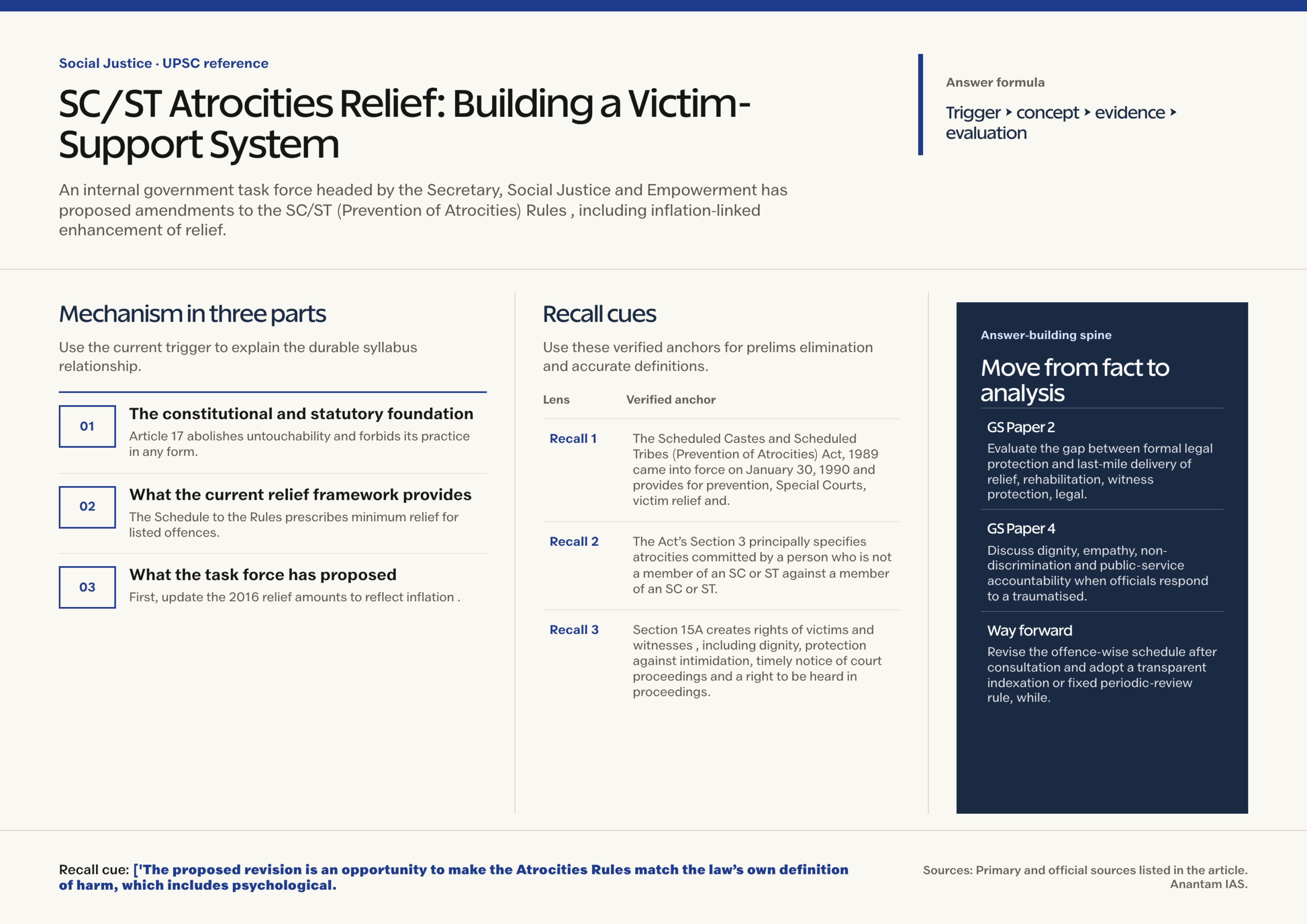
An internal government task force headed by the Secretary, Social Justice and Empowerment has proposed amendments to the SC/ST (Prevention of Atrocities) Rules , including inflation-linked enhancement of relief and rehabilitation amounts and counselling for accused persons, victims and their.
- The task force submitted its report to the government on July 31, 2026. It had been constituted in December 2025 with the approval of the Union Social Justice Minister.
- The Hindu reported that the present statutory relief scale ranges from ₹85,000 to ₹8.25 lakh, according to the offence and degree of harm; these amounts were fixed in 2016.
- The task force proposed dedicated relief and rehabilitation cells in States and Union Territories and transmission of FIRs and chargesheets to the concerned government officials within 24 hours.
- The National Commission for Scheduled Tribes separately suggested livelihood protection for tribal people dispossessed of land during prolonged litigation and checks on retaliatory counter FIRs filed after atrocity complaints.
- The recommendations are not yet law. The Union government has said it will consult State and Union Territory governments and other stakeholders before finalising amendments.
- An FIR and a criminal trial cannot by themselves restore medical costs, lost income, housing, education, safety or mental well-being. Relief is part of justice, not charity after justice.
- Inflation erodes fixed compensation, but merely revising a schedule is insufficient if district officials delay identification, sanction, phased payment or rehabilitation planning.
- Caste atrocities can be accompanied by local power imbalances, economic dependence and threats. A counter-case may be genuine or retaliatory; the answer is independent scrutiny, not automatic acceptance or rejection.
UPSC Relevance
Prelims Relevance
- The Scheduled Castes and Scheduled Tribes (Prevention of Atrocities) Act, 1989 came into force on January 30, 1990 and provides for prevention, Special Courts, victim relief and rehabilitation.
- The Act’s Section 3 principally specifies atrocities committed by a person who is not a member of an SC or ST against a member of an SC or ST.
- Section 15A creates rights of victims and witnesses, including dignity, protection against intimidation, timely notice of court proceedings and a right to be heard in proceedings such as bail.
- The statutory definition of a victim includes physical, mental, psychological, emotional or monetary harm and harm to property; it also includes specified relatives, legal guardians and legal heirs.
- The 2016 Amendment Rules expanded the number of offences carrying prescribed relief from 22 to 47 and set minimum amounts between ₹85,000 and ₹8.25 lakh according to the offence.
- Rule 12(4), read with the Schedule, provides for relief to victims, family members and dependants; official guidance requires admissible relief to be paid within seven days and in the prescribed phases.
Mains Relevance
GS Paper 2
- Evaluate the gap between formal legal protection and last-mile delivery of relief, rehabilitation, witness protection, legal assistance and psychosocial care.
- Examine cooperative federalism in a central protective statute whose police, prosecution, district administration and service-delivery functions operate mainly through States.
GS Paper 4
- Discuss dignity, empathy, non-discrimination and public-service accountability when officials respond to a traumatised complainant facing a local power imbalance.
- Use counter FIRs as an ethics case on impartial investigation: officials must prevent intimidation without prejudging either complaint.
Essay
- Justice is not complete when the offender is punished; it is complete when the survivor can live safely and with dignity.
Background and Context
The constitutional and statutory foundation
The Atrocities Act is a special criminal law built on the Constitution’s rejection of caste hierarchy.
- Article 17 abolishes untouchability and forbids its practice in any form. Article 15 prohibits caste discrimination, while Article 21 protects life and dignity.
- Article 46 directs the State to promote the educational and economic interests of Scheduled Castes, Scheduled Tribes and other weaker sections and protect them from social injustice and exploitation.
- The Protection of Civil Rights Act, 1955 punishes practices arising from untouchability. The 1989 Atrocities Act addresses a wider set of caste-targeted offences, institutional duties, special trials and victim support.
- Section 3 covers acts such as caste humiliation in specified circumstances, social or economic boycott, dispossession or interference with land and forest rights, forced labour, sexual offences and obstruction of access to public places, subject to.
- The 2015 amendment, effective from January 26, 2016, enlarged the offence list, strengthened Special and Exclusive Special Courts and inserted Chapter IVA on victims’ and witnesses’ rights.
What the current relief framework provides
Relief under the Rules is a legally structured entitlement linked to the offence and stage of the case.
- The Schedule to the Rules prescribes minimum relief for listed offences. The 2016 scale runs from ₹85,000 to ₹8.25 lakh, with higher amounts for graver harm such as death, rape, gang rape, severe.
- Payment is commonly divided across procedural stages such as registration of the FIR, filing of the chargesheet and conclusion of trial. The exact phasing varies by the scheduled offence.
- Rule 12 places operational responsibility on the District Magistrate, Sub-Divisional Magistrate or Executive Magistrate to make arrangements for immediate relief, while the Schedule determines the minimum monetary entitlement.
- Rule 11 also covers facilities such as travelling and maintenance expenses for victims, dependants and witnesses during investigation, inquiry and trial.
- Section 15A allows a Special Court or Exclusive Special Court to order protection, travel, maintenance, socio-economic rehabilitation and relocation where required.
What the task force has proposed
The recommendations target both the value of relief and the administrative machinery that delivers it.
- First, update the 2016 relief amounts to reflect inflation. A durable amendment could provide periodic indexation or mandatory review rather than waiting a decade for an ad hoc revision.
- Second, establish special relief and rehabilitation cells in every State and Union Territory. Such a cell can track each case from FIR to payment, medical care, shelter, livelihood support and court-linked protection.
- Third, require FIRs and chargesheets to reach concerned government officials within 24 hours. Early information can trigger relief without forcing a survivor to carry papers from the police station to welfare offices.
- Fourth, introduce counselling for victims, dependants and accused persons. Survivor counselling should be trauma-informed, voluntary and confidential; counselling of an accused may address behaviour and prevention but cannot dilute criminal accountability.
- The proposals remain recommendations under government review. The Ministry has committed to consultation and stated that amendments must remain consistent with the parent Act and must not weaken protection, investigation, relief or rehabilitation.
Why compensation alone does not equal rehabilitation
A survivor may receive a sanctioned amount yet remain unsafe, displaced, indebted or unable to participate in the case.
- Immediate needs can include emergency medical treatment, safe shelter, food, transport, replacement of documents, funeral costs and protection from renewed violence.
- Medium-term recovery may require psychological care, school continuity, livelihood restoration, land access, accessible legal aid and support for repeated interactions with police and courts.
- Trauma can affect memory, sleep, work, relationships and the ability to narrate events consistently. Trauma-informed procedures reduce repeated questioning and avoid treating distress as unreliability.
- Dependants and witnesses can also face threats and income loss. Section 15A recognises them because successful prosecution depends on a safe environment in which people can testify without coercion.
- A district case plan should identify one responsible officer, services required, deadlines and consent. Cash, counselling and protection must be coordinated without making one service conditional on acceptance of another.
Way Forward
Index relief and guarantee prompt payment
- Revise the offence-wise schedule after consultation and adopt a transparent indexation or fixed periodic-review rule, while allowing States to provide higher amounts.
- Trigger the first instalment through secure digital transmission of the FIR to the district cell, with a seven-day dashboard and written reasons for every delay.
- Separate immediate relief from final adjudication: early support should follow the statutory threshold and must not be treated as a finding of guilt.
Conclusion
- The proposed revision is an opportunity to make the Atrocities Rules match the law’s own definition of harm, which includes psychological, emotional, monetary and property loss.
- A credible reform should combine time-bound entitlements, trauma-informed services and procedural accountability .
UPSC Practice Questions
Prelims MCQ 1
With reference to the Scheduled Castes and Scheduled Tribes (Prevention of Atrocities) Act, 1989, consider the following statements:
- Section 15A places a duty on the State to protect victims, their dependants and witnesses against intimidation and violence.
- A preliminary inquiry is mandatory before an FIR can be registered under the Act.
- A victim has a right to timely notice of court proceedings, including bail proceedings.
How many of the above statements are correct?
(a) Only one (b) Only two (c) All three (d) None
Answer: (b) Only two
Explanation:
Statements 1 and 3 are correct under Section 15A. Statement 2 is incorrect because Section 18A says no preliminary inquiry is required for registration of an FIR under the Act.
Prelims MCQ 2
Which one of the following pairs is correctly matched?
(a) National Commission for Scheduled Castes — Article 338A (b) National Commission for Scheduled Tribes — Article 338A (c) Abolition of untouchability — Article 16 (d) Promotion of educational and economic interests of weaker sections — Article 32
Answer: (b) National Commission for Scheduled Tribes — Article 338A
Explanation:
The NCST is established under Article 338A. The NCSC is under Article 338, untouchability is abolished by Article 17, and Article 46 directs the State to promote the educational and economic interests of weaker sections.
UPSC Mains Questions
- Punishment is necessary but insufficient in responding to caste atrocities. Examine the case for a survivor-centred system of relief, rehabilitation, protection and counselling under the SC/ST (Prevention of Atrocities) framework. (250 words)
- The effectiveness of a central social-justice law depends on State and district capacity. Discuss with reference to the proposed amendments to the SC/ST (Prevention of Atrocities) Rules. (250 words)
Sources: The Hindu and Department of Social Justice and Empowerment.
Frequently Asked Questions
What has the government task force recommended?
It has proposed inflation-linked enhancement of relief, dedicated relief and rehabilitation cells in States and Union Territories, counselling for accused persons, victims and dependants, and delivery of FIRs and chargesheets to concerned officials within 24 hours. The recommendations are under.
How much relief is currently prescribed for atrocity victims?
The 2016 schedule prescribes minimum relief ranging from ₹85,000 to ₹8.25 lakh according to the offence and degree of injury or harm. Payment stages differ by offence. Official guidance requires admissible relief within seven days, while the Rules and Section.
Why is counselling part of the proposal?
Caste violence can cause psychological and emotional harm to victims and dependants alongside bodily, property and income loss. Qualified, voluntary and confidential counselling can support recovery and participation in the justice process. Counselling for an accused may aid prevention or.
What is a counter FIR in this context?
It is a separate complaint filed against the original complainant or associated persons after an atrocity FIR. It may allege a genuine cross-offence or may be retaliatory. The NCST has suggested checks of linked police final reports so procedure and.
What rights do victims have under Section 15A?
Section 15A requires fairness, respect and dignity; protection against intimidation, coercion and violence; timely notice of court and bail proceedings; an opportunity to be heard; and access to protective and rehabilitative measures through Special Courts. Its scope includes victims, dependants.