SC Strikes Down Tribunals Reforms Act 2021: Independence of Tribunals and the Madras Bar Doctrine
Introduction
On 19 November 2025, a Division Bench of the Supreme Court of India struck down key provisions of the Tribunals Reforms Act, 2021, declaring that the statute’s clauses on tenure, age of appointment, search-cum-selection committee composition and conditions of service of tribunal members violated the constitutional guarantee of judicial independence and were liable to be read down or excised in their entirety. The bench, comprising Chief Justice of India B.R. Gavai (who authored the lead opinion) and Justice K. Vinod Chandran (concurring), framed the verdict as a continuation of the Madras Bar Association doctrine — the long arc of jurisprudence beginning with L. Chandra Kumar v. Union of India (1997) and running through four successive decisions of Madras Bar Association — that has progressively constitutionalised the principle that tribunals exercising judicial functions must mirror, in their independence and conditions of service, the High Courts whose jurisdiction they replace. For the UPSC aspirant, the judgment opens onto Paper II polity and governance, Paper II separation of powers, Paper IV ethics in public administration, and the Essay paper’s familiar territory of institutional design.
The headline holdings anchor the rest of the discussion. The Court invalidated the four-year fixed tenure for tribunal Chairpersons and Members; held that the principles laid down in Madras Bar Association IV (2020) and Madras Bar Association V (2021) shall continue to govern tenure, qualification and conditions of service until fresh legislation is enacted; struck down the minimum age bar of 50 years for appointment; and directed the Union government to constitute a National Tribunals Commission within four months as a structural safeguard for tribunal independence. The verdict comes four years after the same Court, in Madras Bar Association v. Union of India (2021), struck down the predecessor Tribunals Reforms (Rationalisation and Conditions of Service) Ordinance, 2021 — provisions that Parliament then re-enacted in the 2021 Act in nearly identical form, prompting the present challenge. This article unpacks the doctrinal lineage, the operative provisions, the comparative architecture of tribunal systems abroad, and the structural questions that the verdict leaves open.

Quick Facts at a Glance
| Indicator | Value | Source |
|---|---|---|
| Date of Supreme Court verdict | 19 November 2025 | Supreme Court of India, Division Bench order |
| Statute struck down (operative provisions) | Tribunal Reforms Act, 2021 | Gazette of India, 13 August 2021 |
| Bench strength | Division Bench (CJI B.R. Gavai and Justice K. Vinod Chandran) | Supreme Court of India |
| Tenure regime restored | Madras Bar Association IV (2020) and V (2021) principles; ITAT/CESTAT members till age 62, Presidents/Chairpersons till age 65 | Supreme Court of India, 19 November 2025 |
| Minimum age bar struck down | 50 years for appointment | Section 3(7), Tribunal Reforms Act, 2021 |
| Constitutional anchors invoked | Articles 14, 50, 323A, 323B; Basic Structure | Constitution of India |
| Foundational precedent | L. Chandra Kumar v. Union of India (1997) 3 SCC 261 | Supreme Court of India |
| Madras Bar Association line of cases | 2010, 2014, 2020, 2021 — four successive verdicts | Supreme Court of India |
| Number of Central tribunals affected | 15-plus, including NCLT, NCLAT, ITAT, NGT, AFT, CESTAT | Department of Legal Affairs, Ministry of Law & Justice |
Background and Historical Context
The Indian tribunal system is a creature of the 42nd Constitutional Amendment Act, 1976, which inserted Part XIV-A into the Constitution comprising Article 323A for administrative tribunals and Article 323B for tribunals in other matters such as taxation, industrial disputes, land reforms, foreign exchange and elections. The amendment, enacted in the closing months of the Emergency on the recommendation of the Swaran Singh Committee, was animated by a docket-management argument: that ordinary civil courts were ill-equipped, by procedure and by training, to handle the rising volume of specialised public-law disputes, and that expert bodies sitting in summary proceedings would dispense quicker, technically informed adjudication. The first major statutory expression of this design was the Administrative Tribunals Act, 1985, which set up the Central Administrative Tribunal (CAT) for service matters of Union government employees and provided the template for State Administrative Tribunals.
The deeper story, however, lies in the constitutional friction this design produced. Section 28 of the Administrative Tribunals Act ousted the jurisdiction of the High Courts under Articles 226 and 227 over service matters, and the Supreme Court initially upheld this exclusion in S.P. Sampath Kumar v. Union of India (1987) on the assurance that tribunals would function as effective substitutes for the High Courts. A decade later, in L. Chandra Kumar v. Union of India (1997), a seven-judge Constitution Bench reversed course: it held that the power of judicial review vested in the High Courts under Article 226 and in the Supreme Court under Article 32 was part of the basic structure of the Constitution, that this power could not be ousted, and that tribunals would function as courts of first instance whose orders were subject to writ review by Division Benches of the relevant High Court. Chandra Kumar reset the constitutional position: tribunals are supplementary, not substitutionary, and their members must therefore meet judicial standards of independence and competence.
The second arc of jurisprudence that frames the present verdict is the Madras Bar Association sequence. In Madras Bar Association v. Union of India (2010), the Court tested the constitutionality of the National Company Law Tribunal under the Companies (Second Amendment) Act, 2002 and laid down detailed prescriptions on selection, tenure and conditions of service. A second Madras Bar Association verdict in 2014 struck down the National Tax Tribunal Act, 2005 on the ground that vesting in a quasi-judicial body the power to decide substantial questions of law previously decided by High Courts violated separation of powers. A third verdict in 2020 tested the Tribunal, Appellate Tribunal and Other Authorities (Qualifications, Experience and Other Conditions of Service of Members) Rules, 2020, and a fourth verdict in July 2021 struck down the Tribunals Reforms (Rationalisation and Conditions of Service) Ordinance — provisions that Parliament then re-enacted in nearly verbatim form as the Tribunal Reforms Act, 2021, triggering the present round of litigation. The 19 November 2025 judgment is, in this sense, the fifth instalment in a single doctrinal conversation that has now run for fifteen years.
Key Features
Tribunal Reforms Act 2021 — What It Did
The Tribunal Reforms Act, 2021, notified on 13 August 2021, was Parliament’s omnibus response to a long-standing executive view that tribunals had become institutionally bloated, slow and uneven in disposal. The Act abolished nine appellate tribunals — including the Film Certification Appellate Tribunal, the Airport Appellate Tribunal, the Authority for Advance Rulings, the Intellectual Property Appellate Board, and the Plant Varieties Protection Appellate Tribunal — and transferred their pending matters to High Courts and commercial courts. For the surviving tribunals, the Act introduced uniform service conditions: a four-year tenure for Chairpersons and Members, a minimum age of fifty for appointment, an upper age limit of seventy for Chairpersons and sixty-seven for Members, and a search-cum-selection committee weighted in favour of the executive. The provisions were substantively identical to those struck down in Madras Bar Association IV (July 2021), a re-enactment that the petitioners characterised as a legislative overruling of a binding constitutional judgment.
The Provisions Struck Down on 19 November 2025
The Bench struck down the operative pillars of the 2021 Act. First, the four-year tenure in Section 5 was held unconstitutional for being too short to develop institutional memory and for incentivising executive-friendly behaviour by members anxious about reappointment; the Court directed that the principles in Madras Bar Association IV (2020) and Madras Bar Association V (2021) would continue to govern tenure pending fresh legislation. Second, the minimum age of fifty in Section 3(7) was struck down for excluding accomplished younger advocates with the requisite ten years of practice — a qualification long accepted under Article 217 for High Court judges. Third, the search-cum-selection committee provisions weighted in favour of executive members were held inconsistent with the principle of judicial independence, and the bench directed that the composition prescribed in Madras Bar Association IV (2020) and V (2021) shall continue to govern selections pending fresh legislation. Fourth, the Court directed the Centre to establish a National Tribunals Commission within four months to ensure structural independence in tribunal appointments, administration and service conditions.
The Madras Bar Association Doctrine
The Madras Bar Association doctrine is best read as a four-part proposition crystallised across the 2010, 2014, 2020 and 2021 verdicts and re-affirmed on 19 November 2025. First, tribunals exercising judicial functions are courts within the meaning of the constitutional scheme; a body that determines rights between parties under a statutory framework cannot be a mere administrative authority. Second, the independence of such tribunals is integral to the basic structure, and is breached whenever the appointing, tenure-fixing or service-condition-determining authority is the very executive whose actions the tribunal will adjudicate. Third, the qualifications, tenure and conditions of service of tribunal members must approximate those of judges of the courts whose jurisdiction the tribunal supplants — meaning High Court-equivalent in the case of NCLAT, NGT or CESTAT. Fourth, parliamentary re-enactment of provisions previously struck down, without curing the constitutional defect, amounts to legislative overruling and is itself unconstitutional — a holding the bench described as the doctrine’s enforcement mechanism.
Article 50 and Judicial Independence
Article 50, in Part IV of the Constitution, directs the State to take steps to separate the judiciary from the executive in the public services. Although a Directive Principle and therefore non-justiciable in itself, the Article has been read by the Supreme Court — beginning with Indira Nehru Gandhi v. Raj Narain (1975) and consolidated in Kesavananda Bharati — as a substantive constitutional value that informs the interpretation of the fundamental right to equality under Article 14 and the basic-structure ceiling on legislative competence. The 19 November 2025 verdict draws Article 50 into the tribunals context for the first time as an operative interpretive principle: the bench reasoned that tribunal benches manned, funded and removed by the very executive whose actions they review fail the Article 50 test, and that the failure is constitutionally cognisable through Article 14’s equality guarantee even though Article 50 itself remains non-enforceable in isolation. The reasoning extends the basic-structure doctrine into the institutional design of quasi-judicial bodies in a way that Kihoto Hollohan (1992) did for anti-defection adjudication.

Significance for UPSC
- Direct GS-II Polity hit on “structure, organization and functioning of the Executive and the Judiciary” — tribunals sit at the intersection of both branches.
- GS-II separation of powers and judicial independence — the verdict is the most consequential elaboration of Article 50 in two decades.
- GS-II governance — tribunal reform is part of the larger conversation on judicial pendency, the National Judicial Data Grid, and the All India Judicial Service.
- GS-IV ethics — institutional integrity, integrity of the appointment process, and the ethical implications of executive dominance over adjudicatory bodies.
- Prelims fact-grid — Articles 323A and 323B, 42nd Amendment, the L. Chandra Kumar case, the four Madras Bar Association verdicts, and the list of Central tribunals form a dense, examinable cluster.
- Essay paper — institutional design, accountability, separation of powers and the rule of law are recurring prompts that the verdict supplies primary material for.
- Interview — the verdict is the kind of contemporary constitutional development that DAF-driven panels routinely test on candidates with a Law or Public Administration optional.
Detailed Analysis: Why Tribunal Independence Matters
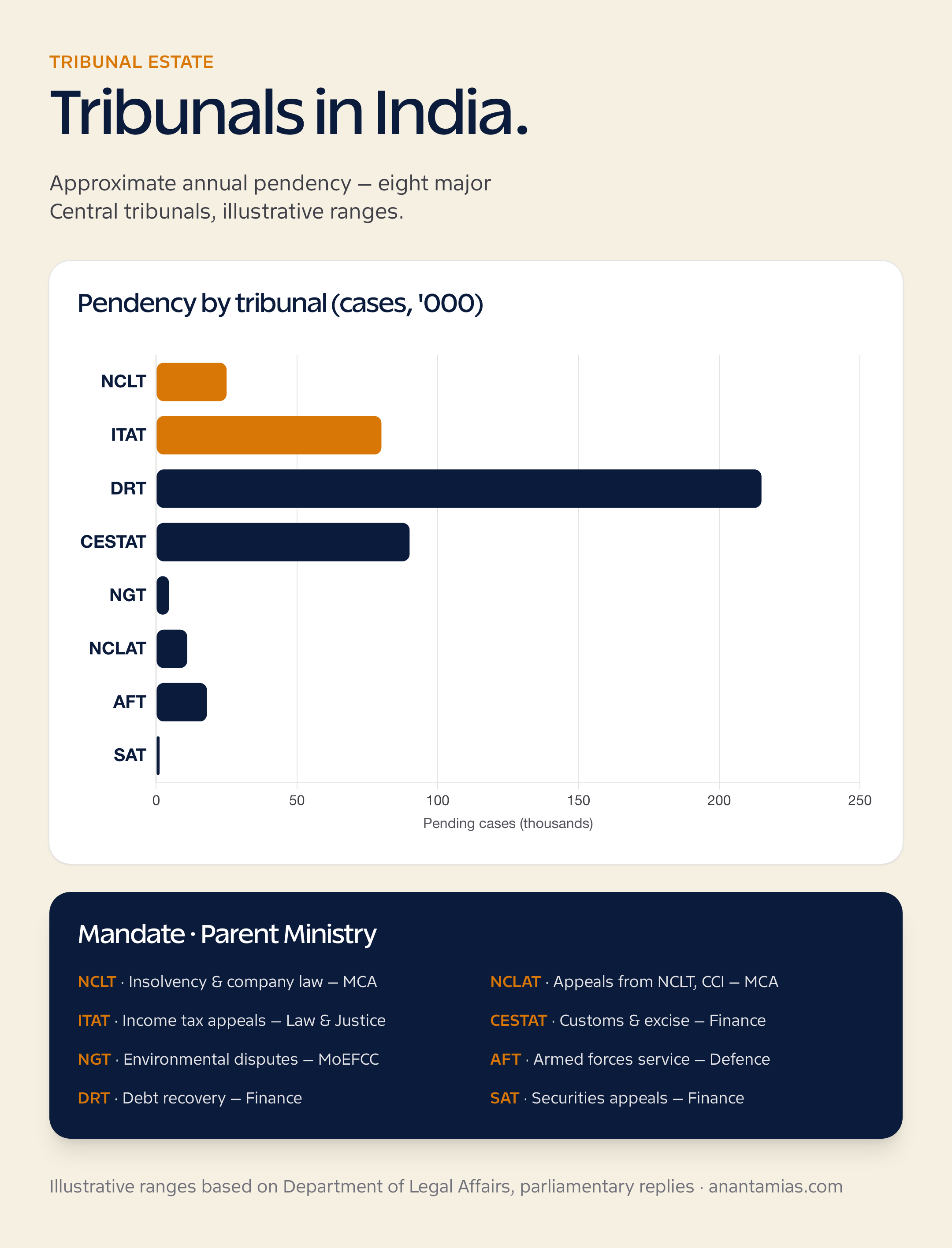
The Indian tribunal landscape is unusually crowded. There are at present more than fifteen Central tribunals operating under different parent statutes and reporting to different Union ministries, with some — such as the National Company Law Tribunal (NCLT) and the National Company Law Appellate Tribunal (NCLAT) — handling case dockets that rival the smaller High Courts in volume. The Income Tax Appellate Tribunal (ITAT), founded in 1941, is the oldest specialised tribunal in the country and disposes of more than fifty thousand appeals each year; the Central Administrative Tribunal (CAT) handles service matters across the Union government and a clutch of subscribing states; the National Green Tribunal (NGT), set up in 2010, exercises original and appellate jurisdiction over environmental disputes and has a docket that is rapidly catching up with the High Courts on writ matters in the environmental domain. Each of these bodies adjudicates between the citizen and the State, and in many cases the State is the deepest-pocketed and most frequent litigant.
The structural problem the verdict attacks is the institutional dependence of these bodies on the executive that they are supposed to hold to account. A tribunal whose Chairperson serves a four-year term, who is appointed by a committee on which the Cabinet Secretary and the parent ministry’s secretary sit alongside a single judicial member, who is paid out of the parent ministry’s budget head, and who must vacate office and seek post-retirement assignments from the same ministry, is structurally vulnerable to executive influence in a way that a High Court judge — appointed under the collegium, paid from the Consolidated Fund of India and with security of tenure until 62 — is not. The bench led by Chief Justice Gavai articulated this as the “shadow of the appointing authority” problem and held that constitutional remedies must address the institutional architecture, not merely the individual instance.
| Tribunal | Year established | Parent ministry | Notable recent reform / context |
|---|---|---|---|
| Income Tax Appellate Tribunal (ITAT) | 1941 | Ministry of Law and Justice | Faceless appeals scheme (2021); pendency of ~80,000 cases |
| Central Administrative Tribunal (CAT) | 1985 | Ministry of Personnel, Public Grievances and Pensions | 17 Benches; service-matter jurisdiction over Union employees |
| Customs, Excise and Service Tax Appellate Tribunal (CESTAT) | 1982 (as CEGAT) | Ministry of Finance | Renamed in 2003; central indirect-tax disputes pre-GST and legacy |
| National Company Law Tribunal (NCLT) | 2016 | Ministry of Corporate Affairs | Insolvency and Bankruptcy Code, 2016 — adjudicating authority |
| National Company Law Appellate Tribunal (NCLAT) | 2016 | Ministry of Corporate Affairs | Appeals from NCLT and Competition Commission of India |
| National Green Tribunal (NGT) | 2010 | Ministry of Environment, Forest and Climate Change | Original and appellate environmental jurisdiction; five Benches |
| Armed Forces Tribunal (AFT) | 2009 | Ministry of Defence | Service matters of armed forces; long-standing independence concerns |
| Securities Appellate Tribunal (SAT) | 1995 | Ministry of Finance | Appeals from SEBI, IRDAI, PFRDA |
| Telecom Disputes Settlement and Appellate Tribunal (TDSAT) | 2000 | Ministry of Communications | Disputes under TRAI Act; appellate jurisdiction over TRAI |
The empirical case for the verdict is reinforced by the data on tribunal vacancies. As the petitioners — led by senior advocates Arvind Datar, K.V. Viswanathan (before his elevation to the Bench) and Indira Jaising — argued in earlier rounds, vacancies at NCLT, NCLAT and DRT have routinely run above 30 per cent, and the parent ministries have repeatedly missed the three-month deadline that the 2020 Tribunal Rules had stipulated for action on selection-committee recommendations. The four-year tenure made the problem worse: by the time a Chairperson developed the institutional knowledge required to manage a tribunal’s docket, the term was up. The Court took explicit notice of this operational failure and treated it as evidence that the 2021 Act’s design — short tenure, executive-heavy committee, no binding timeline — produced precisely the institutional fragility that judicial independence is meant to prevent.
The verdict also engages, in its concurring strand, the question of legislative re-enactment. Justice K. Vinod Chandran, writing a concurring opinion, characterised the 2021 Act as “old wine in a new bottle” — observing that Parliament had repackaged provisions previously struck down without curing the underlying constitutional defects, and that such re-enactment itself amounted to a form of legislative overruling of binding judicial determinations. The concurring opinion reinforced the majority’s reading that the doctrine of legislative competence does not permit Parliament to nullify, in substance, a constitutional judgment by the simple expedient of re-enactment in altered form.
The closing strand of the analysis ties tribunals back to the larger constitutional ecology. India’s pendency problem — over five crore cases across all tiers — is partly a tribunal problem: where tribunals fail to dispose of specialised dockets, the load returns to High Courts as writ petitions under Article 226, defeating the very rationale of Article 323B. The verdict is thus not merely a vindication of judicial independence in the abstract; it is a system-level intervention that says the only sustainable answer to the docket crisis is tribunals that are constitutionally credible, technically competent, and institutionally insulated. The reframing — from administrative convenience to constitutional architecture — is the verdict’s most lasting contribution.
Comparative Perspective
India’s tribunal architecture sits at one end of a comparative spectrum. The United Kingdom, after the Tribunals, Courts and Enforcement Act, 2007, consolidated its previously scattered tribunal estate into a unified two-tier His Majesty’s Courts and Tribunals Service, with a First-tier Tribunal organised into Chambers and an Upper Tribunal that exercises an appellate and judicial-review function. Members are appointed by the Judicial Appointments Commission, hold office on the same terms as judges, and are paid from the Consolidated Fund — a model the Indian Supreme Court has repeatedly held up as the comparator. Australia’s Administrative Appeals Tribunal (AAT), replaced in October 2024 by the new Administrative Review Tribunal (ART), was reorganised precisely because the previous appointment process had drawn criticism for executive-heavy selection — a reform path India is, in effect, being directed toward by the 19 November 2025 verdict. The contrast with India is sharp: where the UK tribunals service operates as a unified judicial body under a single appointing commission, India’s fifteen-plus Central tribunals each report to a different parent ministry whose actions they adjudicate.
| Country | Tribunal architecture | Appointment authority |
|---|---|---|
| India | 15+ statutory tribunals across multiple ministries; no unified service | Search-cum-selection committee per parent statute; final order by Union government |
| United Kingdom | His Majesty’s Courts and Tribunals Service — unified two-tier system since 2007 | Judicial Appointments Commission; statutory independence on par with judges |
| Australia | Administrative Review Tribunal (ART) since October 2024, replacing AAT | Statutory selection panel with judicial member; merit-based appointment process |
| Canada | Federal Court system supplemented by specialised boards (e.g., Tax Court of Canada) | Governor in Council on advisory committee recommendation; superior-court status |
| South Africa | Specialised divisions of High Courts and statutory tribunals (e.g., Competition Tribunal) | Judicial Service Commission for judicial members; merit and constitutional vetting |
The structural insight that emerges from the comparison is that jurisdictions that have credibly preserved tribunal independence have done so through unification — a single appointing body, a single budget head, a single set of service conditions — and not through case-by-case statutory tinkering. India’s response to four successive Supreme Court verdicts has been to legislate, re-legislate and litigate, while leaving the underlying fragmentation of the tribunal estate untouched. The 19 November 2025 verdict invites Parliament to consider an All-India Tribunal Service on the analogy of the All India Judicial Service contemplated by Article 312, a structural reform that has been recommended by the Law Commission of India in successive reports beginning with the 162nd Report (1998).
Challenges and Criticisms
The verdict has drawn three principal lines of critique even from quarters broadly sympathetic to its outcome. The Vidhi Centre for Legal Policy, in a working paper released the week after the judgment, argued that the Court’s repeated intervention in tribunal design has begun to look like substantive constitution-writing — that the Court has, across the Madras Bar Association line, effectively legislated tenure, age and selection-committee provisions that the Constitution itself leaves to Parliament. The Vidhi note observed that the doctrinal move from Chandra Kumar‘s separation-of-powers reasoning to the present judgment’s near-administrative prescription on tenure and committee composition risks blurring the very separation the doctrine was meant to protect. Constitutional scholar Madhav Khosla, writing in the Indian Express shortly after the verdict, made a related point: that the institutional alternative the Court has gestured toward — judicial dominance over selection — substitutes one form of capture for another, and that the deeper democratic problem is the fragmentation of the tribunal estate, not the precise mathematics of the selection committee.
A second criticism, voiced by Faizan Mustafa, Vice-Chancellor of Chanakya National Law University, is that the verdict will do little to fix the operational dysfunction that drives litigant frustration with tribunals: vacancy backlogs, inadequate infrastructure, the absence of a unified case-management system, and the weak appellate architecture that funnels every meaningful tribunal order back to the High Courts under Article 226 and onward to the Supreme Court under Article 136. The risk, Mustafa argued, is that the Court has won the constitutional battle while leaving the institutional war unwon. The National Law University Delhi‘s Centre for Constitutional Law and Public Policy made a similar point in a post-verdict explainer, observing that the disposal data from NCLT and DRT had not improved materially in the four years between the 2021 Madras Bar Association verdict and the 2025 judgment despite both being decided in favour of independence.
A third critique is federal. Several state governments — Tamil Nadu and Kerala in particular — argued through their Advocates General that the verdict’s emphasis on uniform service conditions for tribunal members, while appropriate for Central tribunals, risks crowding the constitutional space available to state legislatures under Article 323B for setting up state-level tribunals on subjects within their legislative competence. The bench acknowledged the federal concern but declined to read down its directions, leaving the federalism question for a later case — an unresolved tension that will likely shape the next round of tribunal litigation, particularly if any state moves to set up a new tribunal under the Concurrent or State List during the next legislative cycle.

Prelims Pointers
- Article 323A — administrative tribunals, inserted by the 42nd Constitutional Amendment Act, 1976.
- Article 323B — tribunals for other matters (taxation, foreign exchange, industrial disputes, land reforms, elections, food adulteration), inserted by the 42nd Amendment, 1976.
- The 42nd Amendment was passed on the recommendation of the Swaran Singh Committee.
- Administrative Tribunals Act, 1985 — set up the Central Administrative Tribunal (CAT) under Article 323A.
- S.P. Sampath Kumar v. Union of India (1987) — initially upheld ouster of High Court jurisdiction over service matters.
- L. Chandra Kumar v. Union of India (1997) 3 SCC 261 — seven-judge bench held judicial review under Articles 226 and 32 to be part of the basic structure; tribunal orders subject to writ review.
- Madras Bar Association v. Union of India (2010) — laid down independence requirements for the National Company Law Tribunal.
- Madras Bar Association v. Union of India (2014) — struck down the National Tax Tribunal Act, 2005.
- Madras Bar Association v. Union of India (2020 and 2021) — successive verdicts on the 2020 Tribunal Rules and the 2021 Tribunals Reforms Ordinance.
- Tribunal Reforms Act, 2021 — notified 13 August 2021; abolished nine appellate tribunals including the Film Certification Appellate Tribunal and the Intellectual Property Appellate Board.
- Income Tax Appellate Tribunal (ITAT) — established 1941, oldest specialised tribunal in India.
- National Green Tribunal — established under the NGT Act, 2010.
- NCLT and NCLAT — set up in 2016 under the Companies Act, 2013; NCLT is the adjudicating authority under the Insolvency and Bankruptcy Code, 2016.
- Article 50 — Directive Principle on separation of judiciary from executive.
- Article 217 — qualifications for High Court judges, including ten years of advocate practice.
Mains Practice Questions
- Discuss the constitutional foundations of tribunal jurisdiction in India under Articles 323A and 323B. Examine, with reference to the L. Chandra Kumar verdict, the limits of statutory ouster of High Court jurisdiction. (15 marks, 250 words)
- The Madras Bar Association line of cases has progressively constitutionalised the principle of tribunal independence. Critically evaluate this jurisprudential trajectory in light of the Supreme Court’s 19 November 2025 verdict on the Tribunal Reforms Act, 2021. (15 marks, 250 words)
- Article 50 of the Constitution remains a Directive Principle. Examine how recent Supreme Court verdicts have read substantive constitutional content into Article 50, and discuss the implications for the doctrine of separation of powers. (10 marks, 150 words)
- Tribunal pendency in India is partly a constitutional design problem and partly an administrative one. Discuss with reference to NCLT, NGT and the Armed Forces Tribunal. (15 marks, 250 words)
- “Parliamentary re-enactment of provisions previously struck down by the Supreme Court is itself unconstitutional.” Examine this proposition with reference to the Tribunal Reforms Act, 2021 and the limits of legislative competence vis-a-vis judicial pronouncements. (15 marks, 250 words)
- Compare India’s tribunal architecture with the unified tribunal services of the United Kingdom and Australia. What lessons do these comparators offer for the reform of India’s tribunal estate? (10 marks, 150 words)
- Discuss the case for an All-India Tribunal Service modelled on the All India Judicial Service contemplated by Article 312. (10 marks, 150 words)
- Examine the federalism implications of uniform service conditions for tribunal members in light of the constitutional space available to state legislatures under Article 323B. (10 marks, 150 words)
Conclusion
The 19 November 2025 verdict is best read as the doctrinal culmination of an argument that began in L. Chandra Kumar in 1997 and ran through the four Madras Bar Association judgments. What the Division Bench has done, in substance, is convert the negative principle that tribunals cannot oust the writ jurisdiction of constitutional courts into a positive prescription that tribunals must themselves be constituted in a manner consistent with the judicial independence those constitutional courts embody. The shift from Chandra Kumar’s external check — High Court writ review — to the present verdict’s internal check — independence at the point of selection, tenure and service conditions — completes the constitutional architecture. The doctrine is no longer about what tribunals cannot do; it is about what tribunals must be.
What to monitor in the months ahead is whether Parliament responds with a third statutory iteration — a Tribunal Reforms (Amendment) Bill that re-enacts the struck-down provisions in modified form — or whether the political and administrative establishment accepts the verdict as a settlement and turns to the harder structural question of unification. The Law Commission of India‘s pending report on tribunal restructuring, the long-mooted proposal for an All-India Tribunal Service, and the Department of Legal Affairs’ internal review of the tribunal estate are the three files to watch. Any one of them could become the vehicle for the systemic reform the verdict has invited but not commanded. Equally important is whether the Supreme Court itself uses the directions on three-month timelines and binding selection-committee recommendations to monitor compliance through periodic status reports — a soft-supervisory model the Court has used effectively in the prison-conditions and police-reform cases.
For the UPSC aspirant, the verdict supplies a quotable formulation that can anchor essay introductions on institutional design and Mains answers on judicial independence: “The independence of a tribunal is not a courtesy extended by statute; it is a structural condition without which the tribunal is, constitutionally speaking, not a tribunal at all.” That sentence, drawn from the bench led by Chief Justice Gavai, captures the doctrine’s evolution from procedural protection to ontological commitment, and is the single most useful takeaway from the November 2025 judgment.
Frequently Asked Questions
When did the Supreme Court strike down the Tribunals Reforms Act, 2021, and who was on the bench?
On 19 November 2025. A Division Bench of Chief Justice of India B.R. Gavai, who authored the lead opinion, and Justice K. Vinod Chandran, who concurred, held that the statute’s clauses on tenure, age of appointment, search-cum-selection committee composition and conditions of service of tribunal members violated the constitutional guarantee of judicial independence.
Which specific provisions did the Court invalidate?
Two headline holdings. It invalidated the four-year fixed tenure for tribunal Chairpersons and Members, and it struck down the minimum age bar of 50 years for appointment, which sat in Section 3(7) of the Act. The Court also faulted the composition of the search-cum-selection committee and the conditions of service.
What tenure regime applies now that the Act’s provisions are gone?
The principles laid down in Madras Bar Association IV (2020) and Madras Bar Association V (2021) continue to govern tenure, qualification and conditions of service until Parliament enacts fresh legislation. Under that restored regime, ITAT and CESTAT members serve till the age of 62, and Presidents and Chairpersons till 65.
What is the National Tribunals Commission the Court ordered?
The Court directed the Union government to constitute a National Tribunals Commission within four months, as a structural safeguard for tribunal independence. The idea is an oversight body for appointments and service conditions across tribunals, rather than leaving each tribunal dependent on the ministry whose decisions it reviews.
Why does the judgment describe itself as a continuation of the Madras Bar Association doctrine?
Because it sits at the end of a long arc rather than standing alone. That arc begins with L. Chandra Kumar v. Union of India (1997) 3 SCC 261 and runs through four successive Madras Bar Association decisions in 2010, 2014, 2020 and 2021. Together they have progressively constitutionalised the principle that tribunals exercising judicial functions must mirror, in independence and conditions of service, the High Courts whose jurisdiction they replace.
Had the Court already struck down these provisions once before?
Yes, and that is what made the challenge unusually strong. In Madras Bar Association v. Union of India (2021) the Court struck down the predecessor Tribunals Reforms (Rationalisation and Conditions of Service) Ordinance, 2021. Parliament then re-enacted those provisions in the 2021 Act, gazetted on 13 August 2021, in nearly identical form, which prompted the present challenge.
Which constitutional provisions did the Court rely on?
Articles 14, 50, 323A and 323B, read alongside the Basic Structure doctrine. Article 50’s directive on separating the judiciary from the executive and Articles 323A and 323B’s tribunal provisions do the structural work, while Article 14 anchors the objection to arbitrary tenure and age conditions.
How many tribunals does the verdict affect?
More than fifteen Central tribunals, including the NCLT, NCLAT, ITAT, NGT, AFT and CESTAT. Because the restored Madras Bar Association principles govern tenure and service conditions generally, the ruling reaches across the tribunal system rather than a single forum.