Grounds of Arrest in Writing: Supreme Court Mulls Larger-Bench Reference
Why in News?
On 9 July 2026, a partial working days bench of the Supreme Court — Justice Manoj Misra and Justice Shree Chandrashekhar — indicated it may refer to a larger bench the question of whether grounds of arrest must mandatorily be supplied in writing to an accused at the time of arrest. LiveLaw reported that the bench flagged conflicting judgments of coordinate benches on the issue.
The question arose in the State of Meghalaya’s challenge to the bail granted to Sonam Raghuvanshi, the prime accused in the murder of her husband Raja Raghuvanshi during their honeymoon in Meghalaya in May 2025. The Meghalaya High Court had granted bail because her arrest memo cited a non-existent penal provision. The Supreme Court did not stay the bail, sought the arrest documents, and listed the matter for 14 July 2026.
- The bench of Justice Manoj Misra and Justice Shree Chandrashekhar signalled a possible larger-bench reference on whether written grounds of arrest are a constitutional mandate in every case.
- Trigger: Sonam Raghuvanshi’s arrest memo cited Section 403(1) — a provision that doesn’t exist — instead of Section 103(1) of the Bharatiya Nyaya Sanhita (murder).
- The Meghalaya High Court held the repeated reference to a non-existent provision showed non-application of mind and vitiated the arrest.
- Justice Misra cited Pankaj Bansal (written grounds under PMLA) and a later NDPS bail order applying Mihir Shah (written grounds under all statutes) to illustrate the divergence.
- No stay was granted, so the bail continues; the state must produce the arrest memo before the next hearing on 14 July 2026.
The development matters in the context of:
- The case sits at the intersection of Article 22(1) due-process guarantees and practical police work — one authoritative rule on the form of communicating grounds will govern every arrest in India.
- Conflicting coordinate-bench rulings mean identical procedural lapses can produce opposite bail outcomes in different states.
- With the BNSS, 2023 now governing arrests, the answer decides how Section 47 BNSS is operationalised — orally, in writing, or in writing within a fixed timeline.

UPSC Relevance
Prelims Relevance
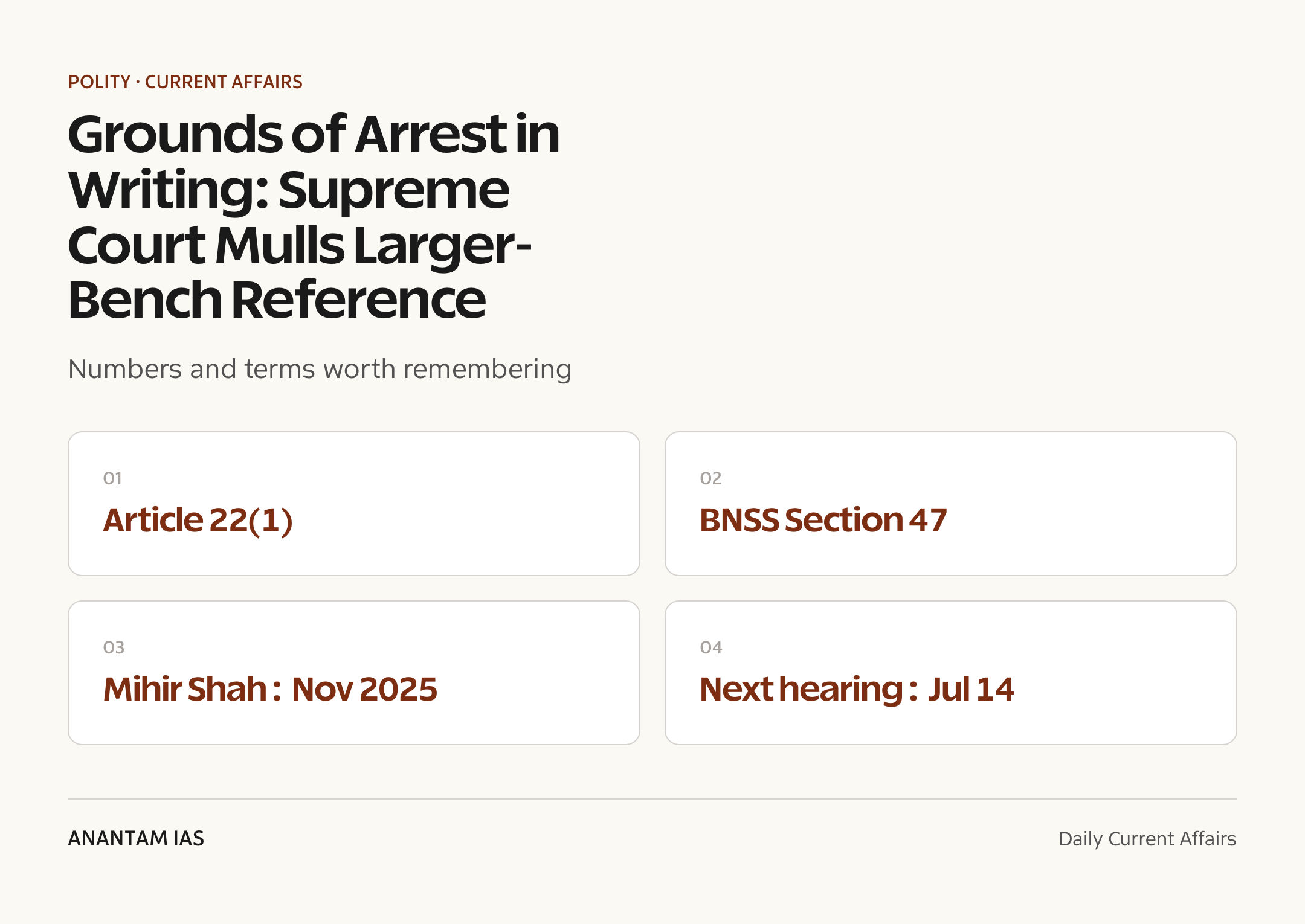
- Article 22(1): an arrested person must be informed, as soon as may be, of the grounds of arrest, and cannot be denied a legal practitioner of choice.
- Article 22(2): production before the nearest magistrate within 24 hours of arrest (excluding journey time).
- Section 47, BNSS 2023 (successor to Section 50 CrPC): the officer arresting without warrant must communicate full particulars of the offence or grounds of arrest, and inform a person arrested for a bailable offence of the right to bail.
- Pankaj Bansal v Union of India (2023): the ED must furnish written grounds under Section 19 PMLA “as a matter of course and without exception”.
- Prabir Purkayastha (2024): extended the written-grounds rule to UAPA; distinguished “grounds of arrest” (personal to the accused) from “reasons of arrest” (general).
- Vihaan Kumar v State of Haryana (2025): Article 22(1) applies to ordinary penal law; non-communication vitiates the arrest and later remand or chargesheet cannot cure it.
- Mihir Rajesh Shah v State of Maharashtra (Nov 2025): written grounds, in a language the arrestee understands, mandatory for all offences under all statutes; if impractical at arrest, within a reasonable time and at least two hours before remand production.
- A coordinate bench cannot overrule an equal-strength bench; conflicts go to a larger bench (Central Board of Dawoodi Bohra Community, 2005).
- D.K. Basu v State of West Bengal (1997): binding arrest-and-detention guidelines, including a witnessed, signed arrest memo.
Mains Relevance
GS Paper 2
- Article 22 as a due-process safeguard: how judicial interpretation has converted a bare right to be “informed” into an enforceable written-communication mandate.
- Conflicting coordinate-bench rulings and the larger-bench reference mechanism as an instrument of judicial certainty and discipline.
- Criminal-justice reform under the BNSS, 2023: whether statutory codification of a written-grounds rule is preferable to case-by-case judicial evolution.
- Police accountability and procedural rigour: the cost of a defective arrest memo — from vitiated arrests to bail in heinous-offence cases.
GS Paper 4
- Rule of law vs outcome anxiety: should a typographical error free a murder accused — the ethics of procedural fidelity in state action.
Essay
- Liberty lives in procedure: due process as the true measure of a constitutional democracy.
- When courts disagree with themselves: judicial consistency as a public good.
Background and Context
Article 22: The Right to Know Why You Are Arrested
The constitutional text guarantees communication of arrest grounds but is silent on the form, and that silence is the root of the present conflict.
- Article 22(1) mandates informing the arrestee “as soon as may be” of the grounds of arrest and access to a lawyer of choice; Article 22(2) adds the 24-hour magistrate-production rule.
- For preventive detention, Article 22(5) requires communication of grounds; Harikisan v State of Maharashtra (1962) held those grounds must be in writing, in a language the detenu understands.
- Joginder Kumar (1994) held the power to arrest is not itself the justification to arrest; D.K. Basu (1997) operationalised safeguards via the arrest memo, witness attestation and intimation to relatives.
- Communication of grounds is functional — it lets the arrestee challenge custody, seek bail and brief counsel — so courts treat defective communication as a constitutional breach, not a technicality.
The Statutory Frame: Section 47 of the BNSS
Parliament restated the safeguard in the new criminal procedure code, again without prescribing the mode of communication.
- Section 47, BNSS 2023 — successor to Section 50 CrPC — obliges the arresting officer to communicate forthwith full particulars of the offence or other grounds for the arrest.
- It also requires informing a person arrested for a bailable offence of the right to be released on bail.
- Section 48 BNSS mandates informing a nominated friend or relative of the arrest and place of custody — the D.K. Basu safeguard in statutory form.
- Neither Article 22(1) nor Section 47 uses the word “writing” — the written-grounds requirement is a product of judicial interpretation, which is exactly what the benches now read differently.
The Precedent Ladder: Pankaj Bansal to Prabir Purkayastha
The written-grounds doctrine began in special-statute cases where arrest powers are exceptionally wide.
- Pankaj Bansal v Union of India (October 2023): the ED must furnish grounds of arrest in writing under Section 19 PMLA “as a matter of course and without exception”.
- Prabir Purkayastha (May 2024) — the NewsClick founder’s case — extended the rule to the UAPA, invalidating the arrest and remand for non-supply of written grounds.
- It drew the key distinction between generic “reasons of arrest” and specific “grounds of arrest” personal to the accused.
- Both rulings anchored the requirement in Article 22(1) itself, not the special statutes — opening the door to every arrest.
Vihaan Kumar and Mihir Shah: Expansion, Then Divergence
Two 2025 rulings pushed the doctrine into ordinary criminal law but left the form of communication in dispute.
- Vihaan Kumar v State of Haryana (February 2025): Article 22(1) applies fully to ordinary penal law; an arrest without meaningful communication of grounds is illegal, and remand or a chargesheet cannot cure it. The Court treated effective communication as the mandate, with writing the desirable mode.
- Mihir Rajesh Shah v State of Maharashtra (6 November 2025) — from the Mumbai BMW hit-and-run case — went further: a bench headed by Chief Justice B.R. Gavai held grounds must be given in writing, in a language the arrestee understands, for all offences under all statutes.
- Mihir Shah’s narrow exception: where written grounds at arrest are impractical, they must follow within a reasonable time and no later than two hours before remand production; commentators note the ruling operates prospectively.
- LiveLaw reported Justice Misra also cited a later NDPS bail order (the Dr Rajinder Rajan matter) applying Mihir Shah — showing how quickly the rule now decides custody outcomes.
- The live conflict: is the mandate effective communication (writing merely advisable, per Vihaan Kumar) or written supply in every case (per Mihir Shah)?
The Meghalaya Case: A Typo That Won Bail
The reference is being considered in an appeal where a clerical slip in the arrest memo proved decisive.
- Indore businessman Raja Raghuvanshi was murdered in May 2025 while honeymooning in Meghalaya; the prosecution alleges his wife Sonam Raghuvanshi conspired with her lover and hired assailants.
- The Meghalaya High Court granted her bail because the arrest memo repeatedly cited Section 403(1) — non-existent — instead of Section 103(1) BNS (murder), holding this vitiated the arrest.
- On 9 July the Supreme Court asked whether a mere typographical error can invalidate an arrest and yield bail in a murder case, while confronting the wider written-grounds conflict.
- It declined to stay the bail, sought the arrest documents, and fixed 14 July 2026 for further hearing — when a formal reference may crystallise.
Why a Larger Bench, and What Rides on It
Judicial discipline requires that conflicting rulings of equal-strength benches be settled by a bigger bench, and the stakes here are systemic.
- A bench cannot overrule a coordinate bench of equal strength; per Dawoodi Bohra (2005) the remedy is a larger-bench reference, and Article 145(3) requires five judges for substantial constitutional questions.
- An authoritative ruling binds every police station: it decides whether a defective or missing written memo automatically vitiates arrest, or whether courts weigh the substance of communication case by case.
- A rigid writing rule demands standard arrest-memo formats, translation capacity and time-stamped records; for liberty, it turns Article 22(1) into a verifiable paper trail.
- The outcome will shape bail jurisprudence — procedural default is now among the most successful bail grounds. See the explainers on mandatory disclosure of arrest grounds and procedure established by law vs due process.
Way Forward
Settle the Law Authoritatively
- An early larger-bench decision should state one clear rule — form, timeline, language and the consequence of breach — so police, magistrates and High Courts stop applying divergent standards.
- It should also distinguish curable clerical errors (a wrong section number) from total non-communication, so substance, not typography, decides liberty.
Codify and Operationalise
- Parliament could amend Section 47 BNSS to expressly prescribe written grounds, a model bilingual arrest-memo format and a service timeline.
- States should issue SOPs, train station-house officers, and adopt digital time-stamped arrest memos through platforms like ICJS.
- Magistrates at first production should routinely verify written grounds — catching defects within 24 hours instead of years later at the bail stage.
Conclusion
The question before the Supreme Court looks procedural but is really about how much paperwork the Constitution demands before the state takes away liberty. From Pankaj Bansal to Mihir Shah, the Court has steadily thickened the Article 22(1) safeguard — without speaking in one voice on whether writing is the mandate or just best practice.
The Meghalaya appeal forces that reckoning through an uncomfortable fact pattern: a murder accused on bail because of a typo. However the larger bench answers, its decision will write the operating manual for every arrest under the BNSS — and the everyday meaning of due process in India.
UPSC Practice Questions
Prelims MCQ 1
With reference to the communication of grounds of arrest in India, consider the following statements:
- Article 22(1) of the Constitution requires that an arrested person be informed of the grounds of arrest as soon as may be.
- In Pankaj Bansal v Union of India (2023), the Supreme Court held that the Enforcement Directorate must furnish grounds of arrest in writing under the PMLA.
- The Supreme Court has held that the safeguards of Article 22(1) do not apply to arrests made under ordinary penal law.
How many of the above statements are correct?
(a) Only one (b) Only two (c) All three (d) None
Answer: (b) Only two
Explanation:
Statements 1 and 2 are correct. Statement 3 is wrong — in Vihaan Kumar v State of Haryana (2025), the Supreme Court held Article 22(1) applies fully to arrests under ordinary penal law, and non-communication of grounds vitiates the arrest.
Prelims MCQ 2
Section 47 of the Bharatiya Nagarik Suraksha Sanhita (BNSS), 2023 corresponds to which provision of the repealed Code of Criminal Procedure, 1973?
(a) Section 41 CrPC (when police may arrest without warrant) (b) Section 50 CrPC (person arrested to be informed of grounds of arrest and right to bail) (c) Section 57 CrPC (person arrested not to be detained more than 24 hours) (d) Section 167 CrPC (procedure when investigation cannot be completed in 24 hours)
Answer: (b) Section 50 CrPC (person arrested to be informed of grounds of arrest and right to bail)
Explanation:
Section 47 BNSS carries forward Section 50 CrPC: the officer arresting without warrant must communicate full particulars of the offence or grounds of arrest, and inform a person arrested for a bailable offence of the right to bail.
UPSC Mains Questions
- Conflicting Supreme Court rulings on whether grounds of arrest must be furnished in writing have created uncertainty in criminal procedure. Examine the constitutional basis of this right under Article 22(1) and the case for an authoritative larger-bench settlement. (250 words)
- Procedural lapses at the stage of arrest increasingly determine bail outcomes in India. Discuss how the Supreme Court’s due-process jurisprudence, from D.K. Basu to Mihir Shah, balances individual liberty with the needs of effective criminal investigation. (250 words)
Sources: LiveLaw and Business Standard.
Frequently Asked Questions
What did the Supreme Court say on 9 July 2026?
A bench of Justices Manoj Misra and Shree Chandrashekhar said Supreme Court judgments conflict on whether grounds of arrest must be supplied in writing, and indicated it may refer the question to a larger bench. It sought the arrest documents in the Sonam Raghuvanshi bail matter and listed it for 14 July 2026.
What does Article 22(1) guarantee an arrested person?
Article 22(1) guarantees that no arrested person shall be detained without being informed, as soon as may be, of the grounds of arrest, and that they cannot be denied the right to consult and be defended by a legal practitioner of their choice. Article 22(2) adds production before a magistrate within 24 hours.
What is Section 47 of the BNSS?
Section 47 of the Bharatiya Nagarik Suraksha Sanhita, 2023 — the successor to Section 50 CrPC — requires a police officer arresting without warrant to immediately communicate full particulars of the offence or other grounds of arrest, and to inform a person arrested for a bailable offence of the right to be released on bail.
Which judgments require written grounds of arrest?
Pankaj Bansal (2023) mandated written grounds for PMLA arrests, Prabir Purkayastha (2024) extended this to UAPA, and Mihir Rajesh Shah (November 2025) made written grounds, in a language the arrestee understands, mandatory for all offences under all statutes, with a narrow two-hours-before-remand exception.
Why was Sonam Raghuvanshi granted bail?
The Meghalaya High Court granted bail because her arrest memo repeatedly cited Section 403(1), a non-existent provision, instead of Section 103(1) of the Bharatiya Nyaya Sanhita, which punishes murder. It held this showed non-application of mind and vitiated the arrest. The State of Meghalaya has appealed to the Supreme Court.
Why refer the issue to a larger bench?
Benches of equal strength have taken conflicting views, and one coordinate bench cannot overrule another. Judicial discipline, affirmed in the Dawoodi Bohra case (2005), requires such conflicts to be resolved by a larger bench, whose ruling will bind all courts and police forces across India.