Scaling Compressed Biogas: Feedstock Supply Chain Is the Next Critical Lever
Why in News?
The Union Cabinet has recently approved the GOBARdhan or the National Circular Bioenergy Scheme with an outlay of ₹23,731 crore for FY 2026-27 to FY 2035-36. It seeks nearly tenfold growth in domestic compressed biogas (CBG) production through assured offtake, stable pricing, capital assistance, pipeline connectivity and credit support.
With the demand side becoming more predictable, reliable sourcing, storage and quality management of feedstock have emerged as the next major constraints.
| UPSC Relevance: GS-3: Energy, Circular Economy, Government Schemes Prelims: Biogas, anaerobic digestion, SATAT, GOBARdhan, CBG Obligation. Mains: Renewable energy, energy security, waste management, circular economy. |
What is Compressed Biogas?
- Biogas is produced when microorganisms break down biodegradable material in the absence of oxygen, a process called anaerobic digestion.
- Raw biogas generally contains around 55-60% methane, along with carbon dioxide, hydrogen sulphide and moisture.
- After these impurities are removed and the gas is compressed, it becomes Compressed Biogas or Bio-CNG, with methane content generally above 90%.

The residual digestate is processed into Fermented Organic Manure (FOM), Liquid Fermented Organic Manure (LFOM) or bio-slurry.
India’s CBG Position:
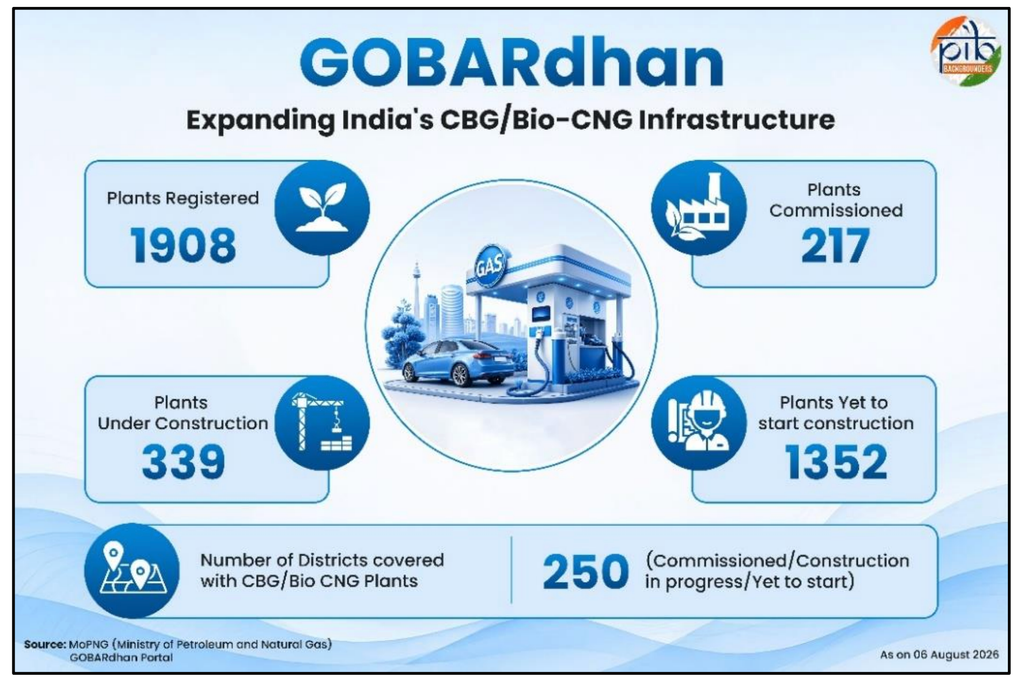
- According to the GOBARdhan Unified Registration Portal, as of mid-2026, a total of 1,908 Compressed Biogas (CBG)/Bio-CNG plants have been registered across the country. Of these, 217 plants have already been commissioned, producing 0.4 Million Standard Cubic Meters per Day (MMSCMD), while 339 plants are under construction.
- The original SATAT vision is 5,000 plants and 15 MMT annual production by 2023-24. This highlights the gap between project announcements and sustained commercial operation.
Why is Feedstock the Critical Bottleneck?
CBG plants require a year-round supply of feedstock with consistent quality. Disruptions reduce gas yield, plant utilisation and financial viability.
- Press mud: It is moist, perishable and available mainly during the four-to-five-month sugar-crushing season. Year-round production requires timely procurement and storage, while long-distance transportation is costly. A radius of about 25 km is generally considered viable.
- Cattle dung: Though available throughout the year, it is dispersed across small livestock holdings. Its high moisture and low energy density necessitate local aggregation through dairy cooperatives, gaushalas or rural entrepreneurs.
- Paddy and wheat straw: Crop residues have relatively high gas potential but are seasonal. Paddy straw may need to be collected, baled and transported within a 15-day window. Storage must prevent summer fires and monsoon moisture damage.
- Municipal and food waste: Poor source segregation causes contamination, while variations in composition and additional pre-sorting increase operational costs.
- Competing uses: Agricultural residues are also used as fodder, bedding and inputs for paper, ethanol, biomass power and industrial boilers. This competition can increase feedstock prices and undermine plant viability.
Why can an Aggregator-Based Model help?
- Individual farmers may be unwilling to sign complex, long-term contracts with industrial plants. An intermediary can bridge this institutional and logistical gap.
- Potential Aggregators include: Farmer Producer Organisations, Primary Agricultural Credit Societies, Dairy and sugar cooperatives, Custom-hiring centres, Self-help groups, Gaushalas and rural entrepreneurs.
- Functions of an Aggregator:
- Mapping farmers and seasonal biomass availability
- arranging balers, rakers, tractors and collection centres
- making prompt digital payments to farmers
- testing moisture and contamination
- managing fire-safe warehouses
- providing plants with assured quantities under supply contracts;
- returning bio-slurry or organic manure to farmers.

Significance of Scaling CBG:
- Energy security: India imports nearly half of its natural gas requirement. Domestically produced CBG can substitute fossil gas and provide protection against global price and supply disruptions.
- Managing stubble and organic waste: Creating a remunerative market for paddy straw can reduce open-field burning and associated air pollution. CBG plants can also divert dung, food waste and municipal organic waste from unmanaged dumping.
- Climate mitigation: CBG can avoid methane emissions from decomposing organic waste and displace fossil natural gas.
- Rural income and employment: Farmers can earn from residues that were previously treated as waste. Collection, baling, transport, storage, plant operation and manure marketing generate decentralised rural employment.
- Soil health: Returning processed bio-slurry to farms can reduce dependence on chemical fertilisers, recycle nutrients and improve soil organic matter.
Government Measures:
- Revamped GOBARdhan Scheme: The 2026 scheme contains six major growth engines:
- assured CBG offtake
- administered price of ₹2,110 per MMBTU
- capital assistance of up to ₹2 crore per tonne-per-day of installed capacity
- pipeline infrastructure connecting plants with gas networks
- credit-guarantee support
- CBG Ecosystem Challenge Fund for feedstock mapping, aggregation, technology and district planning.
- CBG Obligation: City Gas Distribution entities must procure CBG to meet the blending trajectory:
- 3% in FY 2026-27
- 4% in FY 2027-28
- 5% from FY 2028-29 onwards for the CNG-transport and PNG-domestic segments.
Other supporting measures:
- SATAT, 2018: Encouraged entrepreneurs to produce and supply CBG to oil and gas marketing companies.
- Biomass Aggregation Machinery Scheme: Supports machinery required for collection, baling and transport.
- Development of Pipeline Infrastructure Scheme: Supports CBG connectivity with CGD and trunk pipelines.
- Market Development Assistance: Provides ₹1,500 per tonne for eligible FOM, LFOM and phosphate-rich organic manure.
- National Bioenergy Programme: Provides Central Financial Assistance for bioenergy and CBG projects.
Remaining Challenges:
- Overestimation of locally available surplus biomass
- Seasonal feedstock shortages and price spikes
- Single-feedstock plants being vulnerable to crop cycles
- High working-capital requirements for seasonal procurement
- Fire, odour, leachate and moisture risks in storage
- Poor organic-waste segregation
- Methane leakage during production and transport
- Inadequate technical skills and plant maintenance
- Weak market acceptance of bio-manure
- Pipeline and last-mile evacuation gaps
- Inconsistent data between different biogas and CBG portals.
Way Forward:
- Feedstock mapping: Prepare district-level GIS atlases of actual surplus biomass and seasonal availability.
- Optimal location: Establish plants near sugar mills, dairy clusters, gaushalas and crop-residue hotspots.
- Multi-feedstock plants: Enable co-digestion of dung, press mud, food waste and crop residues.
- Aggregation infrastructure: Support balers, collection centres, covered storage, testing facilities and seasonal working capital.
- Quality-linked pricing: Base prices on moisture, contamination and biomethane potential.
- Secure supply contracts: Facilitate multi-year agreements between plants, FPOs and cooperatives.
- Manure market: Standardise and market FOM/LFOM while returning bio-slurry to farmers.
- Environmental monitoring: Track methane leakage, transport emissions, water use and digestate disposal.
India’s CBG challenge is shifting from setting up plants to keeping them reliably fed for 365 days. A locally anchored system of FPOs, cooperatives and professional aggregators supported by feedstock mapping, multi-feedstock technology, safe storage and reverse logistics for bio-manure can convert India’s waste-to-energy ambition into a commercially viable circular bioeconomy.