School Breakfast Expansion: Nutrition and Two Delivery Models
Why in News?
Tamil Nadu expanded its school breakfast scheme to Classes VI–VIII in government and government-aided schools on September 22, 2026, using centralised kitchens and local self-help-group preparation, The Hindu reported.
- The expansion brings upper-primary students within the announced breakfast coverage in government and government-aided schools.
- Centralised kitchens serve the Greater Chennai Corporation and designated schools in other urban and adjoining areas.
- In remaining rural and adjoining areas, women’s self-help groups affiliated with the Tamil Nadu Corporation for Development of Women prepare and serve breakfast.
- The public-policy question is how to provide a safe morning meal reliably before teaching begins, across settlements with different distances and kitchen capacity.
- Coverage announcements describe policy reach; they do not establish nutritional adequacy, daily reliability or measured educational improvement.
UPSC Relevance
Prelims Relevance
- Upper-primary coverage: Classes VI–VIII in the reported expansion.
- Institutional coverage: government and government-aided schools.
- Centralised preparation: cooking at a shared kitchen followed by delivery to schools.
- Decentralised preparation: local self-help groups prepare and serve meals.
Mains Relevance
GS Paper 2
- Designing nutrition services around access, food safety and accountable last-mile delivery.
- Comparing centralised production with community-based preparation without assuming either model is universally superior.
Essay
- A welfare entitlement becomes meaningful through the ordinary reliability of its delivery.
Background and Context
Why the morning meal is a service-delivery issue
School breakfast addresses the timing of food access, while programme quality depends on what reaches children and when it reaches them.
- Classroom hunger concerns children beginning lessons without an adequate morning meal. Breakfast provision addresses that immediate gap; its purpose should be distinguished from a claim that one meal resolves all forms of malnutrition.
- Meal timing is part of access. A nutritionally suitable breakfast delivered after lessons have begun may undermine the service’s purpose, making dependable preparation and serving schedules as important as formal inclusion on beneficiary lists.
- Diet quality requires attention to ingredients, portions and variety, rather than counting plates alone. Menu planning should complement food eaten at home and other school meals instead of treating breakfast as a complete diet.
- Upper-primary expansion extends the reported coverage to older schoolchildren. Its national relevance lies in designing age-appropriate services and managing additional demand without weakening meal reliability for students already covered by the existing programme.
- Equitable access should be assessed at the school level. Administrators need to know whether eligible children actually receive breakfast, including those facing irregular transport or attendance, without turning missed meals into blame directed at families.
Centralised kitchens and local preparation
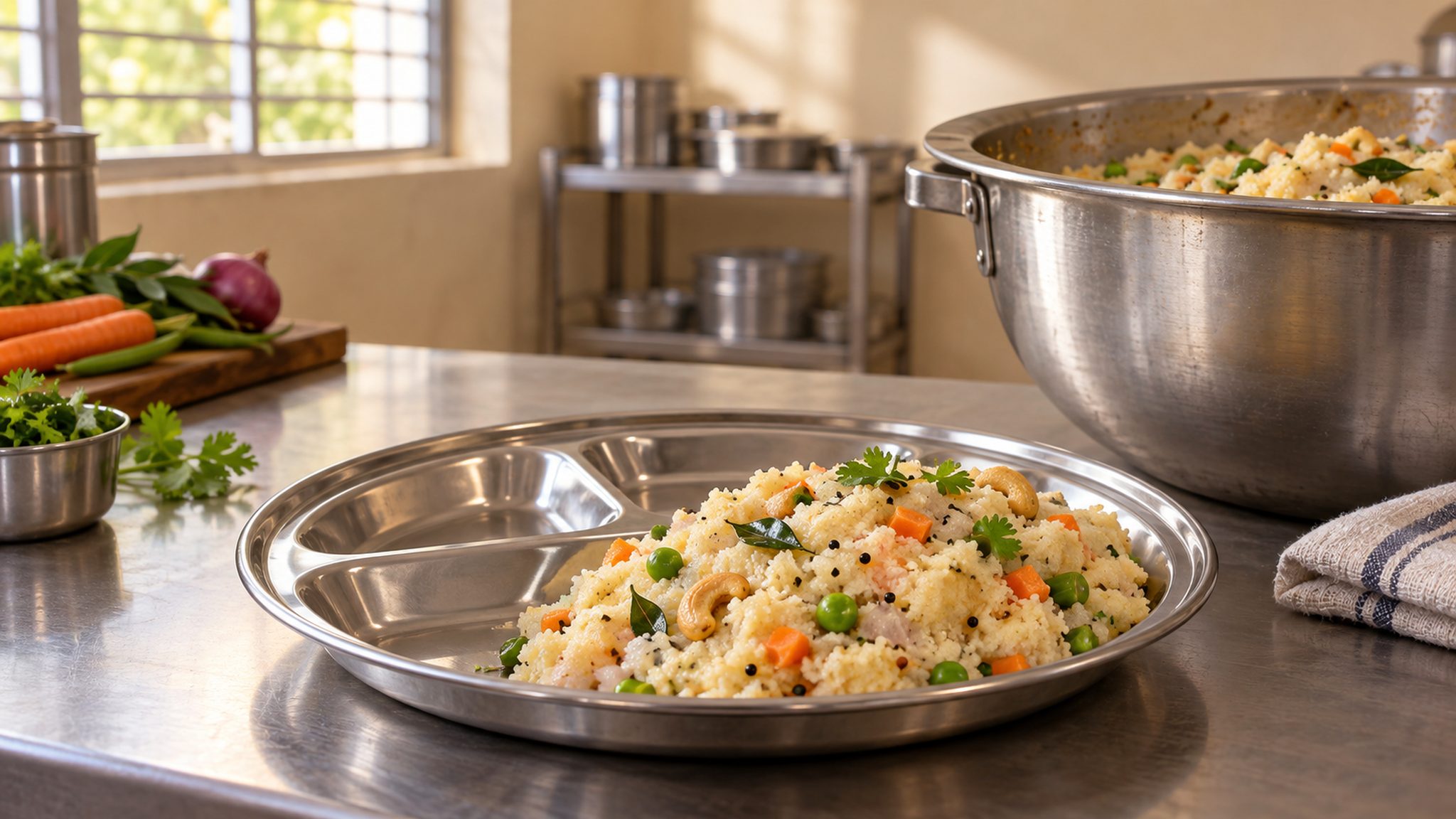
Tamil Nadu’s reported arrangements combine shared kitchens in urban clusters with self-help-group preparation elsewhere; each model places its main operational burden at different points.
- Centralised kitchens prepare meals for several schools, allowing common procurement and cooking arrangements. Their practical advantage depends on suitable equipment, trained staff and enough capacity to finish preparation before the delivery routes must begin.
- Transport becomes critical when cooking and consumption occur at different locations. Clean containers, route planning and timely handover must preserve food safety; a functioning kitchen alone does not guarantee an acceptable meal at school.
- Local preparation places cooking closer to the school community and can reduce reliance on long delivery routes. It still requires dependable ingredients, safe water, storage, fuel and arrangements for absent workers or equipment failure.
- Women’s self-help groups are the reported preparation and serving partners in the rural arrangement. Community involvement can support local oversight, but participation should come with clear responsibilities, training and timely payment for work performed.
- The comparison is contextual: shared kitchens concentrate production capacity but add delivery dependencies; local kitchens shorten the service chain but distribute supervision across many sites. Settlement patterns and available infrastructure should guide the operational choice.
Food safety, accountability and evidence
A delivery model should be judged through observable service standards, while claims about health or learning require evidence beyond the launch announcement.
- Food safety follows the whole chain: ingredient receipt, storage, preparation, movement and serving. Checks should identify where contamination or delay could occur, rather than assuming cooked food is safe simply because it left the kitchen.
- School-level accountability requires a named person to record receipt, serving problems and complaints. Responsibility should remain traceable when a contractor, municipal kitchen or self-help group performs only one part of the overall service.
- Contingency planning should cover water interruptions, spoiled ingredients, staff absence and transport breakdowns. A written fallback and rapid reporting route help schools respond without informally lowering safety standards just to maintain the meal count.
- Outcome evaluation must separate meals delivered from changes in attendance, nutrition or learning. These outcomes have multiple influences; a launch report cannot establish that breakfast caused any improvement or show how benefits vary between schools.
- Useful monitoring combines delivery records with periodic observation and student feedback. Repeated shortages, late arrivals or uneaten food can reveal problems that a headline coverage figure misses, helping administrators correct the service before expanding it further.
Way Forward
Make reliability measurable
- Track meal availability and serving time at schools, and investigate repeated failures instead of reporting only the number of institutions covered.
- Assign food-safety responsibilities across kitchens, delivery teams and schools; provide an escalation route when a meal should not be served.
- Provide self-help-group workers with training, safe equipment and timely payment, matched to clearly defined duties.
- Evaluate nutrition and educational outcomes separately from implementation outputs, using methods that acknowledge other influences on children’s development.
Conclusion
- School breakfast illustrates how social protection depends on delivery design: the meal must be suitable, safe, timely and accessible, whether it comes from a shared kitchen or local preparation.
- For an exam answer, compare the models through capacity, transport and accountability; treat the expansion as a policy development, while keeping claims about improved health or learning conditional on credible evaluation.
UPSC Practice Questions
Prelims MCQ 1
With reference to Tamil Nadu’s reported school breakfast expansion, consider the following statements:
- The expansion covers Classes VI–VIII in government and government-aided schools.
- Every participating school uses a single centralised-kitchen model.
- Self-help groups participate in preparation and serving in the rural arrangement.
How many of the above statements are correct?
(a) Only one (b) Only two (c) All three (d) None
Answer: (b) Only two
Explanation:
Statements 1 and 3 are correct. The reported expansion uses centralised kitchens in designated urban areas and self-help-group preparation in remaining rural and adjoining areas.
Prelims MCQ 2
Which observation most directly measures the reliability of a school breakfast service?
(a) The number of speeches made at its launch (b) The announced budget alone (c) Whether eligible children receive a safe meal before lessons on scheduled days (d) The number of kitchens photographed
Answer: (c) Whether eligible children receive a safe meal before lessons on scheduled days
Explanation:
Reliability concerns actual, timely and safe delivery. Announcements and infrastructure counts alone cannot show whether children consistently receive the service.
UPSC Mains Questions
- Compare centralised kitchens and community-based preparation as delivery models for school nutrition programmes. What should determine the choice between them?
- Why must school nutrition programmes distinguish implementation outputs from educational and health outcomes? Suggest an accountability framework for reliable meal delivery.
Source: The Hindu.
Frequently Asked Questions
What changed in Tamil Nadu’s school breakfast programme?
The reported September 22 expansion covers students in Classes VI–VIII in government and government-aided schools. It combines centralised kitchen delivery in designated urban areas with self-help-group preparation in remaining rural and adjoining areas.
How do the two delivery models differ?
Centralised kitchens concentrate cooking and then deliver meals to schools. Local preparation brings cooking closer to consumption but requires supervision, infrastructure and dependable supplies across a larger number of preparation sites.
Does expansion prove that learning outcomes improved?
No. Expansion establishes broader policy coverage, not a measured educational effect. Learning, attendance and nutrition outcomes require separate evaluation that considers other influences and distinguishes association from a causal impact of breakfast provision.
What is the main accountability challenge?
Responsibility must remain clear from ingredient procurement through serving. Schools need ways to record missing or unsafe meals, report delays and secure corrective action when different organisations handle different parts of the delivery chain.