SCO Bishkek Declaration: Outcomes and India’s Sovereignty Test
Why in News?
At the 26th SCO summit in Bishkek on September 1, 2026, member states adopted the Bishkek Declaration and a package of institutional, security and cooperation instruments.
- The SCO Secretariat reported 28 approved documents, including the Declaration, a Charter-amendment protocol and an emergency-assistance statement.
- PIB described the package as four MoUs plus over twenty decisions and statements covering climate, nuclear safety, energy conservation and drug control.
- The summit approved provisions for a Universal Security Centre and the Executive Committee of an SCO Anti-Drug Centre.
- India-backed proposals recorded in the Declaration included an English-language Charter change, a Civilisation Dialogue Forum, Young Scientist Forum and Young Authors’ Conclave.
- The outcome matters because the SCO moved from broad summit messaging toward institutional rules, specialised centres and external partnerships.
- For India, the test is whether collective language produces non-selective counter-terrorism and connectivity that respects sovereignty and territorial integrity.
UPSC Relevance
Prelims Relevance
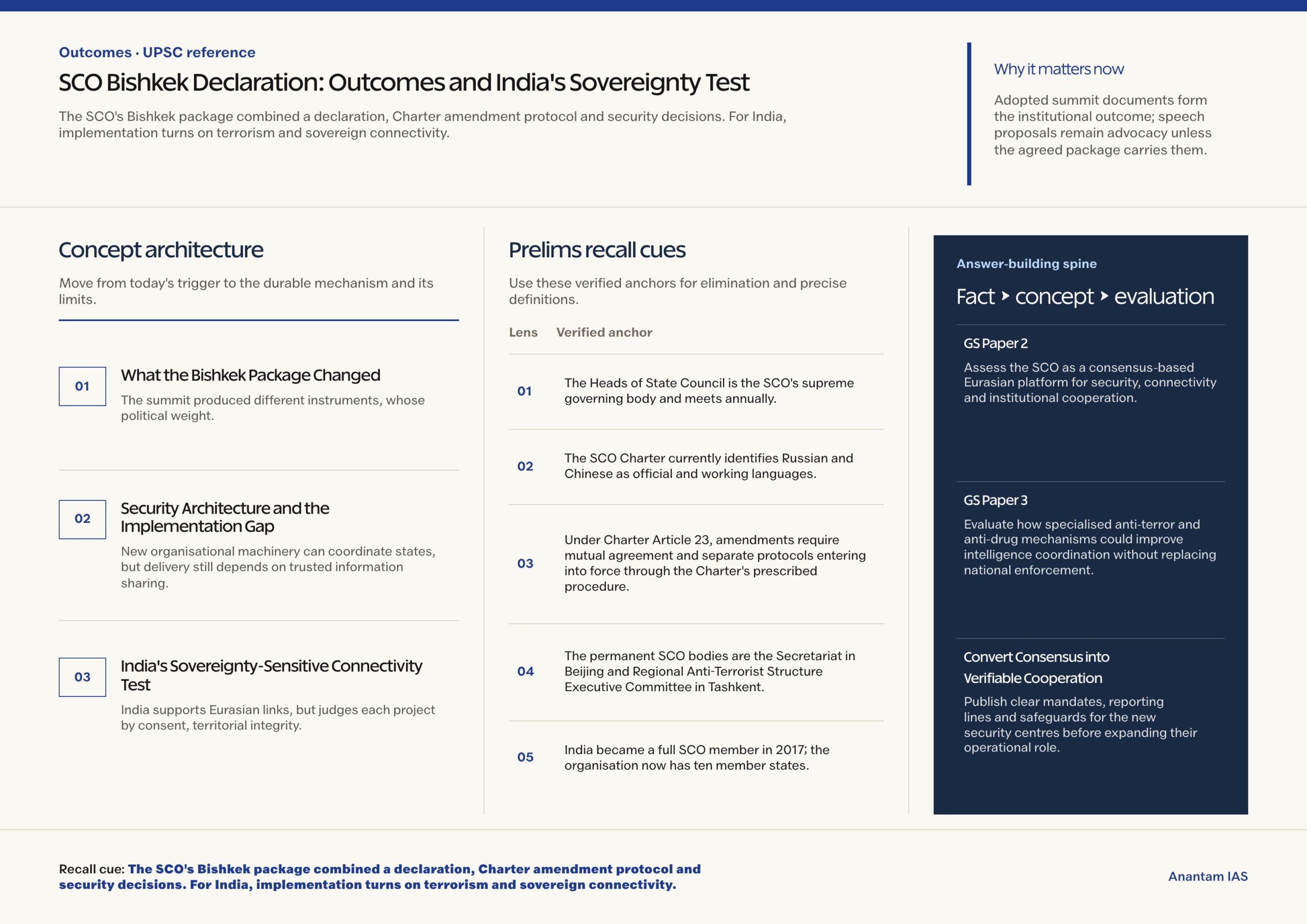
- The Heads of State Council is the SCO’s supreme governing body and meets annually.
- The SCO Charter currently identifies Russian and Chinese as official and working languages.
- Under Charter Article 23, amendments require mutual agreement and separate protocols entering into force through the Charter’s prescribed procedure.
- The permanent SCO bodies are the Secretariat in Beijing and Regional Anti-Terrorist Structure Executive Committee in Tashkent.
- India became a full SCO member in 2017; the organisation now has ten member states.
Mains Relevance
GS Paper 2
- Assess the SCO as a consensus-based Eurasian platform for security, connectivity and institutional cooperation.
- Examine India’s strategy of participating in regional connectivity while insisting on sovereignty and territorial integrity.
GS Paper 3
- Evaluate how specialised anti-terror and anti-drug mechanisms could improve intelligence coordination without replacing national enforcement.
Essay
- Regional institutions become credible when shared declarations are converted into rules, capacity and even-handed implementation.
Background and Context
What the Bishkek Package Changed
The summit produced different instruments, whose political weight, legal route and implementation requirements must not be conflated.
- The Bishkek Declaration records negotiated common positions on regional and international questions; it guides subsequent cooperation but does not itself supply domestic enforcement powers.
- A separate Charter protocol addresses amendments to the organisation’s constitutive document, making it legally and procedurally distinct from a summit declaration.
- Charter Article 23 says amendment protocols form an integral part of the Charter but enter into force through the Article 21 ratification procedure.
- The summit also approved an emergency-assistance statement, extending the package beyond conventional security into disaster response, mutual support and practical humanitarian coordination among member states.
- A decision authorising an SCO Secretariat-African Union Commission MoU widened external institutional cooperation and created a bridge to another major regional organisation.
Security Architecture and the Implementation Gap
New organisational machinery can coordinate states, but delivery still depends on trusted information sharing, compatible procedures and national action.
- Approved provisions for the Universal Centre create a framework for addressing multiple security challenges rather than treating terrorism, cyber risks and organised crime in isolated silos.
- The Anti-Drug Centre’s Executive Committee can support operational coordination against trafficking networks that connect narcotics, organised crime, illicit finance and terrorist activity.
- The Declaration rejected using terrorist, separatist or extremist groups for strategic advantage, reinforcing India’s demand against double standards and selective naming of threats.
- The Declaration also sought an inclusive Afghan government; this remains a collective political position, not evidence that governance conditions or political representation inside Afghanistan have changed.
- Centres and statements cannot independently prosecute offenders; their value rests on timely intelligence, agreed definitions, evidentiary cooperation and consistent national follow-through.
India's Sovereignty-Sensitive Connectivity Test
India supports Eurasian links, but judges each project by consent, territorial integrity, financial credibility and practical access.
- India accepts connectivity that links markets, expands trade and creates development opportunities across a Eurasian region where several members lack direct sea access.
- Its red line is that routes and infrastructure must respect each state’s sovereignty and territorial integrity, rather than normalise disputed territorial alignments.
- This distinguishes support for connectivity as a principle from automatic endorsement of every proposed corridor, financing model, transit condition or route within the SCO space.
- The proposed SCO Development Bank remained under consultation; welcoming work on it does not equal a completed founding agreement, subscribed capital or operational financing.
- India can use the SCO to advance access through transparent, consent-based projects while keeping alternative corridors, maritime options and bilateral partnerships open.
Way Forward
Convert Consensus into Verifiable Cooperation
- Publish clear mandates, reporting lines and safeguards for the new security centres before expanding their operational role.
- Create measurable cooperation on terrorist financing, safe havens, recruitment and narcotics flows without selective exemptions.
- Apply transparent project appraisal, host-state consent and territorial-integrity tests to every connectivity proposal.
- Complete domestic procedures for Charter amendments before presenting political endorsement as an institutional change already in force.
Conclusion
- The Bishkek outcome is significant because it combines political consensus with Charter, security-centre and partnership instruments rather than offering a speech-only summit record without institutional mandates or follow-through.
- A strong answer should separate adoption, entry into force and implementation, then judge India’s gains through even-handed security cooperation, institutional delivery and sovereignty-respecting connectivity.
- The durable exam trap is to treat a Declaration, Charter protocol, institutional decision and proposal under consultation as equivalent outcomes; each demands separate legal and implementation analysis.
UPSC Practice Questions
Prelims MCQ 1
With reference to the Shanghai Cooperation Organisation, consider the following statements:
- The Heads of State Council is the SCO’s supreme governing body.
- Russian and Chinese are the official and working languages under the existing SCO Charter.
- The Regional Anti-Terrorist Structure Executive Committee is based in Beijing.
How many of the above statements are correct?
(a) Only one (b) Only two (c) All three (d) None
Answer: (b) Only two
Explanation:
Statements 1 and 2 are correct. The SCO Secretariat is in Beijing, while the Regional Anti-Terrorist Structure Executive Committee is based in Tashkent.
Prelims MCQ 2
Under the SCO Charter, a change or amendment to the Charter is made through which instrument?
(a) A unilateral Secretariat notification (b) A simple press communique (c) A separate protocol agreed by member states (d) A resolution of the SCO Business Council
Answer: (c) A separate protocol agreed by member states
Explanation:
Article 23 provides for changes by mutual agreement through separate protocols, which form part of the Charter and enter into force under its prescribed procedure.
UPSC Mains Questions
- The Bishkek summit shows both the potential and limits of consensus-based regionalism. Examine with reference to the SCO’s new institutional outcomes.
- How can India pursue Eurasian connectivity through the SCO while protecting sovereignty, territorial integrity and security interests?
Sources: PIB, Prime Minister's Office and The Hindu.
Frequently Asked Questions
What was adopted at the 2026 SCO Bishkek summit?
The SCO Secretariat reported 28 approved documents, including the Bishkek Declaration, a Charter-amendment protocol, an emergency-assistance statement and decisions concerning new security and anti-drug bodies.
Did English immediately become an SCO official language?
PIB said India’s English-language proposal entered the Declaration, and a Charter-amendment protocol was approved. Entry into force still follows the Charter’s amendment and ratification procedure.
What is India’s main connectivity condition in the SCO?
India supports links that expand markets, trade and development, provided each initiative respects national sovereignty and territorial integrity and does not prejudge contested territorial claims.
Why do the new SCO security bodies matter?
They can institutionalise coordination against linked threats such as terrorism, narcotics and organised crime, but results depend on member states sharing intelligence and acting without selective standards.
Is the Bishkek Declaration the same as a binding treaty?
No. It records agreed political positions. Separate protocols, agreements and decisions have their own legal procedures, so adoption and domestic or institutional implementation must be analysed separately.