SCOTUS birthright citizenship ruling: how it compares with India
Why in News?
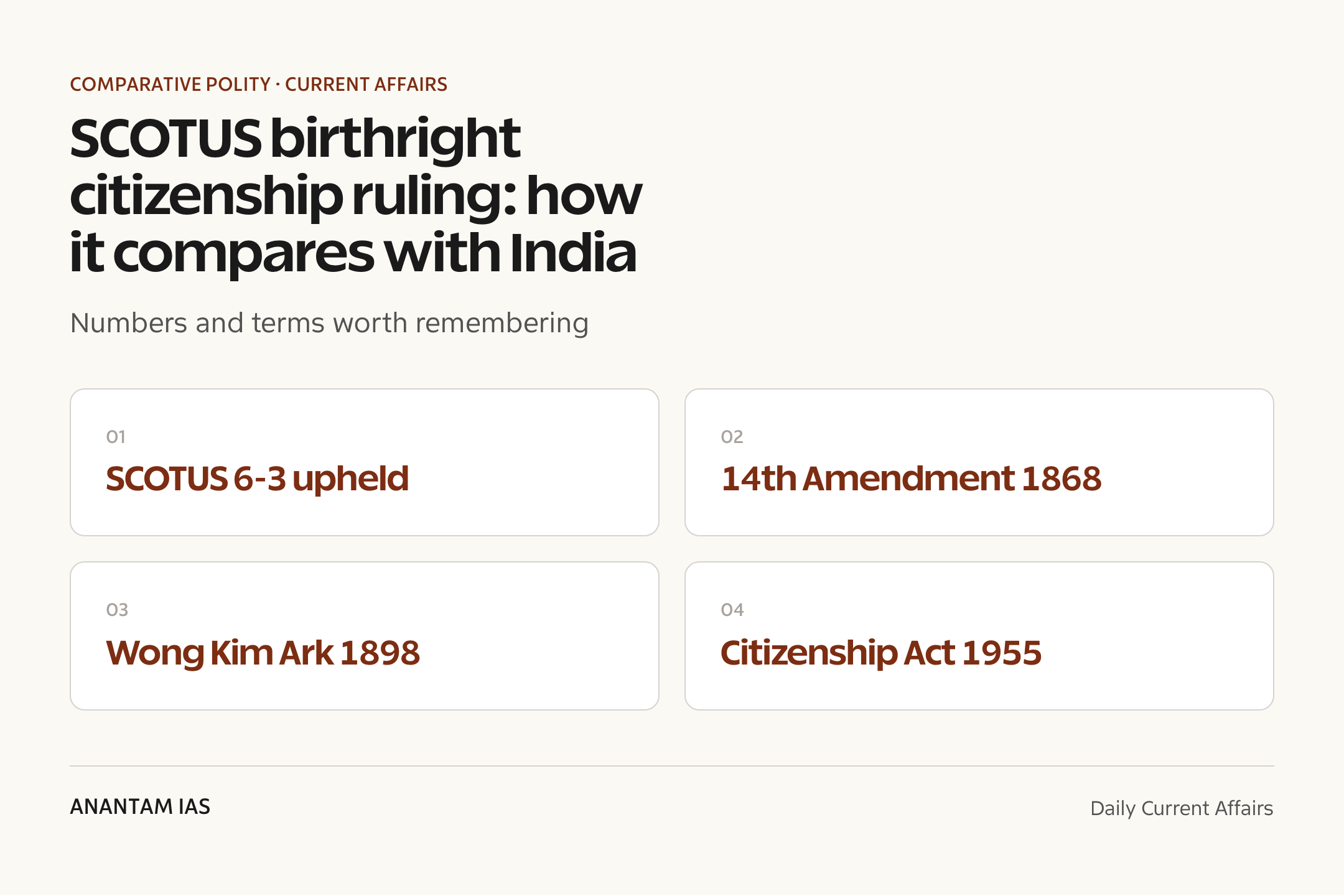
On June 30, 2026, the Supreme Court of the United States (SCOTUS) upheld birthright citizenship guaranteed by the Fourteenth Amendment to the US Constitution, and struck down an executive order that had sought to end unconditional citizenship by birth. The Hindu reported the 6-3 judgment on July 5, 2026.
The ruling reaffirms that anyone born on US soil becomes a citizen regardless of the immigration status of the parents, subject only to narrow exceptions. It offers a sharp contrast with India’s jus sanguinis (citizenship by descent) framework under the Citizenship Act, 1955, making it a rich comparative-polity case.
- SCOTUS by 6-3 upheld the 14th Amendment guarantee and voided Executive Order 14160 (Jan 2025) that targeted children of certain non-citizens born after Feb 19, 2025.
- Exceptions to US jus soli remain only for children of foreign diplomats and members of an invading army.
- The Court held the constitutional text is clear and that changed circumstances cannot justify a narrower reading.
- The Immigration and Nationality Act (INA), 1952 mirrors the constitutional guarantee, declaring a person born in the US and subject to its jurisdiction a citizen ‘at birth’.
- The administration signalled a legislative route, but it lacks the two-thirds support needed for a constitutional amendment in the US Congress.
The development matters in the context of:
- US follows jus soli (right of the soil); India follows a diluted jus sanguinis (right of blood) after the 1987 and 2004 amendments.
- The distinction shapes how each democracy manages migration, statelessness and citizenship documentation.
UPSC Relevance
Prelims Relevance
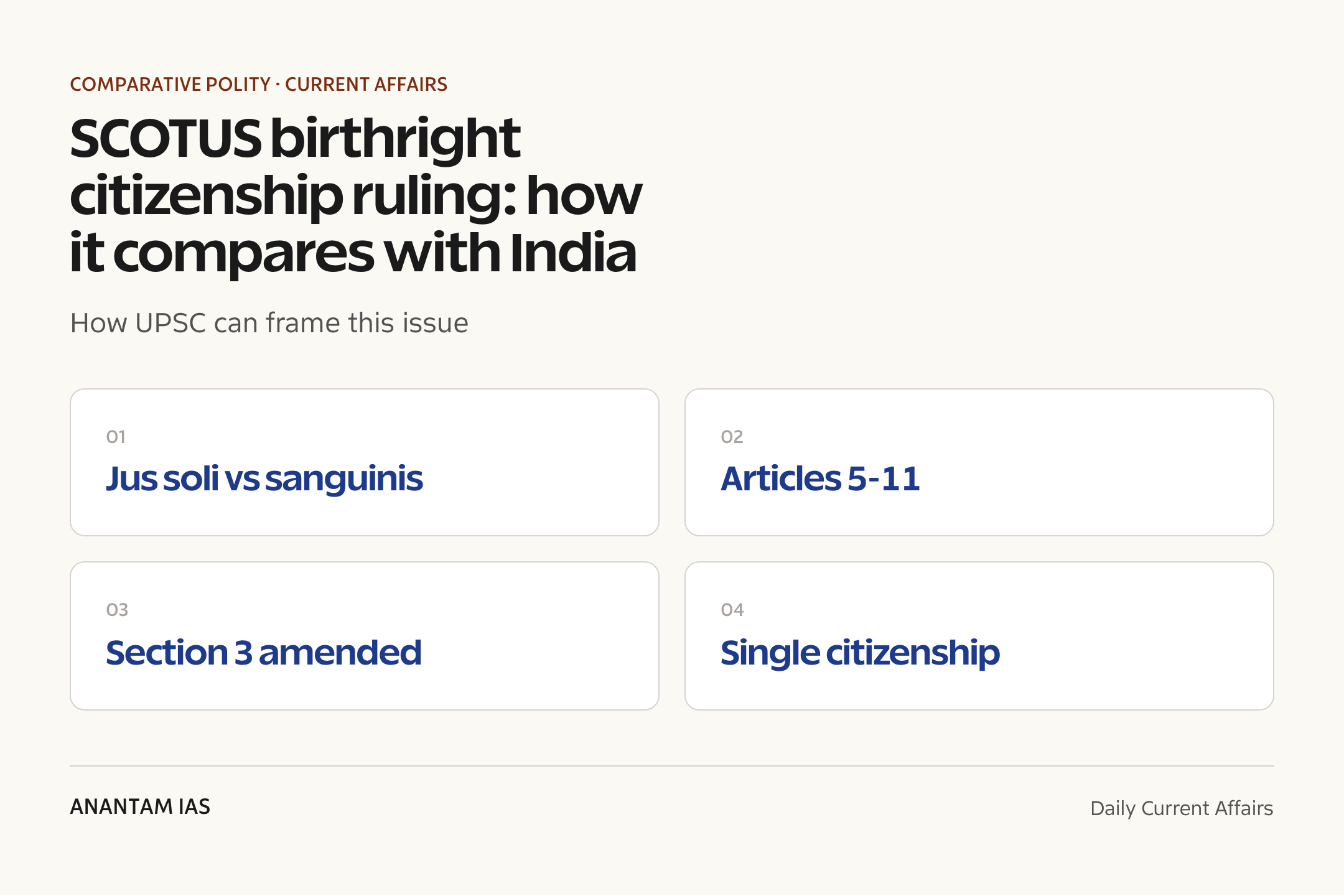
- Jus soli vs jus sanguinis — the two doctrines of acquiring citizenship at birth.
- US 14th Amendment (1868) — ‘all persons born or naturalised in the United States, and subject to the jurisdiction thereof, are citizens’.
- United States v. Wong Kim Ark (1898) — affirmed jus soli for a child of Chinese immigrants.
- India — Articles 5-11 of the Constitution deal with citizenship at commencement; Article 11 empowers Parliament to legislate.
- Citizenship Act, 1955 — modes: birth, descent, registration, naturalisation, incorporation of territory.
- Section 3, Citizenship Act — citizenship by birth, tightened by the 1987 and 2003/2004 amendments.
- Overseas Citizen of India (OCI) — introduced by the 2005 amendment; not dual citizenship.
- India permits single citizenship only; the US permits dual/multiple citizenship.
Mains Relevance
GS Paper 2
- Comparative constitutional design: entrenched fundamental guarantees (US 14th Amendment) versus statute-driven citizenship (India’s Citizenship Act) and the ease of altering each.
- Judicial review as a check on executive action on citizenship and immigration.
GS Paper 2
- Citizenship as a determinant of rights, inclusion and statelessness in large democracies.
GS Paper 1
- How the history of slavery and equality shaped modern citizenship regimes.
Essay
- Who belongs? Citizenship, migration and the idea of the nation.
- The soil and the blood: two competing philosophies of belonging.
Background and Context
Jus soli and jus sanguinis — the core distinction
Citizenship at birth flows from one of two competing principles.
- Jus soli (‘right of the soil’) — citizenship is granted to anyone born within the territory, whatever the parents’ status. The US, Canada and much of the Americas follow it.
- Jus sanguinis (‘right of blood’) — citizenship passes from parents to child by descent, independent of birthplace. Most of Europe, Asia and modern India lean this way.
- Few states use pure jus soli today; many, including India, have shifted toward conditional or descent-based rules to manage irregular migration.
- The doctrines shape passports, documentation, and the risk of statelessness for children of migrants — a stateless child has no country obliged to grant nationality.
- A country can also mix the two: some grant birthright citizenship only if a parent is a lawful resident, blending soil and blood.
- The choice is not merely technical — it encodes a nation’s answer to who belongs and on what terms.
The US 14th Amendment and the SCOTUS ruling
The 2026 judgment reaffirmed a guarantee written into the US Constitution after the Civil War.
- The 14th Amendment, ratified in 1868, was framed to settle the citizenship of freed slaves after the 13th Amendment abolished slavery.
- It overrode the notorious Dred Scott (1857) ruling that had held no Black person could be a US citizen — the case that had made the status of freed slaves ambiguous.
- The provision built on the Civil Rights Act, 1866, which had legislated that any person born in the country is a citizen; its principle was written into the Constitution to shield it from a future Congress or President.
- In 2026, SCOTUS struck down Executive Order 14160 (January 2025), which had directed agencies to stop issuing passports and social-security numbers to some US-born children of non-citizen or temporary-status parents born after 19 February 2025.
- The majority held the framers chose deliberately sweeping, universal language so the guarantee could not be narrowed by a future court or executive, and that changed circumstances cannot justify a new meaning for a clear text.
- The administration had argued the guarantee was only a remedy for former slaves and should be read narrowly; the Court rejected that reading.
- The dispute over whether jus soli is ‘constitutional and statutory’ or ‘only statutory’ echoes India’s debate over whether citizenship rules are constitutionally entrenched or ordinary legislation — one judge, Justice Kavanaugh, treated it as a statutory question.
United States v. Wong Kim Ark — the anchoring precedent
A 19th-century case still defines the scope of US birthright citizenship.
- In United States v. Wong Kim Ark (1898), the Supreme Court held that a child born on US soil to Chinese immigrant parents was a US citizen by birth.
- It read ‘subject to the jurisdiction thereof’ narrowly — excluding only children of diplomats and hostile occupying forces.
- That reading has anchored US jus soli for over a century and framed the 2026 challenge.
- The INA, 1952 later codified the same principle in statute, declaring a person born in the US and subject to its jurisdiction a citizen ‘at birth’ — a legislative guarantee layered over the constitutional one.
- Because the guarantee sits in both the Constitution and statute, ending it would require either a constitutional amendment or, on a contested view, a new law — neither easy to secure.
India's citizenship framework — Articles 5-11 and the 1955 Act
India’s Constitution set the starting roll; Parliament governs acquisition thereafter.
- Articles 5-11 (Part II) defined who was a citizen at commencement on 26 January 1950; Article 11 lets Parliament regulate citizenship by law.
- The Citizenship Act, 1955 provides five modes — by birth, descent, registration, naturalisation, and incorporation of territory.
- India started close to jus soli — Section 3 once granted citizenship to almost anyone born in India.
- For births before 1 July 1987, birth on Indian soil was largely enough — a near jus soli position.
- The 1987 amendment required at least one parent to be an Indian citizen for those born on or after 1 July 1987.
- The 2003 amendment (effective 2004) tightened it further: for births on or after 3 December 2004, one parent must be an Indian citizen and the other not an illegal migrant — a clear jus sanguinis tilt.
- Naturalisation and registration remain the routes for foreigners and persons of Indian origin, subject to residence and other qualifying conditions in the Act.
Single citizenship, OCI and the neutral NRC/CAA backdrop
India’s design differs from the US on dual nationality and documentation.
- India permits only single citizenship; acquiring another nationality ends Indian citizenship. The US allows dual/multiple citizenship.
- The OCI card (2005 amendment) gives long-term residence and entry rights to persons of Indian origin, but it is not dual citizenship and carries no voting or public-office rights.
- The National Register of Citizens (NRC) is a record of citizens; the Citizenship (Amendment) Act, 2019 created a faster naturalisation path for specified non-Muslim migrants from three neighbouring countries who entered before 2015.
- Both remain contested and are cited here only as institutional context for how a descent-based system verifies citizenship.
- The contrast is sharp: US birthright status attaches automatically at birth, while India increasingly relies on parentage and documentary proof of descent.
- That reliance on documentation is a direct consequence of the jus sanguinis tilt — where the soil no longer decides, records of parentage must.
Jus soli vs jus sanguinis around the world
The global map shows a retreat from unconditional birthright citizenship.
- Unconditional jus soli survives mainly in the Americas — the US, Canada, Brazil, Mexico and much of Latin America.
- Many countries adopted conditional jus soli — birthright applies only if a parent is a citizen or lawful resident (Ireland, France, the UK moved this way).
- Most of Europe and Asia, including India, China, Japan and the Gulf, follow jus sanguinis, prioritising descent.
- The trend, driven by migration concerns, is toward hybrid rules — which is precisely the direction India took in 1987 and 2004.
- This makes the US position an outlier among large economies, and explains why its birthright guarantee draws recurring political challenge.
Way Forward
Read citizenship as constitutional design
- For GS2, treat the case as a lesson in entrenchment — a guarantee in the constitutional text (US 14th Amendment) is far harder to reverse than one in ordinary statute (India’s Citizenship Act).
- Note that judicial review checked executive overreach on a core status question, echoing how Indian courts have policed citizenship determinations.
- An executive order or a simple statute cannot override a clear constitutional guarantee — amendment is the only durable route, and it demands broad consensus.
Balance inclusion with verification
- A descent-based system must guard against statelessness and arbitrary exclusion while verifying parentage.
- Robust, non-discriminatory documentation and due process matter as much as the underlying doctrine.
- Verification failures can leave genuine citizens undocumented, so procedural fairness is central to any jus sanguinis regime.
Use the case as comparative material
- The doctrinal pair — jus soli versus jus sanguinis — is the durable exam takeaway, along with how India moved from one toward the other across 1987 and 2004.
- Pair it with the global trend away from unconditional birthright citizenship to build a rounded comparative-polity answer.
Conclusion
The 2026 SCOTUS ruling preserved one of the world’s most expansive jus soli guarantees, rooted in the post-Civil-War promise of the 14th Amendment and the century-old Wong Kim Ark precedent. Its strength lies in being written into the constitutional text, beyond the reach of an executive order or an ordinary statute.
India travelled the opposite road. Starting near jus soli in 1955, it moved decisively toward jus sanguinis through the 1987 and 2004 amendments, tying citizenship at birth to a parent’s citizenship. For comparative polity, the two systems frame a single enduring question — whether belonging follows the soil one is born on or the blood one is born from.
UPSC Practice Questions
Prelims MCQ 1
With reference to citizenship doctrines and the 2026 SCOTUS ruling, consider the following statements:
- The US Fourteenth Amendment embodies the principle of jus soli.
- The 2026 SCOTUS judgment ended unconditional birthright citizenship in the United States.
- United States v. Wong Kim Ark (1898) affirmed birthright citizenship for a child of immigrant parents.
How many of the above statements are correct?
(a) Only one (b) Only two (c) All three (d) None
Answer: (b) Only two
Explanation:
Statements 1 and 3 are correct. Statement 2 is wrong — SCOTUS UPHELD birthright citizenship and struck down the executive order that had sought to end it.
Prelims MCQ 2
Which one of the following best describes India’s approach to citizenship by birth after the Citizenship (Amendment) Act, 2003 (effective 2004)?
(a) Pure jus soli — anyone born in India is a citizen (b) Jus sanguinis tilt — at least one parent must be an Indian citizen and the other not an illegal migrant (c) Dual citizenship is granted automatically at birth (d) Citizenship depends solely on the religion of the parents
Answer: (b) Jus sanguinis tilt — at least one parent must be an Indian citizen and the other not an illegal migrant
Explanation:
For births on or after 3 December 2004, Section 3 requires one parent to be an Indian citizen and the other not an illegal migrant — a clear move away from jus soli toward jus sanguinis. India also permits only single citizenship.
UPSC Mains Questions
- Compare the constitutional guarantee of birthright citizenship in the United States with India’s statutory citizenship framework. What does the difference in entrenchment reveal about how the two democracies protect the status of citizenship? (250 words)
- ‘India has moved from jus soli toward jus sanguinis.’ Examine this shift with reference to the Citizenship Act, 1955 and its subsequent amendments, and its implications for inclusion and statelessness. (250 words)
- Discuss the role of judicial review in checking executive action on core questions of citizenship, drawing on comparative examples. (150 words)
Sources: The Hindu and US Constitution, 14th Amendment (constitution.congress.gov).
Frequently Asked Questions
What did SCOTUS rule on birthright citizenship in 2026?
On June 30, 2026, the US Supreme Court, by a 6-3 vote, upheld birthright citizenship under the Fourteenth Amendment and struck down Executive Order 14160, which had sought to deny citizenship to some US-born children of non-citizen parents. Anyone born on US soil remains a citizen, with narrow exceptions for children of diplomats and invading armies.
What is the difference between jus soli and jus sanguinis?
Jus soli (‘right of the soil’) grants citizenship to anyone born within a country’s territory, regardless of the parents’ status — the US model. Jus sanguinis (‘right of blood’) passes citizenship from parents to child by descent, independent of birthplace — the model most of Europe, Asia and modern India follow.
Does India follow jus soli or jus sanguinis?
India began close to jus soli under the Citizenship Act, 1955, but shifted toward jus sanguinis. Since 1987, at least one parent had to be an Indian citizen; since December 2004, one parent must be an Indian citizen and the other not an illegal migrant. India’s system is now predominantly descent-based.
Which articles of the Indian Constitution deal with citizenship?
Articles 5 to 11 in Part II cover citizenship. Articles 5-8 defined who was a citizen at commencement in 1950, Article 9 bars dual citizenship, Article 10 continues citizenship, and Article 11 empowers Parliament to make laws on citizenship — the basis for the Citizenship Act, 1955.
What is United States v. Wong Kim Ark?
It is an 1898 US Supreme Court case that held a child born on US soil to Chinese immigrant parents was a citizen by birth. It read the 14th Amendment’s ‘subject to the jurisdiction thereof’ narrowly, excluding only children of diplomats and hostile forces, and has anchored US birthright citizenship ever since.
Is OCI status the same as dual citizenship for India?
No. Overseas Citizen of India (OCI) status, introduced by the 2005 amendment, offers long-term residence, entry and some economic rights to persons of Indian origin, but it is not dual citizenship. OCI holders cannot vote, hold constitutional office, or enter certain government jobs, and India permits only single citizenship.