Secularism

Context:
The article is about Chief Justice of India (CJI) B.R. Gavai’s clarification after a controversy over his oral remarks made during a hearing on a damaged Lord Vishnu idol.
UPSC Relevance:
Indian Constitution—historical underpinnings, evolution, features, amendments, significant provisions and basic structure.
UPSC PYQ’s
Q. What was the exact constitutional status of India on 26th January, 1950? (2021)
(a) A Democratic Republic
(b) A Sovereign Democratic Republic
(c) A Sovereign Secular Democratic Republic
(d) A Sovereign Socialist Secular Democratic Republic
Q. Discuss each adjective attached to the word ‘Republic’ in the ‘Preamble’. Are they defendable in the present circumstances? (2016)
Secularism:
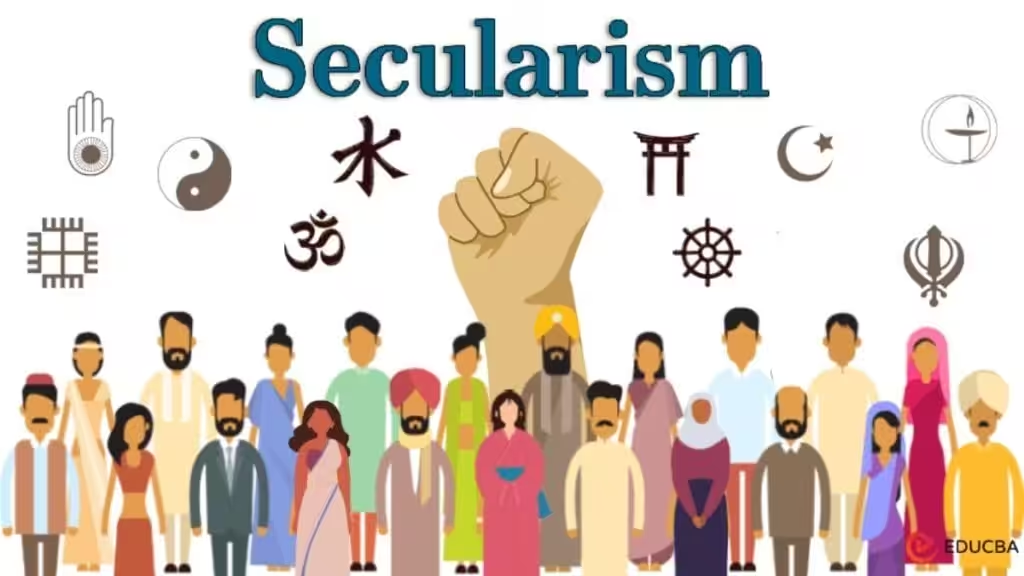
Secularism is a political idea concerned with the best way to govern religiously pluralist societies. The model of secularism we advocate for defends the civil liberties of all, whatever your personal beliefs.
The principles of secularism which protect and underpin liberal democracy and many of the freedoms we enjoy are:
- Separation of religious institutions from state institutions and a public sphere where religion may participate, but not dominate.
- Equality so that our religious beliefs or lack of them doesn’t put any of us at an advantage or a disadvantage.
- Freedom to practise one’s religion or belief without harming others, or to change it or not have one, according to one’s own conscience.
Secularism fosters a society where individuals are free to practise their religions and to express their beliefs freely, but where no single religion dominates or influences the decisions and policies of the government. It is the best chance we have to create a society in which people of all religions or none can live together fairly and peacefully.
SECULARISM IN THE HISTORY OF INDIA:
- Secular traditions are very deep rooted in the history of India. Indian culture is a composite one which is based on the blending of various spiritual traditions and social movements. In ancient India, the Santam Dharma (Hinduism) was basically allowed to develop as a holistic religion by welcoming different spiritual traditions and trying to integrate them into a common mainstream.
- Emperor Ashoka was the first great emperor to announce, as early as third century B.C. that, the state would not prosecute any religious sect. In his 12th Rock Edit, Ashoka made an appeal not only for the toleration of all religion sects but also to develop a spirit of great respect toward them.
- In medieval India the Sufi and Bhakti movements bond the people of various communities together with love and peace.
- The remarks of Guru Nanak, when he says that ‘There is no Hindu and no Musalman, as there is no distinction between man and man’ give support to the roots of secularism.
SECULARISM IN THE CONSTITUTION OF INDIA:
- It is true that the word ‘secular’ did not first occurs either in article 25 or 26 or in any other article of Preamble of the constitution. By the forty-second Constitution Amendment Act of 1976, the preamble was amended. Since then India becomes a sovereign, socialist, secular and democratic republic. The constitution says that, there shall be no ‘state religion’ in India.
- The state will not compel any citizen to pay any taxes for the promotion or maintenance of any particular religion or religious institution (Article 27).
- No religious instruction shall be provided in any educational institution wholly provided by state funds Article 28(1).
Role of Indian Judiciary:
- Kesavananda Bharati Case, 1973: The Supreme Court ruled that Secularism is a fundamental aspect of the Constitution’s basic structure.
- SR Bommai Case, 1994: The Court stated that secularism signifies equal treatment of all religions.
CHALLENGES OF SECULARISM IN INDIA:
Communalism
- One of the most significant challenges to secularism in India is communalism, which involves the mobilization of religious identities for political purposes. Communal tensions between religious communities, particularly between Hindus and Muslims, have periodically erupted into violence, undermining the secular fabric of the nation.
Religious Polarization
Political parties and groups often exploit religious differences to create vote banks, leading to the polarization of society along religious lines. This polarization not only threatens communal harmony but also erodes the secular character of Indian politics.
Hindutva Ideology
The rise of Hindutva, an ideology that promotes the idea of India as a Hindu nation, poses a direct challenge to secularism. Hindutva advocates argue for the primacy of Hindu culture and religion in public life, often at the expense of minority rights and secular principles.
Majoritarianism
The increasing influence of majoritarian politics, where the interests of the majority community are prioritized over those of minorities, has led to the marginalization of religious minorities. This trend undermines the inclusive and pluralistic ideals of secularism in India.
Vote Bank Politics
The use of religion-based vote banks by political parties has contributed to the communalization of politics. This practice encourages political leaders to cater to specific religious groups, often at the cost of secular governance and equal treatment for all citizens.
Hate Speech
- The rise of hate speech and inflammatory rhetoric targeting religious minorities is another challenge to secularism.
After a long history of communal incident in India, still now, Secularism is seen as the only
possible option that would be able to provide harmonious and peaceful survival for the different religions and casts of Indian society.