SHe-Box 2.0: Single-Window Portal to Strengthen the PoSH Act
Why in News?
The Ministry of Women and Child Development has rolled out an upgraded version of its grievance portal, SHe-Box 2.0 (Sexual Harassment electronic Box), positioned as a single-window system to register and track complaints of sexual harassment at the workplace across all sectors.
The upgrade operationalises the Sexual Harassment of Women at Workplace (Prevention, Prohibition and Redressal) Act, 2013 — the PoSH Act — by giving every working woman, whether in the organised or unorganised sector, a uniform digital channel to lodge and monitor a complaint.
- SHe-Box 2.0 is a consolidated single-window platform for filing and tracking workplace sexual-harassment complaints across public and private sectors.
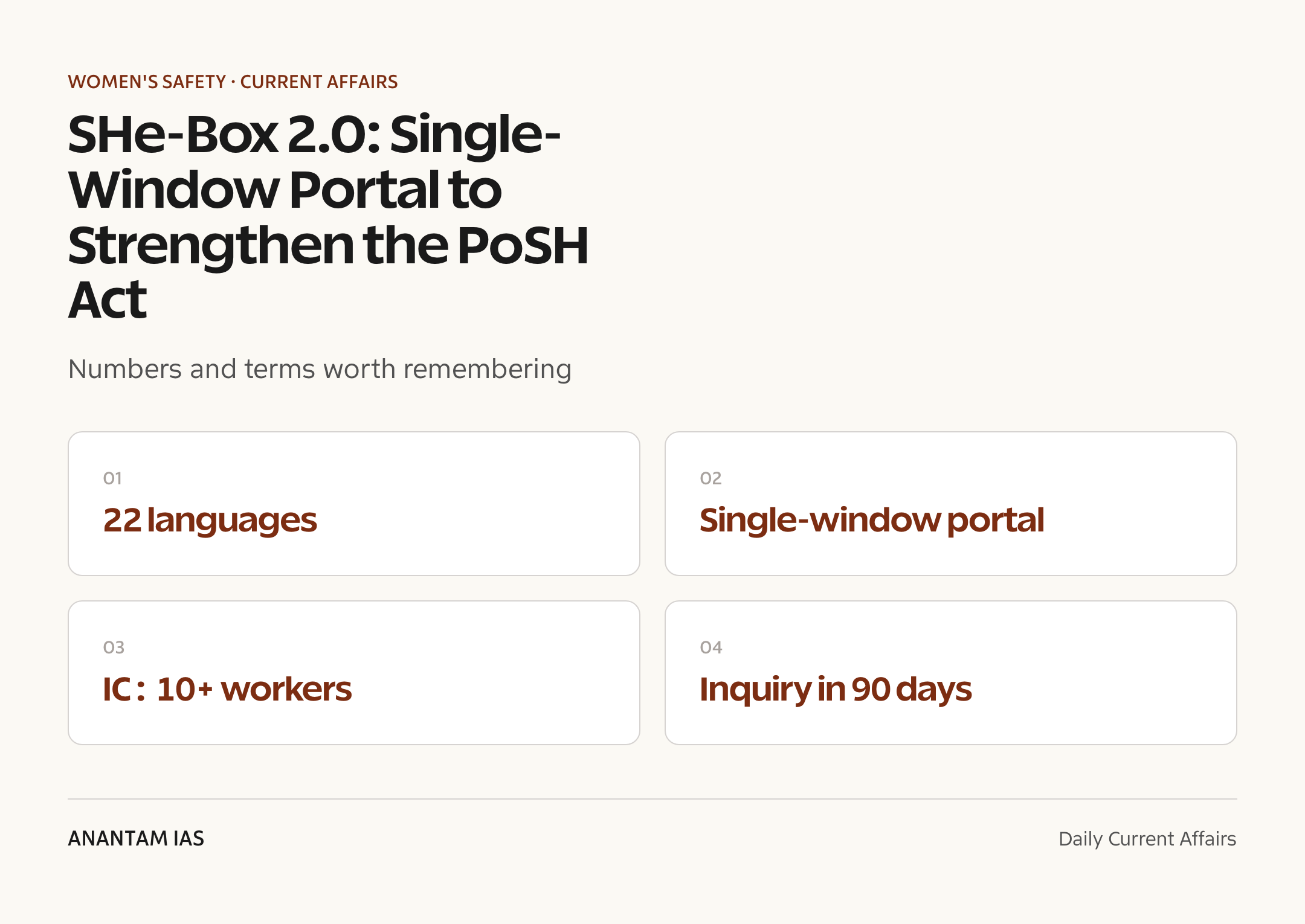
- It is available in 22 languages to widen accessibility for women across regions.
- It supports both registration and real-time tracking of the status of a complaint.
- The original SHe-Box was first launched in 2017; version 2.0 is the redesigned, expanded upgrade.
The development matters in the context of:
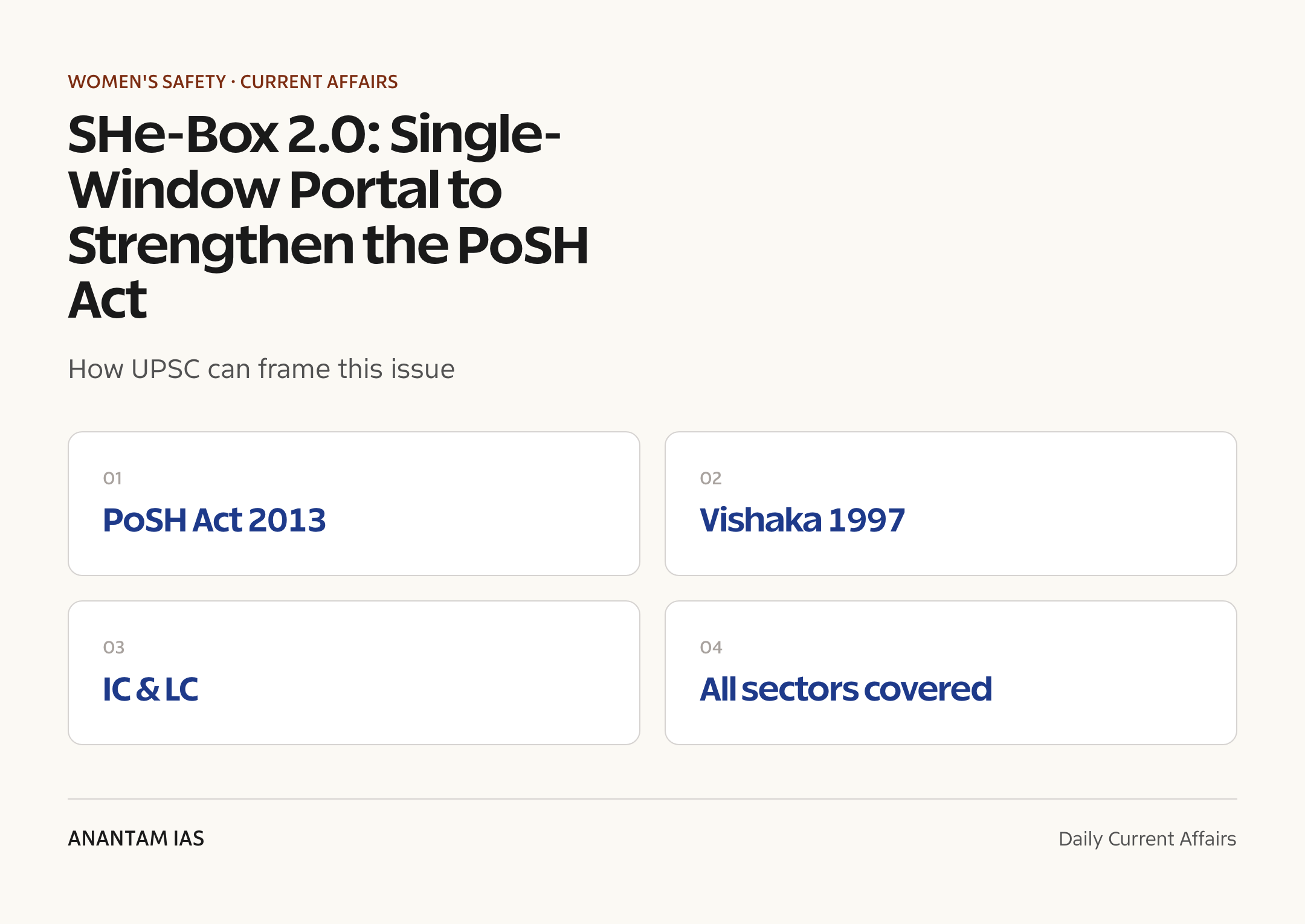
- SHe-Box implements the redressal architecture of the PoSH Act, 2013, which itself codified the Supreme Court’s Vishaka Guidelines (1997).
- The portal routes complaints to the appropriate Internal Committee (IC) or Local Committee (LC) for inquiry.
UPSC Relevance
Prelims Relevance
- SHe-Box — Sexual Harassment electronic Box, a Ministry of Women and Child Development portal; original launch 2017, upgraded to 2.0.
- PoSH Act, 2013 — full name: Sexual Harassment of Women at Workplace (Prevention, Prohibition and Redressal) Act.
- Vishaka Guidelines (1997) — Supreme Court judgment in Vishaka v. State of Rajasthan that preceded the statute.
- Internal Committee (IC) — mandatory at workplaces with 10 or more employees.
- Local Committee (LC) — constituted by the District Officer for establishments with fewer than 10 workers and for the unorganised sector.
- The IC must be headed by a senior woman employee (Presiding Officer) and include an external member from an NGO/association familiar with the issue.
- Inquiry is to be completed within 90 days; the employer must act on the report within 60 days.
- A complaint should ordinarily be filed within three months of the incident (extendable).
- Nodal ministry: Ministry of Women and Child Development.
- The Act covers all women regardless of age or employment status, including the unorganised sector.
Mains Relevance
GS Paper 2
- Mechanisms, laws, institutions and bodies constituted for the protection and betterment of vulnerable sections — SHe-Box as an e-governance tool delivering on a statutory right.
- Implementation gaps in the PoSH Act — non-constitution of Internal Committees, under-functioning Local Committees, low awareness — and how a single-window portal addresses last-mile grievance redressal.
GS Paper 1
- Role of women and women’s organisations; workplace safety as a precondition for rising female labour-force participation and women’s economic empowerment.
Essay
- Dignity at the workplace and the unfinished journey from the Vishaka Guidelines to a digital single-window redressal system.
Background and Context
From Vishaka Guidelines to a statute
The PoSH Act traces directly to a landmark Supreme Court intervention.
- In Vishaka v. State of Rajasthan (1997), the Supreme Court framed binding guidelines treating sexual harassment as a violation of the fundamental rights to equality (Articles 14, 15) and to life and dignity (Article 21).
- The Vishaka Guidelines filled a legislative vacuum and remained the law for 16 years until Parliament enacted a dedicated statute.
- The guidelines drew on India’s commitments under the Convention on the Elimination of All Forms of Discrimination Against Women (CEDAW).
What the PoSH Act, 2013 mandates
The Act sets out definitions, committees, duties and timelines.
- It defines sexual harassment to include unwelcome physical contact, demands for sexual favours, sexually coloured remarks, showing pornography and other unwelcome conduct.
- Every workplace with 10 or more workers must constitute an Internal Committee (IC), headed by a senior woman and including an external member.
- A Local Committee (LC) at the district level handles complaints from smaller establishments and the unorganised sector.
- The IC may recommend interim relief and disciplinary action; an inquiry must conclude within 90 days.
What SHe-Box adds to the framework
SHe-Box is the digital front-end to the statutory machinery.
- First launched in 2017, SHe-Box was conceived as a centralised portal so a woman need not navigate scattered office-level processes.
- A complaint filed online is forwarded to the concerned IC or LC, and the complainant can monitor its progress.
- It covers all sectors — central and state government, public-sector undertakings and private organisations alike.
The 2.0 upgrade
Version 2.0 widens reach and improves usability.
- SHe-Box 2.0 is presented as a single-window grievance redressal system consolidating registration and tracking on one platform.
- It is available in 22 languages, lowering the language barrier that often deters complaints from smaller towns and the informal economy.
- The redesign aims to bring greater transparency and accountability to how complaints are routed and resolved.
Why implementation still matters
A portal is only as effective as the committees behind it.
- Surveys and audits have repeatedly flagged non-constitution of Internal Committees, especially in smaller firms and the unorganised sector.
- Many Local Committees remain weakly resourced or unknown to the women they are meant to serve.
- Under-reporting persists due to fear of retaliation, social stigma and lack of awareness of rights.
Way Forward
Enforce committee compliance
- Use SHe-Box data to map which districts and sectors lack functioning ICs and LCs, and treat non-constitution as a punishable default.
- Mandate periodic public disclosure of complaint and disposal statistics by employers.
Strengthen the unorganised sector
- Resource and publicise Local Committees so domestic, agricultural and gig workers can actually reach them.
- Link SHe-Box outreach with local self-government and women’s self-help-group networks.
Build awareness and trust
- Run sustained multilingual awareness drives so the 22-language interface translates into actual usage.
- Guarantee confidentiality and protection against victimisation to reduce under-reporting.
Conclusion
SHe-Box 2.0 marks an incremental but meaningful step in converting the rights promised by the Vishaka Guidelines and the PoSH Act, 2013 into an accessible, trackable service. A single-window, multi-language portal lowers the threshold for a woman to act on harassment, regardless of which sector she works in.
The portal’s success will ultimately depend on the institutions it feeds into. Well-constituted Internal and Local Committees, credible protection from retaliation, and transparent disposal of complaints are what will make the digital promise real on the ground.
UPSC Practice Questions
Prelims MCQ 1
With reference to the PoSH Act, 2013, consider the following statements:
- An Internal Committee is mandatory at every workplace employing ten or more workers.
- The Local Committee is constituted at the district level for the unorganised sector and small establishments.
- The Act extends protection only to women employed in the organised, formal sector.
How many of the above statements are correct?
(a) Only one (b) Only two (c) All three (d) None
Answer: (b) Only two
Explanation:
Statements 1 and 2 are correct. Statement 3 is wrong — the Act protects women across all sectors, including the unorganised sector, irrespective of age or employment status.
Prelims MCQ 2
Consider the following with reference to SHe-Box and the framework for workplace sexual harassment in India:
(a) SHe-Box is a portal of the Ministry of Home Affairs (b) The PoSH Act, 2013 codified the Vishaka Guidelines laid down by the Supreme Court in 1997 (c) The Vishaka Guidelines were issued in 2013 alongside the Act (d) SHe-Box complaints bypass Internal and Local Committees
Answer: (b) The PoSH Act, 2013 codified the Vishaka Guidelines laid down by the Supreme Court in 1997
Explanation:
SHe-Box is run by the Ministry of Women and Child Development; the Vishaka Guidelines were issued in 1997; and SHe-Box complaints are routed to the relevant IC or LC. Only (b) is correct.
UPSC Mains Questions
- The journey from the Vishaka Guidelines to SHe-Box 2.0 reflects both progress and persistent gaps in protecting women at the workplace. Discuss.
- A grievance-redressal portal is only as effective as the institutions behind it. In the light of the PoSH Act, 2013, examine the challenges in implementing workplace sexual-harassment law in India and suggest measures to address them.
Source: Ministry of Women and Child Development.
Frequently Asked Questions
What is SHe-Box 2.0?
SHe-Box 2.0 is the upgraded version of the Sexual Harassment electronic Box, a portal run by the Ministry of Women and Child Development. It is a single-window system, available in 22 languages, that lets a woman register and track a workplace sexual-harassment complaint across any sector.
What does the PoSH Act, 2013 stand for?
PoSH stands for the Sexual Harassment of Women at Workplace (Prevention, Prohibition and Redressal) Act, 2013. It is India’s dedicated law requiring employers to prevent harassment, set up complaint committees, and provide a time-bound redressal process for working women.
What are the Vishaka Guidelines?
The Vishaka Guidelines were framed by the Supreme Court in Vishaka v. State of Rajasthan (1997). They treated workplace sexual harassment as a violation of fundamental rights and remained the governing norms for 16 years until the PoSH Act, 2013 was enacted.
What is the difference between an Internal Committee and a Local Committee?
An Internal Committee (IC) is set up by an employer at any workplace with 10 or more workers. A Local Committee (LC) is constituted by the District Officer to handle complaints from smaller establishments and the unorganised sector, where an IC may not exist.
Who can use SHe-Box to file a complaint?
Any woman facing sexual harassment at her workplace can use SHe-Box, whether she works in central or state government, a public-sector undertaking, or a private organisation. The portal routes her complaint to the appropriate Internal or Local Committee.
What are the key timelines under the PoSH Act?
A complaint should ordinarily be filed within three months of the incident, though this can be extended. The Internal or Local Committee must complete its inquiry within 90 days, and the employer must act on the committee’s report within 60 days.