India’s First Ship Recycling Credit Note: Linking Green Recycling to Shipbuilding
Why in News?
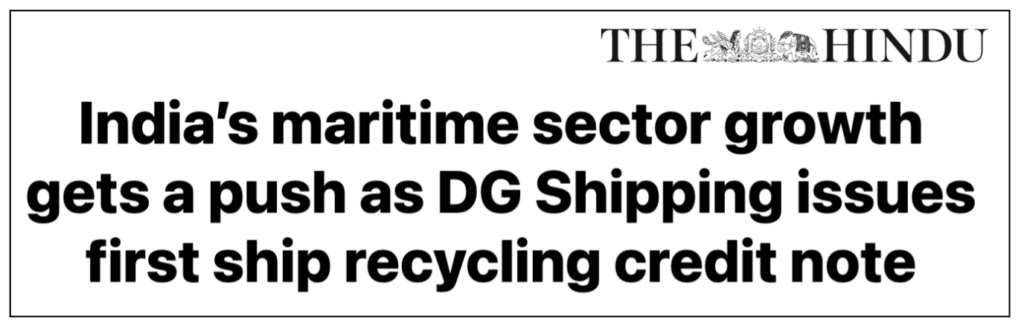
The Directorate General of Shipping (DG Shipping), under the Ministry of Ports, Shipping & Waterways, has issued India’s first-ever Ship Recycling Credit Note (around 15 June 2026). PIB and the ministry describe India as the first country in the world to operationalise such a credit-note system within the framework of the Hong Kong International Convention.
The instrument lets a shipowner who recycles a vessel “green” at an HKC-compliant Indian yard, such as Alang-Sosiya in Gujarat, earn a tradable credit worth 40% of the ship’s scrap value, redeemable for up to 5% of the fair price of a new vessel built in an Indian shipyard. It directly links the Recycling of Ships Act, 2019, to the national shipbuilding push.
- DG Shipping launched a digital Ship Recycling Credit Note Module / Unified Ship Recycling Portal to process and verify the credits.
- Credit value: 40% of the scrap value of the recycled ship; redeemable for up to 5% of the fair price of a new India-built vessel.
- The scheme was announced in the Union Budget 2025-26 and sits under the Shipbuilding Financial Assistance Policy (SBFAP) 2.0.
- Eligibility is restricted to HKC-compliant recycling yards, certified by DG Shipping and State Maritime Boards.
- It is part of a wider ₹70,000-crore maritime development package announced in 2025.
The development matters in the context of:
- Closes the loop between a ship’s end-of-life (recycling) and the start of life (shipbuilding) inside the same domestic economy — an EPR-style, circular-economy design.
- Comes as the Hong Kong Convention entered into force on 26 June 2025, making safe, green recycling a global compliance requirement.
- Aims to revive demand at Alang, the world’s largest ship-recycling yard, which has seen tonnage fall as compliance costs rose.
UPSC Relevance
Prelims Relevance
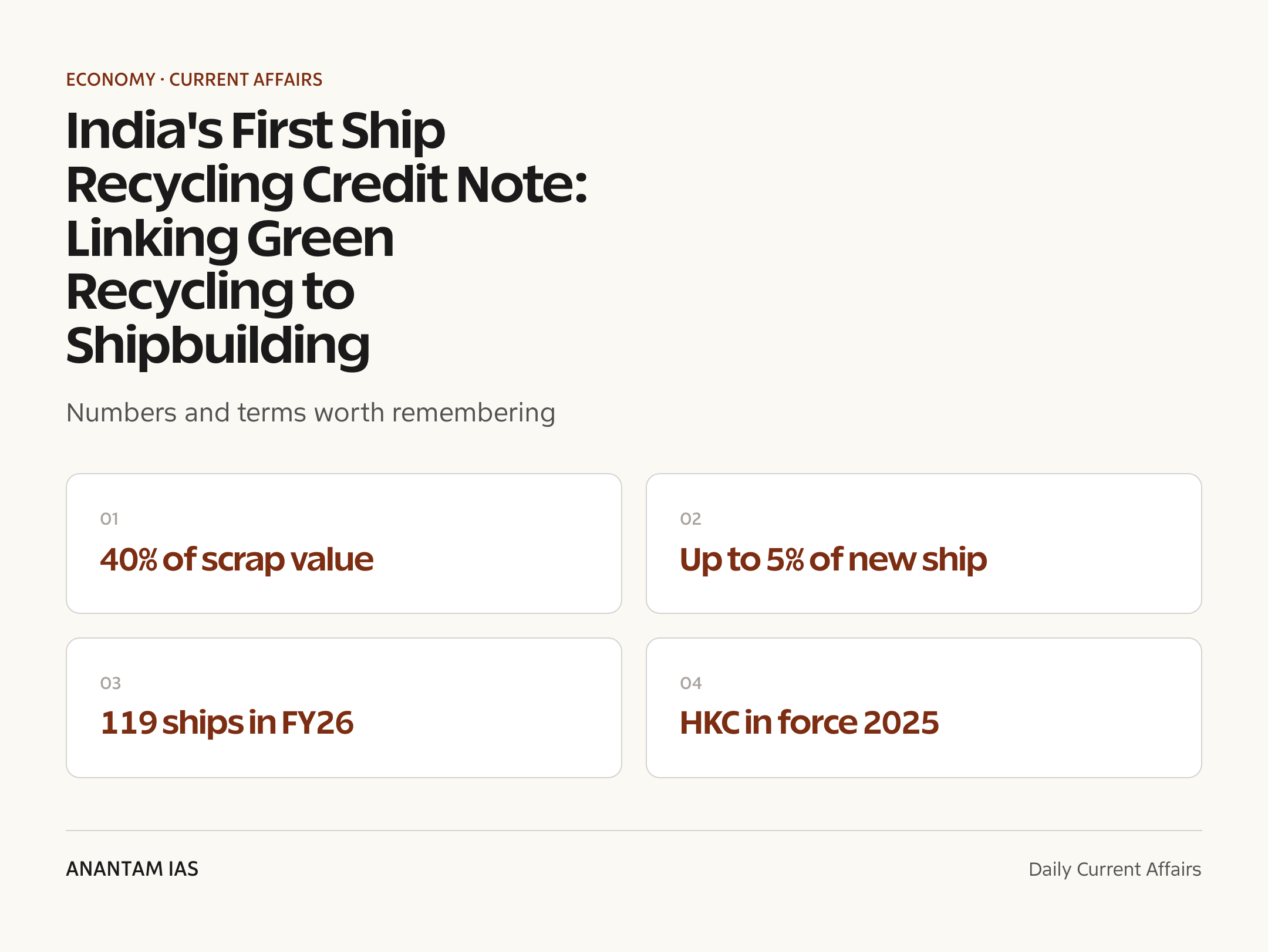
- Ship Recycling Credit Note — 40% of scrap value, up to 5% of a new ship’s fair price.
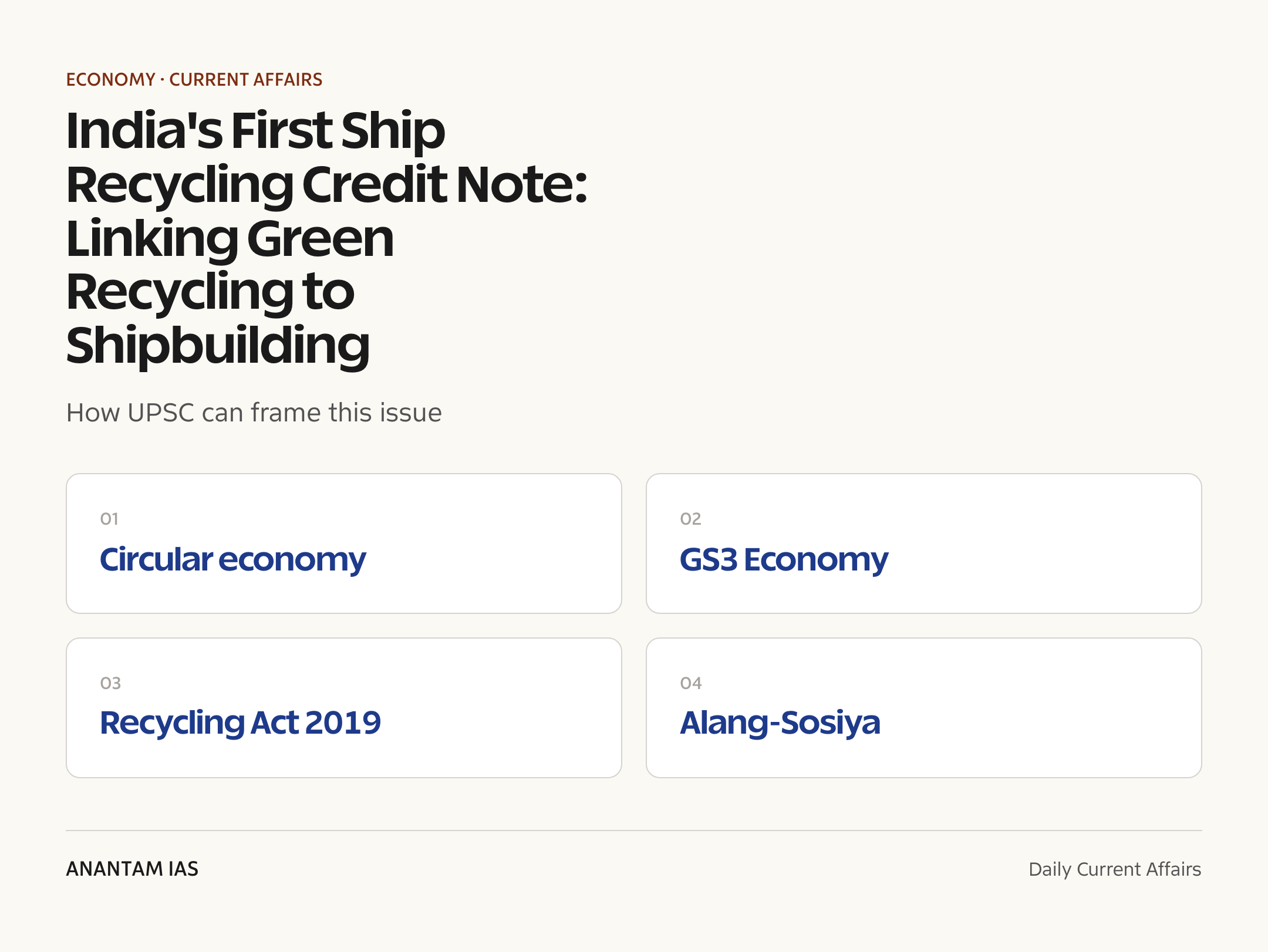
- Recycling of Ships Act, 2019 — India’s domestic law implementing the Hong Kong Convention.
- Hong Kong International Convention — adopted 2009, in force 26 June 2025; applies to ships of 500 GT and above.
- Inventory of Hazardous Materials (IHM) — mandatory hazardous-material list under HKC.
- Alang-Sosiya — Gulf of Khambhat, Gujarat; the world’s largest ship-recycling cluster.
- SBFAP 2.0 — Shipbuilding Financial Assistance Policy under which the credit note operates.
- Maritime Amrit Kaal Vision 2047 — long-term roadmap for India’s maritime sector.
- DG Shipping — issuing/certifying authority, under the Ministry of Ports, Shipping & Waterways.
- Extended Producer Responsibility (EPR) — the circular-economy logic the credit mirrors.
- India recycled 119 ships in FY26 — about one-third of global ship recycling by number of vessels.
Mains Relevance
GS Paper 3
- Circular economy and resource recovery — using a credit note to link recycling to manufacturing.
- Infrastructure and industrial policy — reviving shipbuilding and the Alang recycling cluster as a value chain.
- Environment and sustainable development — balancing green-recycling compliance with industry viability.
GS Paper 2
- Implementation of international conventions (Hong Kong Convention) through domestic law and incentive design.
Essay
- Turning waste into worth — the circular economy as an engine of self-reliance.
- Sustainability and competitiveness need not be rivals.
Background and Context
What does the Credit Note actually do?
It is a financial instrument that monetises green recycling and channels it back into shipbuilding.
- A shipowner who recycles a vessel at an HKC-compliant Indian yard receives a credit note worth 40% of the ship’s scrap value.
- The note can be redeemed for up to 5% of the fair price of a new vessel built in an Indian shipyard.
- It is designed to be tradable/transferable, processed digitally through DG Shipping’s Credit Note Module.
- The mechanism rewards owners for choosing safe, compliant recycling over cheaper, hazardous beaching abroad — and keeps the value within India’s maritime economy.
- By bridging end-of-life and new-build, it functions like an Extended Producer Responsibility (EPR) credit for the shipping industry.
The legal anchor: Recycling of Ships Act, 2019
India’s domestic law gives the recycling industry a compliance framework and global standing.
- The Recycling of Ships Act, 2019, domesticates the Hong Kong Convention, which India ratified in November 2019.
- It mandates an Inventory of Hazardous Materials (IHM), authorised yards, ship-recycling plans, and worker-safety norms.
- Yards must be certified; DG Shipping and State Maritime Boards oversee approvals and inspections.
- It made Alang one of the few clusters in the developing world with a high concentration of HKC Statements of Compliance.
The global frame: Hong Kong Convention in force
Green recycling is now a worldwide legal obligation, not just a voluntary standard.
- Adopted at an IMO conference in Hong Kong in 2009; entry-into-force conditions were met in 2023.
- It entered into force on 26 June 2025, applying to ships of 500 GT and above.
- It requires safe design, an up-to-date IHM, authorised recycling facilities, and survey/certification.
- By acting early under the 2019 Act, India is positioned to capture demand as non-compliant beaching yards lose business.
Alang-Sosiya: the world’s largest ship graveyard
The cluster is the physical backbone of the scheme — and the reason it was needed.
- Located on the Gulf of Khambhat coast in Gujarat, Alang-Sosiya is the world’s largest ship-recycling yard.
- It hosts around 120 operational plots and a large share of globally HKC-compliant facilities.
- India recycled about 119 ships in FY26 — roughly one-third of global ship recycling by vessel count, and around 13% by tonnage.
- Rising compliance costs and thin margins had cut work at Alang; the credit note is meant to revive demand and reward upgrades.
Linking recycling to the shipbuilding push
The credit is one lever inside a much larger plan to rebuild India’s shipyards.
- It operates under the Shipbuilding Financial Assistance Policy (SBFAP) 2.0 and the Budget 2025-26 maritime agenda.
- It is part of a wider ₹70,000-crore maritime development package announced in 2025.
- The long-horizon goal is the Maritime Amrit Kaal Vision 2047 — to lift India among the top global shipbuilding nations.
- By recycling at home, an owner earns credits that lower the cost of building a new ship at home — a deliberately closed domestic loop.
Why is it a circular-economy template
The design converts a waste stream into an input for domestic manufacturing.
- Recovered steel from scrapped ships feeds rolling mills and reduces reliance on virgin-ore steelmaking.
- Incentivising compliant recycling improves worker safety and curbs coastal pollution from hazardous waste.
- The credit ties an environmental “good” (green recycling) to an economic reward (cheaper new-build), aligning incentives.
- It is being read as an EPR-style model that other heavy industries could adapt for end-of-life assets.
Open questions and limits
The instrument is novel, so its real-world traction is still untested.
- Uptake depends on a healthy order book at Indian shipyards — credits are only useful if owners are building here.
- The 5% cap on new-ship price may be modest against the cost gap with foreign yards.
- Verification, valuation of scrap, and preventing gaming of credits will test DG Shipping’s digital systems.
- Global recycling volumes are cyclical; demand at Alang also hinges on freight markets and fleet-renewal cycles.
Way Forward
Build the demand side
- Pair the credit with a stronger shipbuilding order book via SBFAP 2.0 and public-sector demand so credits can actually be redeemed.
- Develop ancillary ecosystems — steel, marine equipment, design — around Alang and major shipyards.
Deepen compliance and trust
- Scale up HKC certification, IHM auditing, and worker-safety training across all Alang plots.
- Make the credit-note registry transparent and auditable to prevent valuation gaming.
Position India as the default green-recycling destination as the Hong Kong Convention bites globally, while ensuring the gains reach yard workers through better wages and safety.
Conclusion
India’s first Ship Recycling Credit Note is a small instrument with an outsized idea — it makes the end of a ship’s life pay for the start of a new one, inside the domestic economy. By tying the Recycling of Ships Act, 2019, to the shipbuilding drive, it turns a compliance burden into a competitive edge.
Its success will depend less on the elegance of the design and more on execution: a credible order book at Indian shipyards, honest valuation of scrap, and continued upgrades at Alang. If those align, it offers a replicable circular-economy template for heavy industry.
UPSC Practice Questions
Prelims MCQ 1
With reference to the Ship Recycling Credit Note recently introduced in India, consider the following statements:
- It allows a shipowner to claim a credit equal to 40% of a recycled ship’s scrap value.
- The credit can be redeemed against the cost of building a new vessel in an Indian shipyard.
- It is available for recycling carried out at any ship-breaking yard in the world.
How many of the above statements are correct?
(a) Only one (b) Only two (c) All three (d) None
Answer: (b) Only two
Explanation:
Statements 1 and 2 are correct — the credit is 40% of the scrap value, redeemable for up to 5% of the fair price of a new India-built ship. Statement 3 is wrong: eligibility is limited to HKC-compliant Indian yards such as Alang-Sosiya.
Prelims MCQ 2
The Hong Kong International Convention, in the news, primarily deals with which of the following?
(a) Trade in endangered marine species
(b) Safe and environmentally sound recycling of ships
(c) Prevention of oil pollution from tankers
(d) Regulation of deep-sea mining
Answer: (b) Safe and environmentally sound recycling of ships
Explanation:
The Hong Kong International Convention, adopted under the IMO in 2009 and in force from 26 June 2025, governs safe and environmentally sound ship recycling, including the Inventory of Hazardous Materials. India implements it through the Recycling of Ships Act, 2019.
UPSC Mains Questions
- India has become the first country to operationalise a Ship Recycling Credit Note. Examine how such an instrument can link green recycling to domestic shipbuilding, and assess the challenges in making it work at scale.
- “A circular economy turns waste streams into inputs for production.” In light of India’s ship-recycling reforms, discuss how policy instruments can align environmental compliance with industrial competitiveness.
- Discuss the significance of the Hong Kong International Convention and the Recycling of Ships Act, 2019, for India’s ship-recycling industry at Alang-Sosiya.
Sources: Directorate General of Shipping, Ministry of Ports, Shipping & Waterways (PIB) and The Hindu / Business Standard.
Frequently Asked Questions
What is the Ship Recycling Credit Note?
It is a financial instrument issued by India’s Directorate General of Shipping that gives a shipowner a credit worth 40% of a recycled ship’s scrap value. The credit can be redeemed for up to 5% of the fair price of a new vessel built in an Indian shipyard, linking green recycling to shipbuilding.
Why is India’s credit note called a world first?
India is the first country to operationalise a credit-note system that ties green ship recycling under the Hong Kong Convention to building new ships domestically. It converts a recycling decision into a redeemable incentive for new shipbuilding within the same economy, an approach not done before at national scale.
Which yards are eligible for the credit?
Only Hong Kong Convention (HKC)-compliant recycling yards qualify, certified by DG Shipping and State Maritime Boards. In practice this centres on the Alang-Sosiya cluster in Gujarat, the world’s largest ship-recycling hub, which holds a high concentration of HKC Statements of Compliance.
What is the Recycling of Ships Act, 2019?
It is India’s domestic law that implements the Hong Kong International Convention. It mandates an Inventory of Hazardous Materials, authorised yards, ship-recycling plans, and worker-safety norms, and it gives the industry a compliance framework that boosts its global standing and credibility.
When did the Hong Kong Convention come into force?
The Hong Kong International Convention was adopted under the IMO in 2009 and entered into force on 26 June 2025. It applies to ships of 500 GT and above on international voyages, making safe, environmentally sound recycling a binding global requirement rather than a voluntary standard.
How does the credit note support a circular economy?
It rewards recovering value from end-of-life ships — recycled steel and materials re-enter manufacturing — and channels that reward into building new vessels at home. By linking an environmental good to an economic incentive, it works like an Extended Producer Responsibility (EPR) credit for the shipping sector.