Should the Rupee be left to Depreciate?
Why in News?
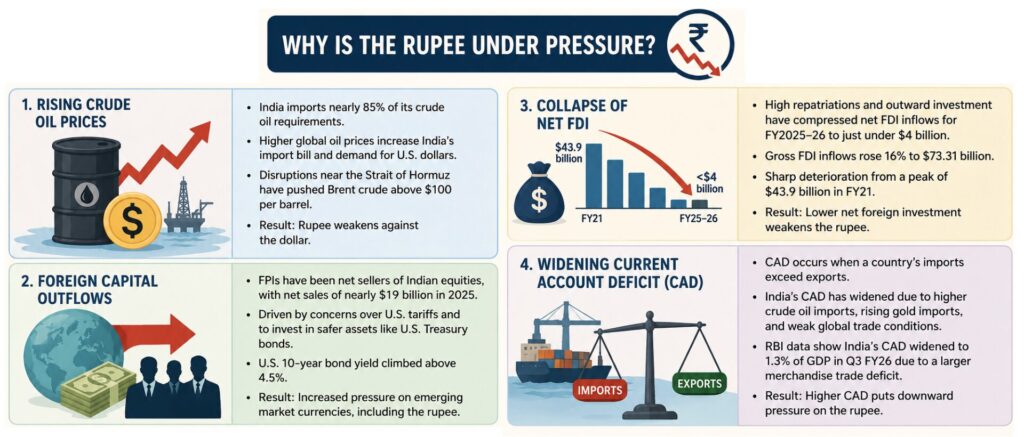
The Indian rupee has witnessed sustained depreciation pressures and reportedly touched nearly ₹97 per U.S. dollar in recent trading sessions. This has started a debate: Should the Reserve Bank of India (RBI) intervene aggressively to stop the fall, or should it let the rupee find its own level naturally?
| UPSC Relevance: GS-3 Economy: Balance of Payments, Capital Flows, Exchange Rate Management Prelims: Rupee Depreciation, Current Account Deficit (CAD), Foreign Institutional Investors (FIIs), Managed Float Exchange Rate System |
What is Rupee Depreciation?
- Rupee depreciation refers to a decline in the value of the Indian rupee relative to foreign currencies, especially the U.S. dollar.
- For example, If $1 = ₹83 earlier and later becomes $1 = ₹97, the rupee is said to have depreciated.
- India follows a managed floating exchange rate system, where market forces determine the exchange rate, but the RBI intervenes occasionally to reduce excessive volatility.
Two Sides of the Debate:
Side 1: Let Rupee fall (Non-Intervention view):
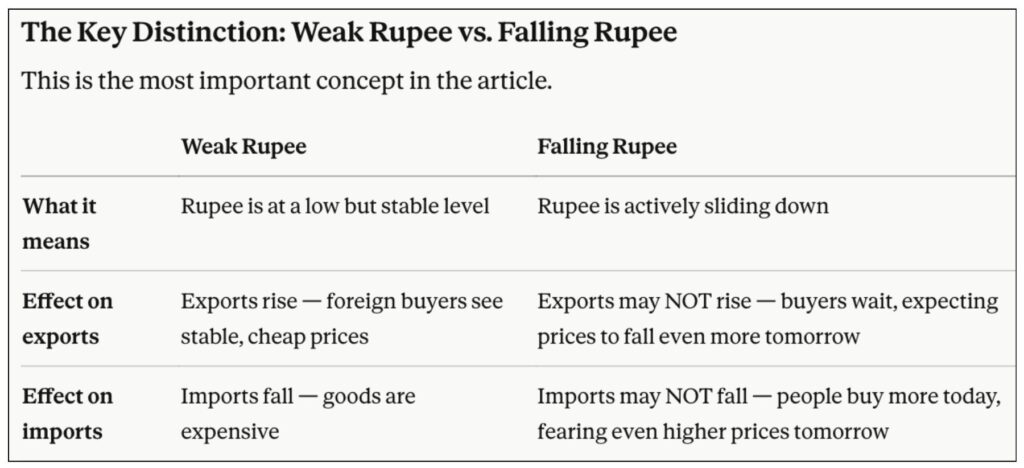
- A weaker rupee automatically fixes the problem. When the rupee falls, Indian goods become cheaper for foreign buyers, so exports go up.
- At the same time, imported goods become costlier for Indians, so imports come down. This reduces the current account deficit on its own.
Side 2: RBI should Intervene (Stability view):
- The non-intervention view has a serious flaw. It confuses a weak rupee with a falling rupee, which are two different scenarios.
- A falling rupee (present case) produces higher import bills but no reliable increase in exports, meaning the trade deficit is not corrected but actually deepens. Example: When petrol prices were hiked, consumers rushed to fill their tanks immediately, anticipating further increases. The same psychology applies to imports during a falling rupee. Instead of import demand falling as the rupee slides, it can actually spike in the short run, worsening the trade deficit.
The Role of Speculation:
- Much of the rupee’s fall is not driven by real trade factors, but by speculative foreign capital flows. Foreign institutional investors (FIIs) pull money out of India when they expect better returns elsewhere, for example, when US interest rates rise. This capital outflow pushes the rupee down. There is no fundamental economic value behind the falling rupee, but pure financial speculation.
As a result, the rupee cannot find a natural equilibrium quickly. It may keep falling for a long time, driven entirely by investor sentiment rather than India’s actual trade position.
Why is uncontrolled Depreciation dangerous?
The key dangers of letting the rupee fall without any check include:
- Inflation: India imports essential goods, especially crude oil. A weaker rupee means higher oil prices in rupees, which raises the cost of transport, food, and almost everything else. This hits common people the hardest.
- No quick export boost: Because the rupee is falling (not just weak), foreign buyers delay purchases. So the expected increase in exports does not materialise quickly.
- Rising import costs squeeze real wages and hurt people who are already under economic stress.
Available Policy Options:
- RBI Forex Intervention: Selling dollars from reserves to absorb excess demand for foreign exchange, as the primary short-term tool.
- Monetary Policy Tightening: Raising interest rates to attract foreign capital, though this risks slowing domestic growth.
- Import Rationalisation: Restricting non-essential imports such as luxury goods to reduce outward pressure on dollar demand.
- Currency Swap Agreements: Bilateral swaps with countries like Japan or the UAE can stabilise dollar demand without depleting reserves.
- Structural Export Promotion: Long-term competitiveness through manufacturing capacity, PLI schemes, and trade diversification to reduce structural dependence on imports.
UPSC PYQ 2019
Q. Which one of the following is not the most likely measure the Government/ RBI takes to stop the slide of the Indian rupee?
(a) Curbing imports of non-essential goods and promoting exports
(b) Encouraging Indian borrowers to issue rupee-denominated Masala Bonds
(c) Easing conditions relating to external commercial borrowing
(d) Following an expansionary monetary policy
Answer: (d)
UPSC PYQ 2022
Q. With reference to the Indian economy, consider the following statements:
1. If the inflation is too high, Reserve Bank of India (RBI) is likely to buy government securities.
2. If the rupee is rapidly depreciating, RBI is likely to sell dollars in the market.
3. If interest rates in the USA or European Union were to fall, that is likely to induce RBI to buy dollars.
Which of the statements given above are correct?
(a) 1 and 2 only
(b) 2 and 3 only
(c) 1 and 3 only
(d) 1, 2 and 3
Answer: (b)