Smart Border Command Centres: Architecture, Risks and Safeguards
Why in News?
The Ministry of Home Affairs is developing a proposed smart-border system linking local command centres, field headquarters and Delhi through integrated surveillance feeds.
- The proposed system would combine cameras, sensors, drones and image-processing tools into a shared operational picture for deployed agencies.
- A pilot is expected to begin along the Pakistan border, where drone-enabled smuggling and reconnaissance are prominent concerns.
- The architecture is intended to improve monitoring where physical fencing is difficult, including mountains, rivers, forests and flood-prone stretches.
- Technology would be terrain-specific, rather than a uniform package applied identically across every land frontier.
- The policy challenge is not merely collecting more video; it is converting heterogeneous feeds into timely, attributable decisions without overwhelming operators.
- Its legitimacy will depend on cybersecurity, privacy safeguards and clear responsibility when an automated alert is wrong, missed or misused.
- For UPSC answers, treat smart borders as a socio-technical system: sensors, networks, human judgment, law, maintenance and local terrain must work together.
UPSC Relevance
Prelims Relevance
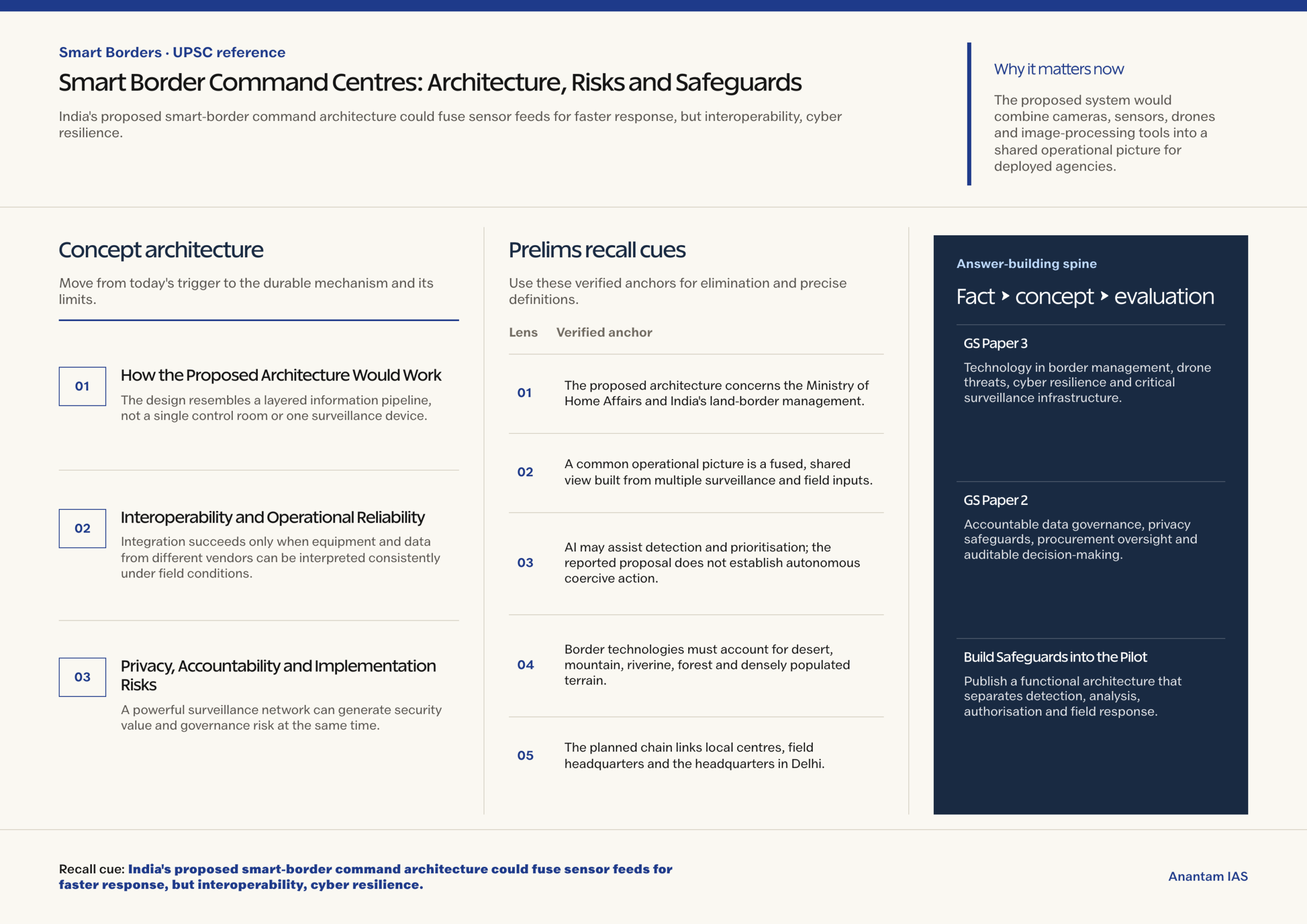
- The proposed architecture concerns the Ministry of Home Affairs and India’s land-border management.
- A common operational picture is a fused, shared view built from multiple surveillance and field inputs.
- AI may assist detection and prioritisation; the reported proposal does not establish autonomous coercive action.
- Border technologies must account for desert, mountain, riverine, forest and densely populated terrain.
- The planned chain links local centres, field headquarters and the headquarters in Delhi.
Mains Relevance
GS Paper 3
- Technology in border management, drone threats, cyber resilience and critical surveillance infrastructure.
- Limits of AI-assisted threat detection, including false positives, blind spots and degraded communications.
GS Paper 2
- Accountable data governance, privacy safeguards, procurement oversight and auditable decision-making.
- Institutional design for sharing operational data while preserving lawful access controls and responsibility.
Essay
- Technology strengthens security only when institutional capacity and constitutional safeguards develop alongside it.
Background and Context
How the Proposed Architecture Would Work
The design resembles a layered information pipeline, not a single control room or one surveillance device.
- At the edge layer, cameras, ground sensors, anti-drone equipment and patrol reports would detect movement, objects or anomalous activity in terrain that fixed fencing cannot reliably cover.
- A communications layer would carry time-stamped feeds to nearby command centres; resilient links, local buffering and offline procedures are essential when connectivity is weak, jammed or contested.
- The fusion layer would correlate inputs from different devices, remove duplicate alerts and present operators with one shared picture rather than several disconnected screens and incompatible timelines.
- An analytics layer could flag patterns or prioritise alerts, but confidence scores, source quality and uncertainty must remain visible to trained human operators.
- The command layer would escalate validated alerts from local centres to field headquarters and Delhi, while recording who viewed, changed, shared or acted upon each item.
Interoperability and Operational Reliability
Integration succeeds only when equipment and data from different vendors can be interpreted consistently under field conditions.
- Common data standards should define timestamps, coordinates, alert categories, device health and confidence levels so one system’s output remains intelligible and comparable to another.
- Open interfaces and tested vendor portability can reduce lock-in, prevent isolated technology silos and allow failed or obsolete components to be replaced without rebuilding the whole network.
- A shared picture needs role-based access: each authorised user should see the minimum data required for a defined operational task, location and period.
- Systems require redundancy and graceful degradation; loss of a sensor, server, power supply or communications link should narrow capability rather than disable the entire decision chain.
- Independent field trials must measure detection accuracy, false alarms, response time and performance across weather, terrain, day-night conditions and deliberate electronic interference before scale-up.
Privacy, Accountability and Implementation Risks
A powerful surveillance network can generate security value and governance risk at the same time.
- Continuous monitoring near settlements may capture lawful civilian activity, homes and livelihoods; collection should be necessary, proportionate, geographically bounded and limited to defined security purposes.
- Data rules should specify retention, deletion and sharing, with stronger controls for biometric or personally identifiable information, documented exceptions and a ban on unrelated reuse.
- Every query, export and alert change needs an immutable audit trail, enabling later review of misuse, selective enforcement, unauthorised access and responsibility after an incident.
- AI errors can produce false positives against harmless activity or false negatives that conceal threats; neither model output should be treated as unquestionable evidence for coercive action.
- Cyber compromise, sensor spoofing and manipulated feeds could corrupt the common operational picture, making zero-trust access, security testing and authenticated data provenance core operational requirements.
Way Forward
Build Safeguards into the Pilot
- Publish a functional architecture that separates detection, analysis, authorisation and field response, with a named official accountable at each stage.
- Test the pilot against realistic spoofing, jamming, outage and false-alarm scenarios, not only ideal demonstrations prepared by vendors.
- Mandate human confirmation for consequential action, document override rules and preserve evidence showing how each alert reached a decision.
- Use periodic security audits, privacy reviews and outcome-based procurement tied to verified field performance, repairability and interoperability.
Conclusion
- A smart border is not defined by the number of sensors; it is defined by whether trusted information produces timely, lawful and reviewable action.
- In a Mains answer, connect capability with safeguards: interoperability, human oversight, cyber resilience, proportional collection and auditability must advance together.
UPSC Practice Questions
Prelims MCQ 1
With reference to the proposed smart-border command architecture, consider the following statements:
- It seeks to combine inputs from cameras, sensors, drones and image-processing tools.
- It is designed as a completely autonomous system that excludes human operators from consequential decisions.
- It proposes a chain linking local command centres with field headquarters and Delhi.
How many of the above statements are correct?
(a) Only one (b) Only two (c) All three (d) None
Answer: (b) Only two
Explanation:
Statements 1 and 3 reflect the reported proposal. Statement 2 is incorrect: the proposal describes AI-enabled integration, not an autonomous system excluding human judgment.
Prelims MCQ 2
In a sensor-rich border command system, the term ‘common operational picture’ most appropriately refers to:
(a) A single nationwide terrain map generated without field inputs (b) A fused and shared view of relevant information from multiple systems (c) An autonomous weapon-selection interface (d) A database accessible without role-based restrictions
Answer: (b) A fused and shared view of relevant information from multiple systems
Explanation:
A common operational picture integrates relevant, time-sensitive inputs into a shared view for authorised decision-makers; it is neither an autonomous weapon system nor unrestricted data access.
UPSC Mains Questions
- Explain how integrated command centres can improve technology-enabled land-border management. What interoperability and operational-resilience conditions are necessary for their effectiveness?
- Security surveillance can create both public value and constitutional risk. Suggest privacy, accountability and human-oversight safeguards for India’s proposed smart-border architecture.
Source: The Hindu.
Frequently Asked Questions
What is a smart-border command centre?
It is a proposed operational hub that would receive and fuse feeds from sensors, cameras, drones and field units, helping authorised personnel assess alerts and coordinate a response.
What does a common operational picture mean?
It means a shared, time-sensitive view created by correlating relevant inputs from multiple systems, with common labels, timestamps and confidence information for authorised decision-makers.
Why is interoperability important for border surveillance?
Different vendors and agencies may produce incompatible data. Common standards and open interfaces allow feeds to be combined, components replaced and alerts interpreted consistently without isolated technology silos.
Can AI independently decide how to respond to a border alert?
The reported proposal describes AI-assisted surveillance integration, not autonomous coercive decisions. Consequential action should remain under trained human authority with documented reasons, review and accountability.
What privacy safeguards should a smart-border system include?
It should limit collection to defined purposes, minimise civilian data, control access, set retention and deletion rules, record every use and provide independent security and privacy audits.