SOAR AI Readiness: Skilling India for the Age of Artificial Intelligence
President Droupadi Murmu launched SOAR, SkillTheNation’s AI Readiness challenge, on 1 January 2026. The initiative seeks to take artificial-intelligence literacy beyond elite institutions and into urban, semi-urban and rural learning ecosystems.
For UPSC, SOAR is not only a technology update. It is a governance question about how India can prepare workers, students and public institutions for an economy where AI changes jobs, productivity, education and state capacity.
This article uses SOAR to examine India’s AI-skilling agenda, its link with Skill India and the risks of treating AI literacy as a certificate exercise rather than a capability project.
Quick Facts
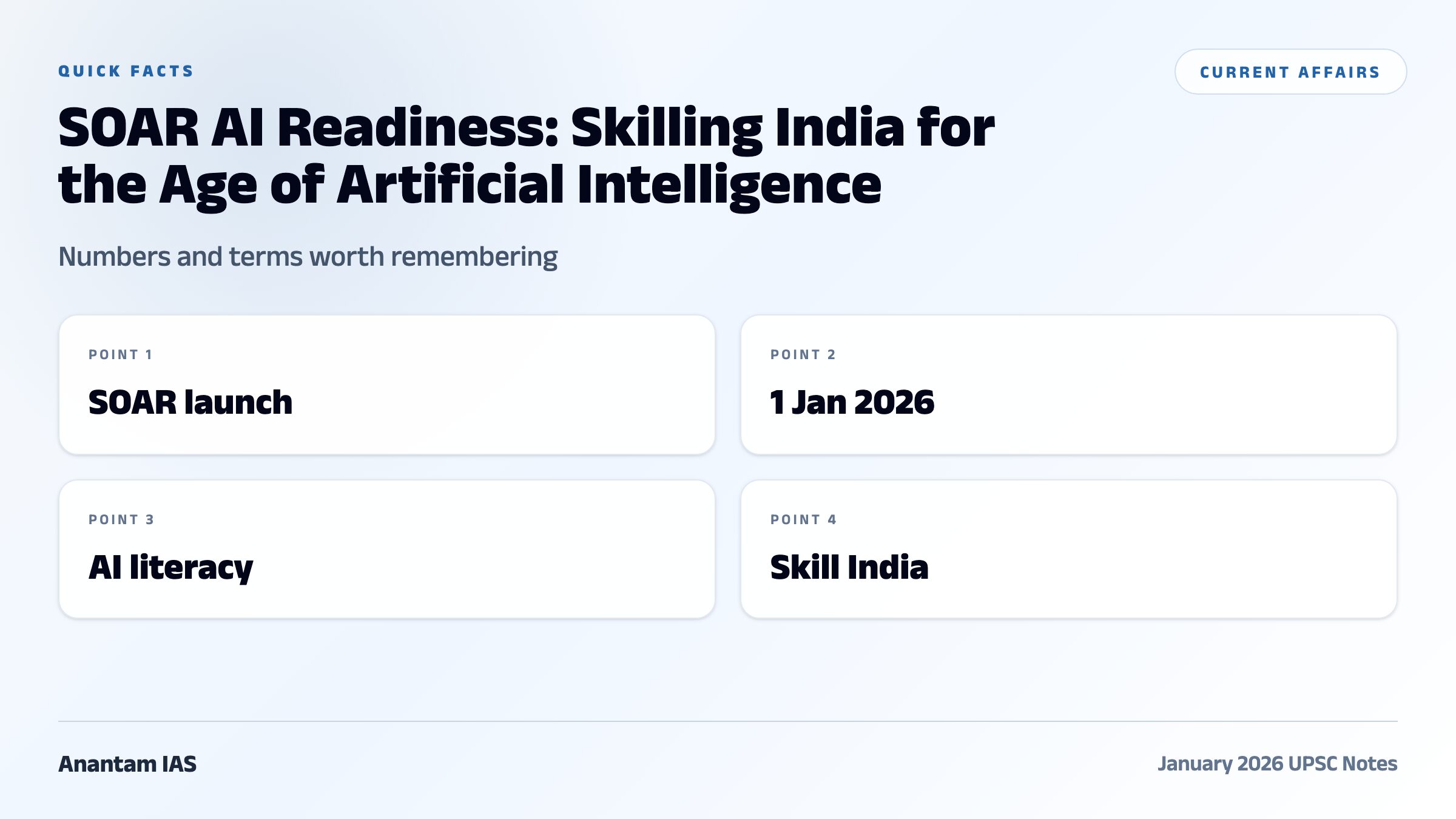
- SOAR stands for SkillTheNation’s AI Readiness challenge.
- It was launched by the President of India on 1 January 2026.
- The program is linked to AI literacy and skilling for diverse learner groups.
- It fits into the wider Skill India and IndiaAI policy ecosystem.
- The theme is relevant for GS-II governance and GS-III science and technology.
- The official source is the PIB release dated 1 January 2026.
- Official source: PIB, Ministry of Skill Development and Entrepreneurship.
What Just Happened
The President launched SOAR as a nationwide AI-readiness initiative. The public message was simple: AI should not remain confined to a small technical elite.
The timing matters because AI tools are entering classrooms, offices, service delivery systems, farms, factories and small enterprises. Workers now need not only coding skills but also judgement, data literacy and responsible-use habits.
For aspirants, the event is a hook to revise AI governance, employment transitions, digital divide, skilling institutions and the role of the state in preparing citizens for technological change.
Background and Historical Context
India’s skilling architecture includes Skill India Mission, NSDC, sector skill councils, PMKVY, ITIs, apprenticeships and state skill missions. The AI era puts pressure on this system because job tasks can change faster than training curricula.
IndiaAI Mission, Digital India and the National Education Policy have already pushed digital capability into policy language. SOAR adds an awareness and readiness layer to that framework.
The core challenge is not whether India can create AI users. It is whether India can create AI-capable citizens who can use tools safely, productively and ethically.
Key Features of AI Skilling
The core policy architecture can be read through these features.
- AI literacy: the focus is on broad familiarity with AI concepts, tools and risks.
- Skilling link: the initiative sits inside India’s larger skill-development ecosystem.
- Inclusion goal: rural and semi-urban learners are part of the policy imagination.
- Workforce relevance: AI-readiness is connected to employability and productivity.
- Governance relevance: state institutions also need AI capacity for service delivery.
- Ethics layer: bias, privacy, misinformation and accountability cannot be ignored.
Why It Matters
This is a high-yield UPSC topic because it joins current news with durable syllabus themes.
- It connects a January 2026 event with durable UPSC syllabus themes.
- It gives usable facts for Prelims and analytical hooks for Mains.
- It helps students move from news recall to policy reasoning.
- It can be linked with static concepts in polity, economy, governance, science, environment or society.
Detailed Analysis: AI Skilling Lens
AI skilling must avoid the certificate trap. A short course can introduce AI vocabulary, but real capability needs problem-solving, domain knowledge and repeated practice.
The digital divide is now an AI divide. Learners without devices, bandwidth, English fluency or mentor access will fall behind unless public systems deliberately include them.
Responsible use is part of skilling. Students must learn what AI cannot do, how hallucinations happen, why data privacy matters and when human judgement is non-negotiable.
Comparative Perspective
A comparison helps prevent the answer from becoming a one-dimensional news summary.
- FutureSkills Prime: focused on emerging technology skills for industry and learners.
- PMKVY: broad vocational skilling with placement and certification goals.
- IndiaAI Mission: compute, data, innovation and ecosystem building.
- SOAR: an AI-readiness and awareness layer that can feed the larger ecosystem.
Challenges
The policy or institutional promise runs into recurring constraints.
- AI courses can become superficial if assessment rewards recall instead of capability.
- Teachers and trainers themselves need AI-readiness.
- Rural and low-income learners need access to devices, connectivity and mentoring.
- Indian-language AI material must improve rapidly.
- Skilling policy must track employment outcomes, not only enrollment.
Prelims Pointers
- AI literacy means basic understanding of AI tools, uses, limits and risks.
- Skill India Mission is India’s broad skilling policy umbrella.
- NSDC supports skill-development initiatives and sectoral skilling ecosystems.
- IndiaAI Mission focuses on AI compute, datasets, innovation and application development.
- AI governance includes ethics, privacy, bias, accountability and safety.
- Digital divide can become an AI-readiness divide.
Mains Questions
- AI-readiness is now a governance challenge, not only a technology challenge. Discuss. (GS Paper III, 250 words)
- How can India ensure that AI skilling does not widen the digital divide? (GS Paper II, 150 words)
- Evaluate the role of public skilling institutions in preparing workers for AI-led labour-market change. (GS Paper III, 250 words)
- AI literacy must include ethics and limitations, not only tool usage. Analyse. (GS Paper IV/III, 250 words)
Way Forward
SOAR should be linked with schools, colleges, ITIs, self-help groups and district skill centres rather than being run only as an online challenge.
India needs Indian-language AI learning material, teacher training, public datasets for practice and outcome tracking.
The stronger UPSC answer is balanced: AI skilling is essential, but without inclusion, ethics and employment pathways it can become another certificate layer.
The examiner is unlikely to reward a bare fact dump here. The better answer connects the January 2026 event to institutional design, implementation capacity and India’s long-term development priorities.
Frequently Asked Questions
What is SOAR?
SOAR is SkillTheNation’s AI Readiness challenge launched on 1 January 2026 to promote AI literacy and readiness.
Why is SOAR important for UPSC?
It links AI with governance, skilling, employment, digital divide and responsible technology use.
Which GS paper is most relevant?
GS-III science and technology is central, with GS-II governance links.
What is the biggest risk?
The biggest risk is superficial certification without real AI capability or ethical understanding.
How is it linked to Skill India?
It extends the skilling agenda into AI literacy and workforce readiness.
What should students remember?
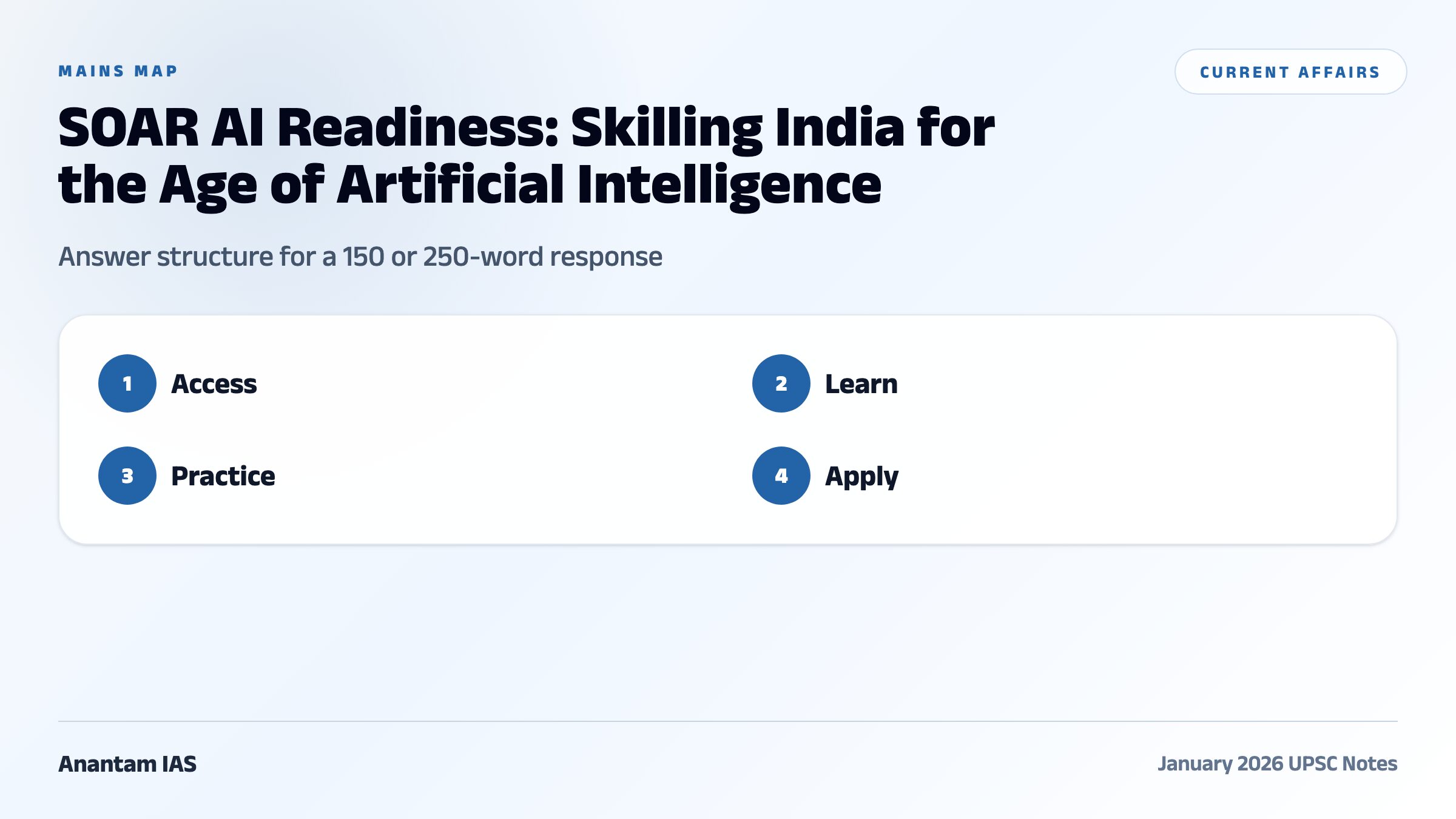
AI readiness needs access, training, ethics, domain knowledge and employment pathways.